Venomous Animals That Can Kill Humans: The Real List
Most “deadliest” rankings of venomous animals that can kill humans are quietly wrong. They confuse venom potency — what a milligram does to a mouse in a lab — with mortality, the body count that actually ends up in hospital ledgers. The two lists barely overlap. Sort honestly and a small, scruffy viper outranks every cobra, every taipan, every headline jellyfish.
Key Facts
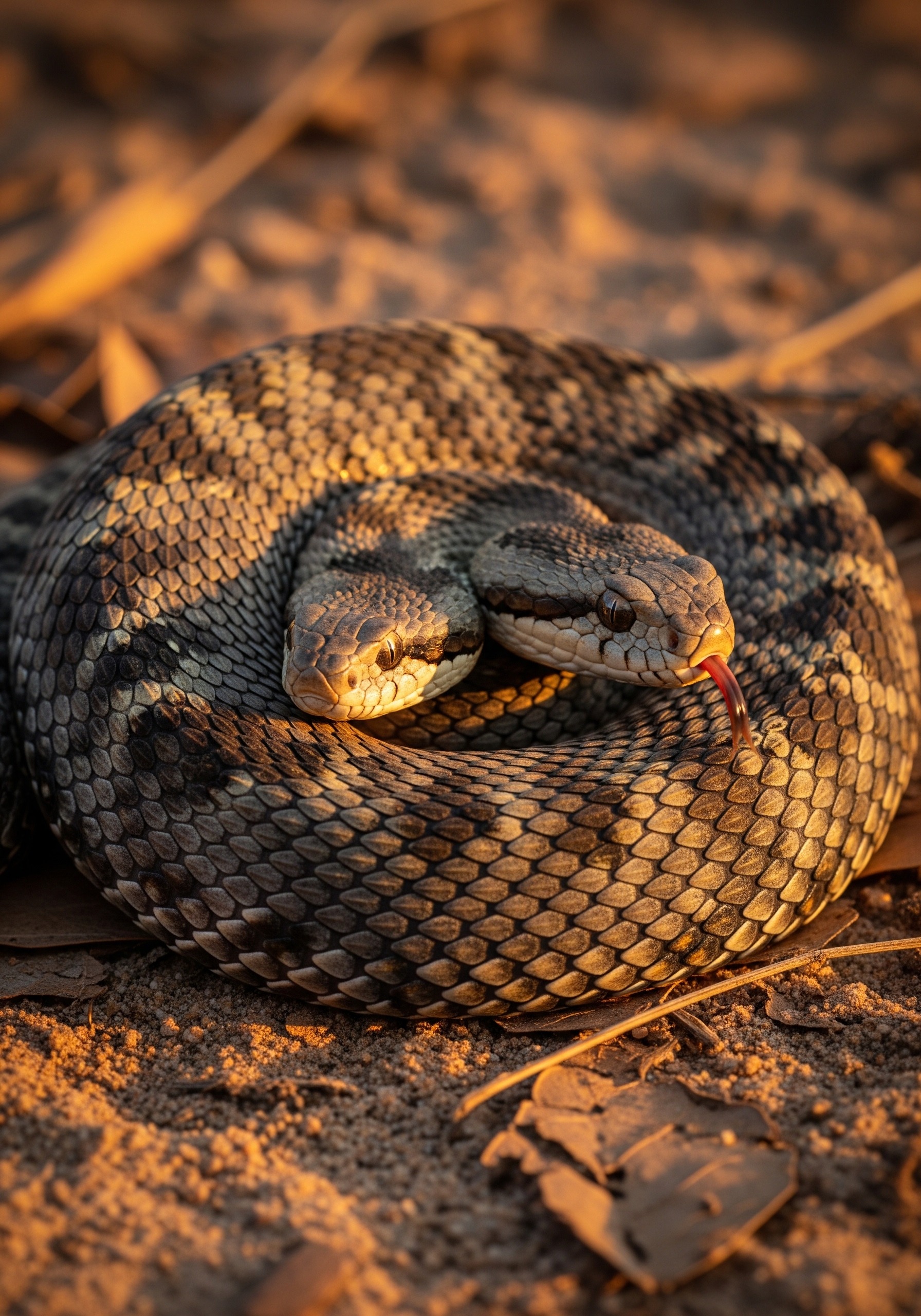
- The saw-scaled viper (Echis carinatus), barely 60 cm long, is blamed for more human deaths than any other snake on Earth — tens of thousands a year, most of them in rural India.
- The inland taipan has the most toxic measured snake venom (LD50 ~0.025 mg/kg in mice), but it lives in remote outback Australia and has caused zero confirmed human deaths in recorded history.
- Box jellyfish (Chironex fleckeri) stings can trigger cardiac arrest in 2–5 minutes; Australia has recorded roughly 70–80 deaths since the 1880s.
- No one has died from a Sydney funnel-web spider bite since the antivenom was rolled out in 1981, despite about 30–40 bites a year.
- Globally, venomous animals kill an estimated 130,000–150,000 people a year. Snakes account for nearly all of that; scorpions add ~3,300; spiders fewer than 10.
In short: The truly dangerous venomous animals that can kill humans aren’t usually the most “venomous” ones. They’re the small, abundant species that live where people walk barefoot and the nearest antivenom is hours away.
Key Facts
- The saw-scaled viper (Echis carinatus), barely 60 cm long, is blamed for more human deaths than any other snake — tens of thousands a year, mostly in rural India.
- The inland taipan has the most toxic measured snake venom (LD50 ~0.025 mg/kg in mice) but has caused zero confirmed human deaths.
- The WHO estimates snakebite kills 81,000–138,000 people a year; India alone reports around 50,000 deaths annually.
- Box jellyfish (Chironex fleckeri) stings can cause cardiac arrest within 2–5 minutes; Australia has recorded roughly 70–80 deaths since the 1880s.
- Globally, venomous animals kill an estimated 130,000–150,000 people a year; scorpions add about 3,300 and spiders fewer than 10.
In short: The deadliest venomous animals are not the most toxic ones but small, abundant species living where people walk barefoot far from antivenom. The saw-scaled viper kills tens of thousands yearly, while the lab-champion inland taipan has killed no one. Snakes cause nearly all of the 130,000–150,000 annual venom deaths worldwide.
Venom vs poison: the rule that decides who’s on this list
Quick distinction, because most articles botch it. A creature is venomous if it injects — fang, stinger, harpoon, spur. It is poisonous if you have to swallow, touch, or breathe it in. Same molecule, totally different delivery system, totally different death.
That matters here because the question “what venomous animals can kill humans” is narrower than it sounds. A golden poison frog is one of the most toxic vertebrates alive, but it does not bite you — it sits there. A pufferfish is murderous on a plate but harmless to a swimmer. Neither is venomous. (For the fish version of that distinction, our piece on pufferfish, porcupinefish, and tetrodotoxin walks through the chemistry.)
So the real list — the one we’ll build — is animals that actively pump a toxin into your bloodstream. Snakes. Spiders. Scorpions. Some marine invertebrates. A handful of fish. That’s it.
The deadliest venomous animals — by actual body count
The World Health Organization estimates snakebite kills 81,000 to 138,000 people a year, with another 400,000 surviving with permanent disability — amputations, kidney failure, blindness. India alone reports around 50,000 deaths annually, more than half the global total.
Within that catastrophe, four species do most of the damage. The “Big Four” of the Indian subcontinent — Indian cobra, common krait, Russell’s viper, and the saw-scaled viper — kill more people every year than every other venomous animal on Earth combined.
The saw-scaled viper is the quiet champion. It’s the size of a shoe. Its venom isn’t the most toxic in any ranking; what it has is geography, attitude, and overlap with farmers. It curls into a sand-rasping coil, strikes from leaf litter, and injects a procoagulant cocktail that consumes the victim’s clotting factors until they bleed internally. Without antivenom, fatality rates run around 20 percent. With antivenom — if the nearest hospital is six hours away across monsoon roads — they run higher.
Compare that to the headline species. Russell’s viper is responsible for tens of thousands of Indian deaths a year. The black mamba in sub-Saharan Africa kills hundreds. The king cobra, longest venomous snake in the world at up to 5.5 metres, kills only a few annually — it’s shy and lives in shrinking forest. The inland taipan, the laboratory champion of pure venom toxicity, has never killed anyone in the wild.
That gap between potency and mortality is the whole story.
The “most venomous” rankings — and why they mislead
Here’s the thing about LD50 — the lethal-dose-50 metric that drives every “world’s most venomous” listicle. It’s the dose that kills half a group of laboratory mice. It says nothing about how much venom an animal actually delivers, whether it bites at all, or whether you can reach a hospital. Drop for drop, the inland taipan tops the table. Encounter for encounter, it is one of the least dangerous snakes a human will ever fail to meet.
Professor Bryan Fry of the University of Queensland’s Adaptive Biotoxicology Lab — who did his PhD on inland taipan venom and is one of the field’s most-cited toxinologists — has spent decades pushing back on the “most venomous” framing for exactly this reason. Potency, in his published work, is just one variable. Yield, behaviour, range, and access to antivenom matter far more for real-world risk.
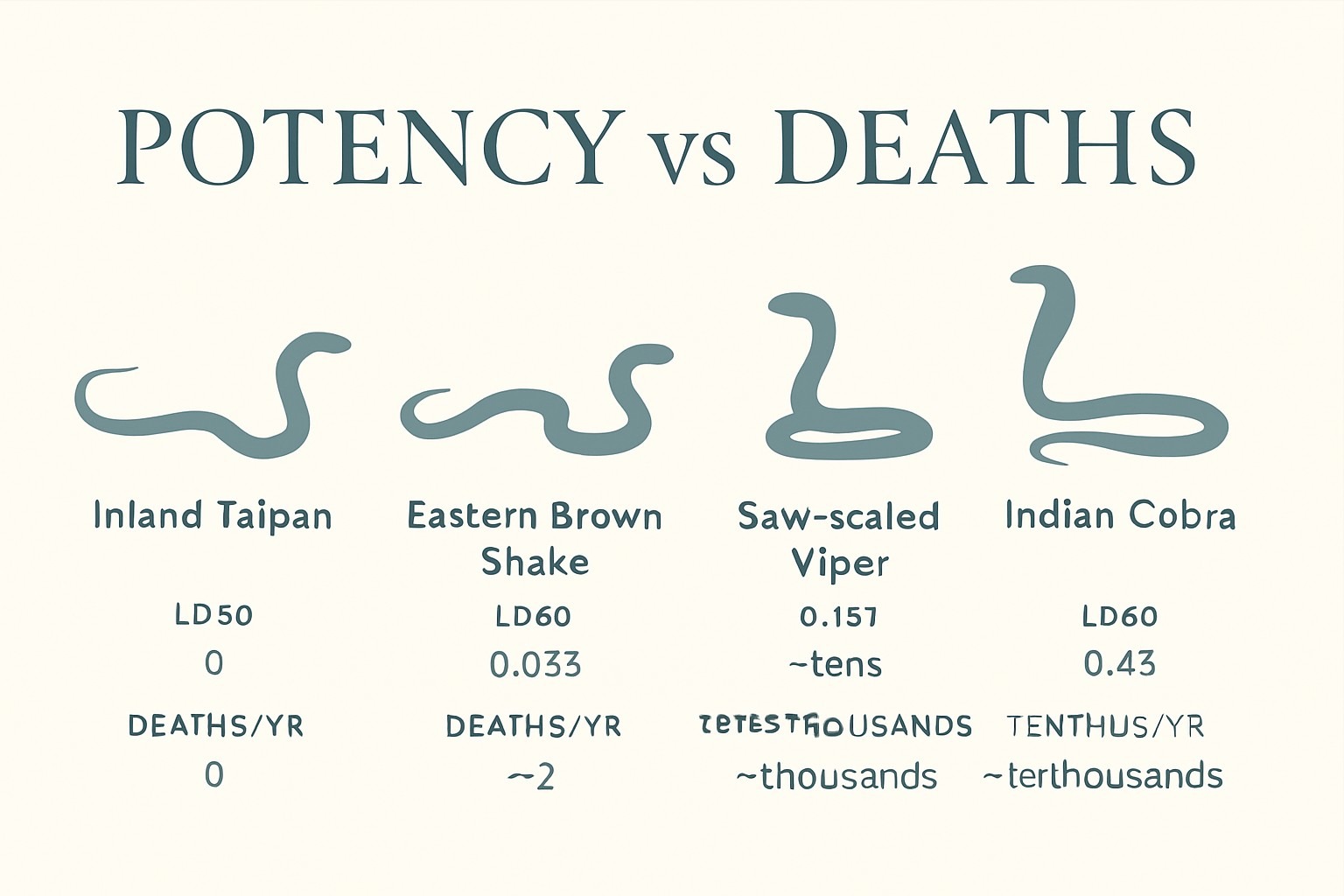
The data-box below shows the punchline. The “most venomous” snake on the planet has killed nobody. A snake 50 times less potent kills tens of thousands.
Potency vs body count: the lab-vs-life mismatch
- Inland taipan — LD50 ~0.025 mg/kg (mice, subcutaneous). Confirmed human deaths: 0.
- Eastern brown snake — LD50 ~0.053 mg/kg. Australian deaths: ~1–2/year.
- Saw-scaled viper — LD50 ~0.151 mg/kg. Annual deaths: tens of thousands.
- Indian cobra — LD50 ~0.29 mg/kg. Annual deaths: thousands.
- Russell’s viper — LD50 ~0.43 mg/kg. Annual deaths: tens of thousands.
LD50 values from published toxinology literature (subcutaneous mice); deaths are clinical estimates and vary by source and region.
{IMAGE_2}
Box jellyfish: a 2-minute clock in tropical water
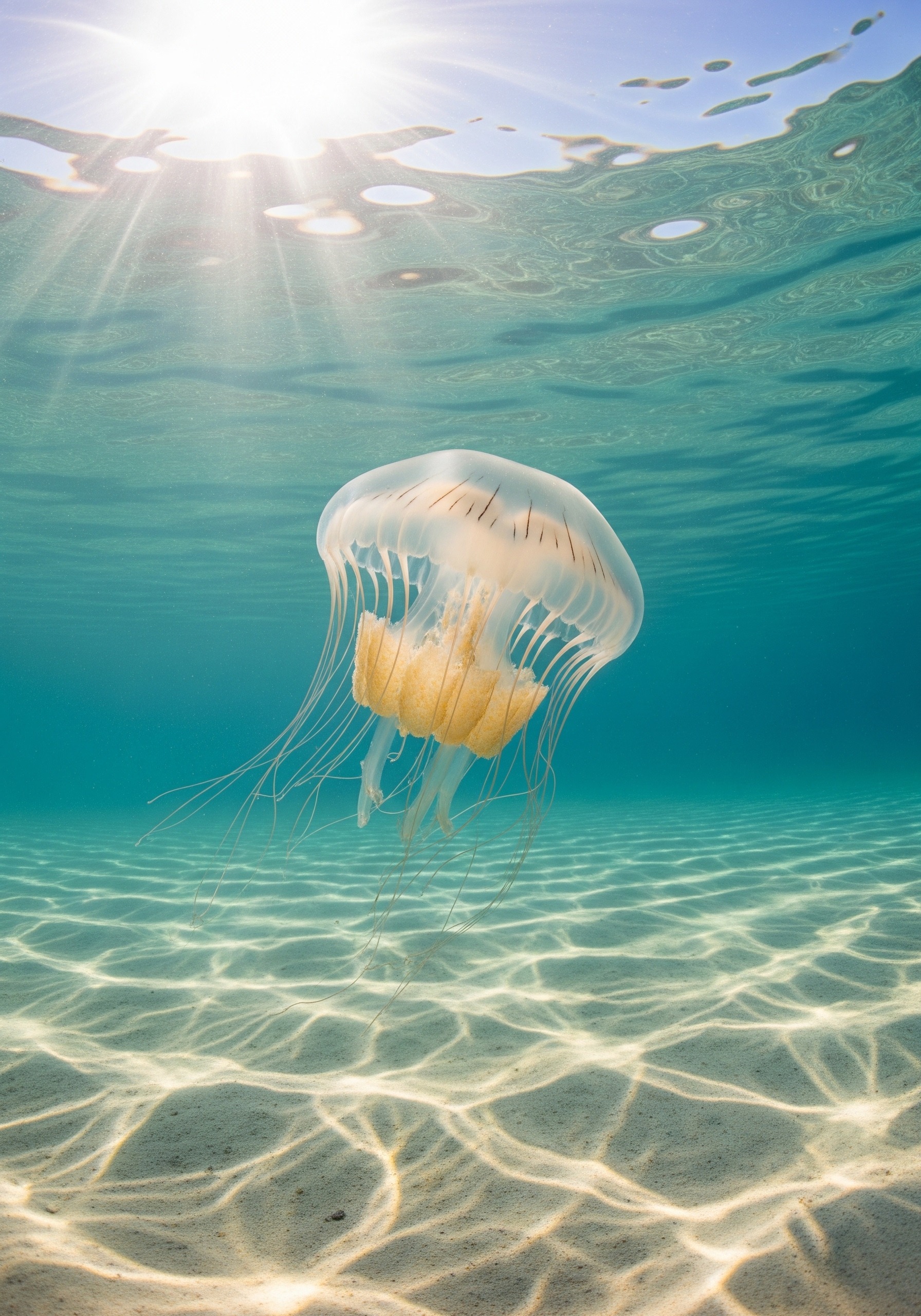
Chironex fleckeri, the Australian box jellyfish, lives in the warm shallows off Queensland and the Northern Territory. It’s nearly invisible — a translucent box about the size of a basketball — trailing up to 60 tentacles, each carrying hundreds of millions of stinging capsules called nematocysts.
A serious sting fires faster than you can pull away. Within seconds, venom proteins punch pores into red blood cells and heart muscle cells; potassium floods out of the cells; the blood goes hyperkalaemic; the heart fibrillates and stops. Time to cardiac arrest in a heavy envenomation: two to five minutes. There is, in many cases, no time to swim back to shore.
Australia has recorded somewhere between 70 and 80 confirmed deaths since the 1880s, with most clustered in remote Indigenous communities along the tropical north. The real toll across Southeast Asia, where reporting is patchier, is almost certainly higher.
One genuinely new piece of science worth knowing: in 2019, researchers at the Australian Institute of Tropical Health and Medicine at James Cook University, working with collaborators, published in Nature Communications a CRISPR screen that identified the molecular pathway box jellyfish venom uses to destroy cells — and showed that ordinary zinc compounds block it in the lab. It’s not a clinical antidote yet, but it’s the first credible candidate in a century. (Read it as cautious optimism, not a beach-bag remedy.)
The funnel-web turnaround — what one Australian scientist changed
The Sydney funnel-web spider (Atrax robustus) is the textbook killer arachnid. Glossy black, mouse-sized, armed with fangs that can pierce a fingernail and a venom that triggers a storm of neurotransmitter release — convulsions, vomiting, paralysis, cardiac collapse in 15 minutes for a small child.
Between the first recorded death in 1927 and the early 1980s, 13 people died from funnel-web bites in eastern Australia. And then — nothing. Not one death in over forty years, despite 30 to 40 serious bites every year.
The reason has a name. In 1981, Dr Struan Sutherland and his team at the Commonwealth Serum Laboratories in Melbourne produced a working antivenom by immunising rabbits against male funnel-web venom and harvesting the antibodies. Sutherland also designed the pressure-immobilisation first-aid technique still taught across Australia for snake and funnel-web bites. Few single careers have done more to wipe a species off a kill-list than his did.
That’s the editorial point worth holding onto: lethality is rarely fixed. Some of the animals on every “deadliest” list belong there only because nobody has done the hard, unglamorous work of building an antivenom yet.
Marine venoms: cone snails, blue-ringed octopuses, stonefish
The ocean’s venomous killers are stranger than land’s. They tend to be small, slow, and decorated like museum objects — which is exactly the problem. People pick them up.
Cone snails. A 2016 review of the medical literature counted 36 recorded deaths from cone snail stings, 31 of them from the geography cone (Conus geographus). The snail fires a hollow, harpoon-tipped tooth from inside its shell, injecting a cocktail of conotoxins that paralyses the diaphragm within hours. Fatality rates among reported envenomations have been estimated as high as 65 percent. The nickname is “cigarette snail” — old beach-folklore for how much time you have left. It is unkind and largely accurate.
Blue-ringed octopuses. Three species in Indo-Pacific tide pools, none bigger than a golf ball, all carrying tetrodotoxin — the same paralytic neurotoxin found in pufferfish. There is no antivenom. Three confirmed human deaths since the 1950s, but plenty of near-misses. We’ve written separately on the blue-ringed octopus and the absent antidote if you want the longer version.
Stonefish. The world’s most venomous fish, camouflaged as a rock on reef floors. The 13 dorsal spines inject a venom that causes excruciating pain, tissue necrosis, and — rarely — cardiac failure. An antivenom exists and works. Deaths in Australia are extremely rare; reports from less-equipped regions across the Indo-Pacific are harder to verify.
Scorpions, bees, and the killers nobody ranks
Scorpions are the second-deadliest venomous family on Earth after snakes. The conservative global estimate is around 3,300 deaths a year, most of them children in Mexico, North Africa, the Middle East, and South Asia. The deathstalker (Leiurus quinquestriatus) and the Brazilian yellow scorpion (Tityus serrulatus) account for a heavy share. Their venoms target sodium channels, triggering autonomic storm: racing heart, lung oedema, cardiac arrest.
Bees, wasps, and hornets are statistically odd cases. Their venoms are not very toxic per dose — but anaphylactic shock in allergic individuals kills around 60 people a year in the United States alone, more than any snake on the continent. Whether to call this “venom that kills humans” is a definitional argument; the families of the victims don’t really care.
Why most envenomations don’t end in death
Roughly half of all venomous snake bites are “dry” — fang strike, no injection. Of the bites that do envenom, the great majority are non-fatal even untreated, because dose, depth, and victim health vary enormously. Then antivenom does the rest.
The deaths concentrate where three things line up: an aggressive small species, a poor rural population that goes barefoot in fields at harvest, and a long road to a hospital that may not stock the right antivenom. That’s the saw-scaled viper. That’s the deathstalker. That’s why the global venom mortality map looks almost identical to the global rural-poverty map.
Improve antivenom supply chains, and the list shortens, fast. The funnel-web is proof.
Frequently Asked Questions
Q: What is the most venomous animal in the world?
A: By measured toxicity, the box jellyfish (Chironex fleckeri) and the inland taipan are usually cited at the top. By human deaths caused, the saw-scaled viper (Echis carinatus) is unmatched. “Most venomous” and “deadliest” are two different rankings.
Q: Which snake kills the most humans each year?
A: The saw-scaled viper. It’s small, ill-tempered, and common across India, the Middle East, Central Asia, and parts of Africa. The World Health Organization counts it as the leading single cause of snakebite mortality globally.
Q: How quickly can box jellyfish venom kill a person?
A: In a heavy envenomation, cardiac arrest can occur within 2–5 minutes. Most victims who survive are pulled out of the water within seconds and reach medical care quickly. Vinegar deactivates undischarged nematocysts and is the standard first response on Australian beaches.
Q: Is there an antivenom for the blue-ringed octopus?
A: No. Tetrodotoxin has no antidote. Treatment is supportive — chest compressions and mechanical ventilation until the body clears the toxin, usually within 24 hours. Survival depends almost entirely on someone being there to keep you breathing.
Sources
- World Health Organization — Snakebite envenoming fact sheet and global burden estimates.
- Australian Museum — Funnel-web spider species and bite history.
- Adaptive Biotoxicology Lab, University of Queensland (Professor Bryan Fry) — Snake venom evolution and toxinology.
- Australian Institute of Tropical Health and Medicine, James Cook University — 2019 Nature Communications study on box jellyfish venom mechanism and zinc-based blocker.
- Commonwealth Serum Laboratories / Seqirus — Antivenom development history (Sutherland, 1981).
- Peer-reviewed toxinology literature on Conus geographus human envenomations (Chivian et al., 2016 review).
The animals on this list aren’t villains. They’re small predators that evolved chemistry to feed themselves, and humans walked into the geography. The honest takeaway from every “venomous animals that can kill humans” list is mundane and useful: most deaths are preventable with boots, lights, vinegar, and a stocked rural clinic — and the world’s deadliest snake is the one nobody outside India has ever heard of.
Illustrations are AI-generated. Article fact-checked and human-edited. Our editorial standards.