Why Are Camel Red Blood Cells Oval Shaped? The Reason
To understand why are camel red blood cells oval shaped, start with one number: roughly 240 percent. That is how much a camel’s red blood cell can swell — to nearly two and a half times its resting volume — when a dehydrated animal finally reaches water and drinks. A human red cell managing the same feat would burst. The camel’s does not, and the reason it survives is written into a single, oddly-shaped cell that no other mammal makes.
The short answer: camel red blood cells are oval because a unique version of a membrane protein called 4.1R locks their outer skeleton into a rigid ellipse — a shape that slips through thickened desert blood and refuses to pop when the animal rehydrates in one enormous gulp.
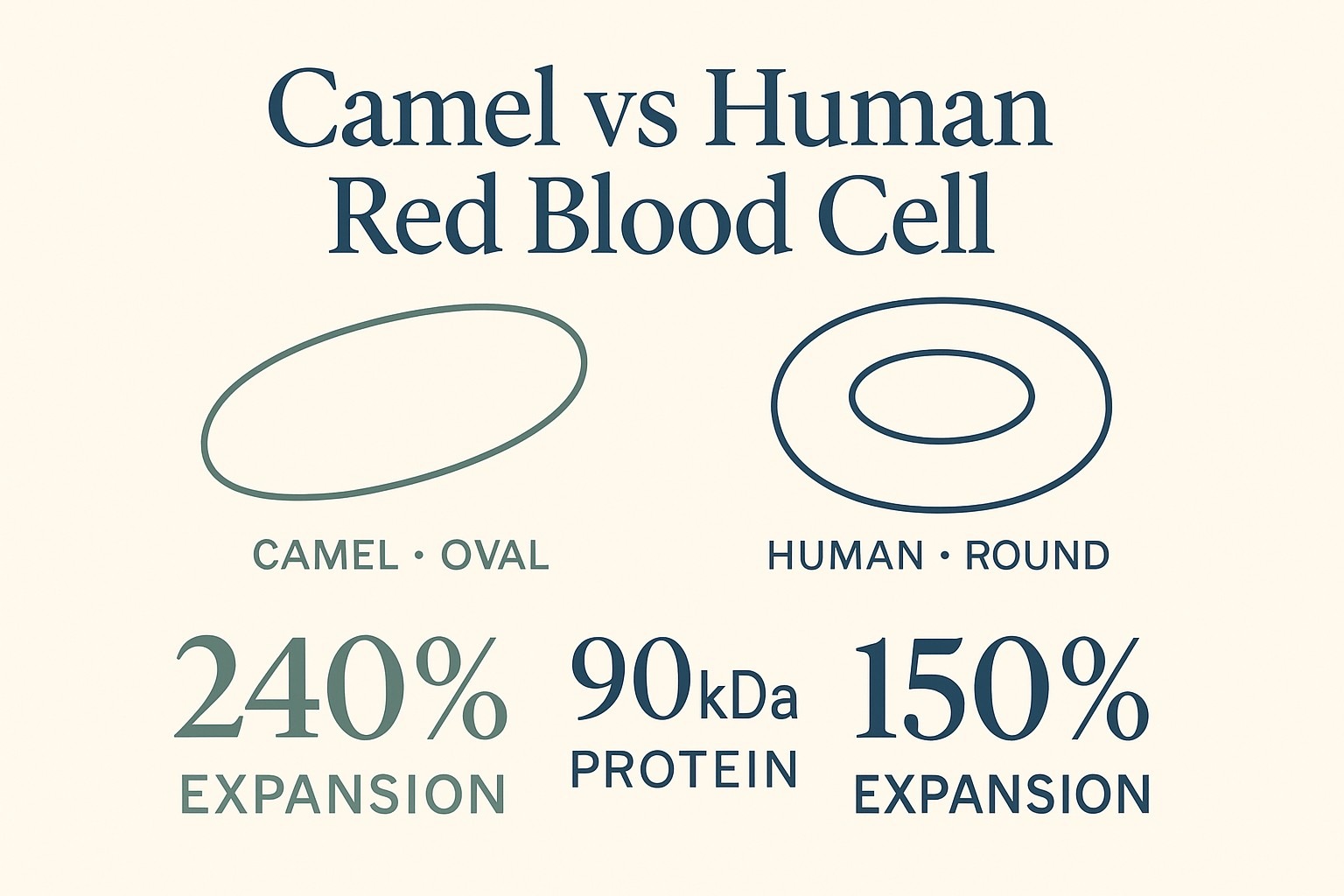
- ~240% — how much a camel red blood cell can expand from its resting volume during rapid rehydration
- ~150% — the expansion ceiling for a typical mammal’s red cell before it fails
- 90 kDa — the mass of the camelid’s special 4.1R protein, larger than the standard version in round-celled mammals
- 0 — number of nuclei in a mature camel red blood cell (they are enucleate, like all mammal red cells)
- 1877 — the year a mis-observation launched the myth that camel red cells are nucleated, a claim textbooks then copied for a century
Key Facts
- A camel’s red blood cell can swell to about 240% of its resting volume during rapid rehydration, versus roughly 150% for a typical mammal.
- Camelids are the only mammals whose red blood cells are elliptical (oval) rather than round.
- A camel can take on more than 100 litres of water in a matter of minutes without its red cells bursting.
- A 2023 Hokkaido University study (Chen and colleagues, Journal of Biological Chemistry) traced the oval shape to a unique ~90 kDa version of the membrane protein 4.1R.
- Like all mammal red cells, mature camel red cells are enucleate — they have zero nuclei.
In short: Camel red blood cells are oval because a unique ~90 kDa version of the membrane protein 4.1R, identified in a 2023 Hokkaido study, locks their skeleton into a rigid ellipse. The shape lets them slip through blood thickened by dehydration and swell to about 240% of resting volume when the camel rehydrates — a feat that would burst a human cell.
What you’re actually seeing: camel red blood cells oval under the microscope

Put a drop of camel blood under a light microscope and the cells look wrong. Almost every mammal on Earth — mouse, whale, human — packs its red blood cells as round, biconcave discs, little dimpled cushions pinched in the middle. Camels, along with their relatives the llama, alpaca, guanaco and vicuña, break the rule. Their erythrocytes are smooth, flat ovals, more like a lens or a grain of rice than a coin.
This makes the camelid family the only mammals whose red cells are elliptical rather than round. And the oddness runs deeper than outline. A camel’s oval cell is also unusually thin and rigid, with a faint band running around its rim. That rim is where a century of confusion began — but hold that thought.
The shape is not decoration. Turns out the oval is a solution to two brutal problems the desert throws at any circulatory system: blood that thickens toward syrup during drought, and blood that must survive a sudden flood when the drought finally breaks.
Why round fails in the desert: blood that thickens like syrup
A camel can go a week or more without drinking. As water leaves the body, the blood plasma shrinks and what remains grows thicker and stickier — higher viscosity, in the language of physiology. Thick blood is hard to push through the body’s narrowest vessels, the capillaries, some of which are barely wider than a single cell. (For scale, the human body’s blood vessels, laid end to end, would wrap the planet several times — and the vast majority of that length is microscopic capillary.)
Here is where the oval earns its keep. An elliptical cell has a long axis, and in flowing blood that long axis tends to line up with the direction of travel, like a canoe pointing downstream. Streamlined that way, camel cells slide through crowded, thickened capillaries where a stack of round discs would jam. The shape keeps oxygen moving to tissue even as the animal’s blood approaches the consistency of a milkshake.
Of all the desert adaptations biologists catalogue — the fat-storing hump, the water-sparing kidneys, the closable nostrils — this one is the most quietly consequential, because circulation is the system that fails first and fastest when everything else has already been rationed.
{IMAGE_2}
The 240% trick: how a camel cell drinks without bursting
Now the harder problem. When a parched camel reaches an oasis, it does not sip. It can take on more than 100 litres of water in a matter of minutes. That water floods into the bloodstream and dilutes it fast, and dilute surroundings are dangerous for a cell: water rushes across the membrane into the saltier interior, and the cell swells. Push a human red cell into that kind of sudden fresh-water bath and it takes on volume until the membrane tears. Biologists call the failure osmotic lysis — the cell literally pops.
The camel cell rides it out. It can balloon to around 240 percent of its resting volume — against roughly 150 percent for the red cells of most other mammals — and then shrink back down when the water is absorbed, without rupturing. The oval, flattened form gives it slack: extra surface area folded into a shape that can inflate toward a sphere before the membrane is ever stretched to breaking. The cell has room to grow into.
Think of it as the difference between over-filling a taut balloon and over-filling a loose, half-empty one. Same added volume; only one survives. So why doesn’t the camel’s balloon tear anyway? The answer is in the wall itself.
So why ARE camel red blood cells oval shaped? Meet protein 4.1R90
For a long time the honest scientific answer to “why oval?” was a shrug — the shape was described, not explained. That changed in 2023. A team led by researchers at the Laboratory of Molecular Medicine at Hokkaido University in Japan, publishing in the Journal of Biological Chemistry, traced the ellipse down to a single protein.
Every red blood cell is held in shape by a mesh of proteins on the inner face of its membrane — the membrane skeleton. A key connector in that mesh is a protein called 4.1R. The Hokkaido group (Chen and colleagues) found that camelids splice their 4.1R gene differently from round-celled mammals, adding an extra segment (an exon-14 cassette) plus a proline- and glutamic-acid-rich stretch. The result is a larger, one-of-a-kind version of the protein — about 90 kilodaltons, heavier than the standard form — informally the “4.1R90” variant.
That bigger connector clamps the membrane skeleton into an unusually stiff, stable lattice. A hyperstable skeleton holds the cell as a fixed ellipse and — critically — resists tearing when the cell inflates during rehydration. In other words, the same molecular change delivers both signature traits at once: the oval shape and the anti-burst toughness. It is the first mechanistic answer to a question that natural history books had been answering with a shrug for decades.
The 150-year myth: no, camel red blood cells do not have a nucleus
Ask the internet whether camel red blood cells have a nucleus and you will find a stubborn “yes.” It is wrong. Mature camel red cells are enucleate — they eject their nucleus during development, exactly like the red cells of every other mammal. There is no functioning nucleus riding along in a camel’s bloodstream.
So where did the myth come from? The historian of this error is zoologist Charles A. Long of the University of Wisconsin–Stevens Point, who in a 2007 analysis traced it to an 1877 observation. Early microscopists peering at that faint band around the rim of the oval cell mistook it for a nucleus. The misreading was copied from textbook to textbook for the better part of a century, each author trusting the last.
What they were actually seeing is a marginal band — a hoop of microtubules running around the cell’s edge, part of the scaffolding that maintains the ellipse. It is structural, not genetic. The lesson is a useful one for anyone reading science: a striking claim repeated in a hundred sources can still trace back to a single person’s honest mistake, made before anyone had the tools to check it.
Every superpower has a cost: the deformability trade-off
It would be tidy to end there — camel makes better red cell, wins desert. But the real biology is more honest, and more interesting. That same hyperstable membrane that keeps the oval from bursting also makes it stiff.
Human red cells are champions of deformability. They fold, bend and squeeze through capillaries narrower than themselves, then spring back. A 2023 study comparing human and camel red cells using optical tweezers and Raman spectroscopy found the camel cells to be markedly less deformable — measurably more rigid under mechanical stress. The rigidity that protects the cell from osmotic rupture is the very thing that costs it flexibility.
Evolution did not build a perfect cell; it built a trade. The camel’s blood is optimized for surviving drought-and-flood cycles, not for the gymnastic squeezing a human cell excels at. Recognizing that cost — rather than selling the oval as a free lunch — is what separates a real explanation from a tidy just-so story.
What 2023–2024 science found, and what’s still open
This is a field that moved recently, which is part of why so much popular writing on camels is out of date. Beyond the 2023 Hokkaido protein work and the optical-tweezers deformability study, a 2024 paper in PLOS One tested camel red cells under hypotonic saline — deliberately watery conditions — and watched the cells hold their elliptical shape and stay intact where other cells would have failed. Together these papers finally connect the visible shape to the molecular machinery to the survival payoff.
Plenty remains unsettled, and it is fair to say so. Exactly how the 4.1R90 skeleton reorganizes as the cell inflates and deflates is not fully mapped. Nor is it entirely clear why camelids alone, among all mammals, evolved this splicing solution while other desert mammals took different routes. Honest uncertainty here is not a weakness in the science — it is the edge of it.
What is settled is the headline. The camel’s oval red cell is not a quirk. It is a two-in-one engineering answer to the desert’s cruelest trick — thickened blood during drought, a fresh-water flood at the end of it — and it works because a single, larger protein turned a soft round disc into a tough little lens.
Quick answers
Why are camel red blood cells oval shaped? A unique, larger version of the membrane protein 4.1R (about 90 kDa, the “4.1R90” variant) locks their membrane skeleton into a rigid ellipse. The shape streamlines flow through thickened blood and resists bursting during rapid rehydration.
Do camel red blood cells have a nucleus? No. They are enucleate like all mammal red cells. The “nucleus” seen in old sources is a marginal band of microtubules, a myth traced to an 1877 mis-observation.
How much can a camel’s red blood cell expand? Up to roughly 240 percent of its resting volume during fast rehydration, versus about 150 percent for a typical mammal’s red cell — without rupturing.
Are camel red cells better than human ones? Not better — different. They win on osmotic toughness but are less deformable (stiffer) than the highly flexible human red cell. It is a trade-off, not an upgrade.
Sources and notes
- Chen, Y., Miyazono, K., Otsuka, Y., et al. “Membrane skeleton hyperstability due to a novel alternatively spliced 4.1R can account for ellipsoidal camelid red cells with decreased deformability.” Journal of Biological Chemistry, 2023 — Laboratory of Molecular Medicine, Hokkaido University.
- “Comparison of the human’s and camel’s red blood cell deformability by optical tweezers and Raman spectroscopy.” Sensing and Bio-Sensing Research, 2023.
- “Towards phenotyping adaptive traits in camels: A study of the influence of hypotonic saline solutions on blood cell area.” PLOS One, 2024.
- Long, Charles A. “Evolution of Function and Form in Camelid Erythrocytes.” WSEAS / University of Wisconsin–Stevens Point, 2007.
- AskNature, The Biomimicry Institute — “Blood Cells Protect From Dehydration.”
The camel’s oval red cell is a reminder that the most extreme survival stories are often hidden at the smallest scale — not in the hump or the endurance, but in a single protein that decided, tens of millions of years ago, to fold a blood cell into a lens. As biologists finish mapping how that lens flexes and holds, expect the humble camel to keep teaching us things about membranes, materials and resilience that reach well beyond the desert.
Frequently Asked Questions
Q: Why are camel red blood cells oval shaped?
Because a unique version of the membrane protein 4.1R locks their outer skeleton into a rigid ellipse. A 2023 Hokkaido University study found that camelids splice the 4.1R gene differently, producing a larger, roughly 90-kilodalton variant that clamps the membrane skeleton into an unusually stiff lattice. That hyperstable skeleton holds the cell as a fixed oval and resists tearing when the cell inflates during rehydration.
Q: How does the oval shape help camels survive?
It solves two desert problems. During drought, blood thickens toward syrup; an elliptical cell lines its long axis up with the flow, like a canoe pointing downstream, sliding through crowded capillaries where stacked round discs would jam. And the flattened oval has slack to inflate toward a sphere, so it can balloon to about 240% of its resting volume during sudden rehydration without the membrane tearing.
Q: How much water can a camel drink at once?
A parched camel can take on more than 100 litres of water in a matter of minutes. That flood dilutes the bloodstream fast, and water rushes across cell membranes into the saltier interior, swelling the red cells. A human red cell in that situation would keep swelling until it ruptured — a failure called osmotic lysis. The camel’s oval cell rides it out, expanding to around 240% of resting volume and then shrinking back without bursting.
Q: Are camel red blood cells nucleated?
No. Mature camel red blood cells are enucleate — they have zero nuclei, like the red cells of all mammals. A persistent myth that they are nucleated traces back to an 1877 mis-observation that textbooks then copied for about a century. The faint band running around the cell’s rim, part of what makes the oval look unusual, is where that century of confusion began, but it is not a nucleus.
Illustrations are AI-generated. Article fact-checked and human-edited. Our editorial standards.