Why Do Cats Always Land on Their Feet? The Real Physics
The question of why do cats always land on their feet looks like idle curiosity until you realize it stumped serious physicists for two hundred years. In November 1894, a French scientist named Étienne-Jules Marey points a chronophotographic camera at a startled white cat, drops her, and at sixty frames per second finally catches what the human eye cannot. The film, all thirty-six frames of it, ends a generations-old argument and starts a new one.
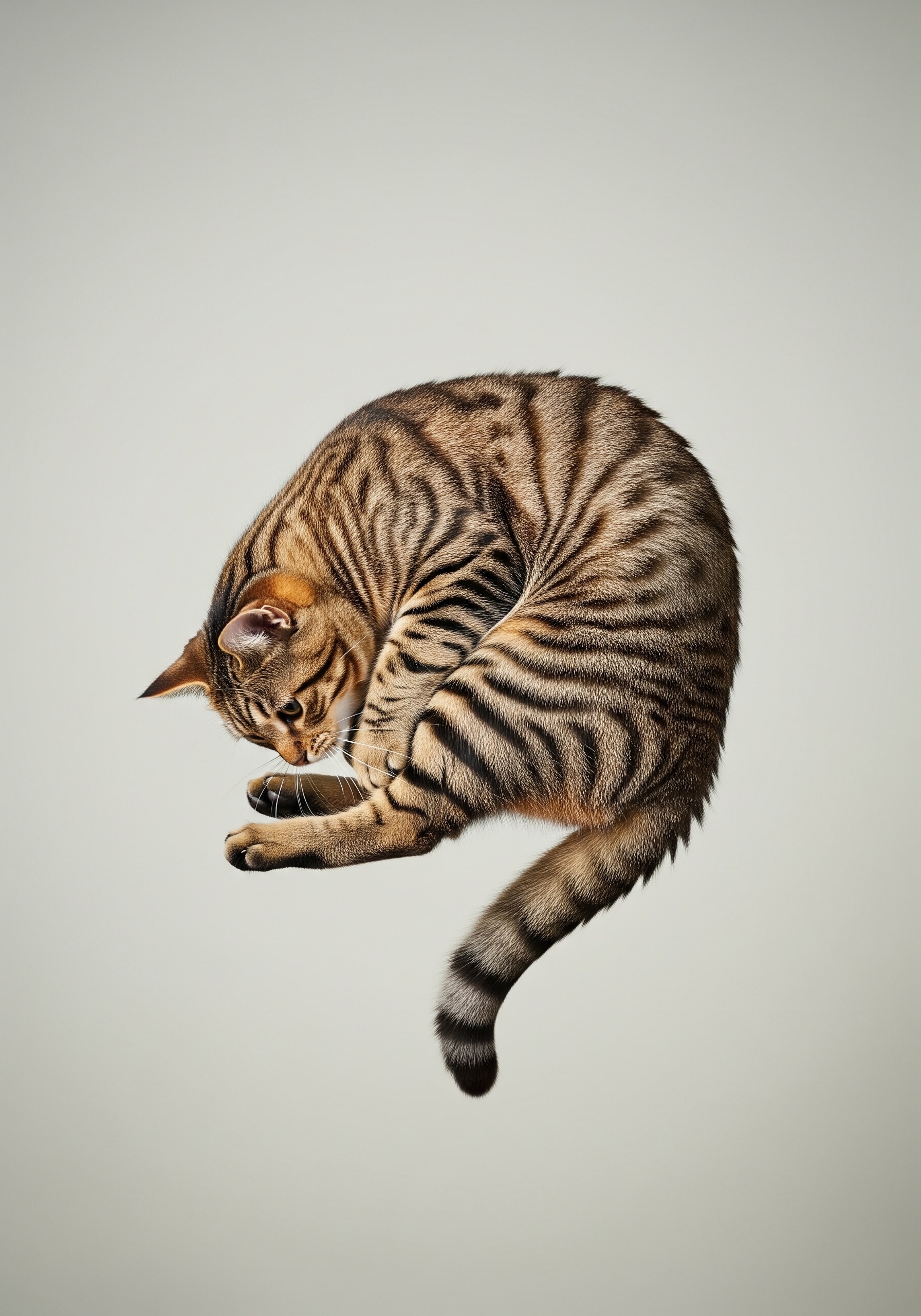
In short: Cats land on their feet thanks to the righting reflex, a fast aerial maneuver in which the cat bends in the middle and rotates the front and back halves of its body on different axes. It looks like cheating physics. It isn’t — and once you understand the trick, what looks like magic turns into elegant mechanics.
Key Facts
- The cat righting reflex first appears at 3–4 weeks of age and is fully perfected by 6–9 weeks.
- French physiologist Étienne-Jules Marey first captured the reflex on film in 1894, shooting at 60 frames per second on 85 mm celluloid.
- Cats rotate by bending at the waist and turning the front and rear halves around different axes — a “bend and twist” that conserves angular momentum.
- A 1987 study of 132 cats who fell from New York high-rises found 90% had chest injuries, yet 90% of those reaching the vet alive survived.
- The terminal velocity of a falling cat is roughly 60 mph (around 100 km/h), after which a relaxed, spread-out posture begins to function like a parachute.
Key Facts
- The cat righting reflex first appears at 3 to 4 weeks of age and is fully perfected by 6 to 9 weeks.
- French physiologist Etienne-Jules Marey first captured the reflex on film in 1894, shooting at 60 frames per second on 85 mm celluloid and publishing in Comptes Rendus.
- Cats rotate by bending at the waist and turning the front and rear halves of the body around different axes, conserving angular momentum so the net total stays at zero.
- A 1987 study of 132 cats that fell from New York high-rises found 90% had chest injuries, yet 90% of those reaching the vet alive survived (Whitney and Mehlhaff, Animal Medical Center).
- A falling cat’s terminal velocity is roughly 60 mph (about 100 km/h); the righting maneuver completes in about 0.3 to 0.5 seconds and needs roughly three feet of fall to finish cleanly.
In short: Cats land on their feet using the righting reflex, bending at the waist and rotating their front and rear halves around different axes to conserve angular momentum. Etienne-Jules Marey first filmed it in 1894 at 60 frames per second. The maneuver takes about half a second and needs roughly three feet of fall to complete.
The 1894 Film That Finally Cracked the Mystery
For most of the nineteenth century, the falling cat is a problem polite scientists pretend isn’t there. The reflex appears to contradict the conservation of angular momentum — one of the iron laws of mechanics. A cat held belly-up with no spin should, by every rule the textbook teaches, hit the ground belly-up. It doesn’t. Generations of mathematicians wave the question away as a biological trick.
Then comes Marey. Working at his outdoor “station physiologique” in the Bois de Boulogne, he has spent two decades inventing the cameras nobody else has — instruments that strobe twelve, twenty-four, sixty times a second and freeze motion no Victorian eye can resolve. In the autumn of 1894 he turns one on a cat. The resulting sequence, published that November in the journal Comptes Rendus of the French Academy of Sciences, shows something the naked eye had always missed: the cat doesn’t rotate as a single object. It rotates as two.
That distinction is the whole answer. Marey writes that the animal’s front and back halves twist independently, the legs alternately tucked and extended like a figure skater’s arms. The Academy, by some accounts, is annoyed: the cat appeared to be violating a sacred law, and now a photographer was telling them how it did so. Marey’s film is preserved today by the Cinémathèque française and is considered the first chronophotographic sequence of a live cat.
{IMAGE_2}
How Cats Land on Their Feet — The Physics, Step by Step
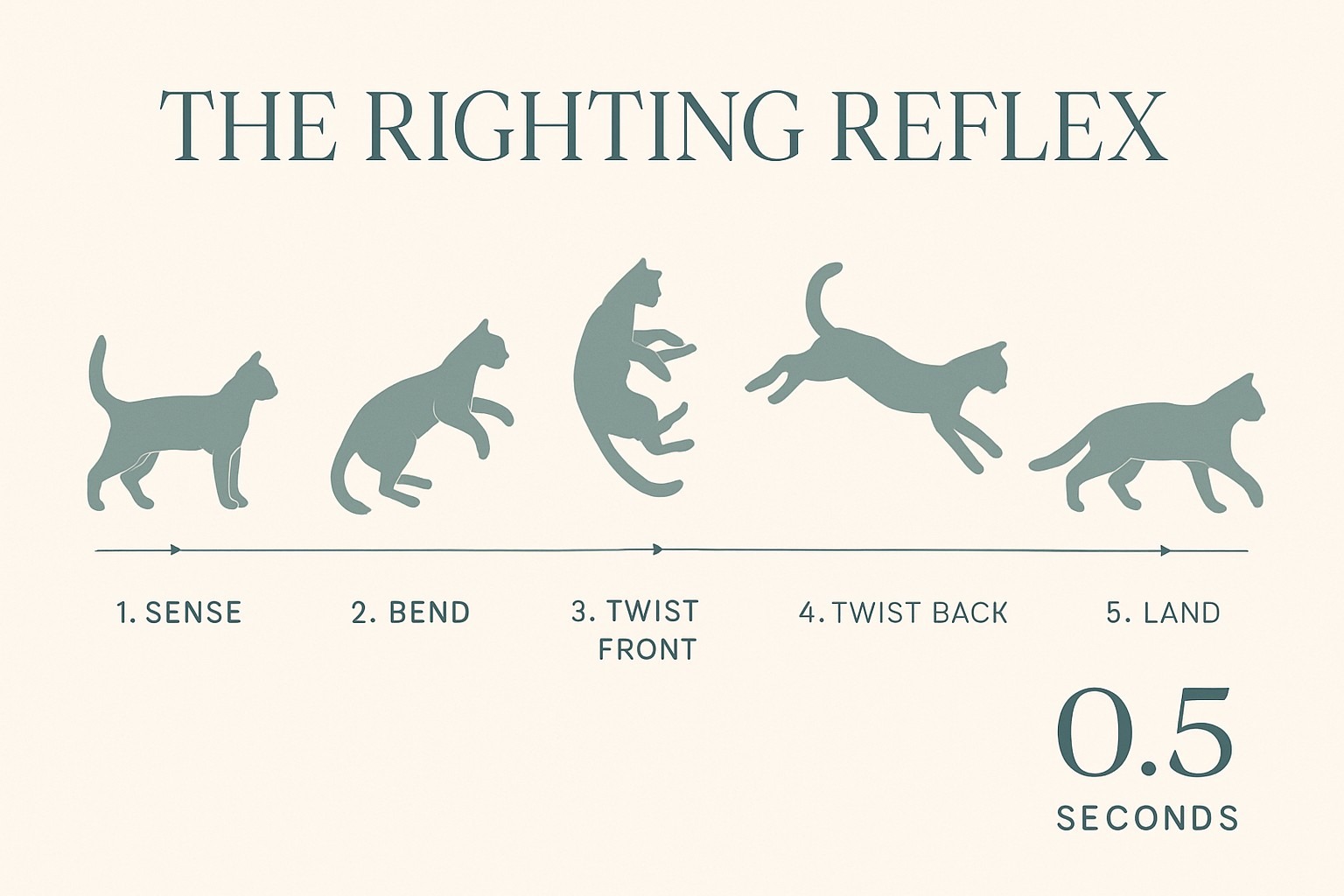
Strip away the slow-motion drama and the maneuver is a tight five-beat sequence, usually completed in under half a second.
First, the cat senses which way is up. The vestibular system — three fluid-filled semicircular canals tucked deep in the inner ear, paired with otolith organs that read gravity — tells the brain, within milliseconds, the orientation of the head. The visual cortex confirms it. The head whips around toward the ground before anything else moves.
Second, the cat bends sharply at the waist, folding the body into a shallow “V” so the spine forms two segments that can move semi-independently.
Third, it tucks the front legs tightly against the chest. This reduces the rotational inertia of the front half, in the same way a figure skater pulling her arms in spins faster.
Fourth — simultaneously — the hind legs extend outward, increasing the rotational inertia of the back half. The front half can now spin quickly through a large angle, while the back half, dragging more inertia, rotates only a little the other way. Net angular momentum: still zero, exactly as the laws of mechanics require. No magic was performed.
Fifth, the cat reverses the trick. The hind legs tuck in, the front legs extend, the back half snaps around to match, and all four feet point earthward. The whole choreography fits in roughly 0.3 to 0.5 seconds.
The Paradox That Embarrassed Nineteenth-Century Physics
Here is the thing that took two centuries to digest. If a rigid object — a brick, a frozen chicken, a textbook — begins falling with no rotation, it cannot acquire rotation in mid-air without something to push against. Angular momentum is conserved. Period.
A cat is not a rigid object. By bending in the middle, it becomes two coupled rotating objects, and the rules change. Each half can rotate as long as the other half rotates the opposite way by an amount that keeps the total angular momentum at exactly zero. Bend, twist, unbend, twist again — the body ends up facing the other way, and the books still balance.
Modern physicists call this maneuver a “geometric phase” or “falling-cat theorem,” and it shows up in places you’d never expect: in how astronauts on a spacewalk can turn themselves around without anything to push against, and in the control software of free-floating satellites. A surprising amount of modern aerospace engineering owes a quiet debt to a cat named in no records.
Why Cats Don’t Actually Always Land on Their Feet
Now for the part the headline gets wrong. They don’t.
Veterinary clinicians have noted for decades — most pointedly in a much-cited 1987 study by Drs. Wayne O. Whitney and Cheryl J. Mehlhaff at the Animal Medical Center in Manhattan — that the cats most likely to land badly are not the ones who fall the farthest. They are the ones who fall short. From a kitchen counter or a child’s outstretched arms, the cat simply has no time. The righting reflex needs about a foot of free-fall to even begin and roughly three feet to complete cleanly. Drop a cat from less than that and it lands however gravity left it.
Health matters too. Older cats and overweight cats execute the reflex slowly. Arthritic spines bend less. A cat born without the vestibular function — a rare congenital defect — never develops the reflex at all. Whitney and Mehlhaff’s study of 132 falling cats found ninety percent had thoracic trauma even when the landing was technically “on the feet”: all four limbs strike at once, and a heavy cat’s own ribcage absorbs the impact.
It would be more honest to say cats usually land on their feet, often beautifully, when given the air to do so.
The High-Rise Paradox Nobody Expects
And then there is the strangest finding of all. Whitney and Mehlhaff observed that cats falling from the second to the sixth floor of a New York apartment building tended to arrive at the vet in worse shape than cats falling from higher up. Falls from the seventh story and above — even from the thirty-second floor in one case — produced, on average, less catastrophic injuries.
The mechanism appears to be a combination of physics and feline behavior. A falling cat reaches terminal velocity, roughly 60 mph, after about five stories. Below that, the cat is still accelerating, tense, legs braced, and the kinetic energy at impact is concentrated through small contact points. Above terminal velocity, the cat stops accelerating, relaxes, and — researchers suspect — spreads its limbs into what one veterinarian called the “flying-squirrel posture,” distributing impact across the whole body and increasing air drag. The math says the very tall fall should be worse. The data, drawn from a self-selected sample of cats whose owners chose to bring them in, says the middle floors are the killing zone. That is a counterintuitive result that has shaped emergency-medicine triage in urban veterinary clinics ever since.
One important caveat the original authors flagged honestly: cats who died on impact never made it to the clinic, so the very highest falls are almost certainly underrepresented. The paradox is real, but its edges are softer than headlines like to suggest.
The Three-Week Switch: When Kittens Learn the Trick
Kittens are not born knowing how to do this. For their first three weeks they are essentially incapable of righting themselves at all, which is one reason mother cats keep them so low to the ground. Between weeks three and four, the vestibular system matures and the first wobbly attempts appear. By week six the maneuver is usually clean; by week nine it is the reflex it will be for life. It is, in development terms, one of the fastest neuromechanical skills any mammal acquires.
That window matters for any household with a young cat: the early-twentieth-century myth that a kitten will instinctively right itself from any height is, simply, false. Until about nine weeks they are no more aerodynamic than any other small mammal.
Frequently Asked Questions
Q: Do cats really always land on their feet?
A: No. They usually do, given enough air. Falls of less than about three feet often don’t allow the righting reflex to complete, and even successful landings can cause serious injury — Whitney and Mehlhaff’s 1987 study found 90% of cats falling from urban buildings had chest trauma despite often landing “correctly.”
Q: How does a cat rotate in mid-air without violating physics?
A: It bends at the waist and rotates the front and back halves around different axes. By tucking and extending the legs in opposite phase, each half rotates while the total angular momentum stays at zero. No law is broken — it is just hard to picture without slow motion.
Q: At what age can a kitten land on its feet?
A: The righting reflex first appears at three to four weeks and is reliably perfected by six to nine weeks. Before that, kittens cannot orient themselves in a fall.
Q: Why do falls from middle-story windows hurt cats more than falls from higher up?
A: A cat reaches terminal velocity (about 60 mph) after roughly five stories. Below that it is still accelerating and tense; above it, the cat appears to relax and spread out, distributing impact and adding drag. The Whitney–Mehlhaff dataset shows that pattern clearly, with the important caveat that cats killed on impact rarely make it into the dataset at all.
Sources
- Whitney, W. O. & Mehlhaff, C. J. — “High-rise syndrome in cats,” Journal of the American Veterinary Medical Association, 1987.
- Étienne-Jules Marey — chronophotographic sequence of a falling cat, 1894; preserved by the Cinémathèque française.
- Wikipedia, “Cat righting reflex” and “High-rise syndrome” (used as starting reference for cross-checked claims).
- Scientific American, “Why Do Cats Land on Their Feet? Physics Explains.”
- VCA Animal Hospitals, “True or False: Cats Always Land on Their Feet.”
So the answer to why do cats always land on their feet is, in the end, two answers laid on top of each other. The physics one is satisfying: a flexible spine, a brilliant inner ear, and a half-second routine that turns one rotating body into two — exactly within the rules. The honest one is gentler: they usually do, when given the height and the health for it. The next time a household cat steps off the back of a couch and arrives, irritated but upright, on the carpet, you’ll know you are watching a maneuver that took Étienne-Jules Marey three decades of camera-building to even photograph. It is worth a second of admiration.
Illustrations are AI-generated. Article fact-checked and human-edited. Our editorial standards.