Why the Voynich Manuscript Has Never Been Decoded
The question — why has the Voynich manuscript never been decoded — has a starting point you can pin to a season and a room: a spring day in 1912, when a book dealer named Wilfrid Voynich pried open a chest of old volumes in a Jesuit villa outside Rome and lifted out a small book written in a script no living person could read. He thought he had found a lost work of the philosopher Roger Bacon. He had, in fact, found the most stubborn puzzle in the history of writing — a book that has since defeated military codebreakers, university linguists, and, more recently, neural networks trained on every language humans have ever recorded.
Key Facts
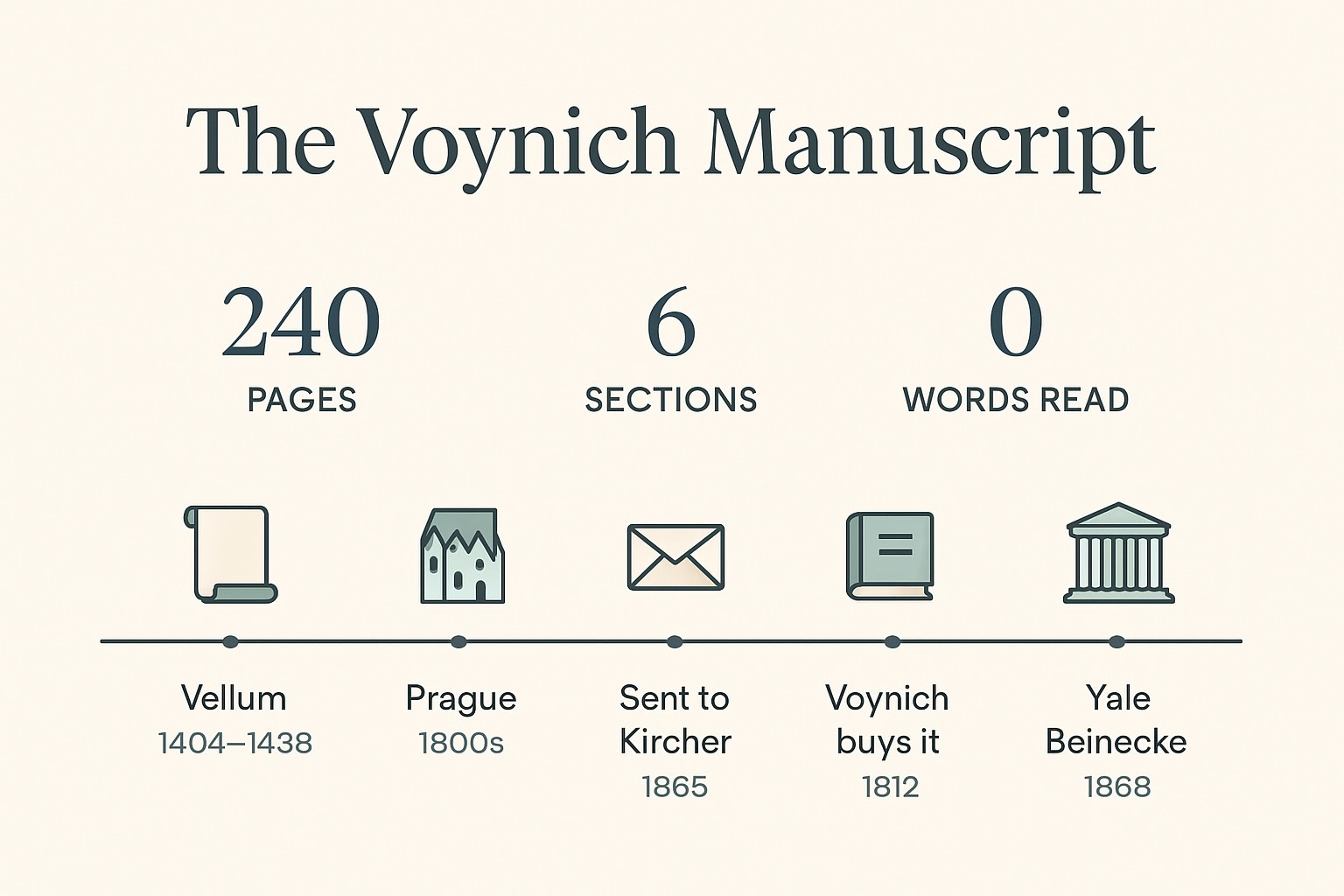
- The manuscript is catalogued as MS 408 at Yale’s Beinecke Library and runs to about 240 vellum pages, roughly 88% of an original ~272.
- Radiocarbon dating at the University of Arizona in 2009 placed the vellum between 1404 and 1438.
- It is written in an alphabet of about 20 to 30 recurring symbols called Voynichese, and not one word has ever been confidently read.
- Scholars divide it into six sections: Herbal (~126 pages), Astronomical, Balneological, Cosmological, Pharmaceutical and Recipes.
- Codebreakers who failed to crack it include William and Elizebeth Friedman and Bletchley Park’s John Tiltman.
In short: The Voynich manuscript is a roughly 240-page vellum book radiocarbon-dated to 1404-1438, written in an unknown 20-30 symbol script called Voynichese. Named after dealer Wilfrid Voynich, who bought it in 1912, it has defeated military codebreakers and linguists; not a single word has ever been reliably read.
A book bound in the 1400s, unread ever since
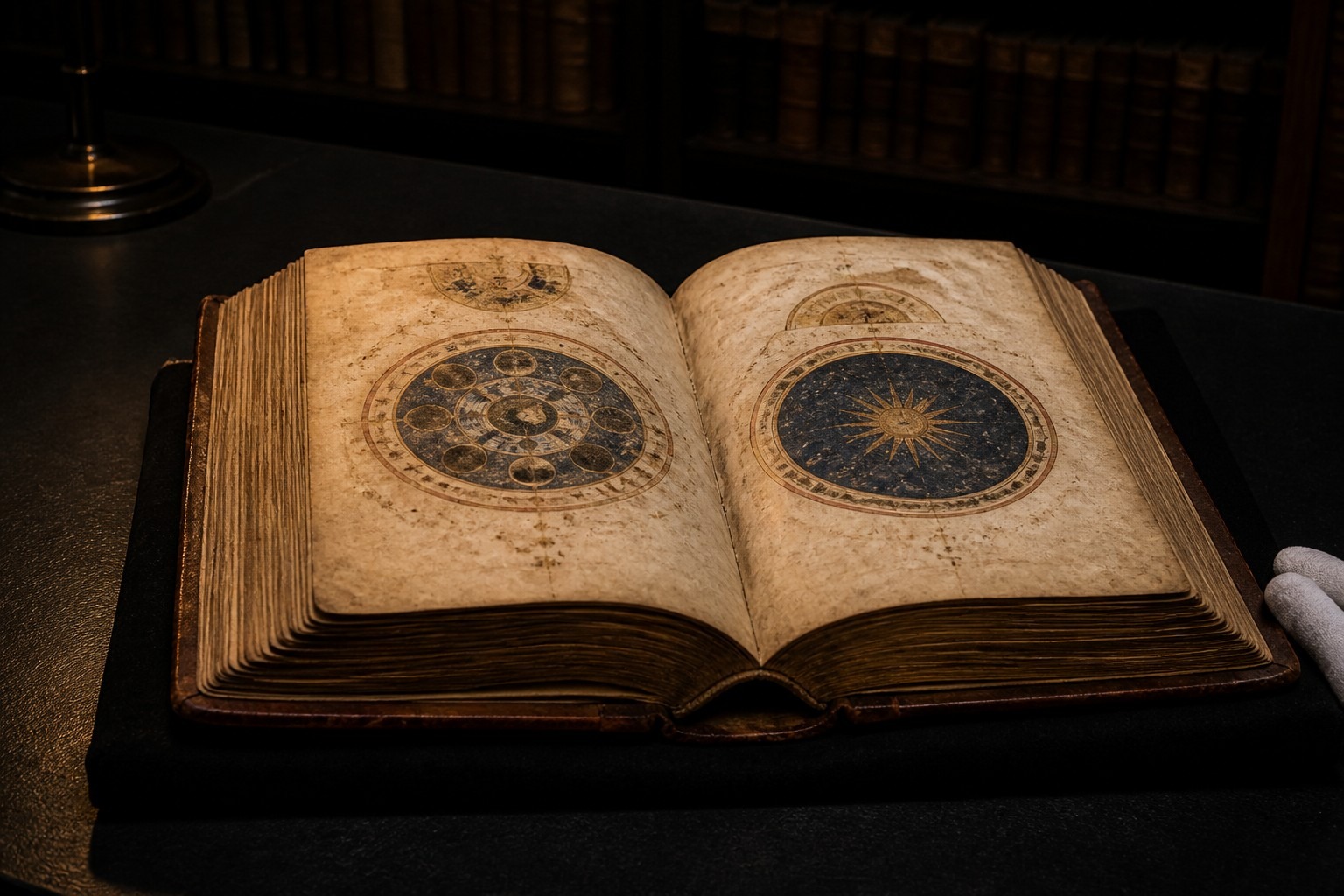
Strip away the legend and you are left with a physical object of unusual precision. The manuscript now catalogued as MS 408 at Yale’s Beinecke Rare Book & Manuscript Library runs to about 240 vellum pages — roughly 88 percent of what was probably an original 272 — cut from an estimated fifteen calfskins. In 2009, radiocarbon dating carried out at the University of Arizona placed the animal skins between 1404 and 1438. That date is the first fact that hurts the easy theories: the parchment is genuinely early-15th-century, not a Victorian forgery cooked up to sell to a collector.
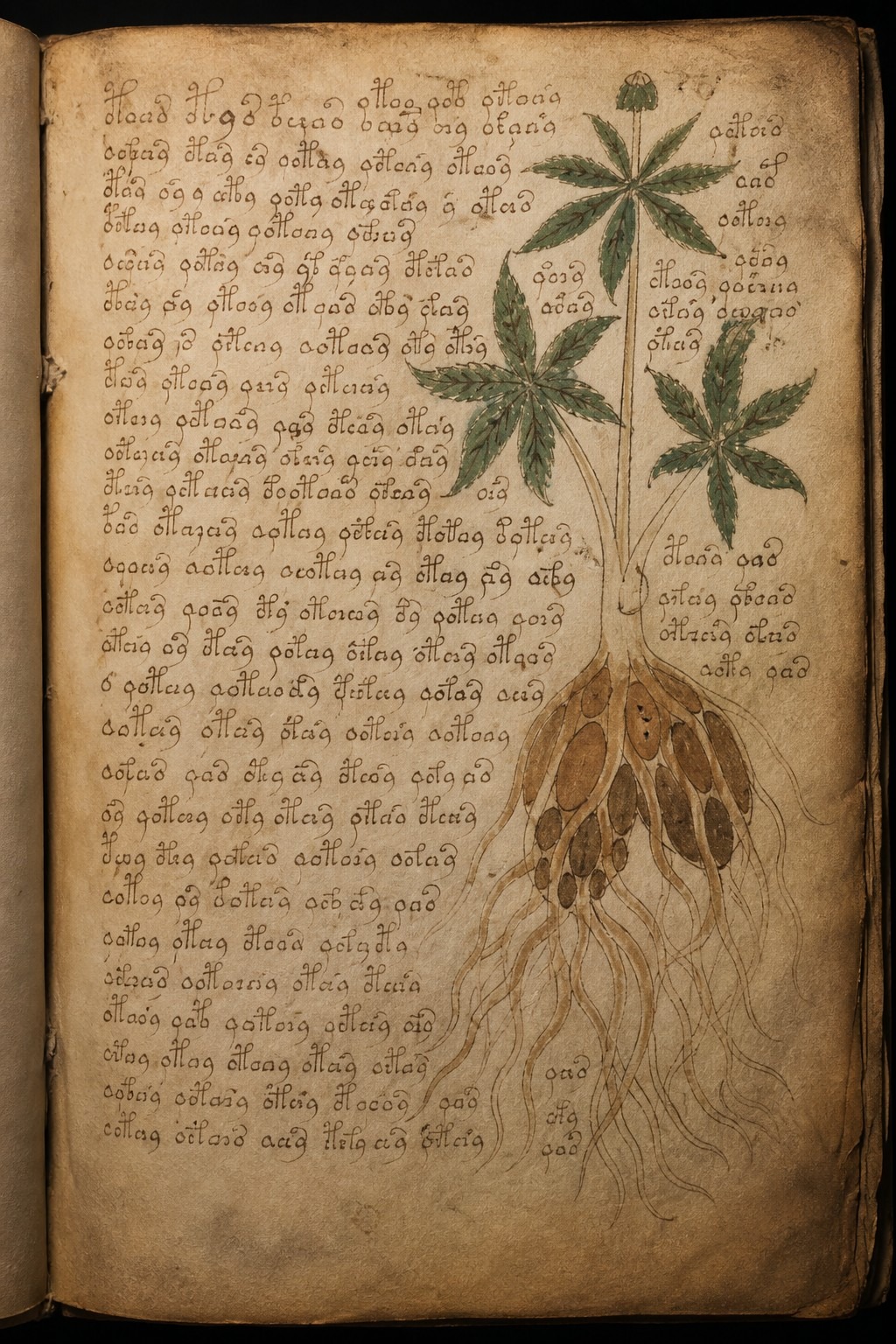
Every page is covered in a flowing, confident hand — no crossings-out, no obvious hesitation — using an alphabet of about 20 to 30 recurring symbols now called Voynichese. Nobody knows what it says. Not one word, name, or date inside the book has ever been read with confidence. The writing loops around illustrations of plants, stars, and small naked figures bathing in green channels, as if the scribe expected a reader who never came.
- 1404–1438 · Vellum produced (radiocarbon-dated, University of Arizona)
- c. 1600s · Prague: legend has Emperor Rudolf II paying 600 ducats for it; later owned by Georg Baresch, then Jan Marek Marci
- 1665/66 · Marci mails the book to the Jesuit scholar Athanasius Kircher in Rome, begging for a translation. None comes.
- 1912 · Wilfrid Voynich buys it and gives it his name
- 1969 · Donated to Yale’s Beinecke Library, where it stays
- Nov 2025 · A new cipher study in the journal Cryptologia reopens the case
What’s actually inside — a tour of the six sections
Most write-ups show you the prettiest pages and leave it there. Here is the actual map. Scholars divide the manuscript into six sections by the pictures that dominate them, and the page counts tell you where the author spent their effort.
The largest by far is the Herbal section — about 126 pages, each built around a single plant drawn in careful color. The catch: botanists have never matched most of them to a real species. The roots, leaves, and flowers are recombined like a child’s flip-book of nature. Then comes the Astronomical section (roughly 17 pages of suns, moons, and zodiac medallions), a Balneological section (about 20 pages of nude women standing in interconnected pools and green pipes), and a Cosmological section (around 14 pages) that includes the manuscript’s showpiece: a six-panel foldout of circular “rosettes” linked by causeways, unfolding to roughly six times a normal page. The last stretches are Pharmaceutical — some 16 pages of jars and clipped plant parts — and Recipes, about 25 pages of dense, short paragraphs each marked with a star, and no pictures at all.
{IMAGE_2}
That structure is a clue in its own right. It mirrors the layout of a real medieval reference book — herbal, then heavens, then medicine, then a recipe register. Whoever made this understood what a book of natural knowledge was supposed to look like. They just filled it with a language nobody else has ever spoken.
Why has the Voynich manuscript never been decoded, given who has tried?
The roll-call of failure is the strongest evidence that this is no ordinary riddle. During and after the World Wars, some of the sharpest cryptanalysts alive turned their tools on it. William F. Friedman — the man whose team broke Japan’s PURPLE cipher — and his wife Elizebeth Smith Friedman, herself a legendary codebreaker, worked the manuscript for years. William’s private conclusion, famously encoded in an anagram he left behind, was that the text was “an early attempt to construct an artificial or universal language of the a priori type.” In plain terms: he suspected it was a built language, not a code hiding Latin.
John Tiltman, a senior British cryptanalyst from Bletchley Park, spent decades on it and concluded it was no simple substitution cipher — nothing he tried unlocked it. His American colleague Prescott Currier noticed something stranger still: the book is written in at least two distinct statistical “hands,” now called Currier A and Currier B, as if two systems (or two people) were at work. None of them read a single sentence.
Here’s the uncomfortable part. These were people who broke the ciphers that decided wars. If the Voynich were a straightforward code, they would have cracked it. That they didn’t points somewhere odd — either the method is genuinely unusual, or there is no message underneath at all.
The real obstacle — the statistics that don’t add up
Turn from the codebreakers to the numbers, and you find the actual reason the book resists. Voynichese looks like language from a distance and stops looking like it up close.
Its character entropy — a measure of how unpredictable each symbol is — is unusually low, lower than Latin or English, meaning the script is oddly repetitive and rule-bound. Word lengths cluster tightly around a binomial curve, unlike the ragged spread of natural languages. Words follow something close to Zipf’s law (a few words very common, most rare), which real languages do — but not quite in the normal way. And there is the eeriest feature of all: identical or near-identical words sit next to each other far more often than any human language allows, yet a given word almost never repeats in the way grammar demands. Real sentences reuse “the,” “of,” “and.” Voynichese doesn’t behave like that.
And yet it isn’t random noise. In a 2013 study published in the journal PLOS ONE, physicist Marcelo Montemurro of the University of Manchester and his colleague Damián Zanette showed that the words are distributed across the book in patterns that carry real information content — clusters of related “vocabulary” rise and fall between sections, exactly as topic words do in a genuine text. So the book sits in a maddening middle: too structured to be gibberish, too strange to be any known language. That contradiction, more than any missing key, is why every decoder has walked away empty-handed.
Hoax, lost language, or cipher?
Three theories have competed for a century, and it’s worth scoring them honestly against what we now know rather than leaving it as a shrug.
| Theory | The claim | How it holds up in 2026 |
|---|---|---|
| Elaborate hoax | Meaningless gibberish generated to look like text — possibly to defraud a wealthy buyer | Weakened. Explains the oddities but not the genuine information-content patterns; expensive vellum for a fake is hard to square. |
| Invented language | A constructed “artificial” tongue, à la Friedman’s a-priori-language idea | Alive but unproven. Fits the low entropy; no one has demonstrated the grammar. |
| Real-language cipher | Ordinary Latin or a Romance tongue, enciphered by a lost method | Strengthened. The 2025 Naibbe result shows a hand-workable cipher can reproduce the statistics — the strongest evidence yet the text may encode something real. |
The hoax camp had a serious champion. In 2004, Gordon Rugg of Keele University showed that a low-tech 16th-century device — a Cardan grille, a card with holes slid over a table of syllables — could churn out gibberish that mimics some Voynich traits. It was a genuine blow to the “there must be meaning” assumption. But Montemurro’s information patterns are exactly what a grille shouldn’t produce, and the debate never closed.
The 2026 wrinkle — a game of cards and dice
Then, in late 2025, the needle moved. Writing in Cryptologia, researcher Michael A. Greshko described what he calls the Naibbe cipher — named for naibbe, a late-14th-century Italian word for a card game. It is a “verbose homophonic substitution”: each letter of a Latin or Italian text maps not to one symbol but to several possible strings of Voynichese glyphs, and which one you write is chosen by a physical process — drawing from a set of cards and rolling dice — that a scribe could run entirely by hand with 15th-century materials.
The result is the first method ever shown to mechanically reproduce several of Voynichese’s fingerprint statistics at once — the low entropy, the odd word structure, the near-repetitions — while still encoding a fully recoverable Latin or Italian message. That is genuinely new. For a hundred years the objection to the “it’s a cipher” theory was that no plausible medieval technique produced this precise statistical shadow. Now one does.
Greshko himself supplies the honest caveat, and it deserves top billing: the Naibbe cipher is “almost certainly not” how the Voynich was actually made. What he has built is a proof of possibility — a documented, hand-operable bridge between real Latin and “something that behaves kind of like the Voynich manuscript.” It doesn’t decode a single page. It shows the door was never locked in the way everyone assumed.
Has AI cracked it?
You might expect modern machine learning to have finished the job. It hasn’t — and the failures are instructive. In 2018, computer scientists Bradley Hauer and Greg Kondrak at the University of Alberta ran the text through translation algorithms and reported that the underlying language was most likely Hebrew, letters possibly reordered. The wider field never accepted it; the “translated” output didn’t cohere into readable sentences. Later deep-learning studies, comparing Voynichese glyph shapes against the world’s writing systems, have pointed toward everything from ancient Indian scripts to Romance languages — each announcement confident, none reproducible.
The pattern by now is familiar. An algorithm finds a statistical resemblance, a headline follows, and the “solution” dissolves under scrutiny because it can’t turn the resemblance into a text that says anything. Neural nets are pattern-matchers of extraordinary power, and even they have slid off this book. That tells you the barrier isn’t a lack of computing muscle. It’s that we may not have the one thing a machine can’t infer from the ciphertext alone: the key.
Will anyone ever read it?
So we arrive at the strangest place a mystery can end — not solved, but reframed. Before 2025, the open question was whether the Voynich could be a real message at all. After the Naibbe result, the more likely question is: what was the message, and can the method ever be recovered?
The trouble is arithmetic. A verbose homophonic cipher works because the sender and reader share tables — which glyph-strings stand for which letters, which draws mean what. If the Voynich hides Latin behind a scheme like that, then somewhere, once, there existed a set of cards, tables, or rules that made it legible. Those are gone. Georg Baresch couldn’t read it in the 1600s; Athanasius Kircher, the era’s great decipherer of Egyptian hieroglyphs, was mailed a sample and produced nothing. The key, if there was one, was likely lost within a generation of the ink drying.
That is the quiet, honest punchline six centuries in the making. The manuscript may not be unbreakable so much as unread — a real book in a real cipher whose instruction sheet crumbled to dust long ago. We now have a plausible sense of how such a book could have been built. We still have no way to open it. And there is a certain dignity in a puzzle that has outlasted every mind sent against it, still turning its pages toward a reader who may never arrive.
Sources and notes
- Beinecke Rare Book & Manuscript Library, Yale University — holder of the Voynich Manuscript (MS 408), fully digitized; vellum radiocarbon-dated 1404–1438 (University of Arizona)
- Michael A. Greshko, “The Naibbe cipher: a substitution cipher that encrypts Latin and Italian as Voynich Manuscript-like ciphertext,” Cryptologia (Taylor & Francis), published online November 2025
- Marcelo A. Montemurro & Damián H. Zanette, “Keywords and Co-Occurrence Patterns in the Voynich Manuscript,” PLOS ONE (2013), University of Manchester
- Bradley Hauer & Greg Kondrak, computational language-analysis of the Voynich Manuscript, University of Alberta (2018)
- Voynich Manuscript — encyclopedic synthesis of provenance, sections, and the Friedman, Tiltman, Currier and Rugg analyses
Six hundred years on, the Voynich manuscript keeps its bargain with silence — decoded by no one, dismissed by no one who has truly looked. If the newest work is right, the message was always there; only the reader’s key was lost. Perhaps that is the most human thing about it.
Frequently Asked Questions
Q: What is the Voynich manuscript?
It is a small illustrated book, catalogued as MS 408 at Yale’s Beinecke Library, running to about 240 vellum pages written in an unknown alphabet of roughly 20 to 30 symbols. Its pages loop around drawings of plants, stars and bathing figures. Book dealer Wilfrid Voynich bought it in 1912 and gave it his name; it is often called the most stubborn puzzle in the history of writing.
Q: How old is the Voynich manuscript?
In 2009, radiocarbon dating at the University of Arizona placed the vellum between 1404 and 1438, genuinely early-15th-century and not a Victorian forgery. The animal skins came from an estimated fifteen calfskins. That early date undercuts many easy theories, since the parchment is centuries older than figures once suspected of fabricating the book.
Q: Why has nobody decoded it?
The strongest evidence it is no ordinary cipher is who failed: William and Elizebeth Friedman and Bletchley Park’s John Tiltman, people who broke wartime codes, got nowhere. The obstacle is statistical. Voynichese has unusually low character entropy, tightly clustered word lengths, and identical words sitting next to each other far more often than any human language allows.
Q: What is written inside the Voynich manuscript?
Nobody knows; not one word, name or date has been read with confidence. The book divides into six sections by their illustrations: a large Herbal section of about 126 pages, plus Astronomical, Balneological, Cosmological, Pharmaceutical and Recipes sections. The structure mirrors a real medieval reference book, yet it is filled with a language no one else has ever spoken.
Illustrations are AI-generated. Article fact-checked and human-edited. Our editorial standards.