The Animal With the Fewest Chromosomes Has Just One
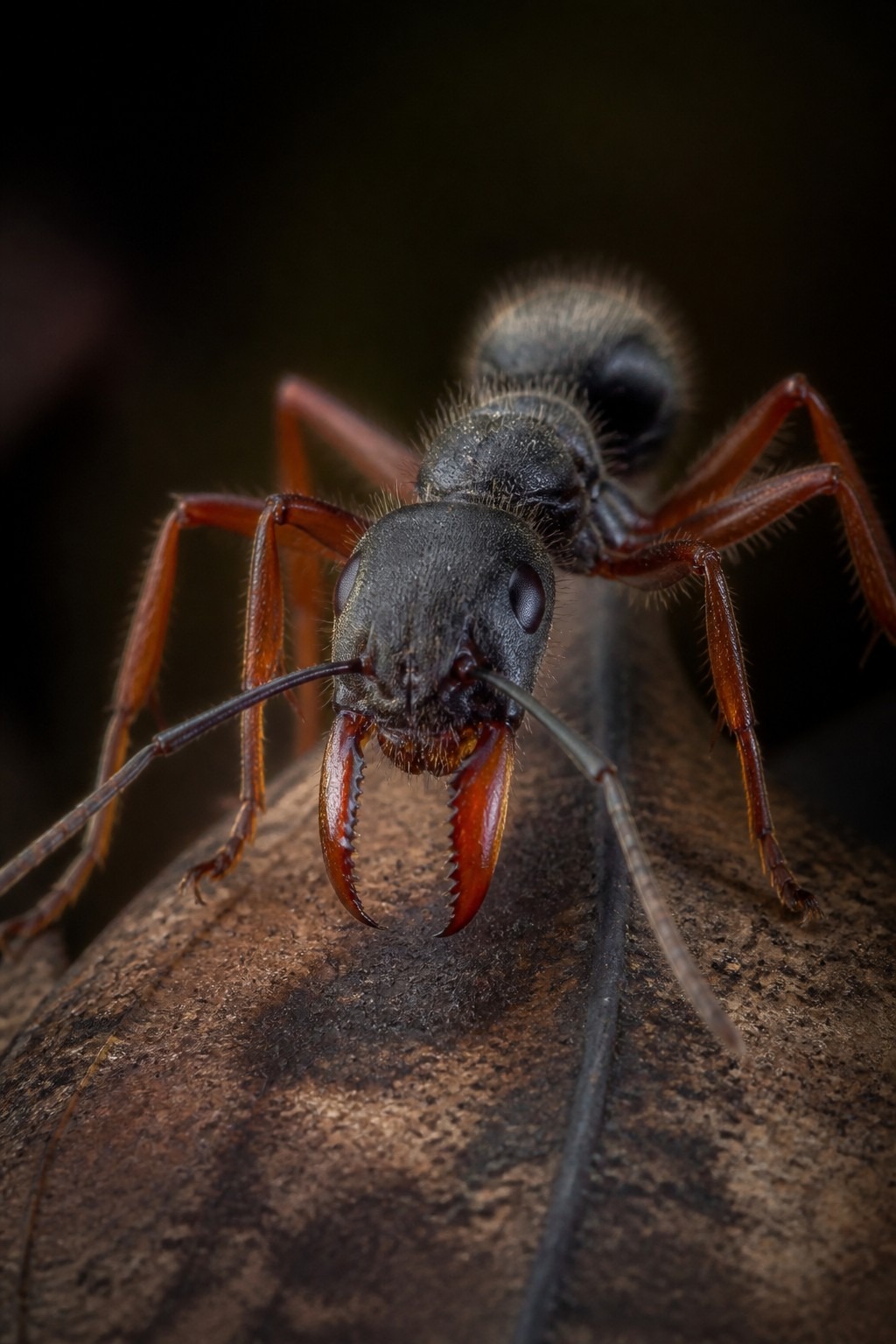
In 1986, two geneticists reported that the animal with the fewest chromosomes is a small, ferociously stinging ant from the eucalypt woodlands of south-eastern Australia — and the number they found still stops biologists mid-sentence. A male jack jumper ant (Myrmecia pilosula) carries a single chromosome. Not one pair. One. It is the entire hereditary blueprint for a functioning insect, packed onto a solitary strand of DNA, and it remains the lowest count ever documented in the animal kingdom.
Key Facts
- A male jack jumper ant (Myrmecia pilosula) carries a single chromosome — the lowest count documented in the animal kingdom.
- Female jack jumper ants are diploid with a single pair (two chromosomes); males are haploid with one.
- The record was reported in 1986 by Michael Crosland and Ross Crozier in a one-page paper in Science.
- Males arise from unfertilised eggs (haplodiploidy), so a male has a mother but no father and can sire daughters but never sons.
- Some roundworms — including Parascaris univalens and Diploscapter species — tie the record with a single chromosome pair.
In short: A male jack jumper ant (Myrmecia pilosula) has just one chromosome — the fewest of any animal, reported by Crosland and Crozier in Science in 1986. Females have a single pair (two). Because males hatch from unfertilised eggs via haplodiploidy, they have a mother but no father. Some roundworms tie the record with one chromosome pair.
One pair in her, one chromosome in him
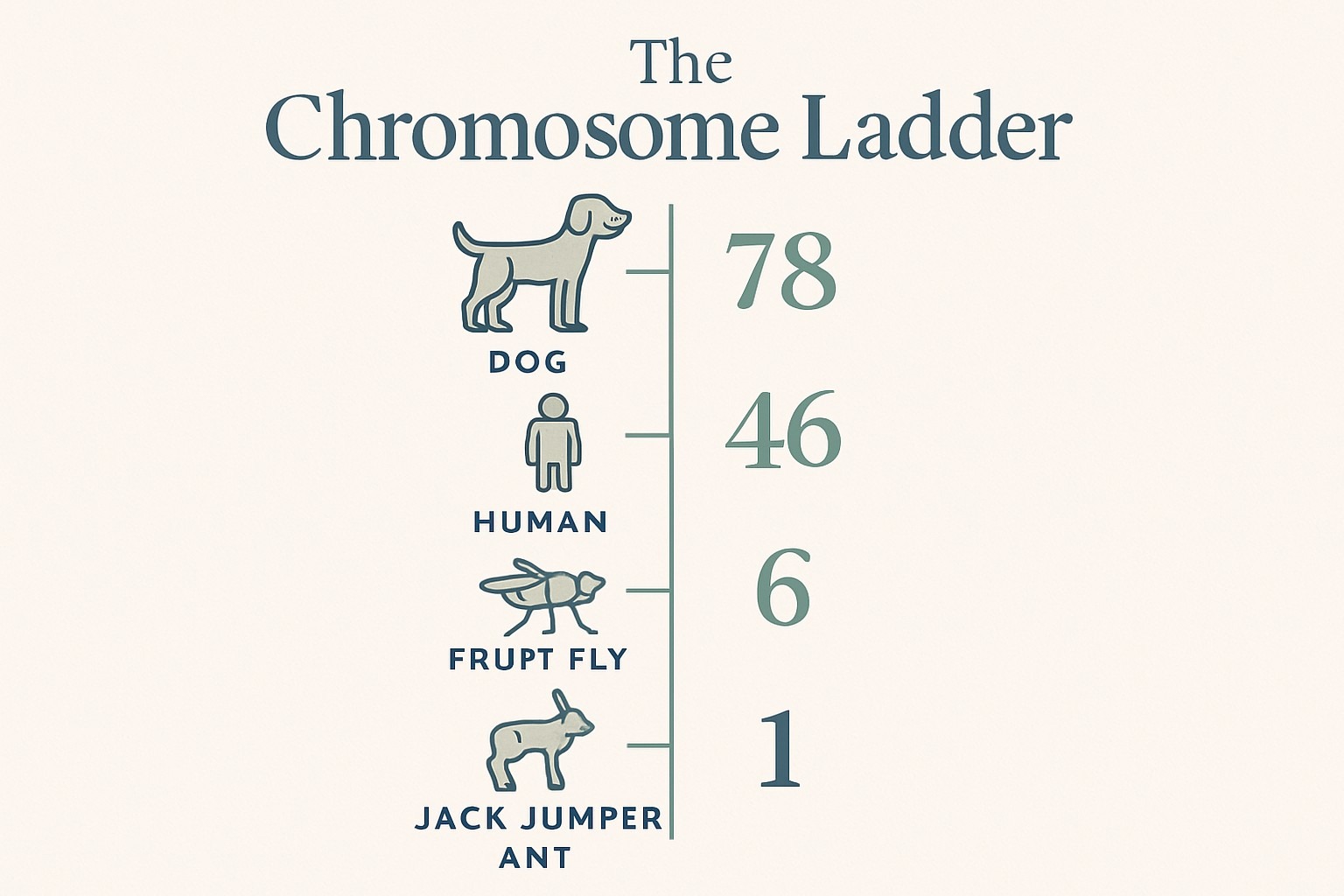
Start with the raw figures, because they are the whole story. A female jack jumper ant is diploid: her body cells hold a single pair of chromosomes, two in total. Her sons are haploid — their cells contain just one. For comparison, you are reading this with 46 chromosomes in nearly every cell of your body.
That gap is almost comic. A human genome is parcelled out across 23 pairs; a dog manages 39 pairs. This ant runs a complete animal — nervous system, venom glands, the famous leap that gives the species its name — off a genome divided into the smallest possible number of pieces. You cannot go lower than one and still have a chromosome to speak of.
The record belongs specifically to the male. Because he develops from an unfertilised egg, he never receives a second set, so his body cells are stuck at n=1. The female’s two are simply his one, doubled.
Haplodiploidy: a mother, no father, and no sons of his own
How does an animal end up with an odd, unpaired chromosome count in half its population? The answer is a reproductive system called haplodiploidy, shared across ants, bees and wasps. A fertilised egg becomes a female (diploid, two chromosomes here). An unfertilised egg becomes a male (haploid, one chromosome).
Follow that logic and something strange falls out. A male jack jumper has a mother but no father — he grew from an egg that was never fertilised. And because he passes on his single chromosome set only through his own sperm, and only daughters result from fertilised eggs, he can father daughters but never sons. He is, genetically, a dead end for the male line.
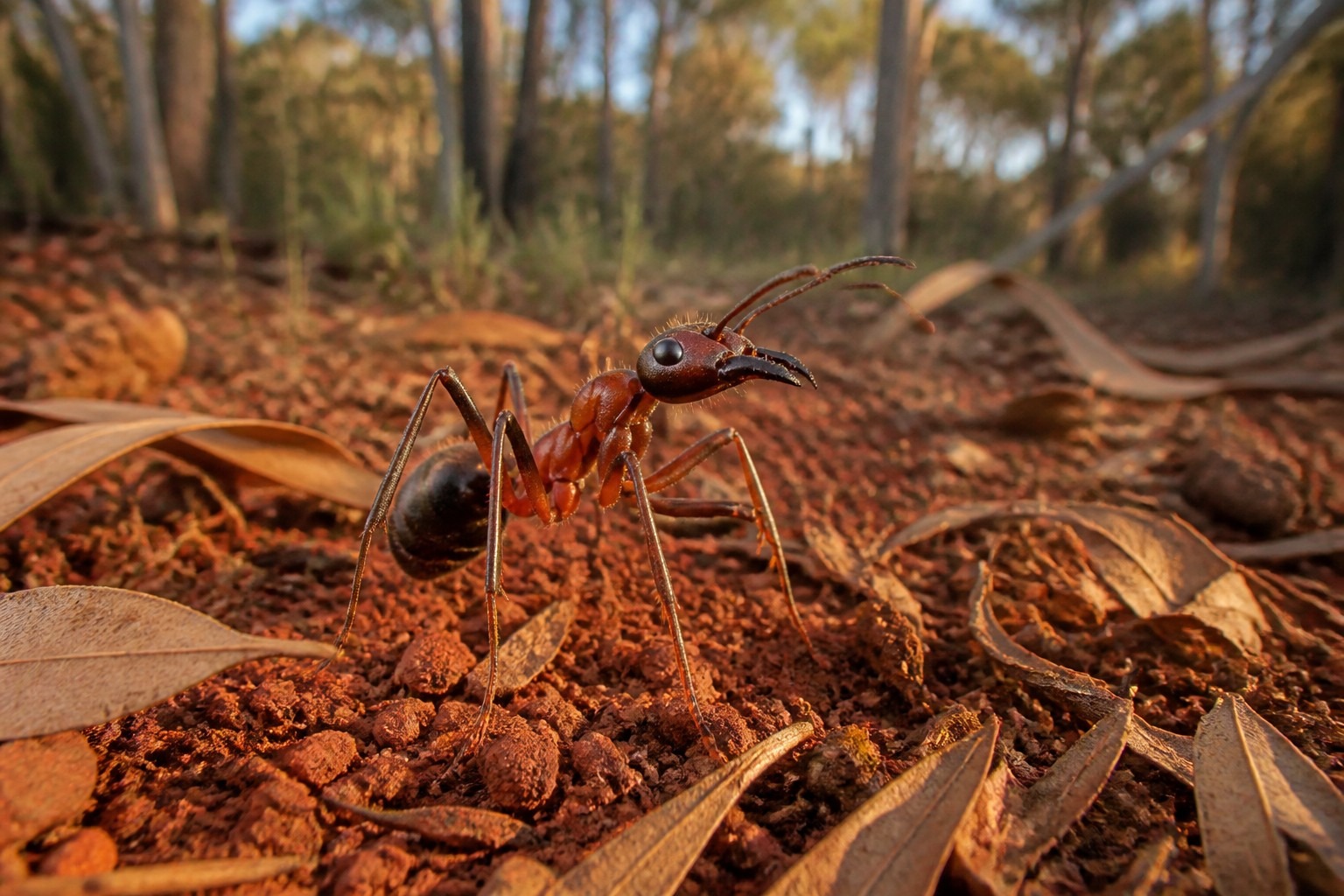
For a record so often trotted out as a pub fact, it is remarkably badly explained — most popular versions call it an “XY pair” or a “sex chromosome,” which it is not. Sex here isn’t set by a special chromosome at all. It’s set by whether the egg was fertilised. That distinction is the single most-mangled part of the whole story.
{IMAGE_2}
1986: the paper that crowned the animal with the fewest chromosomes
The discovery has a precise origin. In 1986, Michael W. J. Crosland and Ross H. Crozier published a one-page report in the journal Science — “Myrmecia pilosula, an Ant with Only One Pair of Chromosomes” — describing a population of jack jumpers whose workers carried a single pair. Using a staining method called C-banding, they confirmed the two chromosomes in females were genuinely a homologous pair, and that males held just one.
Name-checking that paper matters, because almost no popular article does. The finding wasn’t folklore or a rounding-down of some larger number; it was a peer-reviewed result, replicated since, and it turned an obscure Australian stinging ant into a fixture of genetics textbooks.
There’s a nice footnote to it. The true single-chromosome ant is now usually placed under the name Myrmecia croslandi — christened, years later, in honour of Crosland himself. The scientist who found the record ant ended up with the record ant named after him.
Not the only one at the bottom: the nematodes that tie
Here’s the correction almost every “fewest chromosomes” page misses: the ant does not hold the record alone. It shares the floor with a handful of roundworms.
The parthenogenetic nematode Diploscapter pachys, its relative Diploscapter coronatus, and the horse parasite Parascaris univalens all reach a single chromosome pair in their germline. In Diploscapter, that lone chromosome is thought to have formed when six ancestral chromosomes fused into one — and the worm appears to have lost the telomerase enzyme that normally caps chromosome ends, which may be why it couldn’t keep them separate.
So the honest headline is “co-record-holder,” not “the unique champion.” The jack jumper ant is the most famous n=1 animal and the one people mean when they ask the question — but among animals with a single chromosome, it has company.
A chromosome ladder: where humans, dogs and this ant sit
Numbers like these mean more on a ladder than in isolation. Chromosome count, it turns out, tells you almost nothing about how “advanced” or complex an organism is — the tally reflects the accidents of chromosome fusion and splitting, not sophistication. A fern can carry hundreds; this ant runs on one.
| Organism | Chromosomes (typical body cell) | Note |
|---|---|---|
| Dog | 78 | One of the higher mammal counts |
| Human | 46 | 23 pairs |
| Fruit fly (Drosophila) | 8 | Genetics’ favourite lab animal |
| Indian muntjac (female) | 6 | Lowest known in any mammal |
| Jack jumper ant (female) | 2 | A single pair |
| Jack jumper ant (male) | 1 | Fewest of any animal |
Note where the mammal record sits. The female Indian muntjac, a small Asian deer, gets down to six — and University of Vienna evolutionary biologists have studied it precisely because that is as low as mammals go. The ant undercuts it by a factor of six. Different rules apply to insects.
Why the record won’t hold still
The most interesting thing about this record is that it is a snapshot of something in motion. What Crosland and Crozier called Myrmecia pilosula turned out not to be one species at all, but a cluster of look-alike sibling species — the pilosula complex — that are almost impossible to tell apart by eye yet differ wildly in their chromosomes.
Across that complex, karyotypes run from a single chromosome up to around 16 pairs. Sibling ants that share a genus, a look and a habitat can differ tenfold in chromosome number. Biologists call this “rampant karyotype evolution”: chromosomes fusing together and splitting apart on a fast evolutionary clock, so the record of “one” is really the extreme low end of a genome that is actively rearranging itself.
- 1986 — Crosland & Crozier report a single pair of chromosomes in Science.
- 2015 — taxonomists formally split the jack-jumper “pilosula” into several distinct species, confirming a complex.
- 2024 — researchers establish the first primary cell cultures from the single-chromosome ant, Myrmecia croslandi, opening it to modern lab study.
That 2024 work is the freshest turn in the tale. Being able to grow the ant’s cells in culture means this 40-year-old curiosity is becoming a live research tool — a natural laboratory for how a genome behaves when it is squeezed onto as few chromosomes as physically possible.
Fewest chromosomes, not smallest genome — and the sting
One trap worth stepping around: “fewest chromosomes” is not the same as “smallest genome.” Chromosome count is how many packages the DNA is filed into; genome size is how many DNA letters — base pairs — there are in total. A creature can shove a large genome onto one chromosome, or spread a tiny genome across many. The jack jumper holds the packaging record, not the size record; those are separate contests, and conflating them is the second-most-common mistake about this animal.
And the chromosomes are not why most people have heard of it. In Australia — especially Tasmania — the jack jumper is notorious for a sting that can trigger severe allergic reactions in sensitive people, and it is the subject of ongoing venom-immunotherapy research there. The genetics made it famous among biologists; the sting made it famous among everyone else. (This article is about the science of its chromosomes, not medical guidance — anyone with sting-allergy concerns should speak to a clinician.)
Frequently Asked Questions
Which animal has the fewest chromosomes? The jack jumper ant, Myrmecia pilosula (the record-holding form is now often called Myrmecia croslandi). Males have a single chromosome; females have one pair. A few nematode roundworms tie the record at one chromosome pair.
Why do male jack jumper ants have fewer chromosomes than females? Because of haplodiploidy. Males hatch from unfertilised eggs and are haploid — one chromosome. Females hatch from fertilised eggs and are diploid — two. Sex is decided by fertilisation, not by a special sex chromosome.
Sources and notes
- Crosland, M. W. J. & Crozier, R. H. (1986). “Myrmecia pilosula, an Ant with Only One Pair of Chromosomes.” Science, 231(4743):1278.
- Guinness World Records — “Fewest chromosomes in an insect” (Myrmecia pilosula, male n=1).
- AntWiki — entries for the jack jumper ant, Myrmecia croslandi, and the Myrmecia pilosula species complex.
- Peer-reviewed literature on nematode chromosomes (Diploscapter pachys, Diploscapter coronatus, Parascaris univalens) and on primary cell cultures from Myrmecia croslandi (2024).
- University of Vienna, Department of Evolutionary Biology — research on the Indian muntjac, the lowest chromosome number among mammals.
Four decades after two geneticists filed a single page in Science, the ant with the fewest chromosomes still holds its record — no longer as a lonely oddity, but as the sharp edge of a genome caught in the act of rearranging itself. It is a useful reminder that nature does not measure life by the number of boxes it files its instructions into. One chromosome, doubled, and out walks an insect that hunts, leaps, stings and builds a colony. The wonder isn’t the smallness of the number. It’s how little the number turned out to matter.
Illustrations are AI-generated. Article fact-checked and human-edited. Our editorial standards.