Herto Skull: The 160,000-Year-Old Human, Explained
Two hundred. That is how many fragments a team had to reassemble to rebuild one child’s face, and that shattered skull turned out to be part of the story of the Herto skull, a 160,000-year-old human found in the Ethiopian desert. The pieces were scattered across roughly 400 square feet of eroding sediment, some of them cracked further by cattle that had trampled the site before anyone knew it was there. When the fragments finally came together, they showed the rounded braincase of a six-to-seven-year-old — anatomically one of us, and dead for more than a hundred and fifty millennia.
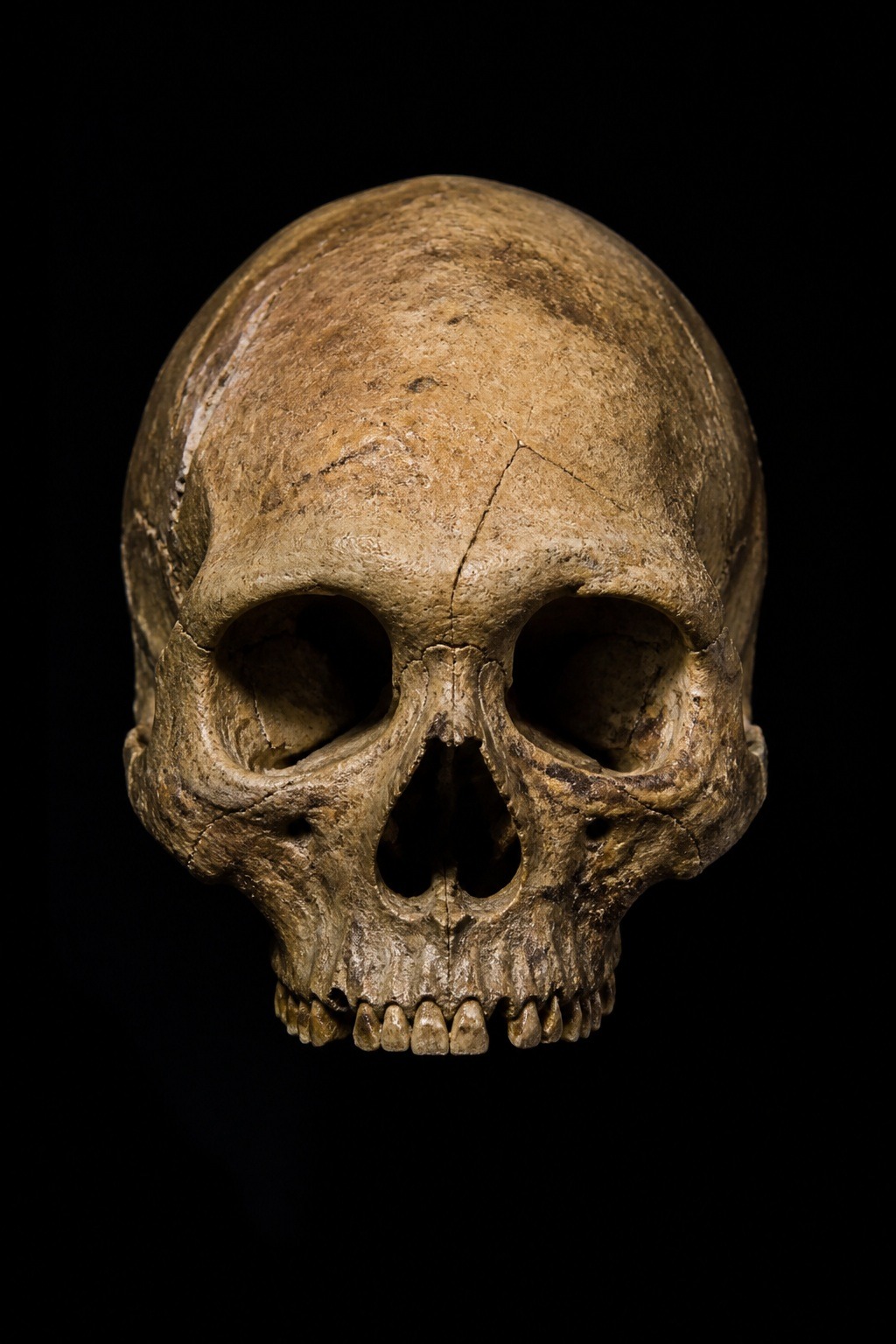
The short answer: The Herto fossils from Ethiopia, dated to 160,000–154,000 years ago, are among the oldest known skulls with a fully modern, globular human braincase — and they carry the earliest solid evidence of people handling and caring for the dead.
- 160,000–154,000 years — age of the Herto fossils (argon-argon dating of volcanic tuffs)
- 1,450 cc — braincase volume of the adult cranium BOU-VP-16/1
- ~200 fragments — pieces of the child skull (BOU-VP-16/5) painstakingly refitted
- 640+ — stone tools recovered from the surrounding sediments
- Nov 16, 1997 — the day the first bones were spotted eroding out of the ground
Key Facts
- The Herto fossils from Ethiopia are dated to 160,000-154,000 years ago via argon-argon dating of volcanic tuffs
- The adult cranium BOU-VP-16/1 has a braincase volume of about 1,450 cubic centimetres
- The child skull BOU-VP-16/5 was reassembled from roughly 200 fragments
- The first bones were spotted eroding out of the ground on 16 November 1997 near Herto Bouri in the Middle Awash region
- The discovery team proposed the subspecies name Homo sapiens idaltu in their 2003 Nature paper
In short: The Herto fossils from Ethiopia, dated to 160,000-154,000 years ago, are among the oldest known skulls with a fully modern globular human braincase. Led by Tim White and Berhane Asfaw, the find included polished, cut-marked bones that provide the earliest solid evidence of people handling and caring for the dead.
A child’s skull in 200 pieces

It started, as these things often do, with an animal. On 16 November 1997, a research team working the Middle Awash region of Ethiopia’s Afar Triangle spotted a butchered hippopotamus skull and a scatter of stone tools weathering out of the sediment near the village of Herto Bouri. Butchery marks and tools meant people. People meant it was worth digging.
What came out of that ground over the next field seasons was extraordinary: three well-preserved human skulls — two adults and the child — plus fragments of several more individuals. The excavation was led by paleoanthropologist Tim White of the University of California, Berkeley, working alongside Ethiopian paleoanthropologist Berhane Asfaw. The child’s cranium, catalogued BOU-VP-16/5, was the hardest to recover. Rain had partly exposed it, cattle had scattered it, and the team collected some two hundred fragments before rebuilding it by hand.
Here’s the thing about that reconstruction: the shape it revealed was not archaic. It was tall, rounded, high-vaulted — the braincase of a modern child.
160,000 years old: what the dating actually pinned down
How do you put an age on a skull with no birth certificate? Not by dating the bone directly. The team dated the rock instead. The Herto fossils were sandwiched between layers of volcanic tuff — compacted ash from ancient eruptions — and volcanic minerals contain a natural radioactive clock. Argon-argon dating measures the slow decay of potassium into argon gas trapped in those minerals, and the tuffs above and below the fossils returned ages that bracket the bones between roughly 160,000 and 154,000 years old.
That precision matters. A fossil floating in undated sediment is a curiosity; a fossil locked between two dated ash layers is evidence. And the date landed in exactly the spot the human family tree needed it most — inside a stubborn gap in the fossil record between about 100,000 and 300,000 years ago, a stretch where modern-looking skulls had been frustratingly scarce.
{IMAGE_2}
The Herto skull: a 160,000-year-old human, but not the oldest one
The best-preserved adult, BOU-VP-16/1, is the one you have probably seen photographed: a long, heavy cranium with a braincase volume of about 1,450 cubic centimetres — comfortably within the range of people alive today. Its vault is high and globular, its face relatively flat, its brow ridges reduced compared with older African forms like Bodo and Kabwe. By any reasonable measure, this is a Homo sapiens skull.
But it is a big, robust one. The Herto crania run slightly larger and heavier than the average modern head, enough that the discovery team proposed a new subspecies name in their 2003 paper in the journal Nature: Homo sapiens idaltu. “Idaltu” means “elder” in the Afar language. Writing a commentary in the same issue titled “Out of Ethiopia,” Christopher Stringer of London’s Natural History Museum framed the find as powerful support for the idea that our species arose in Africa and spread out from there.
For two decades, Herto wore an informal crown: the oldest anatomically modern human skull yet found. That crown no longer fits — and the reason it slipped is one of the most interesting things about the whole story.
Polished bone: the oldest handling of the dead
Look closely at the Herto skulls and you find something that has nothing to do with anatomy and everything to do with behaviour. Cut-marks — deliberate, made with stone tools — trace across the bone in patterns consistent with defleshing rather than butchery for food. The edges around the foramen magnum, the large opening where the spine meets the skull, are smoothed and polished. So are broad areas of the vault.
Bone does not polish itself. That sheen is the signature of repeated handling: skulls carried, touched, passed from hand to hand over a long period. The child’s cranium in particular shows the kind of wear you would expect from an object kept and revisited, not one buried and forgotten.
Archaeologists reach for an ethnographic parallel here, and it is a striking one. In parts of New Guinea, recorded into the twentieth century, communities kept and curated the skulls of their ancestors — cleaning, handling, and displaying them as part of mortuary ritual. The Herto bones look like the deep-time echo of exactly that behaviour. Which leads to the detail that tends to stop people cold: these were people who kept their children’s skulls, polished smooth by years of touch. They grieved in a way we can recognise.
Herto vs Jebel Irhoud: why “oldest” changed in 2017
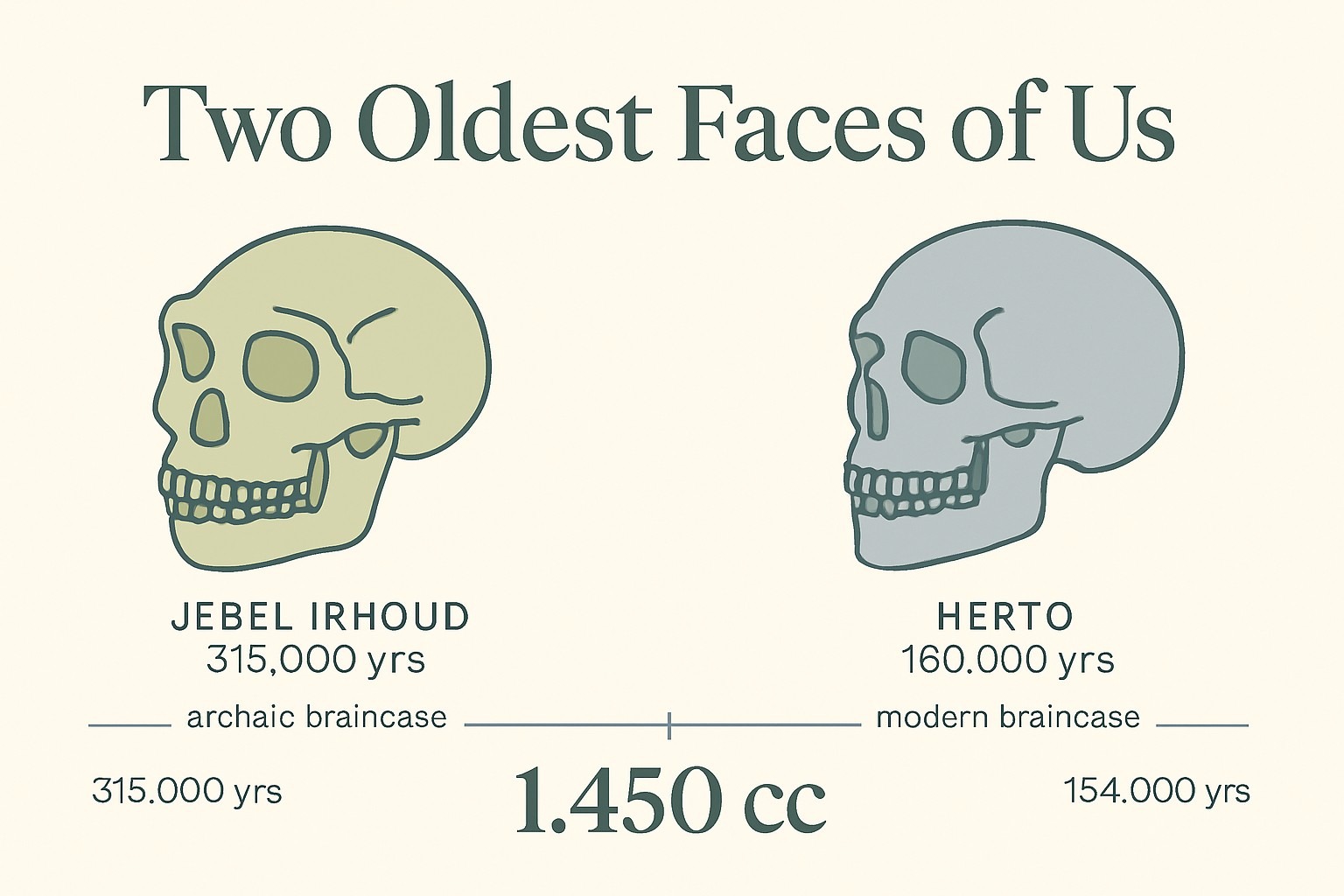
In 2017, a team led by Jean-Jacques Hublin of the Max Planck Institute for Evolutionary Anthropology published a bombshell in Nature. Fossils from Jebel Irhoud in Morocco, redated using thermoluminescence on heated flint tools, came in at around 315,000 years old — nearly twice Herto’s age. Overnight, the title of “oldest Homo sapiens” moved from Ethiopia to Morocco.
So is Herto now just a footnote? No — and understanding why makes the fossils more interesting, not less. The Jebel Irhoud people had a remarkably modern face, but the virtual cast of their braincase was long and low, closer to archaic humans than to us. Face shape modernised first; the rounded, globular braincase came later. Herto sits on the modern side of that transition. Jebel Irhoud sits on the archaic side of it.
| Herto (Ethiopia) | Jebel Irhoud (Morocco) | |
|---|---|---|
| Age | ~160,000–154,000 years | ~315,000 years |
| Face | Modern, flat | Modern, flat |
| Braincase shape | High, rounded, globular (modern) | Long, low, elongated (archaic) |
| Dated | 2003 (argon-argon) | 2017 (thermoluminescence) |
| Best claim to fame | Oldest fully modern skull shape + earliest mortuary handling | Oldest known Homo sapiens fossils |
Read that way, Herto’s real distinction is sharper than “oldest.” It is among the oldest skulls that looks fully like us from the inside out — and it comes bundled with the oldest strong sign of people treating their dead as something more than remains.
When fossils met mitochondrial Eve
There is a second reason the 160,000-year date mattered so much in 2003, and it comes from a completely different laboratory: genetics. By tracing mitochondrial DNA — the small loop of genetic material passed down the maternal line — researchers had estimated that all living humans share a common maternal ancestor, nicknamed “mitochondrial Eve,” who lived roughly 150,000 to 200,000 years ago in Africa.
Notice the overlap. A skull dated by volcanic rock to about 160,000 years, and a genetic clock pointing to 150,000–200,000 years, for a population in the same continent. Two entirely independent methods — one reading atoms in ash, the other reading mutations in DNA — converged on the same window. That kind of agreement is what turns a hypothesis into a working consensus, and Herto was a physical fossil sitting right where the molecules said it should be.
The idaltu subspecies that science quietly retired
Not every part of the original 2003 interpretation survived. The subspecies name idaltu — the idea that Herto was a distinct, slightly-archaic “elder” form transitional to fully modern humans — has quietly lost support.
In 2011, researchers Kaye Lubsen and Robert Corruccini published a morphometric re-analysis of BOU-VP-16/1. Using shape-based statistical methods, they found that the Herto cranium groups closely with Skhul 5, a Homo sapiens skull from Israel, and with living modern humans — not in an intermediate position between archaic forms like Kabwe and ourselves. Their conclusion was blunt: the data did not support treating Herto as a transitional morph, nor did it support the name idaltu. Later reassessments have leaned the same way, folding Herto into Homo sapiens proper.
Stripping away the subspecies label takes nothing away from these fossils; if anything, welcoming Herto fully into our own species makes the story bigger. This was not some almost-human cousin. It was a person, with a modern brain shape, who lived beside a shallow lake dammed by the Awash river — a landscape of hippos, crocodiles, catfish and buffalo — and who, with more than 640 obsidian and basalt tools, butchered game, and cared for the dead.
Common questions
Is the Herto skull the oldest human skull ever found? No. The oldest known Homo sapiens fossils are from Jebel Irhoud in Morocco, at about 315,000 years. Herto is younger, at 160,000–154,000 years, but it has a more fully modern braincase shape.
How was it dated to 160,000 years? Through argon-argon dating of volcanic ash layers above and below the fossils — a method that measures radioactive decay in volcanic minerals, not in the bone itself.
What is Homo sapiens idaltu? A subspecies name proposed in 2003 for the robust Herto skulls; “idaltu” means “elder” in the Afar language. Later morphometric studies found little support for it, and most researchers now classify Herto simply as Homo sapiens.
Why do the skulls look polished? The bone shows cut-marks from deliberate defleshing plus a smoothed, polished surface consistent with repeated handling — interpreted as an early mortuary practice, with ethnographic parallels in recorded New Guinea ancestor-skull rituals.
Sources and notes
- White, T.D., Asfaw, B., et al. (2003). “Pleistocene Homo sapiens from Middle Awash, Ethiopia.” Nature, vol. 423.
- Clark, J.D., et al. (2003). “Stratigraphic, chronological and behavioural contexts of Pleistocene Homo sapiens from Middle Awash, Ethiopia.” Nature, vol. 423.
- Stringer, C. (2003). “Out of Ethiopia.” Commentary in Nature, vol. 423 — Natural History Museum, London.
- Hublin, J.-J., et al. (2017). “New fossils from Jebel Irhoud, Morocco and the pan-African origin of Homo sapiens.” Nature, vol. 546 — Max Planck Institute for Evolutionary Anthropology.
- Lubsen, K. & Corruccini, R. (2011). “Morphometric Analysis of the Herto Cranium (BOU-VP-16/1): Where Does It Fit?” Journal of Contemporary Anthropology.
Fossils rarely get the last word. The crown of “oldest Homo sapiens” already jumped from Ethiopia to Morocco once, and the Afar sediments are still eroding, still surrendering bone. What Herto pinned down was subtler and, in a way, more durable than a date: the moment when a modern-shaped mind looked at death and refused to simply walk away from it. Whatever gets dug up next, that particular record — of grief made visible in polished bone — is the one worth watching.
Frequently Asked Questions
Q: How were the Herto fossils dated to 160,000 years old?
The bones themselves were not dated directly. The Herto fossils were sandwiched between layers of volcanic tuff, and volcanic minerals contain a natural radioactive clock. Argon-argon dating measures the decay of potassium into argon gas trapped in those minerals. The tuffs above and below the fossils returned ages that bracket the bones between roughly 160,000 and 154,000 years old, locking them into a dated sequence.
Q: What does the subspecies name Homo sapiens idaltu mean?
The Herto crania run slightly larger and heavier than the average modern head, enough that the discovery team proposed a new subspecies name in their 2003 paper in the journal Nature: Homo sapiens idaltu. The word ‘idaltu’ means ‘elder’ in the Afar language. In a commentary in the same issue titled ‘Out of Ethiopia,’ Christopher Stringer framed the find as support for an African origin for our species.
Q: What evidence shows the Herto people cared for their dead?
The skulls carry deliberate cut-marks made with stone tools in patterns consistent with defleshing rather than butchery for food. The edges around the foramen magnum and broad areas of the vault are smoothed and polished. Bone does not polish itself; that sheen is the signature of repeated handling over a long period. Archaeologists compare it to communities in New Guinea who kept and curated ancestors’ skulls into the twentieth century.
Q: Who led the excavation of the Herto skulls?
The excavation was led by paleoanthropologist Tim White of the University of California, Berkeley, working alongside Ethiopian paleoanthropologist Berhane Asfaw. Their team worked the Middle Awash region of Ethiopia’s Afar Triangle after spotting a butchered hippopotamus skull and stone tools weathering out of the sediment near the village of Herto Bouri. Over several field seasons they recovered three well-preserved skulls plus fragments of several more individuals.
Illustrations are AI-generated. Article fact-checked and human-edited. Our editorial standards.