How Did the Moai Statues Move? They Walked
In 1919, when the English archaeologist Katherine Routledge asked the people of Rapa Nui how did the moai statues move from the quarry to the coast, she wrote down an answer that scholars would file under folklore for the better part of a century: the statues walked. Not rolled. Not dragged. Walked — upright, rocking down the road on their own wide stone feet. A hundred and six years later, a team armed with 3D models, 962 catalogued statues and a 4.35-tonne replica has arrived at the same one-word answer. It turns out the islanders were being literal.
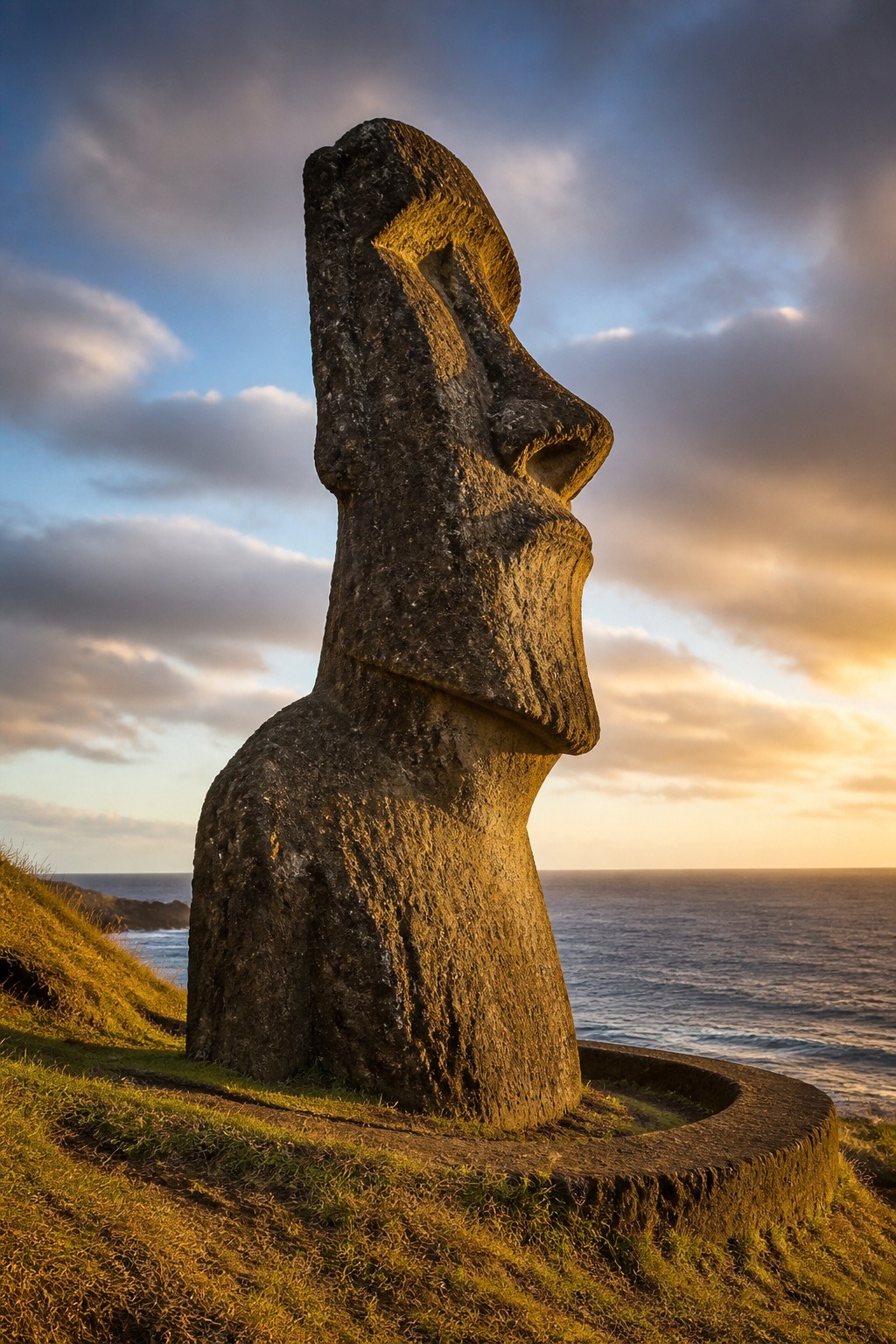
Key Facts
- In 2012, Terry Hunt and Carl Lipo walked a 4.35-tonne concrete replica moai 100 metres in 40 minutes using 18 people split into three teams
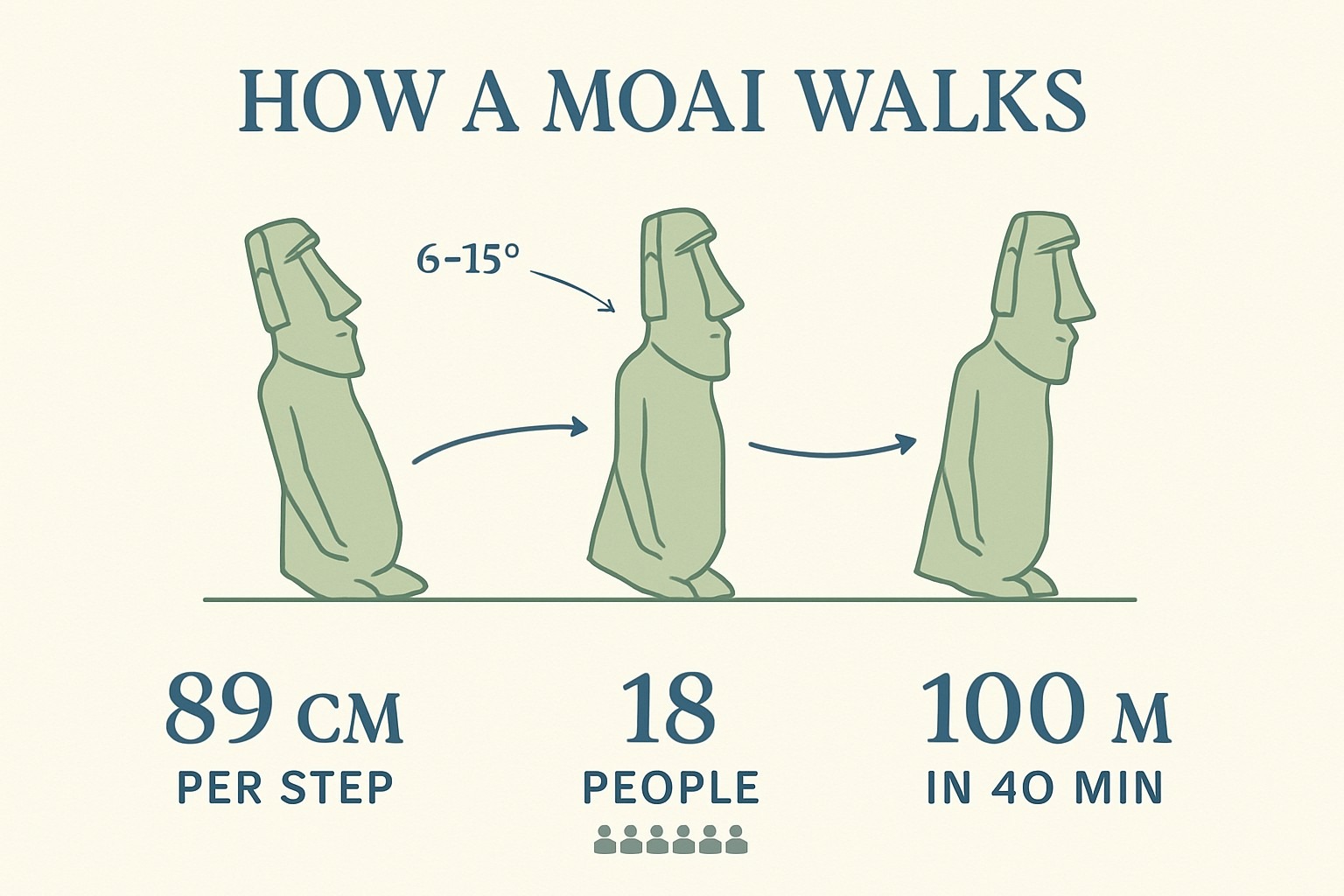
- Each rocking oscillation advances a statue by an average step of about 89 centimetres (roughly 35 inches)
- Crossing a 10-kilometre road requires on the order of 11,000 oscillations
- Lipo and Hunt analysed all 962 known moai, focusing on the 62 found along the transport roads
- The full ‘walking moai’ validation was published in the Journal of Archaeological Science in November 2025
In short: Research by Terry Hunt and Carl Lipo confirms the Rapa Nui oral tradition that moai statues ‘walked’ to their platforms. In 2012 they rocked a 4.35-tonne replica 100 metres in 40 minutes with 18 people, and a November 2025 paper analysing 962 statues showed road moai were engineered to walk upright.
How did the moai statues move? The answer sat in plain sight for a century
Routledge led the Mana Expedition, the first proper archaeological survey of Easter Island, from 1913 to 1915. Her notebooks recorded an old woman who was said to have “moved the images by supernatural powers — mana — ordering them about at her will.” The statues, the tradition insisted, had gone to their platforms upright and under their own power.
Western scholars heard a fairy tale. After European contact in 1722, the practical knowledge of how the moai were transported had faded from living memory on the island, and outsiders assumed the “walking” stories were myth filling the gap. So the search for a “real” mechanism — logs, sledges, ramps — began. For most of the twentieth century, the islanders’ own testimony was treated as the one explanation not worth testing.
That was the mistake. The oral tradition was not a metaphor. It was a maintenance manual, badly misread.
How were the moai moved without wheels? The theories that took over
Rapa Nui had no wheels, no draft animals, and no metal. That left human muscle and rope, and for decades the assumed method was horizontal. In his expeditions of 1955–56, the Norwegian explorer Thor Heyerdahl had islanders lash a ten-tonne moai onto its back on a wooden sledge and haul it flat — the “lie it down and drag it” model that would dominate textbooks.
Others reached for logs. The best-known version held that crews laid the statues on their sides across timber rollers and pushed. That image did more than explain transport; it seeded a whole morality tale. If every giant statue demanded a forest’s worth of rollers, then Rapa Nui must have felled its palms into oblivion to feed its own monuments — the classic “ecocide” story of a society that consumed itself.
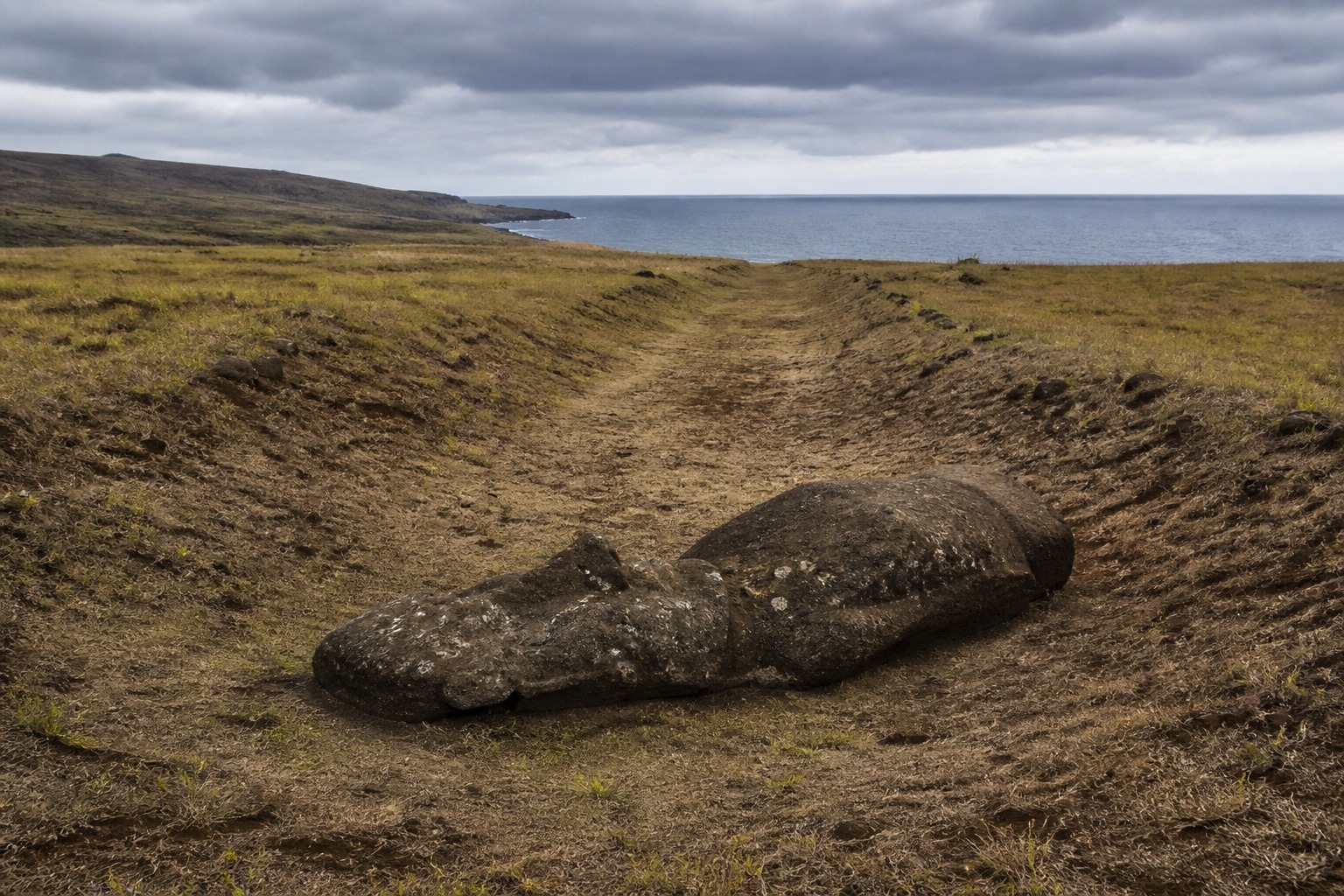
The trouble was the evidence on the ground. Statues abandoned along the ancient roads lie face-down or face-up in ways a careful sledge crew would never leave them. And the road moai are shaped wrong for lying flat — top-heavy, pot-bellied, tilted forward. Nobody designs a sledge cargo to fall over.
- c. 1250–1600 — Moai carved at the Rano Raraku quarry and moved across the island.
- 1722 — First European contact; visitors find statues already standing on their platforms.
- 1919 — Katherine Routledge publishes The Mystery of Easter Island, recording the tradition that the moai “walked.”
- 1955–56 — Thor Heyerdahl’s expedition tests horizontal sledge transport.
- 2012 — Terry Hunt & Carl Lipo walk a 4.35-tonne replica 100 m in 40 minutes with 18 people.
- Nov 2025 — Lipo & Hunt publish the full “walking moai” validation in the Journal of Archaeological Science.
2012: the experiment that walked a statue in 40 minutes
Archaeologists Terry Hunt, now at the University of Arizona, and Carl Lipo of Binghamton University decided to stop arguing and start pulling. In a 2012 field experiment filmed for National Geographic, they cast a 4.35-tonne concrete replica of a road moai, wrapped ropes around its head, and split eighteen people into three teams: one pulling left, one pulling right, and one steadying from behind.
The rhythm did the work. Pull right, and the statue rocks onto one edge of its curved base and swings a foot forward. Pull left, and it swings the other. Add the back rope to keep it from tipping, and the whole multi-tonne mass advances in a rolling zig-zag — a stone giant swaggering downhill. The replica covered 100 metres in 40 minutes.
“Once you get it moving, it isn’t hard at all — people are pulling with one arm,” Lipo told Binghamton University. “It conserves energy, and it moves really quickly.” No logs were harmed. No forest was required.
{IMAGE_2}
89-centimetre steps and 11,000 rocks to the sea
The 2025 paper turned that demonstration into numbers. Each rock of the statue advances it by an average step of about 89 centimetres — roughly 35 inches, the stride of a tall man. To cross a 10-kilometre road, an average moai needs on the order of 11,000 of those oscillations. Eleven thousand deliberate, coordinated heaves, each one a small controlled fall caught by rope.
How long is that walk? Here is one way to feel it. At the pace Hunt and Lipo actually demonstrated — 100 metres every 40 minutes — a 10-kilometre road works out to roughly 65 hours of active rocking (that figure is our arithmetic on their measured pace, not a claim from the paper). The researchers themselves, factoring in real working days, estimate that the longest transport roads on the island — 20 to 25 kilometres — would have taken a crew somewhere between 10 and 14 days.
Days. Of a stone figure the weight of three cars, shuffling toward the horizon a yard at a time, in full view of everyone. That is not a construction project hidden in a forest. It is a public performance.
Why the statues were shaped to walk
This is the part the old log-and-sledge models could never account for, and it is the heart of the case. The moai still standing along the roads are not scaled-down versions of the finished statues on the coast. They are a distinct engineering type. Analysing all 962 known moai and focusing on the 62 found along the transport roads, Lipo and Hunt found the road statues share three deliberate features: a wide, D-shaped base, a heavy forward lean of roughly 6 to 15 degrees, and — tellingly — no carved eye sockets.
The lean is the machine. Tilt a top-heavy object forward and its centre of mass sits ahead of its base, so it behaves like an inverted pendulum: rock it side to side and it wants to fall forward, step by step, while the base’s curved edge keeps catching it. The statue is not a load being moved. The statue is the tool that moves itself.
And the missing eyes? On the coastal platforms, the finished moai have deep, carved eye sockets that once held white coral and stone pupils. The road statues have blank faces because the eyes — and the final upright posture — were cut only after arrival. The forward tilt that made walking possible was carved away at the destination, standing the statue upright and giving it its face. The moai reached the coast leaning like a runner mid-stride, then were finished into gods.
The roads built for giants — and the statues that fell along them
You do not walk a five-metre monolith down a goat track. The Rapa Nui transport roads are engineered surfaces, about 4.5 metres wide, and — crucially — many have a concave, dished cross-section rather than a flat or crowned one. A concave road cradles the rocking base, nudging a tipping statue back toward centre. The road is not merely a path the moai travelled; it is part of the mechanism, a stone rail shaped to keep a swaying giant from toppling.
Which brings us to the strongest evidence of all — the failures. Scattered along these roads are moai lying where they fell, face-down on downhill slopes, face-up on the uphill ones. For a century these were “the abandoned statues,” a mystery of interrupted labour. Read through the walking hypothesis, they stop being a mystery: they are exactly what a walk gone wrong leaves behind. A crew loses the rhythm, the pendulum over-swings, and 12 tonnes goes down in the direction it was leaning. The fallen road moai are not a puzzle against the theory. They are its crash-test data.
What the 2025 study settles — and what it doesn’t
The most far-reaching consequence is about people, not physics. Because the walking method exploits the statue’s own balance, it needs shockingly few hands: the study estimates 15 to 60 people to get a moai moving, and as few as 5 to 25 to keep it going. That quietly dismantles the old picture of thousands of labourers and a society working itself to ruin to haul stone gods across the land. Fewer workers, less timber, no ecological suicide required — the walking statues carry away a good deal of the “collapse of Rapa Nui” myth on their backs. On the weight of the road evidence and the successful replica walks, the horizontal-transport models now look like the genuinely harder story to defend.
None of which means the file is closed. Lipo and Hunt frame their 2025 paper explicitly as a response to critics, and critics remain. Some researchers argue the replica trials scale up imperfectly to the largest coastal moai, which dwarf the 4.35-tonne test piece. Others hold that more than one method may have been used across the island’s 500-plus years of statue-building. Honest reading of the field: walking is now the best-supported explanation for the road statues in particular, but “best-supported” is not “unanimous,” and the very biggest moai still invite argument.
What has genuinely changed is who gets believed. For a hundred years, the islanders’ own account was the one hypothesis nobody bothered to test. The physics finally caught up to the oral tradition — a reminder that “myth” is sometimes just knowledge waiting for the right experiment. For more on the island’s other puzzles, see our feature on the ancient mysteries of Easter Island and the walking moai.
Questions Readers Ask
How many people did it take to move a moai? Far fewer than the old “hundreds of slaves” picture. The 2025 study estimates 15 to 60 people to start a statue rocking and as few as 5 to 25 to sustain the motion, depending on the moai’s size.
Did the moai really walk? Upright, yes — in a rocking, zig-zag motion powered by ropes, not on legs. A 4.35-tonne replica was walked 100 metres in 40 minutes with 18 people, matching the islanders’ own long-dismissed oral tradition.
Sources and Notes
- Carl P. Lipo & Terry L. Hunt, “The Walking Moai Hypothesis: Archaeological Evidence, Experimental Validation, and Response to Critics,” Journal of Archaeological Science, November 2025.
- Binghamton University News (October 2025) — official write-up and Carl Lipo interview.
- Terry Hunt & Carl Lipo, 2012 National Geographic field experiment (4.35-tonne replica walked 100 m in 40 minutes).
- Katherine Routledge, The Mystery of Easter Island (1919), recording Rapa Nui oral tradition of the walking statues.
- Thor Heyerdahl, Norwegian Archaeological Expedition to Easter Island (1955–56), sledge-transport trials.
A hundred years is a long time to wait for a hypothesis. The people of Rapa Nui told the first archaeologists exactly how their ancestors moved the moai, and were politely ignored because the truth sounded too much like magic. There is a quiet lesson in that stone. Before we reach for the exotic explanation — lost technology, vanished forests, tragic collapse — it is worth asking whether the people who were actually there already told us, and whether we simply hadn’t yet learned how to listen.
Frequently Asked Questions
Q: How did the moai statues actually move?
They were walked upright, rocked from side to side on their wide curved stone bases rather than dragged or rolled on logs. Teams pull ropes wrapped around the statue’s head: pull right and it rocks onto one edge and swings a foot forward, pull left and it swings the other way, while a back rope keeps it from tipping. The multi-tonne mass advances in a rolling zig-zag, matching the Rapa Nui tradition that the statues ‘walked.’
Q: What did the 2012 experiment prove?
Archaeologists Terry Hunt and Carl Lipo cast a 4.35-tonne concrete replica of a road moai, wrapped ropes around its head, and split eighteen people into three teams: one pulling left, one pulling right, and one steadying from behind. The rhythm did the work, and the replica covered 100 metres in 40 minutes. No logs were harmed and no forest was required, undercutting the older log-roller theories and the ‘ecocide’ story tied to them.
Q: How long would it take to walk a moai across the island?
The 2025 paper turned the demonstration into numbers. Each rock advances a statue by about 89 centimetres, and crossing a 10-kilometre road needs on the order of 11,000 oscillations. At the demonstrated pace of 100 metres every 40 minutes, a 10-kilometre road works out to roughly 65 hours of active rocking. Factoring in real working days, the researchers estimate the longest roads of 20 to 25 kilometres would have taken a crew between 10 and 14 days.
Q: How do we know the statues were built to walk?
Analysing all 962 known moai and focusing on the 62 found along the transport roads, Lipo and Hunt found the road statues share three deliberate features: a wide, D-shaped base, a heavy forward lean of roughly 6 to 15 degrees, and no carved eye sockets. These road statues are a distinct engineering type, not scaled-down versions of the finished coastal statues. The forward lean is the machine that makes rocking-walking work, which log-and-sledge models could never explain.
Illustrations are AI-generated. Article fact-checked and human-edited. Our editorial standards.