The 40-Minute Onion Secret French Cooks Guard Closely
Nobody set a timer. That’s how French home cooks knew it was done — by smell, by color, by the way the onions collapsed into something that bore almost no resemblance to what went into the pan forty minutes earlier. And most people cooking at home have never actually waited that long.
Walk into a Lyon kitchen on a cold Tuesday and you’ll smell it before you see it: that low, sweet, almost smoky perfume that means someone’s been standing at the stove, unhurried, doing the one thing modern cooking keeps trying to skip. It’s not complicated. It’s just slow. And French cooks have understood something about that slowness for centuries — something food chemistry eventually caught up to explain.
Key Facts
- Onions are roughly 5 percent sugar by weight, and slow heat triggers the Maillard reaction first described by French physician Louis-Camille Maillard in 1912.
- A raw onion is about 89 percent water and loses approximately 75 percent of its volume during caramelization, so one pound yields roughly one cup.
- The Maillard reaction produces over 1,000 distinct chemical compounds in cooked food.
- Onions have been cultivated for at least 5,000 years, with ancient Egyptians burying them with pharaohs as symbols of eternal life.
- France’s soupe a l’oignon recipes from the 18th century call for onion cooking times of 45 minutes to a full hour.
In short: The caramelized onions technique relies on slow, medium-low heat that lets sugars and the Maillard reaction transform onions over 40 minutes to an hour. Onions are about 5 percent sugar and 89 percent water, losing roughly 75 percent of their volume, a method French cooks perfected centuries before chemistry explained it.
Why Caramelized Onions Technique Defies Every Shortcut
Onions are roughly 5% sugar by weight — glucose, fructose, sucrose, all of it locked inside each crisp layer. Apply heat slowly and those sugars don’t just melt. They trigger the Maillard reaction, a cascading series of chemical interactions first systematically described by French physician Louis-Camille Maillard in 1912. Food scientist Harold McGee has spent considerable ink explaining how this single reaction produces hundreds of distinct flavor compounds. But the reaction has one condition it will not negotiate on.
You can’t rush it.
Crank the heat and the water inside the onion evaporates too fast. The sugars scorch instead of transform. You get bitter, not sweet. Dark, not golden. The whole point collapses in about ninety seconds of impatience — which is roughly how long most people wait before deciding the heat needs to go up.
French Cooks Knew Something Chemistry Later Confirmed
Long before anyone could name the Maillard reaction, French home cooks in Lyon — a city so food-obsessed it earned the title “gastronomic capital of the world” — had worked out the formula through sheer repetition. The classic soupe à l’oignon, that bubbling crock of broth, beef, and melted cheese, depends entirely on onions cooked low and slow for sometimes a full hour. The dish isn’t famous because of the broth.
It’s famous because of what the onions become.
And if you’re curious how other ancient food traditions quietly shaped entire cultures, this-amazing-world.com has stories that’ll genuinely surprise you. There’s something almost meditative about the caramelized onions technique. You can’t multitask your way through it. The onions demand attention — not constant attention, but present attention. Every few minutes, a stir. A check. A small adjustment of the flame. It asks something of you that most modern cooking has quietly stopped asking.
The Humble Onion Hides a Surprisingly Deep History
It is 3000 BC, roughly. Someone in the ancient Near East is cooking onions over a fire, and they have no idea they’re participating in a ritual that will still be happening five thousand years later in professional kitchens across France.
Onions have been cultivated for at least 5,000 years. Ancient Egyptians considered them sacred — burying them with pharaohs as symbols of eternal life, largely because of those concentric rings that just keep going inward. Roman soldiers ate them for strength. Medieval European peasants relied on them as one of the few affordable flavor sources available year-round. The caramelized onions technique we’re talking about, that specific slow-cook method, represents the absolute peak of what human ingenuity could coax from an ingredient that cost almost nothing and grew almost everywhere.
Centuries of standing over a fire to discover what a cheap vegetable could become. That last fact kept me reading for another hour.
What’s Actually Happening Inside the Pan
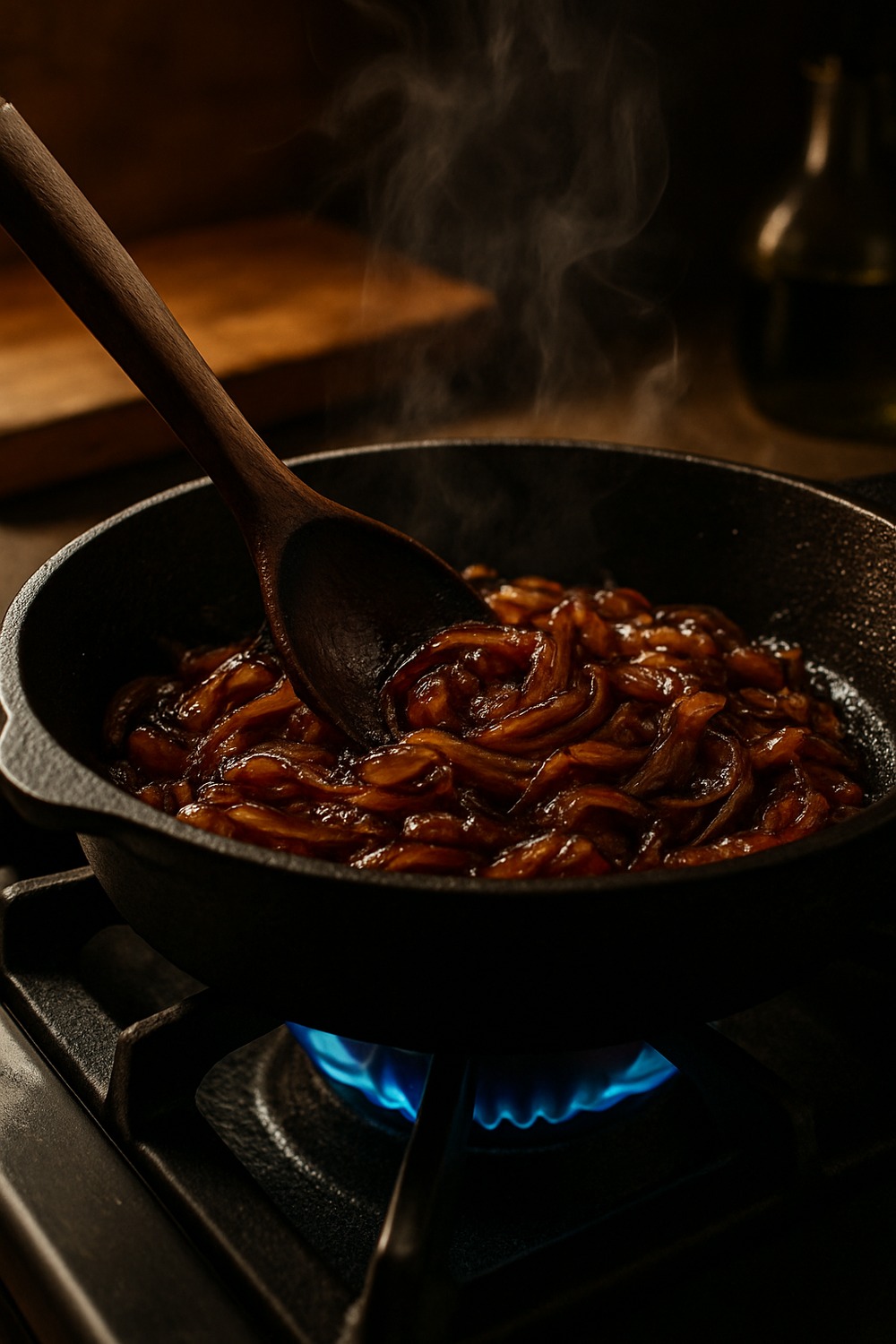
Here’s the thing: caramelization and the Maillard reaction are actually two separate processes unfolding simultaneously in your skillet, which most recipes don’t bother to mention. Caramelization is purely sugar breaking down — it begins around 320°F for fructose, slightly higher for glucose and sucrose. The Maillard reaction involves amino acids reacting with those same sugars, producing the brown color and that specific deep, savory-sweet complexity that makes people describe caramelized onions as tasting somehow more than the sum of their parts. You need both to happen at once. Medium-low heat, steady and patient, is the only temperature that lets both processes unfold without burning one out before the other even gets started.
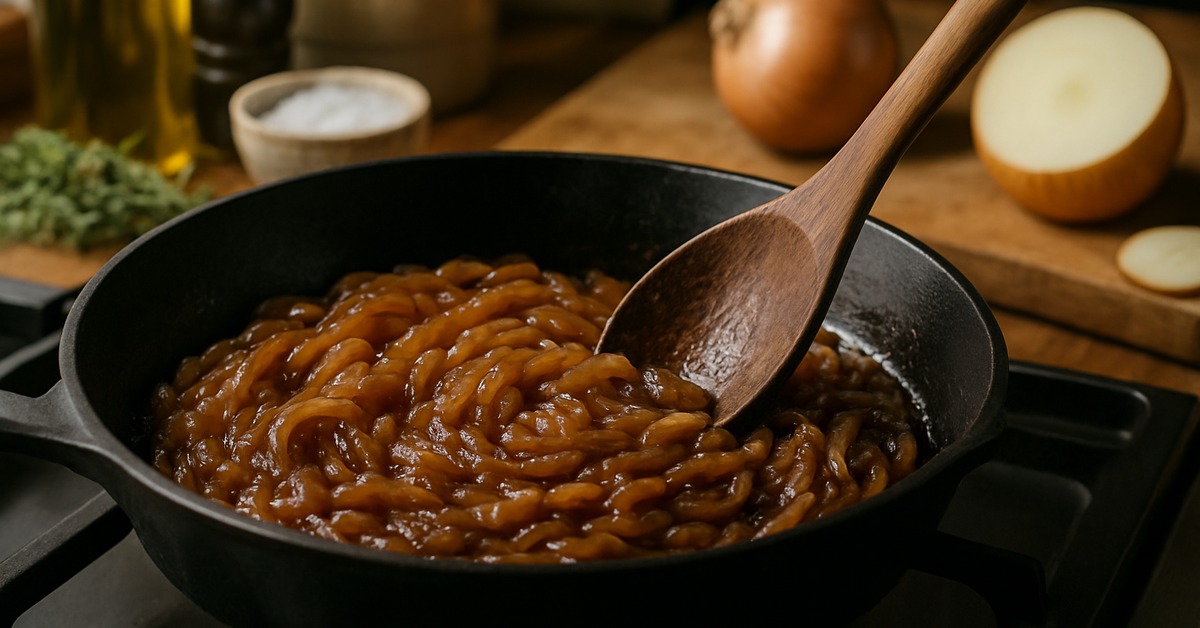
A raw onion is about 89% water. As it cooks, that water evaporates steadily, and the onion physically shrinks to roughly a quarter of its original volume. A full pound of raw onions becomes about a cup of finished caramelized onions.
Every spoonful is carrying the essence of the whole pile.
By the Numbers
- 5,000 years of cultivation, with evidence found in Bronze Age settlements across Asia and the Middle East (Oxford Food Symposium, 2002).
- A raw onion loses approximately 75% of its volume during full caramelization — one pound of sliced onions yields roughly one cup of finished product.
- The Maillard reaction produces over 1,000 distinct chemical compounds in cooked food. Many of those compounds are specifically why humans associate certain smells with comfort and home cooking — it’s not nostalgia. It’s chemistry triggering memory.
- France’s soupe à l’oignon became internationally recognized in the 18th century, and recipes from that period call for onion cooking times of 45 minutes to one full hour — nearly identical to what any serious cook will tell you today.
Field Notes
- Baking soda speeds browning dramatically — raises the pH, accelerates the Maillard reaction, and also turns the texture slightly mushy, which is exactly why most French cooks won’t touch it.
- The sugar in onions isn’t evenly distributed. The outermost layers tend to be slightly more pungent and less sweet, while the inner layers closer to the core carry higher concentrations of fructose. Some professional cooks actually reserve the innermost rings specifically for caramelizing and use the outer layers for raw applications — a level of precision most home cooks never know to think about.
- Roman cookbook writer Apicius referenced slow-cooked onions in sauces in the 1st century AD.
- Which means the principle of cooking alliums low and slow for sweetness predates French cuisine by well over a thousand years.
Why This Ancient Kitchen Ritual Still Matters
In an era of air fryers and pressure cookers and seventeen-tab recipe rabbit holes promising dinner in under fifteen minutes, the caramelized onions technique stands as something genuinely stubborn. It can’t be hacked. It can’t be meaningfully shortened without losing the thing that makes it worth doing. And that’s precisely why it keeps reappearing, generation after generation, in kitchens from Lyon to Los Angeles.
There’s a category of flavor that only time creates.
No technology has figured out how to replicate it without putting in the minutes, because the minutes are structural — they’re not waiting time, they’re the actual mechanism. And maybe that’s why people feel something when they stand over a pan of slowly browning onions. It connects you physically, sensory, almost ancestrally, to every person who’s done the same thing over an open flame for the last five thousand years. That smell isn’t just dinner. It’s a thread running backward through human history, through pharaohs and Roman soldiers and peasants and Lyon grandmothers who never wrote anything down because they didn’t need to.
The 40-minute wait isn’t a flaw in the recipe. It is the recipe. Some things can’t be rushed without being ruined, and the patience the process demands is inseparable from why the result tastes like it does. Stand at the stove. Stir now and then. Watch something plain become something that fills a room. That’s the oldest cooking lesson there is — and nobody’s improved on it yet. There’s more at this-amazing-world.com, and the next one is even stranger.
Frequently Asked Questions
Q: Why does the caramelized onions technique take 40 minutes or more?
Caramelization and the Maillard reaction must both unfold without burning one process out before the other starts, and only steady medium-low heat allows that. Crank the heat and the onion’s water evaporates too fast, scorching the sugars into something bitter rather than sweet. French soupe a l’oignon recipes from the 18th century already called for 45 minutes to a full hour, nearly identical to what serious cooks recommend today.
Q: What is actually happening chemically when onions caramelize?
Two separate processes run simultaneously. Caramelization is sugar breaking down, beginning around 320 degrees Fahrenheit for fructose. The Maillard reaction, first described by French physician Louis-Camille Maillard in 1912, involves amino acids reacting with those sugars to produce brown color and deep savory-sweet complexity. The reaction can generate over 1,000 distinct chemical compounds, many of which humans associate with comfort and home cooking.
Q: How much do onions shrink when caramelized?
A raw onion is about 89 percent water, and as it cooks that water evaporates steadily. The onion loses approximately 75 percent of its volume, shrinking to roughly a quarter of its original size. A full pound of raw sliced onions reduces to about one cup of finished caramelized onions, which is why every spoonful carries the concentrated essence of the whole pile.
Q: How old is the practice of slow-cooking onions for sweetness?
Onions have been cultivated for at least 5,000 years, with evidence found in Bronze Age settlements across Asia and the Middle East. Ancient Egyptians considered them sacred and buried them with pharaohs as symbols of eternal life. Roman cookbook writer Apicius referenced slow-cooked onions in sauces in the 1st century AD, meaning the principle of cooking alliums low and slow predates French cuisine by well over a thousand years.
Illustrations are AI-generated. Article fact-checked and human-edited. Our editorial standards.