A Child and a Wolf Walked Chauvet Cave 26,000 Years Ago
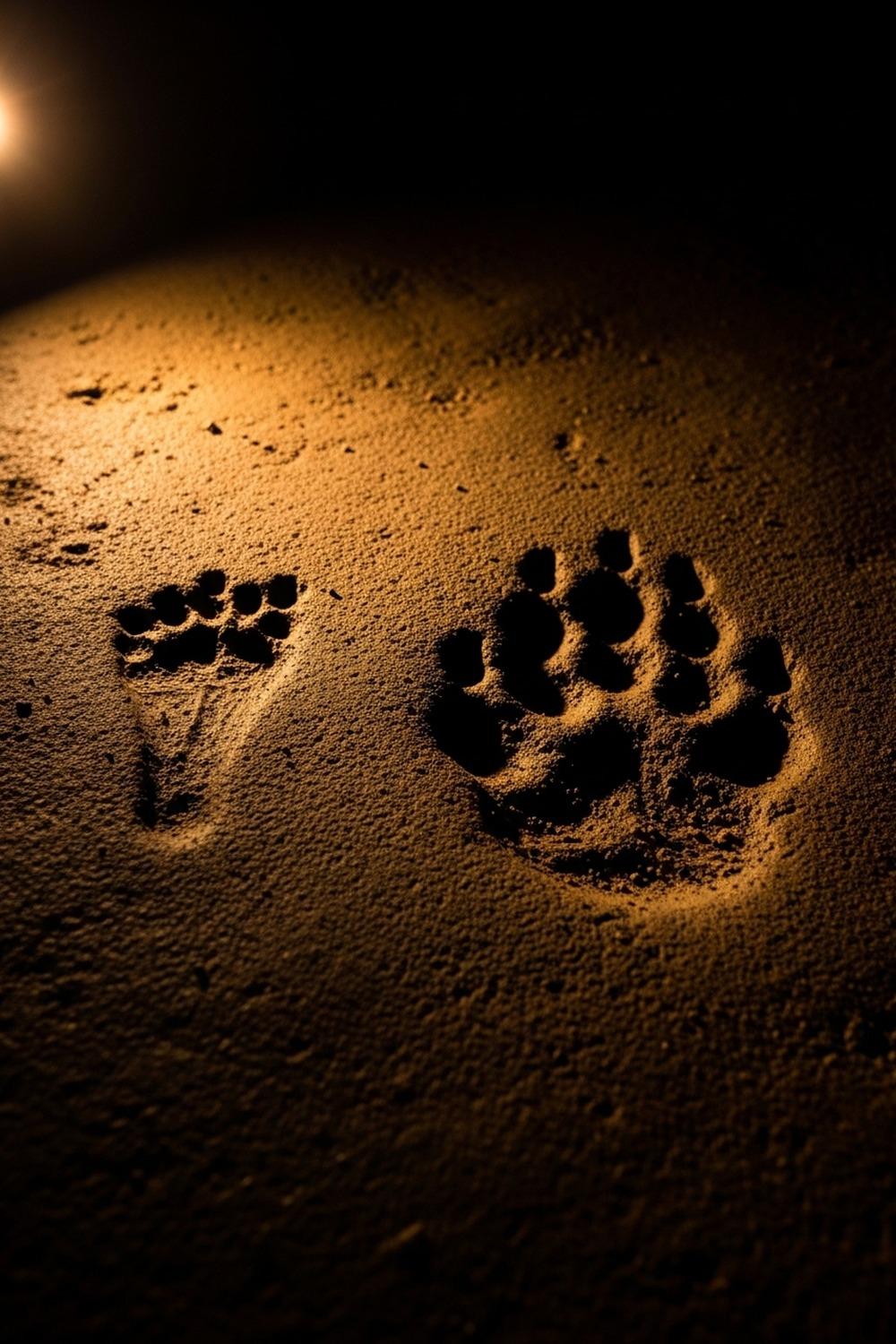
A torch. A narrow passage. And pressed into ancient clay — 26,000 years old — the Chauvet Cave child and wolf footprints, still moving in the same direction. The child was perhaps ten years old. The canid was large, possibly a wolf, possibly something closer to a dog. What walked beside that child remains unanswered, preserved in clay when the torch dimmed.
Southern France. The Ardèche region. Chauvet Cave holds some of the oldest art on Earth — but not only art. On the cave floor, two sets of tracks tell a story the paintings never could. A child’s small footprints run parallel to the tracks of a large canid. They move in the same direction. They maintain consistent distance. The question those footprints raise hasn’t been answered in 26,000 years: were they companions?
Key Facts
- The Chauvet Cave child and wolf footprints are roughly 26,000 years old, preserved in clay in the Hillaire Chamber in southern France
- Archaeologist Michel-Alain Garcia identified the child’s tracks in 1998, with a stride length of about 54 centimetres indicating a child aged eight to twelve
- Chauvet Cave was discovered on December 18, 1994 by Jean-Marie Chauvet, Eliette Brunel, and Christian Hillaire
- Chauvet’s earliest paintings date to about 32,000 years ago, predating Lascaux by roughly 15,000 years
- Over 400 animal figures representing at least 14 species are painted or engraved across Chauvet’s chambers
In short: The Chauvet Cave footprints, preserved in clay for about 26,000 years in southern France, show a child of eight to twelve walking beside a large canid with matched stride. Identified by Michel-Alain Garcia in 1998, they offer rare behavioural evidence of early human-canid companionship in a cave whose art predates Lascaux by 15,000 years.
The Discovery Inside the Hillaire Chamber
Michel-Alain Garcia, an archaeologist working with the French Ministry of Culture’s team, identified the child’s tracks in 1998. The team had managed Chauvet since its initial discovery in 1994 by Jean-Marie Chauvet and two colleagues. Garcia was mapping the cave floor — photographing and casting impressions across several chambers — when the footprints appeared in the Hillaire Chamber, one of the cave’s deepest sections. The footprints were small. The stride measured roughly 54 centimetres, consistent with a child aged between eight and twelve.
Beside the child’s tracks, something else emerged. A large canid’s paw impressions ran parallel to the human prints for a substantial stretch — not crossing them, not diverging, but matching pace.
What stopped researchers wasn’t simply the presence of the animal. It was the synchrony. The stride patterns aligned. In field analysis, Garcia noted that the prints showed no signs of the canid circling or straying — behaviours associated with a wild wolf tracking prey or exploring a space independently. Instead, the animal appeared to move with the child the way a dog moves beside a familiar person. Steady. Deliberate. Present. And here’s the thing: the prints tell you they weren’t occasional companions. The consistency of alignment suggests sustained, deliberate movement together through multiple chambers.
The torch wipe is the detail that haunts you.
Alongside the footprints, a smear of charcoal on the cave wall was left by someone clearing a spent torch — the prehistoric equivalent of shaking a dying flashlight. The child was managing their own light source. They weren’t being carried. They weren’t being led. They walked into that darkness under their own power, with something walking beside them. As Smithsonian Magazine has documented, this level of independence in Palaeolithic childhood remains rare in the archaeological record.
Was This the World’s Earliest Dog?
The identity of the animal has never been conclusively settled, and that uncertainty is itself significant. At the time the Chauvet Cave child and wolf footprints were made — roughly 26,000 years ago — the domestication of dogs from wolves was either just beginning or, by some estimates, had already been underway for several thousand years. The genetic record is contentious. A 2021 study published by the Francis Crick Institute in London, drawing on ancient DNA from canid remains across Europe and Asia, pushed the most likely timeline for dog domestication back toward 40,000 years ago, suggesting that by Chauvet’s era, at least some wolf lineages had already begun the long genetic drift toward the domestic dog.
Why does domestication matter here? Because the canid tracks at Chauvet measured large — the print span suggesting an animal comparable in size to a modern grey wolf, or a very early, not-yet-fully-domesticated dog. Wolves don’t typically accompany humans into enclosed spaces without significant conditioned trust. Caves amplify sound and smell in ways that make wild predators acutely uncomfortable. The fact that this animal moved alongside a child — not a dominant adult hunter, but a child — into the cave’s innermost chamber is the part that researchers keep returning to.
It doesn’t prove domestication. But it suggests relationship.
García’s work drew international attention precisely because it didn’t overclaim. He described what the prints showed: parallel movement, matched stride, sustained proximity. He left the interpretation open. That restraint made the finding more powerful, not less. The debate mirrors other questions we’ve struggled to answer about our deep past — like the persistent mystery of when and why ancient creatures first began living in close proximity to humans. We’ve been drawn to animals, and they to us, far longer than the historical record once suggested. It’s a pattern that shows up repeatedly across prehistoric life, much like the ancient behaviours documented in creatures that have barely changed since the Cambrian, such as the extraordinary evolutionary persistence described in the record of trilobites gathering in groups 500 million years ago — evidence that social behaviour has ancient, deep roots.
What Chauvet’s Art Tells Us About the People Inside
To understand why these footprints matter, you need to sit with what Chauvet Cave actually contains. Lions in motion. Woolly rhinoceroses. Herds of aurochs. A panel of horses rendered with a naturalistic confidence that stuns modern artists who have stood in that chamber. These weren’t crude markings. They were sophisticated visual art, made at a time when the Neanderthals had only recently disappeared from Europe.
The paintings predate the celebrated Lascaux cave art by nearly 15,000 years — a gap so large it’s difficult to compress into human intuition. Lascaux feels ancient. Chauvet makes Lascaux feel recent.
But here’s what matters: the Chauvet Cave child and wolf footprints exist in the same space as some of humanity’s most extraordinary early art. That’s not coincidence — it’s context. The people who painted those walls lived in a world of deep relationship with animals. They observed them obsessively. They rendered them with care and skill. Watching a species of human develop this kind of visual sophistication in the same moment they’re walking beside wolves, you stop calling it coincidence. It’s the same knowledge, expressed two different ways.
The Hillaire Chamber, where the child walked, is one of the richest areas of the cave. The child wasn’t passing through a plain corridor. They walked past paintings. Past images of creatures their community knew and watched and perhaps feared. With an animal beside them. Whatever that walk was — ritual, curiosity, an errand no adult bothered to supervise — it wasn’t nothing.
Chauvet Cave Footprints and What They Change About Prehistory
Before the Chauvet Cave child and wolf footprints entered the record, the evidence for early human-canid companionship was largely skeletal. 2008 brought a study by archaeologist Mietje Germonpré at the Royal Belgian Institute of Natural Sciences. She re-examined canid skulls from sites across Belgium and Russia, identifying morphological differences — shortened snouts, wider braincases — that suggested incipient domestication as far back as 31,700 years ago at Goyet Cave in Belgium. Germonpré’s findings were contested, but they repositioned the domestication debate into deep prehistory rather than the previously assumed 15,000-year window.
What Chauvet adds is behavioural. Not anatomy. Not genetics. Behaviour — captured in clay, preserved by the cave’s sealed microclimate for more than two and a half centuries of human generations. The implications for how we reconstruct Upper Palaeolithic social life are substantial.
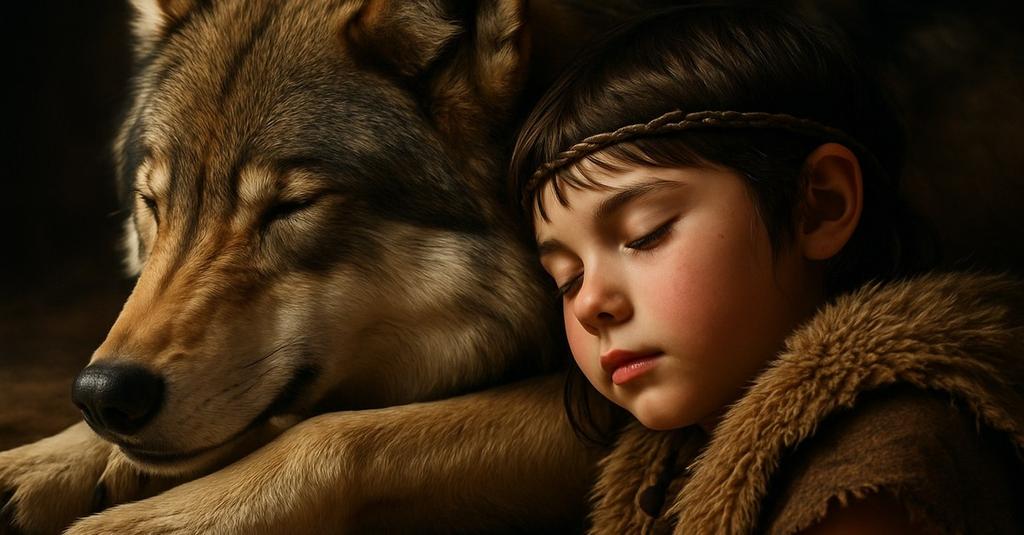
Children in these communities weren’t insulated from the cave — they entered it. They carried torches. They moved through darkness to the deepest chambers, past paintings that took real effort and intent to create. And they did this, at least once, with a large canid by their side. That single data point — two sets of footprints, matched stride, same direction — expands the picture of Palaeolithic childhood from something we imagine as purely survival-driven into something more recognisable. A child and an animal, moving together in the dark. That’s not a hunter and prey. That’s a kid and a companion.
Researchers at the French National Centre for Scientific Research (CNRS) have continued documentation of the cave under strict access protocols. Since 2010, they’ve used 3D laser scanning to preserve the footprint record without physical contact. The scans confirmed Garcia’s original analysis and added spatial data showing the child’s path wound through multiple chambers. Where the animal’s tracks appear, they consistently align with the human stride length.
This wasn’t a brief crossing of paths.
How It Unfolded
- December 18th, 1994 — Jean-Marie Chauvet, Éliette Brunel, and Christian Hillaire discover the cave, finding intact painted chambers sealed for millennia.
- 1998 — Michel-Alain Garcia identifies the child’s footprints and the parallel canid tracks during systematic floor mapping of the Hillaire Chamber.
- 2008 — Mietje Germonpré’s morphological study at the Royal Belgian Institute of Natural Sciences repositions dog domestication debate into the Upper Palaeolithic, adding scientific weight to the Chauvet footprint interpretation.
- 2010–present — CNRS researchers deploy high-resolution 3D laser scanning to document the footprint record non-invasively, producing the most detailed spatial analysis of the tracks to date.
By the Numbers
- 32,000 years ago — the date of Chauvet Cave’s earliest paintings, confirmed by radiocarbon dating of charcoal pigment (French Ministry of Culture, 2012).
- 54 centimetres — the measured stride length of the child’s footprints, consistent with a child aged eight to twelve years.
- ~15,000 years — the gap between Chauvet’s art and the famous Lascaux paintings, making Chauvet’s record nearly twice as ancient.
- 31,700 years ago — the estimated age of canid remains at Goyet Cave, Belgium, showing possible early domestication morphology (Germonpré et al., 2008).
- Over 400 — the number of animal figures painted or engraved across Chauvet Cave’s chambers, representing at least 14 species.
Field Notes
- The torch wipe found near the child’s footprints — a charcoal smear from clearing a spent torch against the wall — indicates the child was actively managing their own light source, not following an adult holding a flame. This detail, documented by Garcia in 1998, is rarely discussed but fundamentally changes the image of that walk. (Researchers actually call this evidence of independent mobility in the Upper Palaeolithic — a finding that contradicts older assumptions about dependent childhood in prehistoric communities.)
- Large canid prints marked the Chauvet record — larger than most modern domestic dogs — which is part of why the debate between “wolf” and “early dog” has never been resolved from the prints alone.
- Access to Chauvet is uniquely restricted. The cave has never been opened to public visits. All research is conducted under special permit. The footprints are among the most restricted archaeological records in the world.
- The timing of the child’s walk and the canid’s presence can’t be determined precisely from clay preservation alone. Researchers still can’t confirm whether the two entered together or whether their tracks simply overlap from separate visits at different times — or even different decades.
Frequently Asked Questions
Q: What exactly are the Chauvet Cave child and wolf footprints, and how were they found?
Parallel tracks preserved in the clay floor of the Hillaire Chamber — that’s what we’re discussing. Deep inside Chauvet Cave in southern France. They were identified in 1998 by archaeologist Michel-Alain Garcia during floor-mapping work. The child’s prints indicate a young person aged roughly eight to twelve, and the canid tracks run alongside them for an extended stretch — matching stride and direction — suggesting the two moved through the cave together.
Q: Does this prove that people 26,000 years ago kept dogs as pets?
Not definitively. The tracks show proximity and matched movement, which is consistent with a domesticated or semi-domesticated canid companion, but the prints alone can’t confirm domestication. The animal’s tracks are large — wolf-sized — and some researchers argue the canid may have been a wolf that was habituated to human presence rather than a fully domesticated dog. The genetic and morphological debate about when dogs diverged from wolves is still active, with estimates ranging from 15,000 to 40,000 years ago depending on the study.
Q: Why is Chauvet Cave considered so important compared to other prehistoric caves?
Lascaux often gets the reputation for oldest cave art. That’s incorrect. Chauvet predates Lascaux by roughly 15,000 years, making its paintings the oldest confirmed figurative art in Europe. The cave also preserves an unusually complete record — including bones, hearths, bear scratch marks, and the footprints — because it was sealed by a rock collapse roughly 20,000 years ago, protecting everything inside. That accidental sealing is why the child’s footprints and the canid tracks are still readable today.
Editor’s Take — Dr. James Carter
What strikes me most isn’t the question of whether the canid was a wolf or a dog. It’s the torch wipe. A child, alone or nearly so, deep inside one of the most extraordinary spaces in the prehistoric world, clearing a dying torch against the wall to keep the light going. That single gesture tells you more about Palaeolithic childhood than a thousand artefacts catalogued in a museum. These were people who let their children walk into the dark. Who trusted them with fire. And apparently, sometimes, with wolves.
Twenty-six thousand years of silt and silence, and those footprints are still readable — still pointing the same direction, still the same distance apart. Archaeology spends most of its energy recovering what people made: tools, pigments, bones shaped by use. Rarely does it recover what people felt. But two sets of tracks, pressed into cave clay by a child and an animal moving through torchfire together, come closer than almost anything else we’ve found. The real question isn’t what kind of animal walked beside that child. It’s what the child felt, moving through all that painted darkness, knowing something was there.
Illustrations are AI-generated. Article fact-checked and human-edited. Our editorial standards.