Why You Now Have 3 Minutes to Escape a House Fire
You have three minutes to get out. Maybe less. In 1975, you had seventeen. That collapse — fourteen minutes evaporated from the house fire escape time you once would have relied on — didn’t happen by accident. Every design choice, every material substitution, every wall knocked down for the sake of open-plan living has methodically transformed the modern home into perhaps the most efficient fuel load ever constructed, a structure that now burns in the time it takes to wake up fully and understand what that sound actually is.
Fire researchers began documenting this catastrophe years ago. The public largely ignored the findings. In 2008, Underwriters Laboratories, the independent safety science organization testing materials since 1894, conducted a study that should have rewritten every safety protocol in America — and then conducted it again in 2012 to confirm the results. Yet most households still operate on instinct shaped by a fire risk that no longer exists. So how did the homes we built for comfort become something so radically engineered to burn?
Key Facts
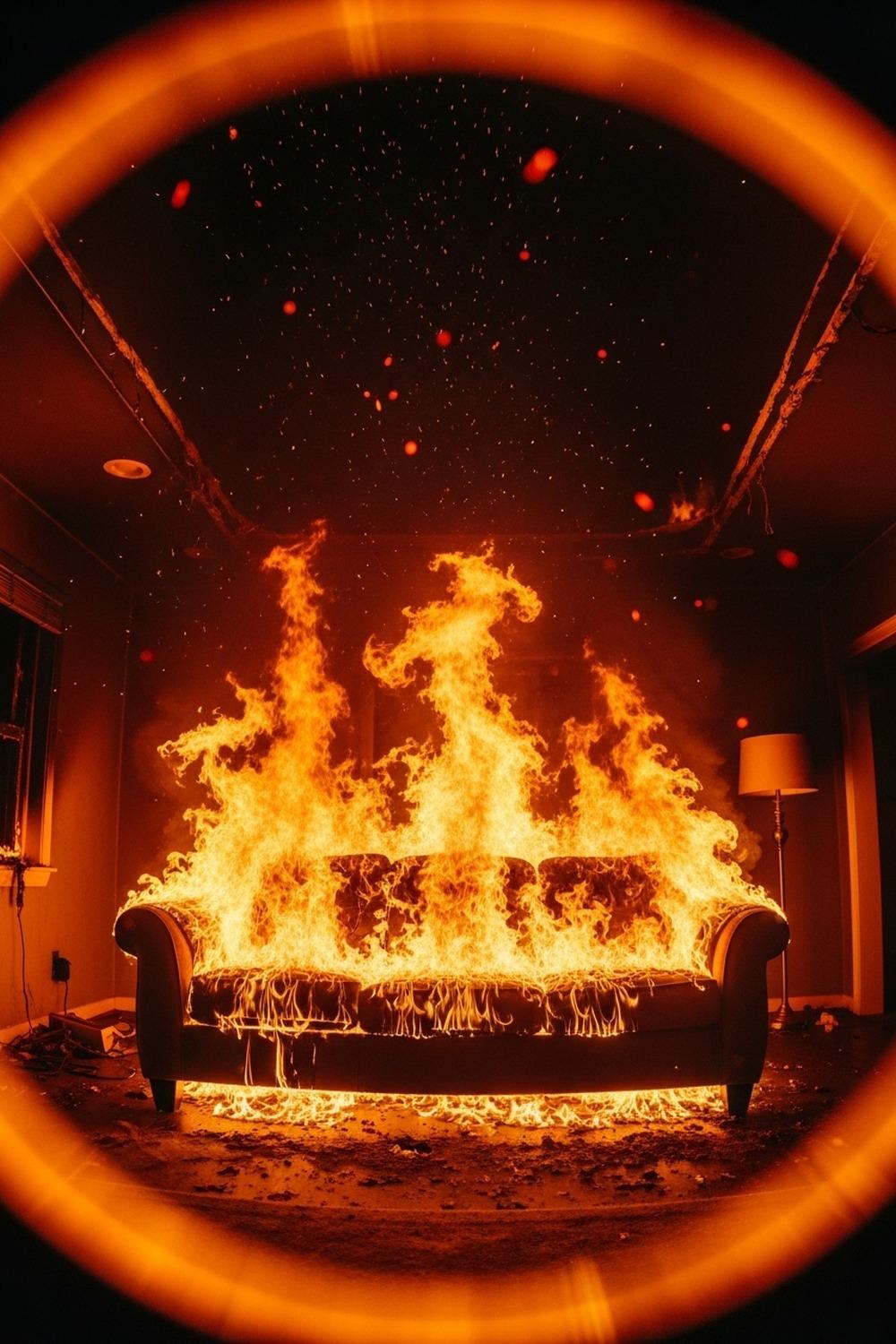
- A 2008 Underwriters Laboratories (UL) study compared full-scale 1975 and modern living rooms under identical fire conditions; the 1975 room took nearly 30 minutes to reach flashover, the modern room reached it in 3 minutes 30 seconds
- UL repeated the test in 2012 and confirmed the results, transforming how fire departments brief their communities
- UL 2012 testing found that lightweight engineered floor joists collapse in as little as 6 minutes of fire exposure, compared with up to 26 minutes for traditional solid-wood joists
- Polyurethane foam in furniture releases hydrogen cyanide when it burns, inhibiting the body’s ability to use oxygen at the cellular level
- National Institute of Standards and Technology research has documented toxic gas concentrations reaching incapacitating levels within 90 seconds of ignition in modern residential fires
In short: In 1975 you had roughly 17 minutes to escape a house fire; today you have about 3 minutes. Underwriters Laboratories’ 2008 and 2012 tests showed modern rooms reach flashover in 3 minutes 30 seconds versus nearly 30 minutes for 1975 rooms. Synthetic furniture, engineered lumber that collapses in 6 minutes, and open-concept layouts have engineered homes to burn faster.
The Collapse: What the UL Study Actually Showed
In 2008 and again in 2012, UL researchers built two full-scale replica rooms — one furnished in 1975 style, one contemporary — and set them alight under identical conditions. The 1975 room took nearly thirty minutes to reach flashover, that catastrophic point where every surface simultaneously ignites. The modern room hit it in three minutes and thirty seconds. A single comparison that changed how fire departments across North America briefed their communities, and that anchored a conversation the construction and furniture industries had spent decades avoiding.
The mechanism is chemistry. Polyurethane foam cushions. Synthetic carpet fibers. Plastic-laminate surfaces. These materials are derived from petroleum and burn the way petroleum burns — fast, hot, with toxic smoke that incapacitates before the flames even reach you. A 1975 living room held solid wood frames, wool or cotton upholstery, natural-fiber rugs. These materials char slowly, releasing smoke more gradually, buying time. The room itself was a passive protection. The modern room is a timer counting down.
Firefighters on the ground felt this shift years before the lab results came public. Crews working residential fires since the early 1980s started reporting something changing — rooms that behaved differently, more volatile, less predictable.
What the UL study did was transform instinct into data.
The numbers anchored a new conversation, but they didn’t end it. Here’s the thing: the furniture industry knew about these findings almost immediately. The data appeared in peer-reviewed publications. Trade magazines reached architects, interior designers, contractors. Nobody claimed ignorance. What happened instead was something more troubling — a systematic absence of change, accompanied by the appearance of change where it mattered least.
Modern Homes Are Engineered to Accelerate Flames
Open-concept floor plans became the standard layout in most new residential construction after the 1990s. They eliminated the compartmentalization that once acted as passive fire barriers. A fire starting in the kitchen would have to work through a doorway to reach the living room — and that doorway, that corridor, that wall slowed the spread and reduced oxygen feeding the flames. Knock those walls out and fire engineers describe what results bluntly: a “wind tunnel.” Flames cross entire floors in seconds.
Why does this matter physically? Because the kind of decision-making under pressure that keeps people alive — and that requires a degree of calm most of us never practice — becomes impossible when the environment deteriorates this fast.
But the structural issue runs deeper. Since the 1980s, residential construction has increasingly relied on engineered lumber — oriented strand board, laminated veneer lumber, I-joists — replacing traditional dimensional lumber like Douglas fir or Southern yellow pine.
Engineered wood is lighter, cheaper, performs fine under normal load conditions. Under fire conditions, it fails catastrophically. UL testing from 2012 found that lightweight engineered floor joists collapse in as little as six minutes of fire exposure. Traditional solid-wood joists, under identical conditions, can hold for up to twenty-six minutes. That’s not marginal. That’s a floor collapsing beneath a firefighter or a sleeping child four times earlier than it would have thirty years ago. Drive through any new subdivision built after 2000 and look at the framing before the drywall closes it in. The I-joists are elegant, skeletal, almost beautiful. They’re also closer to kindling than timber.
The Toxic Chemistry Nobody Talks About
Flames are visible. Smoke is not, not until it’s everywhere. And in a modern house fire, the smoke is what kills you before you ever see a flame. A Smithsonian investigation into fire toxicology found that the majority of residential fire fatalities result not from burns but from inhalation of toxic gases — carbon monoxide, hydrogen cyanide, acrolein — produced when synthetic materials combust. Polyurethane foam, the material inside almost every sofa, mattress, and car seat manufactured since the 1970s, releases hydrogen cyanide when it burns. That gas inhibits the body’s ability to use oxygen at the cellular level. It doesn’t smell like danger. It smells like almost nothing. And it works fast.
Researchers at the National Institute of Standards and Technology have documented cases where toxic gas concentrations in modern residential fires reached incapacitating levels within ninety seconds of ignition. Not three minutes. Ninety seconds. You may lose your ability to navigate before you lose consciousness. You may lose your mind before the fire reaches your body. The smoke takes your cognition first.
In a 1975 home fire, the slower-burning natural materials produced smoke more gradually. This gave occupants a longer window of breathable air and visible space. In a modern home, that window collapses almost simultaneously with the fire’s ignition of synthetic furnishings. The house fire escape time problem is, in large part, a smoke problem.
This is why fire safety researchers have shifted their language in recent years. They no longer talk about “fire survival” as a question of physical distance from flames. They talk about “tenability” — the point at which the environment inside a structure ceases to support human function. In a modern home, tenability collapses faster than most people can lace a shoe.
What House Fire Escape Time Means for How You Live Now
The three-minute figure isn’t worst-case. It’s average, drawn from controlled burn studies of modern furnished rooms conducted by UL’s Fire Safety Research Institute between 2008 and 2019. Those studies consistently found that modern furnished rooms reached flashover — the point of no return — in under four minutes, and that survivable conditions in adjacent rooms degraded within sixty to ninety seconds of that. In 2019, the institute released updated guidance for fire departments recommending that all public education materials be revised to reflect the three-minute window. Some jurisdictions updated their materials. Many did not. In 2024, the message still hasn’t reached most households in any systematic way, which means millions of families mentally rehearse escape plans calibrated for a risk that no longer resembles their actual home.
Every bedroom door closed at night reduces the spread of toxic gases by a measurable margin — studies from UL show that a closed interior door can reduce room temperatures on the other side by hundreds of degrees Fahrenheit and delay smoke infiltration by minutes. Smoke alarms on every floor, tested monthly, not annually. A practiced escape plan — not discussed, not thought through, but physically practiced — with a designated outdoor meeting point. Two exits from every room if possible. And a frank reckoning with the statistics: stopping to grab a phone, a wallet, a pet carrier is not risk calculation in a three-minute window. It is, statistically, a death sentence.
Fire departments in cities that updated their messaging — Toronto, Seattle, London — have started using language that would have seemed alarmist a decade ago: “Get out and stay out.” No exceptions. No retrieval. No hesitation. Because in a modern home, hesitation is the variable that kills.
The Design Industry Knows — and Mostly Hasn’t Changed
The furniture and construction industries are not ignorant of these findings. California’s TB 117 standard — the flammability regulation for residential furniture foam — was updated in 2013 to phase out certain flame retardants shown to be toxic. The revision was widely criticized by fire safety researchers for failing to require materials that actually resist ignition in the first place. The result: furniture that no longer contained one category of harmful chemicals but remained just as fast to burn. Reform in appearance, not substance.
Meanwhile, the open-concept trend shows no sign of reversing. According to the National Association of Home Builders’ 2023 survey, open kitchen-living layouts remain the single most requested feature in new residential construction. Buyers want them. Builders provide them. The fire risk is disclosed nowhere in the transaction. You buy a home, you absorb its fire physics, and nobody tells you that the floor plan you paid extra for has effectively halved the escape time your parents would have had in the same situation.
A small but vocal cohort within the fire-safe building movement pushes back — architects advocating for compartmentalized layouts, fire-rated interior doors, sprinkler systems in all new residential construction, not just commercial buildings. In New Zealand, residential sprinkler installation became mandatory in all new care homes and multi-story dwellings in 2021. Some places are having the conversation. It is not yet happening fast enough, and the gap between what the data demands and what gets built grows wider each year.
How It Unfolded
- 1973: The Consumer Product Safety Commission begins early research into residential fire fatalities, identifying furniture combustibility as a significant factor in civilian deaths.
- 1987: California introduces Technical Bulletin 117, the first state-level flammability standard for residential foam furniture — widely adopted by manufacturers as a de facto national standard.
- 2008: UL’s Fire Safety Research Institute conducts its first side-by-side burn comparison of 1975 versus modern furnished rooms, documenting the seventeen-minute to three-minute collapse in survivable escape time.
- 2013: California revises TB 117 to remove certain toxic flame retardants, but fire safety researchers argue the update fails to meaningfully reduce ignition risk.
- 2019: UL issues updated guidance recommending all public fire safety education be revised to reflect the three-minute escape window — adoption across jurisdictions remains inconsistent as of 2024.
By the Numbers
- 3 minutes: average time to flashover in a modern furnished room (UL Fire Safety Research Institute, 2012)
- 29 minutes: time to flashover in a room furnished with 1975-era natural materials under identical test conditions (UL, 2012)
- 6 minutes: time for engineered lumber floor joists to fail under fire exposure, versus up to 26 minutes for traditional dimensional lumber (UL, 2012)
- 90 seconds: time for toxic gas concentrations to reach incapacitating levels in some modern residential fire scenarios (NIST)
- 2,500+: residential fire fatalities recorded annually in the United States, with smoke inhalation listed as the primary cause in the majority of cases (NFPA, 2023)
Field Notes
- In UL’s 2012 full-scale burn tests, the modern furnished room reached temperatures over 1,000°F within four minutes of ignition — hot enough to melt aluminum and ignite materials untouched by direct flame. The 1975 room, at the same elapsed time, remained survivable.
- A closed bedroom door can reduce fire-side temperatures from over 1,000°F to under 100°F on the protected side, buying occupants measurable additional minutes — yet fewer than 20% of households in UL surveys reported practicing “close before you doze” as a regular habit.
- Hydrogen cyanide — released by burning polyurethane foam — was historically associated with industrial fires. It’s now consistently detected at residential fire scenes involving modern upholstered furniture, fundamentally changing the toxicological profile of an ordinary house fire.
- Researchers still cannot fully predict which specific combination of synthetic materials, room geometry, and ventilation conditions will push the escape window below sixty seconds. The three-minute figure is an average; the true lower bound remains an open and troubling question in fire science.
Frequently Asked Questions
Q: Is the three-minute house fire escape time the same for every type of home?
No — it’s an average drawn from controlled burn studies of modern furnished rooms, not a universal constant. Older homes with solid-wood framing and natural-fiber furnishings may still provide a longer window. Conversely, heavily furnished modern rooms with large volumes of synthetic foam and fully open floor plans can collapse to survivable conditions in under sixty seconds. The three-minute figure should be treated as a ceiling, not a guarantee.
Q: Do smoke alarms actually give you enough warning to escape in time?
A functioning smoke alarm is still your most critical defense — but it only works if you act immediately upon hearing it. In modern home fires, the window between alarm activation and untenable smoke conditions can be under two minutes. Researchers at UL recommend that families treat a smoke alarm like a starting gun, not a warning bell. Every second spent gathering belongings, confirming the source, or waiting to see if it’s a false alarm reduces the margin between escape and fatality.
Q: Won’t fire sprinklers solve the house fire escape time problem?
Residential sprinkler systems dramatically improve survival odds — they reduce the risk of death in a home fire by about 80%, according to the National Fire Protection Association. But fewer than 5% of existing U.S. homes have them, and they’re not required in new single-family construction in most states. They’re effective when present. For the vast majority of households, they simply aren’t. Closed interior doors remain the most accessible passive protection currently available to most people.
Editor’s Take — Sarah Blake
What strikes hardest about this story isn’t the three-minute number — it’s that the research has been sitting in public view since 2008 and the guidance still hasn’t reached most households in any coherent way. We’ve quietly redesigned the American home into a faster-burning structure, told almost nobody, and then wondered why residential fire fatalities haven’t fallen as sharply as we’d hoped. Watching a risk this stark persist this long because it doesn’t fit neatly into sales conversations or design aesthetics, you begin to understand how societies make decisions that harm their own people — not through conspiracy, but through the accumulated weight of small, individually rational choices made without looking at the whole.
The modern home is a remarkable thing — comfortable, efficient, luminous with natural light pouring across open space. It’s also, under the wrong conditions, a structure that can move from functional to fatal in the time it takes to find your shoes. The materials we chose for softness burn with the intensity of petrochemicals. The walls we removed for connection became corridors for fire. The question worth sitting with isn’t whether you know the three-minute figure now. It’s whether you know exactly — step by step, door by door — what you’d do with those three minutes at two in the morning.
Illustrations are AI-generated. Article fact-checked and human-edited. Our editorial standards.