The Orca Who Carried Her Dead Calf for 17 Days
She wouldn’t let go. For seventeen days in the summer of 2018, orca Tahlequah pushed her dead calf through the Salish Sea — over a thousand miles of open Pacific water — in a display of mourning that stopped marine biologists cold. The world watched. Nobody had words for what they were seeing.
Tahlequah, designated J35 by researchers at the Center for Whale Research, gave birth on July 24, 2018. The calf — a female — survived less than thirty minutes. What happened next would redefine how scientists talk about animal grief, animal consciousness, and the emotional lives of one of the planet’s most imperiled predators.
How does a species that can’t cry make its sorrow visible?
Tahlequah found a way.
Key Facts
- Orca Tahlequah (J35) carried her dead newborn for 17 days across approximately 1,000 miles of the Salish Sea in summer 2018
- Her calf, born July 24, 2018, survived less than 30 minutes
- The Southern Resident killer whale population numbered just 73 individuals in July 2018
- In September 2020, Tahlequah gave birth to a healthy male calf named Phoenix (J57)
- NOAA listed Southern Residents as endangered under the Endangered Species Act in 2005
In short: The story of orca Tahlequah grieving calf documents how J35 carried her dead newborn for 17 days across 1,000 miles of the Salish Sea in 2018. Her vigil, supported by her pod, reshaped scientific understanding of cetacean grief and spotlighted the critically endangered 73-member Southern Resident population.
A Mother’s Vigil: What Tahlequah’s Journey Revealed
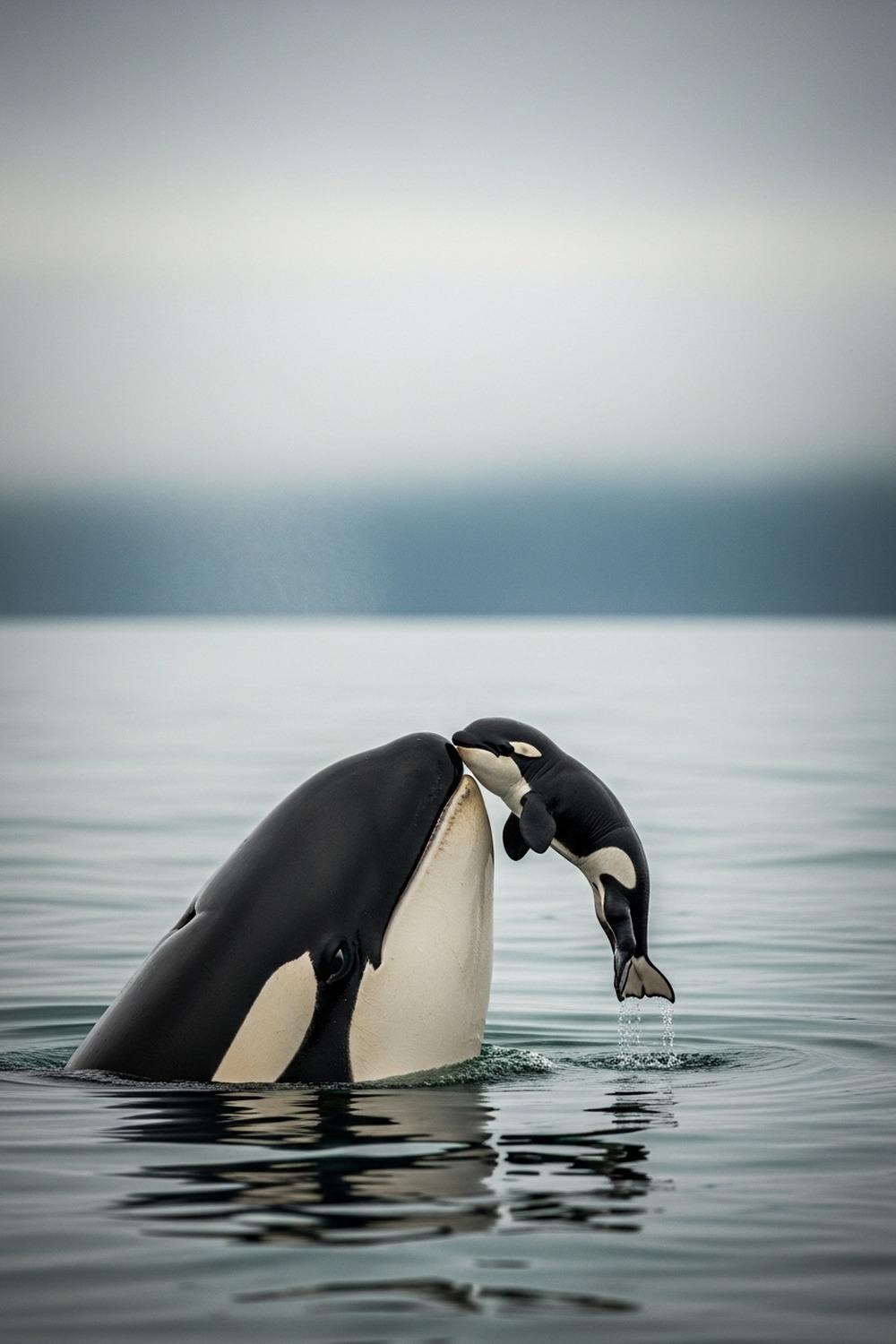
For seventeen consecutive days, Tahlequah carried her dead newborn on her rostrum — the rounded, melon-shaped tip of her snout — keeping the body at the surface as she swam. Researchers at the Center for Whale Research, which has tracked the Southern Resident killer whale population continuously since 1976, had never documented anything like it.
The total distance traveled exceeded 1,000 miles. The calf’s body began to decompose within days, yet Tahlequah maintained her vigil without interruption, surfacing to breathe with the small form balanced carefully across her beak. Ken Balcomb, the Center’s founder, told reporters it was “an expression of grief, loss, and love,” and he wasn’t speaking metaphorically. He’d spent four decades watching these animals. He knew the difference between behavior and feeling.
What made the vigil even more striking was the involvement of other pod members. When Tahlequah’s body visibly flagged from exhaustion — her dives becoming shallower, her speed dropping — other females in the J-pod took turns supporting the calf. It was communal mourning. A grief distributed across a family unit. Southern Residents live in tight matrilineal groups: daughters stay with mothers for life, sons rarely stray far from their birth pod. Tahlequah’s sisters and cousins weren’t bystanders. They were participants.
Scientists noted that Tahlequah appeared to eat normally during portions of the journey, suggesting the behavior wasn’t a physical collapse — it was a choice, sustained over more than two weeks. Researchers watching from research vessels gave the pod space. There was little else to do. That distinction matters enormously to the scientists who study cetacean cognition.
What Grief Looks Like in the Animal Kingdom
Marine biologists had documented mourning behavior in cetaceans before 2018, but the scale and duration of Tahlequah’s vigil placed it in a category of its own. Dolphins carrying dead calves had been observed for periods of hours, occasionally a day or two. A 2016 study from the journal Animal Cognition catalogued dozens of such incidents across at least ten species of cetacean, noting that the behavior appeared more common in highly social species with strong mother-calf bonds.
But the complexity of the Salish Sea vigil — seventeen days, pod-wide participation, over 1,000 miles of active travel — suggested something qualitatively different. Elephants, for instance, return to the bones of dead relatives for years, touching them with their trunks in behaviors primatologists and ethologists classify as mourning rituals. It’s tempting to draw comparisons across these high-intelligence social species. The emotional parallels are impossible to ignore — and the science of animal grief, like the science of infant attachment in primates, keeps pushing us toward the same uncomfortable conclusion: loss registers deeply across species lines.
What drives this behavior, mechanically? Orcas have spindle neurons — elongated brain cells previously thought to be unique to humans and great apes — in the regions associated with emotional processing. Tahlequah’s brain, in other words, is structurally equipped to grieve. The most widely accepted hypothesis among cetacean researchers at the University of British Columbia and the Woods Hole Oceanographic Institution is that the same neurological architecture that enables complex social bonding also produces grief responses when those bonds are severed. The behavior stopped being a mystery once researchers accepted the neurological evidence.
The harder question became: what does that grief cost the animal carrying it?
Researchers estimated that carrying the calf’s weight while swimming long distances required measurably more caloric expenditure. For an already nutritionally stressed population — Southern Residents were classified as critically endangered by the National Oceanic and Atmospheric Administration — that energy cost wasn’t trivial. Watching a population this small absorb that kind of metabolic loss, you stop calling it a behavior and start calling it a catastrophe waiting to happen. Grief, for Tahlequah, was metabolically expensive.
The Population Behind the Story
July 2018 placed Tahlequah inside a crisis. The Southern Resident killer whales — the population that ranges through the waters between Washington State and British Columbia — numbered just 73 individuals at the time, down from a historic low already reached in 2001 when the population fell to 78. These aren’t migratory animals passing through anonymously; they’re a defined, closed community whose members have been individually identified, named, and monitored for nearly five decades. Every birth matters. Every death registers statistically and personally.
NOAA Fisheries listed Southern Residents as endangered under the Endangered Species Act in 2005, identifying three primary threats: reduced prey availability (they eat almost exclusively Chinook salmon), vessel disturbance, and toxic contamination. A National Geographic investigation published in the months following Tahlequah’s vigil made the connection explicit: her calf didn’t die randomly. It died into a food crisis.
Chinook salmon collapse is the central, brutal fact behind every Southern Resident death — these orcas eat almost nothing else. Chinook, the largest Pacific salmon species, have declined catastrophically across their range due to dam construction, habitat loss, and overfishing spanning the twentieth century. Body condition scores assessed through aerial photogrammetry by researchers at the Vancouver Aquarium and University of Washington showed measurable “peanut head” malnutrition in multiple individuals by 2018. By 2018, Southern Residents were spending more time hunting and less time socializing.
A malnourished pregnant female is a female whose calf is at elevated risk from the moment of conception.
With only 73 individuals and a birth rate that barely replaces natural mortality in good years, the math of recovery is unforgiving. Each failed birth tightens the demographic noose. Tahlequah’s loss, in this light, wasn’t just a singular tragedy. It was a population-level signal. Every calf counts in a way it simply doesn’t for a population of thousands.
Orca Tahlequah After 2018: A Story That Continued
What happened after the seventeen-day vigil is, remarkably, a story with hope embedded in it. In September 2020, researchers at the Center for Whale Research confirmed that Tahlequah had given birth to a healthy male calf, designated J57 and quickly nicknamed “Phoenix” by the research community — a name that arrived with obvious symbolic weight. He survived. He thrived.
Aerial drone surveys conducted by the SR3 SeaLife Response, Rehabilitation and Research team in 2021 showed Phoenix growing normally, swimming tight to his mother’s flank, entirely unaware of the story that preceded his birth. Tahlequah, for her part, showed no outward behavioral changes that researchers could quantify. She hunted. She socialized. By every metric the Center for Whale Research applies, she was a functioning, healthy member of J-pod.
But the conditions that killed her first calf hadn’t changed.
Chinook salmon populations in the Fraser River — the Southern Residents’ primary summer hunting ground — remained suppressed through 2022 and 2023. The Biden administration’s decision to remove four dams on the lower Snake River in Idaho, finalized in 2024, was partly framed as a salmon recovery measure and, by extension, a Southern Resident orca recovery measure. Dam removal on that scale hadn’t been attempted in the continental United States before. Researchers estimated it could restore up to 1 million additional Chinook salmon per year to the system. Whether that’s enough, and how quickly fish populations respond, remained live scientific questions at the time of writing.
Phoenix is alive. That’s the fact researchers return to. He’s the counterweight to seventeen days of watching his mother carry what the ocean couldn’t take from her. His dorsal fin grows. He’ll be identifiable for life. The Center for Whale Research tracks him.
How It Unfolded
- 1976 — The Center for Whale Research begins continuous individual identification and tracking of the Southern Resident killer whale population, establishing the longest-running cetacean study of its kind in North America.
- 2005 — NOAA Fisheries officially lists Southern Resident killer whales as endangered under the Endangered Species Act, citing Chinook salmon decline, vessel noise, and chemical contamination as primary threats.
- July–August 2018 — Tahlequah carries her dead newborn calf for seventeen days and approximately 1,000 miles through the Salish Sea, catalyzing global attention on Southern Resident conservation and forcing a scientific reappraisal of cetacean grief.
- September 2020 — Tahlequah gives birth to a healthy male calf, Phoenix (J57), who survives and thrives — the first healthy Southern Resident birth in three years.
By the Numbers
- 73 — Southern Resident killer whales alive at the time of Tahlequah’s vigil in July 2018, near the population’s historic low (Center for Whale Research, 2018)
- 17 days, ~1,000 miles — the duration and estimated distance of Tahlequah’s mourning journey through the Salish Sea
- Less than 30 minutes — how long Tahlequah’s first calf survived after birth on July 24, 2018
- 75% — estimated decline in Fraser River Chinook salmon runs since the early twentieth century, the primary food source for Southern Residents
- ~1 million — additional Chinook salmon per year projected to return to the Snake River system following dam removal, according to NOAA modeling estimates (2023)
Field Notes
- When Tahlequah finally released her calf’s body on August 11, 2018 — the seventeenth day — researchers observed her immediately rejoining the pod and resuming normal foraging behavior in the waters off Vancouver Island. The transition appeared almost instantaneous, which marine ethologists noted as consistent with grief resolution rather than prolonged depression.
- Southern Resident orcas have a documented behavior called “greeting ceremonies,” in which separated sub-groups reunite with synchronized swimming and physical contact — behavior that has no known foraging or reproductive function and appears to serve purely social and emotional purposes (researchers actually call this “affiliative bonding,” though the term doesn’t quite capture what you’re watching).
- Tahlequah’s calf wasn’t the first Southern Resident lost that summer: the population lost three additional members between May and August 2018, a mortality rate that alarmed even veteran researchers.
- Scientists still can’t determine exactly why Tahlequah’s vigil lasted precisely seventeen days while other documented cetacean mourning events end in hours or days — the neurological or social trigger that determines the duration of these behaviors remains one of the genuinely open questions in cetacean cognition research.
Frequently Asked Questions
Q: What exactly happened when orca Tahlequah’s grieving calf vigil ended?
On August 11, 2018 — seventeen days after her calf’s death — Tahlequah released the body in the waters off the coast of Victoria, British Columbia. She rejoined the J-pod group and resumed normal behavior relatively quickly. No further prolonged carrying behavior was documented. The calf’s body sank. Tahlequah did not attempt to retrieve it again. Researchers monitoring the pod noted the transition with a kind of quiet relief.
Q: Are Southern Resident orcas really endangered, and what’s being done?
Yes, critically. With a population hovering near 73–75 individuals, Southern Residents are one of the most endangered marine mammal populations in the Northern Hemisphere. Active recovery efforts include NOAA vessel speed and distance restrictions in the Salish Sea, ongoing Chinook salmon restoration programs across Washington and British Columbia, and the landmark removal of four lower Snake River dams completed in 2024 — the largest dam removal project in U.S. history, specifically designed in part to restore salmon runs for these orcas.
Q: Does Tahlequah’s behavior prove that orcas truly feel grief, or could it be something else?
This is where honest science gets complicated. Most researchers avoid claiming certainty about subjective emotional states in animals — we can’t directly access what an orca feels. What we can say is that Tahlequah’s behavior was functionally consistent with grief: prolonged attachment to a dead offspring, apparent refusal to abandon the body despite physical cost, and social participation from other pod members. The neurological substrate — spindle neurons, complex social bonding architecture — is present. Whether that constitutes “grief” in a philosophical sense depends on how you define the word, not on the evidence.
Editor’s Take — Alex Morgan
What stays with me about Tahlequah isn’t the seventeen days. It’s the other pod members taking turns. The moment grief becomes communal, it stops being instinct and starts being something harder to categorize. We’ve spent decades trying to determine whether animals feel things the way we do, and this story keeps suggesting we’re asking the wrong question. Maybe the more urgent question is what we owe a species capable of distributing its sorrow across a family — and what it says about us that we’ve pushed that family to the edge of extinction.
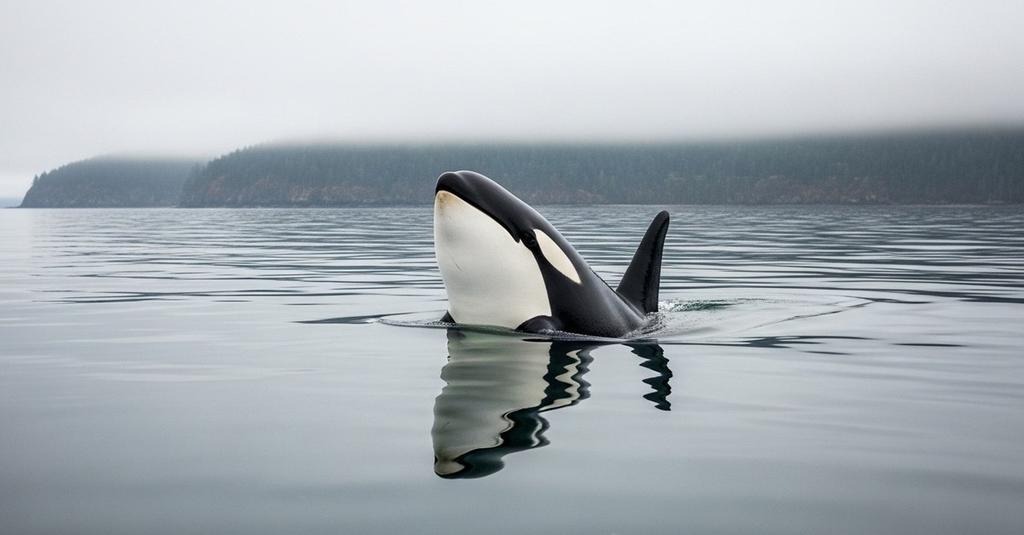
Tahlequah swims in the Salish Sea right now, somewhere between the San Juan Islands and the waters off Vancouver Island, likely hunting Chinook alongside Phoenix. Two fins visible at the surface. Both alive. The population is still at the edge — 73 animals, a few hundred miles of coastline, one food source in long decline. What Tahlequah carried for seventeen days wasn’t just a calf. It was a question the ocean put to every person watching from shore: at what point does witnessing grief become an obligation to act on its cause?
Illustrations are AI-generated. Article fact-checked and human-edited. Our editorial standards.