Whales Are Using Kelp as a Spa Tool and It’s Deliberate
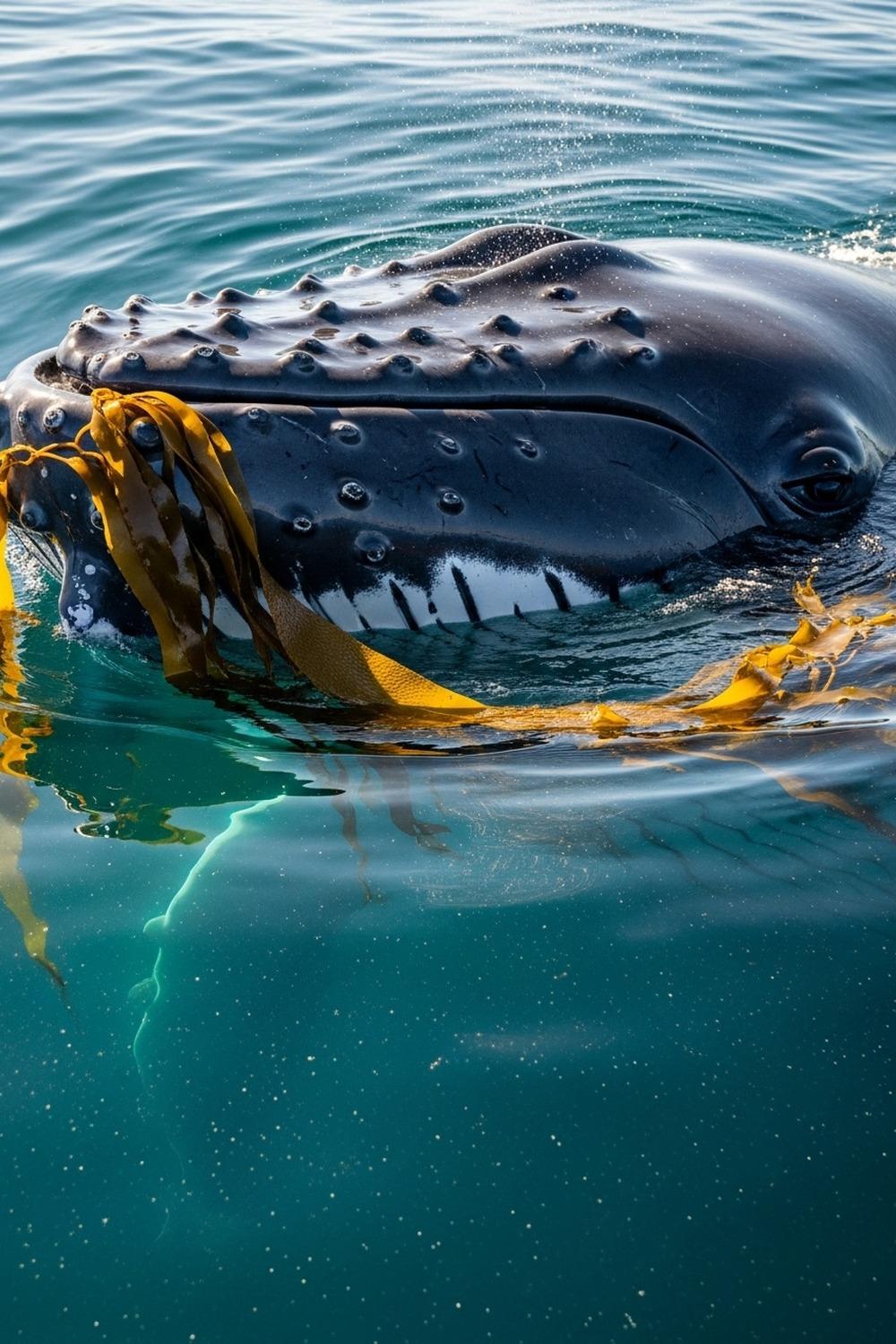
Watch a humpback whale lift a ribbon of kelp and hold it motionless against its snout, and you’re not seeing play — you’re seeing deliberate tool use, social transmission, and evidence that kelping behavior in whales is rewriting everything we thought we knew about cetacean intelligence in the wild.
Multiple ocean populations now show this behavior. Humpbacks off Australia. Humpbacks off New England. Orca pods in the North Pacific. What marine biologists are documenting doesn’t look like random contact or accident. It looks engineered. Learned. Shared between individuals. Refined across generations. But here’s what nobody can fully explain yet: what, exactly, are the whales getting out of it?
Key Facts
- Macquarie University researchers published a 2022 analysis confirming deliberate, repeated kelping in Australian humpback populations.
- Kelping has been documented in humpbacks off Australia and New England and in North Pacific orca pods, spanning three ocean regions.
- Orca pods were documented passing kelp in sequences of up to 8 exchanges in a single session (Center for Whale Research, 2015).
- Kelping events were recorded roughly 3 times more frequently in juvenile humpbacks than in adults in the 2022 Macquarie dataset.
- Humpback whales can weigh up to 36,000 kilograms, and bull kelp (Nereocystis luetkeana) stipes can reach 36 meters long.
In short: Kelping behavior in whales is the deliberate use of seaweed for rubbing and social exchange, documented in humpbacks off Australia and New England and in North Pacific orcas. A 2022 Macquarie University study confirmed it is learned, not instinctive, and the fact juveniles do it 3 times more than adults suggests whale culture can bubble up from play.
What Kelping Behavior in Whales Actually Looks Like
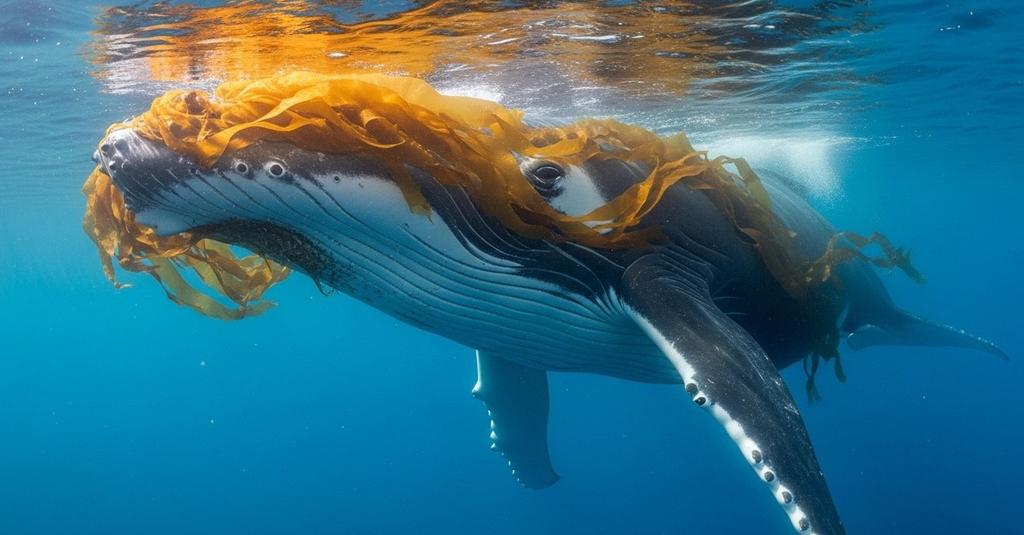
Citizen science caught this first. Hours of whale-watch video, reviewed by researchers at Macquarie University in Sydney, published findings in 2022 confirming what ocean observers had long suspected: this wasn’t incidental contact. Humpback whales were repeatedly seeking out kelp beds, maneuvering their rostrums beneath ribbons of algae, and lifting them clear of the water — then holding still. The rostrum, that broad barnacle-studded snout, functions as a near-perfect platform for balancing seaweed. The whales appeared to know it. Some individuals spent several minutes in this position, rotating slowly, working the frond along their bodies in what researchers described as a deliberate rubbing motion.
Two separate ocean basins showed the same pattern. Australian coastal waters. New England. That immediately ruled out regional quirk. Humpback whales already carried a reputation for cultural complexity — their songs evolve across populations — but kelping added a dimension entirely new.
Here’s what makes the footage so striking: whales don’t stumble into kelp and react. They navigate toward it. They select specific fronds. An animal weighing up to 36,000 kilograms, capable of breaching completely clear of the water, is making fine-motor choices about which piece of seaweed to pick up. That gap between raw power and delicate intention is where the interesting science actually lives.
Juveniles show up in the data more often than adults.
That’s not a footnote — it’s a signal. Young animals at play, experimenting with their environment, learning what their bodies can do. Sound familiar? It should.
Orcas Push It Further Than Anyone Expected
If humpback kelping is striking, orca kelping is something else entirely. North Pacific killer whale populations — documented by the Center for Whale Research off San Juan Island, Washington — show orcas not just picking up kelp individually but passing it between animals. One whale drapes a frond across its body. Another takes it. Roles reverse. The sequence repeats. No food involved. This is not foraging. What it resembles, uncomfortably closely, is mutual grooming — a behavior associated across the animal kingdom with social bonding, stress reduction, and group hierarchy reinforcement.
Why does kelp matter to orcas if they’re not eating it? Because the scrubbing function appears genuinely real. Orcas shed skin at significant rates, and the coarse, textured surface of bull kelp, Nereocystis luetkeana, with its rope-like stipe, provides mechanical exfoliation. A 2023 paper in Aquatic Mammals noted that the behavior concentrated in areas of dense kelp canopy and appeared more frequent in summer months when surface temperatures rise and skin-shedding accelerates. Correlation, not conclusive proof. But consistent enough to take seriously.
Watch the footage and something else catches your attention immediately.
The animals are calm. No threat displays. No competition for the kelp. If anything, the body language reads as relaxed — a quality that, in wild orcas, is not always easy to find. For readers who’ve followed similar stories about unexpected animal intelligence — the way some of Australia’s coastal species reveal depths of behavior that rewrite textbooks — this pattern of social tool use will feel like recognition. The ocean has a way of holding those surprises close until someone with a camera and patience finally catches them.
Social Learning Means Culture, and That Changes Everything
Here’s the detail that elevates this from curiosity to scientific argument: the distribution of kelping across geographically separated whale populations. If the behavior were hardwired — instinct — you’d expect to see it everywhere humpbacks or orcas live. You don’t. It clusters. Certain populations do it regularly; others, living in similar environments with identical kelp species access, don’t do it at all. That asymmetry is the fingerprint of social learning. One individual innovates. Others observe. The behavior spreads — not through genes, but through watching and copying. This is, by the formal definition used in behavioral ecology, culture.
A 2022 review published in Science identified cetaceans as one of the clearest non-human examples of cumulative cultural transmission — the ability to copy behaviors, build on them, refine them, and pass improved versions to the next generation. Kelping behavior in whales fits that framework with precision.
What’s counterintuitive is the direction of learning. Most researchers expected cultural transmission in whales to flow downward — adults teaching juveniles, experienced animals training naive ones. Kelping complicates that model severely. Because juveniles appear in the data more frequently than adults, some researchers now suspect the behavior may have originated in play and been adopted upward. Young animals experimenting. Older individuals observing them. Something useful being recognized by the group. That’s a reversed learning gradient. Rare in mammals. And it carries implications that extend well beyond seaweed.
And when you frame it that way, the distance between a whale with a piece of kelp and a human with a loofah becomes uncomfortably small.
Kelping Behavior in Whales: The Biology Beneath the Surface
Researchers want to know what kelping is actually doing to whale skin at the biological level. Whale skin renews itself with striking speed. Humpbacks can shed their entire outer epidermal layer multiple times per year — a process linked to thermoregulation, parasite load management, and possibly immune function. The leading hypothesis is mechanical exfoliation, and it has compelling support.
Ectoparasites — whale lice (Cyamus spp.) and barnacles — are a constant presence on humpback rostrums and pectoral fins. These are precisely the surfaces most frequently described in kelping observations. A 2021 study from the University of Queensland examined attachment sites of whale lice on humpbacks and found the highest densities concentrated exactly where kelping contact is most frequently observed. Correlation. But the spatial overlap is genuinely hard to ignore, pointing toward a functional explanation that goes beyond simple play or curiosity.
There’s also a chemical angle. Kelp — particularly Macrocystis and Nereocystis species — produces bioactive compounds, including antimicrobial polyphenols and iodine-rich phlorotannins. If whale skin absorbs even trace quantities during prolonged contact, the interaction could offer antimicrobial protection.
This remains speculative. No study has directly measured compound transfer from kelp to cetacean skin in field conditions yet. But institutions like the Woods Hole Oceanographic Institution are taking the hypothesis seriously enough to design experiments around it. The data doesn’t exist. That’s not the same as saying the mechanism doesn’t.
In populations where kelping has been observed for more than a decade, the behavior appears more common in recent years. Whether that reflects genuine cultural spread or simply better documentation remains impossible to determine from current evidence, and the difference matters enormously.
How It Unfolded
- Early 2000s — Whale-watch operators off New England begin noting repeated interactions between humpbacks and floating kelp mats, initially logged as incidental surface behavior.
- 2015 — Researchers with the Center for Whale Research formally document kelp-passing behavior in North Pacific orca pods, flagging it as a candidate for social transmission rather than individual play.
- 2021 — A University of Queensland study on whale lice distribution highlights the spatial overlap between parasite hotspots and kelping contact zones, strengthening the exfoliation hypothesis.
- 2022 — Macquarie University researchers publish systematic analysis confirming deliberate, repeated kelping in Australian humpback populations, with juvenile frequency data suggesting a play-to-culture learning pathway.
By the Numbers
- Humpback whales can weigh up to 36,000 kg — making the fine-motor precision required to balance a kelp frond on the rostrum all the more remarkable.
- Bull kelp (Nereocystis luetkeana) stipes can reach 36 meters in length, giving foraging whales access to substantial lengths of textured, scrubbing material.
- Orca pods documented kelp-passing in sequences of up to 8 exchanges between individuals in a single observed session (Center for Whale Research, 2015).
- Kelping events were recorded roughly 3× more frequently in juvenile humpbacks than in adults in the 2022 Macquarie University dataset.
- Humpback whale skin can regenerate completely multiple times per year — a shedding rate that contextualizes why active exfoliation might offer measurable biological benefit.
Field Notes
- In 2022, researchers reviewing whale-watch footage from Hervey Bay, Australia, identified a single juvenile humpback interacting with kelp on four separate occasions over six days — suggesting individual preference, not random contact, is at work.
- Kelp isn’t the only material. Some orca populations have been observed rubbing against gravel beaches in what researchers call “beach rubbing” — a physically similar behavior with possible shared functional logic, though no genetic or chemical overlap has been confirmed.
- The rostrum’s barnacle coverage — which can add several centimeters of rough texture to a humpback’s snout — may itself function as a scrubbing surface, meaning the whale isn’t just using the kelp: it may be using itself on the kelp simultaneously.
- Researchers still can’t determine whether kelping provides measurable health outcomes — reduced parasite load, improved skin condition, or antimicrobial benefit — because no controlled study has yet tracked individuals before and after sustained kelping behavior over a full season.
Frequently Asked Questions
Q: What exactly is kelping behavior in whales, and how widespread is it?
Kelping behavior in whales refers to the deliberate use of seaweed — particularly kelp — for what appears to be rubbing, scrubbing, or social exchange. It’s been documented in humpback whales off Australia and New England, and in orca populations in the North Pacific. The behavior isn’t universal across all populations, which is one reason researchers believe it’s culturally transmitted rather than instinctive. Current evidence places it in at least two distinct whale species across three ocean regions.
Q: Why do researchers think this is intentional and not accidental contact?
Several lines of evidence point to deliberate intent. Whales actively navigate toward kelp beds rather than encountering them by chance. They select specific fronds, position their bodies precisely, and maintain contact for extended periods — sometimes several minutes. Orcas pass kelp between individuals in repeated sequences that rule out coincidence. The behavior also clusters in specific populations while being absent in others living in identical environments, which is the classic signature of learned rather than instinctive behavior.
Q: Does kelping actually benefit the whales physically, or is it just play?
Probably both, and the line between them may not be meaningful. The exfoliation hypothesis — that kelp physically removes dead skin and may reduce ectoparasite loads — is supported by the spatial overlap between kelping contact zones and known parasite hotspots on humpback bodies. The chemical hypothesis, involving bioactive compounds in kelp, remains unconfirmed. Play itself serves developmental functions in young mammals, so even if no direct physical benefit is proven, the behavior may still be adaptive in ways that take longer to measure.
Editor’s Take — Alex Morgan
What stops me here isn’t the spa angle — it’s the reversed learning gradient. If juveniles are innovating and adults adopting, then whale culture doesn’t flow the way we assumed. It bubbles up from play. Watching a species develop entirely new behaviors this quickly, and through mechanisms we got backwards, you realize how much our models of cetacean intelligence have been based on what we expected to see rather than what was actually happening. The seaweed is almost beside the point.
There’s a strip of kelp floating in a bay off New South Wales right now. Maybe a juvenile humpback will find it. Maybe it’ll balance that frond on its rostrum for two minutes, three minutes, working it slowly along its body while researchers on a boat above try to write down exactly what they’re seeing without letting their own astonishment get in the way. That moment — that gap between a wild animal and a behavior we don’t fully understand — is where the best science actually begins. What else are the whales doing that we haven’t thought to look for yet?
Illustrations are AI-generated. Article fact-checked and human-edited. Our editorial standards.