Banana Peel Bioplastic Dissolves in 47 Days
Here’s the thing: a material that vanishes in 47 days sounds like marketing. But banana peel bioplastic isn’t hype — it’s a flexible, food-safe wrapping film that researchers have engineered from fruit waste, and the environmental math is unambiguous. Nearly every metric that matters, it outperforms petroleum plastic. The question now is whether industrial systems can catch up to what the science already proved.
Globally, the banana industry discards roughly 40 million tonnes of peels annually. Most rot in landfills or burn in the open air. What materials scientists working out of universities in India, Brazil, and the Philippines noticed was that the packaging industry had overlooked something obvious in that waste stream for decades: a cocktail of starch, cellulose, and natural fiber with real structural potential. The question they’re answering isn’t whether banana peel bioplastic works. It’s whether the world will use it at scale.
Key Facts
- The global banana industry discards roughly 40 million tonnes of peels annually (FAO, 2022).
- Banana peel bioplastic films reached over 90% disintegration within 47 days under industrial composting conditions (CIPET, Chennai, 2022).
- Banana-starch films produced roughly 68% fewer greenhouse gas emissions per kilogram than low-density polyethylene (Resources, Conservation and Recycling, 2023).
- Conventional polyethylene food wrap persists in landfills for an estimated 500 years, versus under 180 days for banana peel bioplastic in home compost.
- Wageningen University estimated in 2022 that processing 5% of global banana peel waste could substitute about 2.3 million tonnes of conventional plastic packaging per year.
In short: Banana peel bioplastic is a flexible, food-safe wrapping film engineered from banana peel starch. It disintegrates over 90% within 47 days under industrial composting and produces roughly 68% fewer greenhouse gas emissions than polyethylene, drawing from the 40 million tonnes of peel waste discarded globally each year.
What Makes Banana Peel Bioplastic Tick
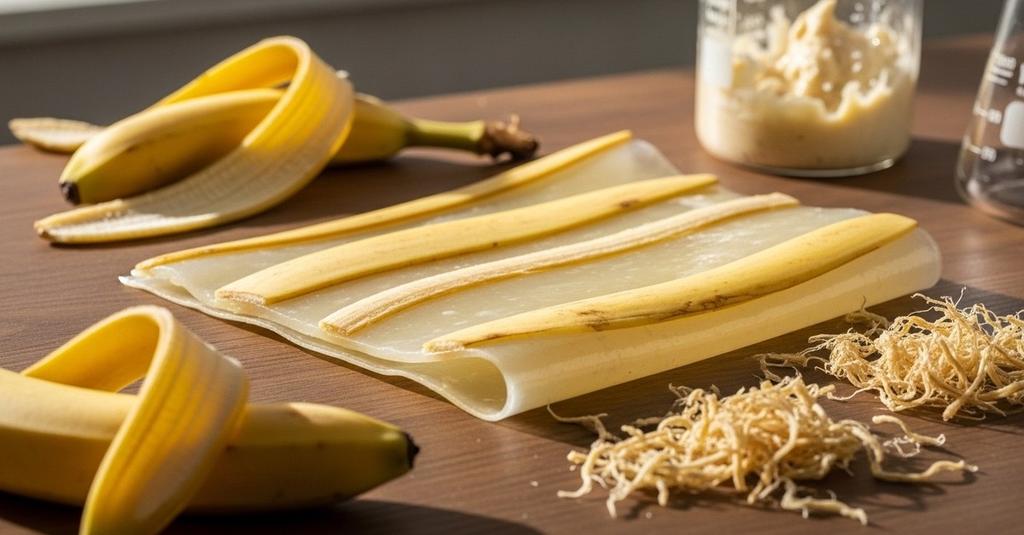
The chemistry starts almost embarrassingly simple. Dried banana peels get boiled into a concentrated slurry. That slurry is rich in starch — a polysaccharide that forms long polymer chains without synthetic binders when processed correctly. Researchers at the University of São Paulo found in 2021 that Musa acuminata peels (the Cavendish variety accounting for nearly half of global production) yield starch concentrations of up to 22 percent dry weight — competitive with cassava starch, which already underpins a mature bioplastics industry.
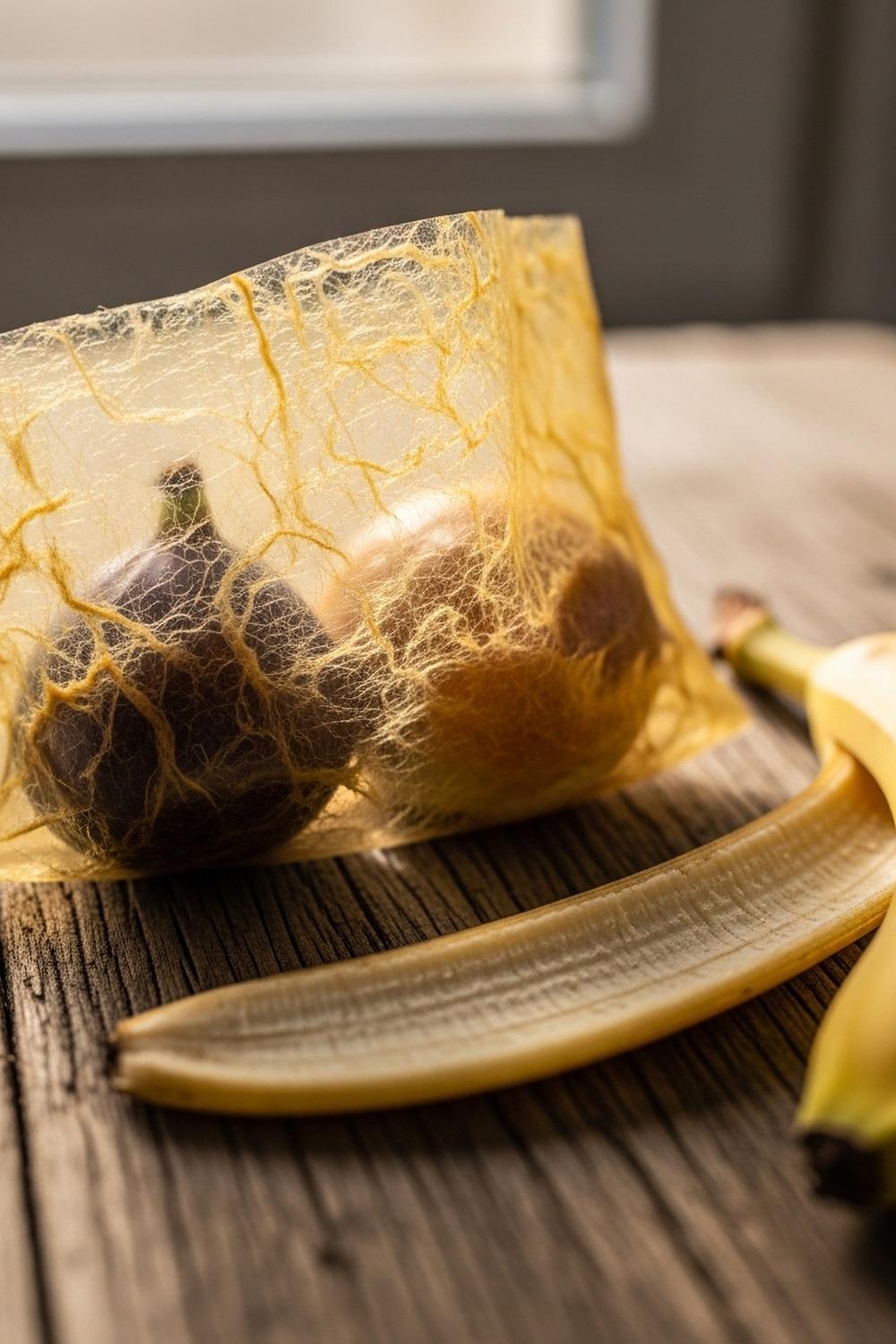
The team mixed their peel extract with plasticizers: glycerin for flexibility, acetic acid (essentially vinegar) for structural integrity. Then they ran it through tensile strength and elongation tests designed for commercial food packaging. The resulting films were translucent, slightly waxy, and flexible enough to wrap curved surfaces without cracking — a persistent failure point for earlier corn or potato starch prototypes. Better humidity handling too. It’s not that banana starch is chemically exotic. It’s that the natural fiber network in the peel — cellulose microfibrils running through the material — acts as an internal scaffold that other starch-based films simply don’t have.
That structure distributes stress across the material instead of concentrating it at weak points. The film is also non-toxic at every stage of its lifecycle. No solvents. No heavy metal catalysts. Food-grade plasticizers throughout. A wrapper that started as breakfast waste becomes compost, releasing no measurable microplastic residue.
That last part is not incidental — it’s the whole point.
Ocean Plastic Makes This Conversation Urgent
Eight million metric tonnes of plastic enter the ocean every year. That figure isn’t a projection — it comes from Jenna Jambeck’s landmark 2015 study at the University of Georgia, and subsequent sampling suggests it has only grown. A single-use food wrapper made from petroleum polyethylene or polypropylene persists in marine environments for 400 to 500 years. It doesn’t biodegrade. It photodegrades, breaking into smaller pieces until it becomes microplastic that enters fish, seabirds, and human bodies with no exit route.
Why does this matter for banana peel specifically? Because packaging represents the largest single category of plastic waste globally — roughly 36 percent of total production annually, according to OECD 2022 data. Watching a species of material replace another at scale requires intervention at exactly this leverage point — single-use food wrapping, the highest-volume category where alternatives still barely exist.
Banana peel bioplastic doesn’t solve the 150 million tonnes already circulating in marine environments. That’s worth stating plainly. But replacing even a fraction of single-use food wrappers at the production end changes the inflow calculation in meaningful ways. A 2023 lifecycle analysis in Resources, Conservation and Recycling found that banana-starch films produced roughly 68 percent fewer greenhouse gas emissions per kilogram than conventional low-density polyethylene — factoring in processing energy. The gap widens further at end-of-life: bioplastic composting versus centuries of landfill persistence.
Single-use food packaging is the hardest category to replace precisely because it requires material properties that most natural polymers can’t deliver simultaneously: flexibility, moisture resistance, and structural strength. Banana peel formulations are threading that needle. That’s rarer than it sounds.
The 47-Day Number Needs Context
Forty-seven days is real. It’s also conditional. This figure comes from controlled composting trials at the Central Institute of Plastics Engineering and Technology (CIPET) in Chennai, India, in 2022. Their trials used industrial composting conditions — sustained temperatures between 50°C and 60°C, controlled moisture, and active microbial communities. Under those conditions, banana peel bioplastic films reached greater than 90 percent disintegration within 47 days, meeting EN 13432 certification standards for compostable packaging.
The honest caveat: home composting, running cooler with less consistent microbial activity, would extend that timeline to between 90 and 180 days. Science.org has documented how the shift toward bio-based polymer films is reshaping packaging certification processes globally — CIPET’s result fits into a broader pattern of natural-material films beating petroleum equivalents on degradation timelines.
What banana peel bioplastic doesn’t do: degrade reliably in open environments. A film that lands in a river or on a beach won’t vanish in seven weeks. It needs heat and microbial activity, just like food waste in a backyard pile. This distinction matters because marketing language around “biodegradable” has blurred the line between controlled composting and open-environment degradation. Banana peel formulations don’t escape that criticism entirely — they’re compostable, specifically. The difference is not semantic.
Still, compostable is useful. Municipal composting infrastructure exists in dozens of countries. Where it doesn’t, it can be built.
Banana Peel Bioplastic From Lab to Supply Chain
The journey from university lab to commercial shelf is littered with promising bioplastics that never arrived. Polylactic acid (PLA) was supposed to transform food packaging in the early 2000s — it’s now a two-billion-dollar industry, but it captures a fraction of a percent of global plastic packaging volume. The obstacle isn’t usually chemistry.
Cost, consistency, and infrastructure stop most bioplastics before they reach scale. A 2023 Ellen MacArthur Foundation report found that bio-based packaging materials cost between 1.5 and 4 times as much per kilogram as petroleum equivalents, depending on feedstock and processing method. Right now, small-batch production in research settings runs at costs that no mass-market food brand could absorb without passing the expense directly to consumers. Banana peel bioplastic sits in that range.
But two things are shifting that calculation. First: banana processing waste is essentially free. Peels are a disposal problem for plantations and processing plants — they pay to remove them. Capturing that waste stream at scale changes the feedstock economics entirely. Second: regulatory pressure in the European Union is tightening. The EU Single-Use Plastics Directive, which came into force in 2021, has already banned certain plastic food containers and cutlery. Extensions covering packaging films are under active discussion. When regulation mandates change, cost differentials compress faster than markets otherwise allow.
A consortium of Filipino universities, including the University of the Philippines Diliman, has been piloting small-scale banana peel film production since 2022, partnering with local banana exporters in Mindanao who generate hundreds of tonnes of peel waste weekly. The films are currently being tested as wrapping for locally sold bakery products. It’s not global. It’s real, and it’s not a laboratory experiment anymore.
What Happens When the System Catches Up
Scale is where the numbers become genuinely interesting. The Philippines alone exports approximately nine million metric tonnes of bananas annually, generating peel waste in the millions of tonnes as a byproduct. Brazil, India, and Ecuador add comparable volumes. Researchers at Wageningen University in the Netherlands estimated in a 2022 feasibility study that if even five percent of global peel waste were redirected into bioplastic film production, the resulting material output could substitute for approximately 2.3 million tonnes of conventional plastic packaging per year.
Global single-use food packaging plastic production runs at roughly 80 million tonnes annually — so 2.3 million tonnes is a small fraction. Small fractions of enormous numbers remain large absolute values. They represent a starting point, not a ceiling. The compounding effect matters here. Unlike petroleum plastic infrastructure, which requires petrochemical refineries and dedicated industrial plants, banana peel processing can be distributed.
Small-scale processing units can be located close to banana plantations, reducing transport emissions and keeping value in agricultural communities rather than centralizing it in industrial hubs. That’s a fundamentally different economic geography than the one that built the plastic packaging industry. It doesn’t require dismantling existing infrastructure — it builds parallel infrastructure where agricultural waste already accumulates. In the banana-growing highlands of Mindanao, the peel waste from a single mid-sized processing facility fills truck after truck, every day, bound for disposal. Workers there have watched that material rot in open piles for years. Now some of those piles are feedstock.
How It Unfolded
- 2008 — Early academic papers from Indian agricultural universities first document the starch-extraction potential of Musa peel waste as a polymer precursor, though no film production was attempted.
- 2017 — A team at the University of São Paulo produces the first structurally viable banana peel bioplastic films in controlled lab conditions, publishing tensile and elongation data comparable to commercial packaging.
- 2021 — The EU Single-Use Plastics Directive comes into force, creating regulatory urgency that redirects industry funding toward bio-based packaging alternatives including banana-starch formulations.
- 2023 — The University of the Philippines Diliman consortium begins real-world pilot testing of banana peel films with Mindanao bakery partners, marking the first documented commercial-scale trial outside a laboratory setting.
By the Numbers
- 40 million tonnes — estimated annual global generation of banana peel waste from commercial agriculture (FAO, 2022)
- 47 days — time to greater than 90 percent disintegration under industrial composting conditions (CIPET, Chennai, 2022)
- 68% — reduction in greenhouse gas emissions per kilogram compared to low-density polyethylene, across the full lifecycle (Resources, Conservation and Recycling, 2023)
- 500 years — estimated persistence of conventional polyethylene food wrap in landfill conditions, versus under 180 days for banana peel bioplastic in home compost
- 2.3 million tonnes — estimated annual plastic packaging substitution possible if five percent of global banana peel waste were processed into bioplastic film (Wageningen University, 2022)
Field Notes
- In 2022, CIPET researchers discovered that adding turmeric extract to the banana peel formulation increased UV resistance by approximately 30 percent without compromising biodegradation rate — an unexpected finding that opens the door to outdoor and agricultural packaging applications where UV stability is currently a barrier for bioplastics.
- Banana peels contain significantly more potassium than the fruit itself, and that mineral content persists into the bioplastic film — meaning the compost produced when the film degrades is measurably nutrient-richer than compost from paper or PLA packaging breakdown.
- The natural yellow-brown tint of banana peel films — which researchers initially tried to bleach out for aesthetic reasons — has been shown in consumer trials in the Philippines to increase perceived product freshness, because buyers associate it with natural, minimally processed wrapping.
- Researchers still can’t fully predict how banana peel bioplastic films perform across highly variable humidity environments — tropical versus arid climates show divergent results in shelf-life testing, and no study has yet produced a reliable predictive model for moisture-barrier performance across the full range of global climate conditions where the material might be deployed.
Frequently Asked Questions
Q: Is banana peel bioplastic actually strong enough to replace conventional food packaging?
In controlled laboratory testing, yes — with caveats. Films produced in the University of São Paulo’s 2021 trials met tensile strength and elongation benchmarks used for commercial food wrapping applications. They handle dry and lightly moist foods well. High-moisture environments, like fresh meat or liquid-adjacent products, remain a challenge. Current formulations perform best as wrappers for bakery goods, fresh produce, and dry foods, which covers a substantial portion of the single-use packaging market.
Q: Does banana peel bioplastic break down in the ocean if it ends up there?
Not reliably or quickly. The 47-day degradation figure applies to industrial composting conditions — sustained heat and active microbial communities. Cold ocean water doesn’t provide those conditions. Degradation in marine environments would be significantly slower and less complete, potentially lasting months to years. Banana peel bioplastic is meaningfully better than polyethylene in open-environment scenarios (researchers actually call this “comparative persistence”), but it isn’t marine-degradable in any practical sense. It’s a compostable material, which is narrower and more specific.
Q: Why haven’t we been using banana peel bioplastic for years if it works so well?
Good science doesn’t translate quickly to commercial products. The cost of bio-based packaging films remains 1.5 to 4 times higher per kilogram than petroleum equivalents, according to the Ellen MacArthur Foundation’s 2023 analysis. Regulatory frameworks for certifying new food-contact materials are slow and expensive to navigate. The research has been solid for several years; the infrastructure, economics, and policy environment are only now beginning to catch up. Regulatory pressure from the EU and similar bodies is accelerating that process more than any single scientific breakthrough.
Editor’s Take — Alex Morgan
What strikes me about the banana peel bioplastic story isn’t the chemistry — it’s the economics of waste. The feedstock is free. Plantations pay to dispose of it. Processing can be distributed close to source. That’s a supply chain architecture that inverts almost everything about how the plastics industry was built. The science has been ready for longer than the coverage suggests. What’s changed is the regulatory clock — and that’s a far more reliable engine of industrial transformation than scientific elegance alone has ever been.
The wrapper on your next loaf of bread might outlast your grandchildren. Or it might dissolve quietly in a compost heap seven weeks after you toss it. Those two futures are technically available right now — the material exists, the research is solid, and the waste stream it would draw from is enormous and growing. What sits between those two futures isn’t a chemistry problem. It’s a question of whether the systems we’ve built to move products around the planet are willing to move fast enough to matter.
“
Illustrations are AI-generated. Article fact-checked and human-edited. Our editorial standards.