Why Roosters Don’t Go Deaf Crowing at 140 Decibels
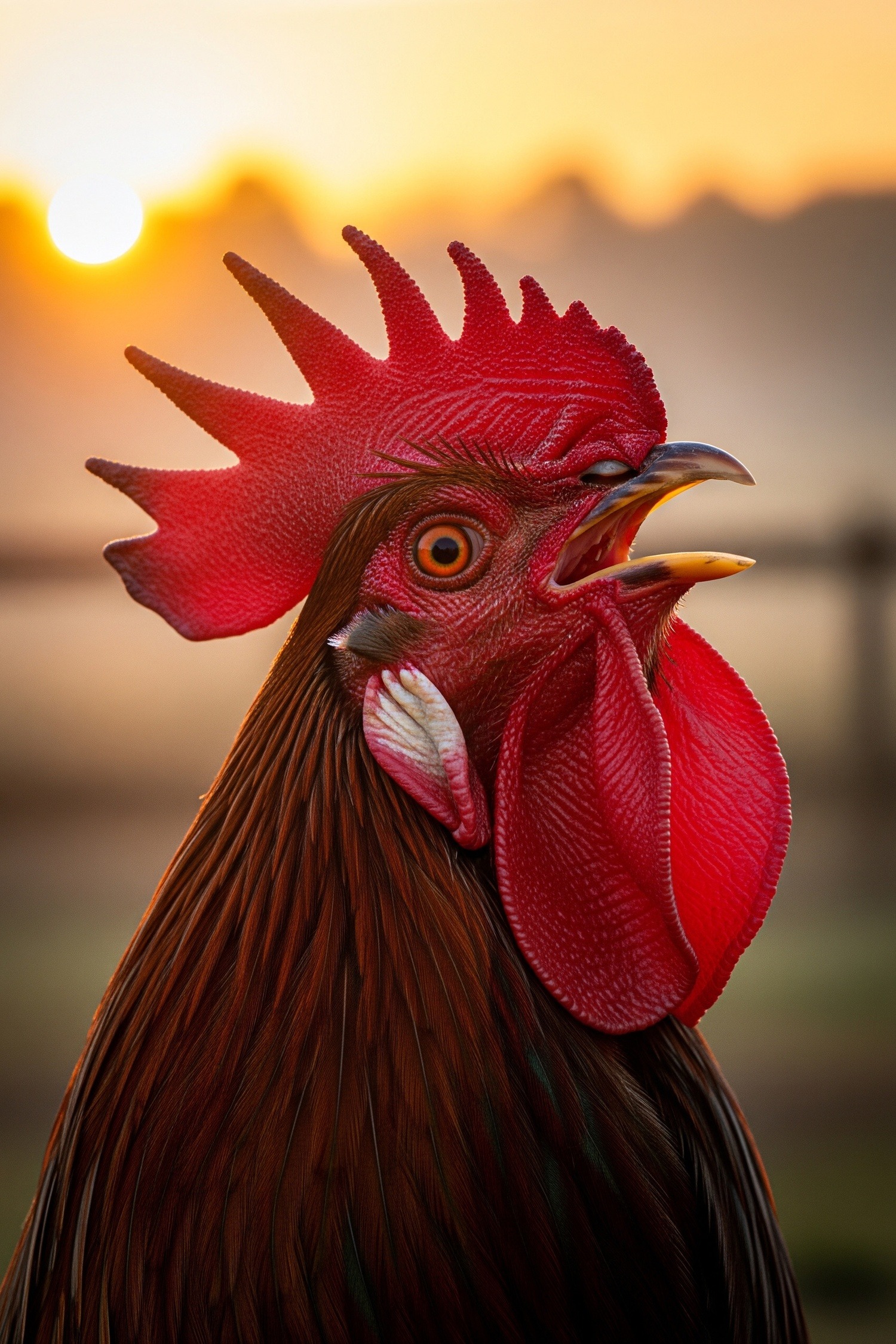
Consider this: a creature produces sound at 140 decibels — chainsaw levels, point-blank, every single morning — and walks away with perfect hearing. How roosters protect their hearing is one of biology’s most elegant and persistent unsolved riddles. The bird stands inches from its own sonic blast. No hearing loss. No damage accumulation. That paradox has driven researchers into laboratories for nearly four decades, and the answer turns out to reach much deeper than anyone initially expected.
A rooster’s crow peaks louder than a jackhammer, louder than front-row stadium seating. Industrial safety thresholds mark 85 decibels as the point where prolonged exposure begins destroying human hearing. Roosters routinely double that. Yet across the world — from smallholder farms in Vietnam to backyard coops in Ohio — domestic chickens crow for years, sometimes decades, without measurable hearing loss.
The question isn’t rhetorical anymore. Scientists now understand that two separate biological systems work in concert: one mechanical, one cellular. The mechanical system is straightforward enough. The cellular answer is where things get strange. It involves a regeneration capacity that humans lost somewhere along our evolutionary path, and that birds never abandoned.
Key Facts
- A rooster’s crow peaks at about 140 decibels at close range, comparable to a gunshot at short distance (University of Antwerp, 2018).
- When a rooster crows, its ear canal partially collapses, providing roughly 10 decibels of attenuation and cutting perceived loudness about in half.
- Birds can regenerate inner ear sensory hair cells, a capacity humans lost; University of Washington researchers first documented this in adult birds in 1988.
- A 2013 Nature study identified the transcription factor Atoh1 (Math1) as a key switch for inducing hair cell formation in adult mammalian cochleae.
- About 1.5 billion people live with disabling hearing loss worldwide, projected to exceed 900 million with noise-induced loss alone by 2050 (WHO).
In short: Two systems let roosters protect hearing from their own 140-decibel crows. Their ear canals reflexively collapse, attenuating sound by about 10 decibels, and their inner ears can regenerate damaged hair cells within days, a capacity humans lost. Documented since 1988, this regeneration drives research toward reversing human hearing loss.
The Anatomy Behind How Roosters Protect Their Hearing
When a rooster opens its beak to crow, the ear canal partially closes. That’s the first defense. Research from the University of Antwerp in 2018 — using high-speed CT imaging of crowing roosters — confirmed this self-triggered reflex happens instantaneously, the soft tissue surrounding the external auditory canal deforming inward, compressing the canal by roughly half its resting diameter. Sound attenuation reaches as much as 10 decibels. Every 10-decibel reduction cuts perceived loudness in half. The rooster is wearing built-in earplugs, deploying them automatically, without thought. Hearing protection engineers have studied it as a model for passive acoustic shielding in industrial environments.
But mechanical compression alone doesn’t account for the full picture. Why does this matter? Because the rooster’s eardrum also sits within a particularly well-cushioned anatomical pocket, where surrounding tissue absorbs shock by distributing vibration rather than concentrating it.
Think of the difference between punching a wall and punching a mattress — the energy has to go somewhere, but where it goes determines the damage. In the rooster’s ear, it dissipates. The eardrum survives. The columella — the tiny middle ear bone (birds have one; mammals have three) — transmits the signal onward with less structural stress than the mammalian equivalent would face under the same acoustic load.
Put both systems together and you have a creature wearing passive hearing protection built into its skull, never needing replacement, never running out of charge. It’s almost offensively elegant.
The Regeneration Secret That Changes Everything
The mechanical defenses are impressive. But the real story — the one driving hearing researchers into laboratories at 2am for four decades — is cellular regeneration. Birds can regenerate the sensory hair cells of the inner ear after damage. Humans cannot. For the 1.5 billion people worldwide living with disabling hearing loss according to the World Health Organization, this distinction is potentially the most important difference between a bird’s ear and a human’s.
When hair cells lining the cochlea — the spiral chamber of the inner ear responsible for converting sound waves into nerve signals — are destroyed by noise, disease, or age in a human, they’re gone forever. No regrowth. No repair. The loss accumulates invisibly across a lifetime until one day you realize you haven’t heard birdsong clearly in years.
Avian biology tells a different story entirely. Damage the hair cells through sustained loud noise exposure, ototoxic drugs, or direct trauma, and within days, supporting cells begin dividing. New hair cells differentiate from those divisions. Within weeks, the cochlea returns to near-normal function. The University of Washington’s Virginia Merrill Bloedel Hearing Research Center documented this rigorously in the early 1990s, tracking hair cell regeneration in chickens exposed to ototoxic aminoglycoside antibiotics. The cells grew back. The hearing recovered. One researcher on the team called it “not what we expected the inner ear to be capable of.”
Roosters don’t just tolerate their daily acoustic assault. Small damage gets fixed before the next morning’s performance. The crow never stops. The ear never breaks. It’s a closed loop that mammals simply don’t have access to, and here’s the thing: nobody fully understands why the mammalian cochlea gave this up.
What Science Has Been Trying to Steal From Birds
Discovery of avian hair cell regeneration didn’t stay in ornithology journals. It migrated fast into hearing science, generating a research field spanning gene therapy, stem cell biology, and pharmaceutical intervention. A landmark 2013 study in Nature identified the transcription factor Atoh1 — also known as Math1 — as a key molecular switch controlling hair cell differentiation in mammals. Overexpressing Atoh1 in adult mammalian cochleae encouraged new hair cell formation (and this matters more than it sounds). The implication shocked audiology departments globally: the machinery for regeneration might still exist in human ears. It might simply be switched off.
Why humans lost regenerative capacity that birds retained remains the deeper question. Leading hypotheses center on evolutionary trade-offs.
The mammalian cochlea became more sensitive and frequency-precise over millions of years, potentially at the cost of cellular flexibility needed for regeneration. The more finely tuned an instrument, the harder it is to replace individual components without disturbing the whole. Birds, whose hearing is excellent but differently structured, may have retained the trade-off space needed for repair. Watching a species develop hearing loss at this scale, watching it accelerate into the billions, you stop calling it a biological puzzle and start calling it a crisis.
Noise-induced hearing loss alone affects an estimated 466 million people worldwide, a number the WHO expects to exceed 900 million by 2050. Age-related hearing loss adds hundreds of millions more. If the molecular switch identified in avian research can be reliably activated in human cochleae, the clinical impact would be staggering — not a treatment for hearing loss, but a reversal of it.
How Roosters Protect Their Hearing: The Evolutionary Timeline
Birds diverged from the reptilian lineage roughly 250 million years ago, and the avian inner ear has been evolving along its own trajectory ever since. Hair cell regeneration capacity isn’t a recent innovation — it’s an ancient inheritance conserved across avian species from zebra finches to eagles to domestic chickens, suggesting survival advantages strong enough to never be abandoned. Cornell Lab of Ornithology researchers studying vocal communication note that acoustic self-damage would be evolutionarily catastrophic for species relying on sound for territory defense, mate attraction, and predator avoidance.
The rooster’s crow itself is part of this story. It’s not random noise. Studies at Nagoya University in 2013 demonstrated that roosters crow according to circadian rhythm driven by internal biological clock, not simply responding to light. The crow begins roughly two hours before sunrise, driven by endogenous timing, repeated at intervals throughout the day.
A rooster living five to ten years produces tens of thousands of crows. That’s tens of thousands of 140-decibel events, point-blank, self-generated. The hearing protection system doesn’t just work — it works across an entire lifetime of industrial-grade acoustic abuse.
Researchers at Leiden University Medical Center in the Netherlands are mapping precise genetic expression profiles of supporting cells in the avian cochlea, trying to identify which genes remain active in birds but are silenced in mammals. The work is painstaking, cell by cell, gene by gene. The roadmap they’re building might eventually identify exactly which biological door to knock on — and what key to use.
How It Unfolded
- 1988 — University of Washington researchers first documented spontaneous hair cell regeneration in the cochlea of adult birds, fundamentally challenging the assumption that inner ear hair cells were permanent and irreplaceable.
- 1993 — Virginia Merrill Bloedel Hearing Research Center published findings showing chickens exposed to ototoxic antibiotics fully regenerated functional hair cells and recovered measurable hearing within weeks of damage.
- 2013 — A Nature study identified Atoh1 as a key transcription factor capable of inducing limited hair cell formation in adult mammalian cochleae, opening the first credible molecular pathway toward human hearing regeneration.
- 2018 — University of Antwerp CT imaging research confirmed mechanical ear-canal collapse in crowing roosters, providing the first high-resolution anatomical evidence of the passive acoustic shielding mechanism.
By the Numbers
- 140 dB — peak sound pressure level produced by a rooster crowing at close range, comparable to a gunshot at short distance (University of Antwerp, 2018)
- 1.5 billion — people worldwide currently living with disabling hearing loss, according to the World Health Organization (2023)
- 85 dB — the threshold above which prolonged noise exposure begins causing permanent hair cell damage in humans, per OSHA occupational safety standards
- 10 dB — estimated attenuation provided by the rooster’s ear canal collapse reflex during a crow, cutting perceived loudness approximately in half
- 900 million+ — projected number of people affected by hearing loss by 2050, nearly double the current figure, according to WHO forecasts
Field Notes
- In 2013, researchers at Nagoya University demonstrated that a rooster’s crow is controlled by its internal circadian clock — not by external light cues. Even roosters kept in complete darkness began crowing on schedule, roughly two hours before their body clock expected sunrise. The crow isn’t a reaction to dawn. It’s a prediction of it.
- Birds have only one bone in the middle ear — the columella — compared to three in mammals. This simpler structure may actually reduce the mechanical stress transmitted to the inner ear during intense sound exposure, contributing to the rooster’s acoustic resilience in ways researchers are still quantifying.
- Hair cell regeneration capacity exists in fish and amphibians too — but was lost somewhere along the evolutionary branch leading to reptiles and mammals. Exactly where, and why, remains one of inner ear biology’s most actively debated questions.
- Scientists still can’t fully explain why supporting cells in the mammalian cochlea don’t divide after damage, even though similar cells in birds do. The molecular brake preventing mammalian regeneration hasn’t been definitively identified — which means the key to unlocking it hasn’t been found yet.
Frequently Asked Questions
Q: How do roosters protect their hearing from their own crows?
Two overlapping systems work in concert. First, their ear canals partially collapse the moment they begin to crow — a reflexive mechanical compression that attenuates the incoming sound by roughly 10 decibels before it reaches the inner ear. Second, if hair cell damage does occur, the avian inner ear can regenerate those cells within days or weeks, restoring function. Together, these systems allow roosters to produce 140-decibel calls daily for years without measurable hearing loss.
Q: Can humans regenerate inner ear hair cells like birds can?
Currently, no. Human cochlear hair cells, once destroyed by noise, disease, or age, do not regenerate spontaneously. The cellular machinery appears to be suppressed in mammals — likely a trade-off made during evolution of the more acoustically sensitive mammalian cochlea. However, research since the early 1990s has progressively identified the molecular pathways involved in avian regeneration, and gene therapy trials exploring how to reactivate those pathways in mammalian ears are ongoing as of 2024.
Q: Is it true that a rooster would deafen nearby hens with its crow?
This is a reasonable concern. Both male and female chickens share the ear canal compression reflex and hair cell regeneration capacity, though the effect is less pronounced in hens because they aren’t generating the sound themselves. Hens living in close proximity to frequently crowing roosters do experience some acoustic stress, but the regenerative system compensates effectively — one more reason scientists consider the avian inner ear genuinely remarkable.
Editor’s Take — Alex Morgan
What gets me about this story isn’t the rooster. It’s the 1.5 billion people on the other side of the equation — the ones whose hair cells are gone and aren’t coming back. We’ve known since 1988 that birds solve this problem effortlessly. Thirty-six years of knowing that, and we still can’t do it in a human ear. That’s not a failure of effort or funding. It’s a measure of how genuinely, humblingly difficult the biology is. The rooster crows every morning. The researchers keep showing up too.
There’s something quietly vertiginous about the fact that the answer to one of medicine’s most stubborn problems might have been crowing in a barnyard since before recorded history. Every morning, in villages and farms across every inhabited continent, roosters produce their 140-decibel alarm and suffer nothing for it. Their ears are fine. Their biology has been running a solution we’re still trying to reverse-engineer. If — when — researchers finally crack the regeneration code in a human cochlea, the rooster won’t know it made any contribution at all. It’ll just crow again at 4am, on schedule, wearing its built-in earplugs, into the dark.
Illustrations are AI-generated. Article fact-checked and human-edited. Our editorial standards.