The Tree Frog That Crawls Like a Primate, Not a Frog
Imagine a frog that refuses to jump. In the rainforests of South America, the tiger leg tree frog moves through the canopy one deliberate grip at a time — crawling like a tiny primate, not leaping like the amphibian it is. Most species of Callimedusa tomopterna behavior breaks almost every assumption about what a frog should do. Scientists have documented this strange locomotion for decades. The world is only now starting to pay attention.
Deep in the Amazon basin and across a broad arc of South American lowland forest, this small nocturnal climber has evolved a strategy that doesn’t match the textbook. It moves through the trees with a patience that feels almost mammalian. That quiet persistence, as it turns out, is no accident—it’s the result of millions of years of selection pressure in a specific ecological niche.
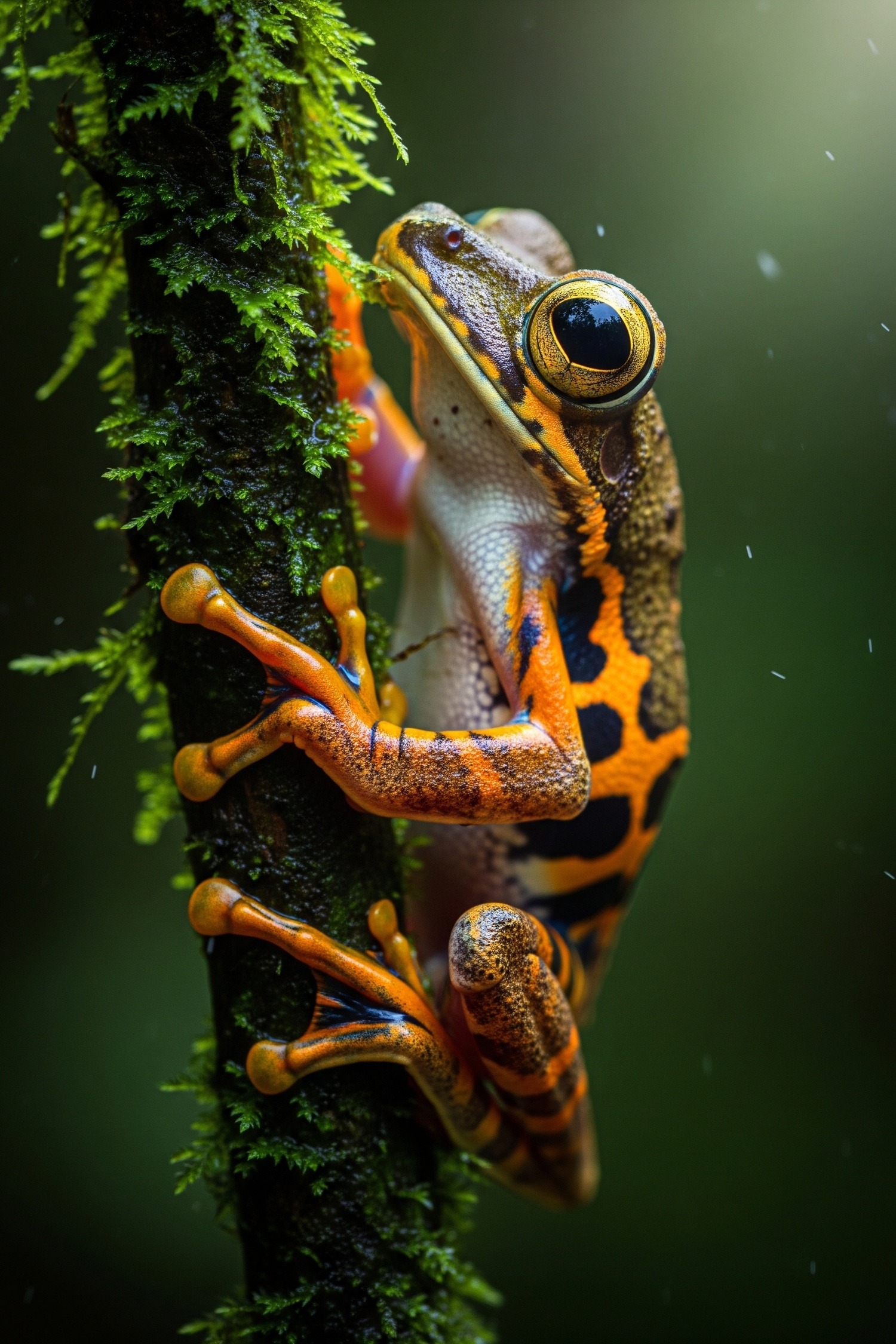
Key Facts
- Callimedusa tomopterna, the tiger leg tree frog, inhabits the Amazon basin and lowland forests across a broad arc of South America.
- Herpetologists at Brazil’s Instituto Nacional de Pesquisas da Amazônia began cataloguing arboreal frog behavior in the family Phyllomedusidae in the late 1990s.
- The Museu Paraense Emílio Goeldi, founded in 1866, has supported research indicating the orange-and-black leg banding in phyllomedusid frogs is likely aposematic in origin.
- Breeding occurs roughly from November through March, when males call from vegetation overhanging forest pools, flooded clearings, and the margins of slow-moving streams.
- Eggs are laid on leaves above water and typically hatch within five to ten days, after which the tadpoles drop directly into the water below.
In short: The tiger leg tree frog (Callimedusa tomopterna) of South American rainforests walks rather than jumps, gripping branches with a slow, alternating gait that researchers compare to a slow loris. Its hidden orange-and-black leg bands serve as a deimatic, likely aposematic bluff, and it lays eggs on leaves above forest pools.
The Frog That Walks Like a Loris
When herpetologists at Brazil’s Instituto Nacional de Pesquisas da Amazônia began cataloguing arboreal frog behavior in the late 1990s, one genus kept standing out for the wrong reasons. While most tree frogs in the family Phyllomedusidae would launch themselves between branches in characteristic bounding leaps, certain species in the group now classified under Callimedusa simply didn’t. They walked. More precisely, they gripped and stepped — moving each limb in a slow, controlled alternating pattern that researchers compared, almost apologetically, to the gait of a slow loris. That comparison stuck. The tiger leg tree frog had found its way into scientific literature as the frog that climbs like a primate, which is not a sentence that gets written very often.
Tree frogs in this group possess specialized toe pads with mucus-secreting cells that generate adhesive friction on wet leaf surfaces — but the tiger leg tree frog relies on that grip more heavily than most. Rather than using explosive leg muscles to arc through open air, it keeps at least two limbs in contact with the substrate at nearly all times. It’s a strategy built for stability, not speed. In a canopy dripping with rain at 2 a.m., that might be a smarter bet than it first appears. Watch one move for ten minutes and you start to recalibrate your mental image of what a frog is. The body barely bobs. The limbs extend and retract with quiet precision.
It looks, improbably, like something thinking about where it’s going next.
Those Stripes Aren’t Just for Show
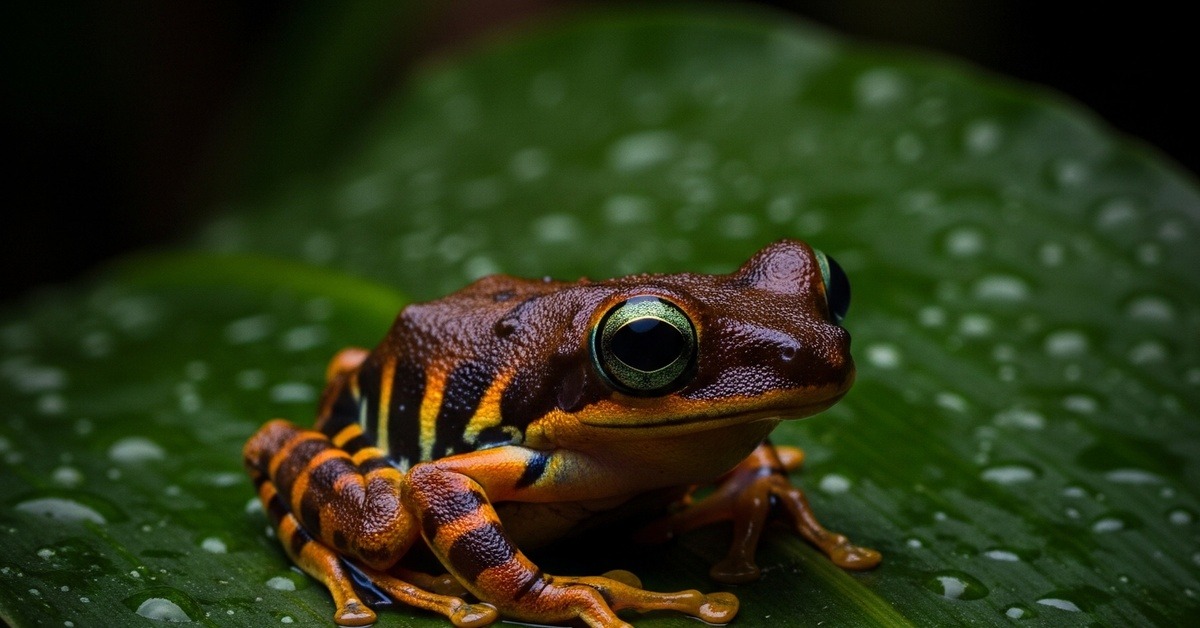
By day, the tiger leg tree frog is almost invisible. It presses itself flat against a leaf surface, legs tucked tight against its body, and its dorsal coloring — muted greens and browns — blends into the background with practiced efficiency. Flip to the underside, or catch one mid-movement at night, and something entirely different appears: vivid orange-and-black banded legs that flash into view the moment the frog extends them. Herpetologists call this strategy deimatic display — a sudden visual shock intended to startle a predator into hesitation.
It’s a behavior well-documented in a number of Neotropical amphibians, and it works on the same principle as a magician’s misdirection. The flash buys a fraction of a second. In the canopy, a fraction of a second is everything. This same logic plays out across unrelated lineages — the eyelash viper’s cryptic stillness followed by sudden explosive movement is a different adaptation but rooted in exactly the same arms race between predator and prey in dense tropical forest.
Research published through the Museu Paraense Emílio Goeldi — one of Brazil’s oldest and most respected natural history institutions, founded in 1866 — has helped establish that the orange-black patterning in phyllomedusid frogs is likely aposematic in origin, meaning it evolved as a warning signal. In this case, the frog isn’t actually toxic the way a poison dart frog is. The pattern may work as a bluff. Predators that have learned to avoid brightly banded animals — a learned association reinforced across generations of encounters with genuinely toxic species — may flinch at the tiger leg’s coloring even when the threat isn’t real. It’s evolutionary mimicry at its subtlest, and (this matters more than it sounds) it doesn’t require a single moment of actual danger to succeed.
The frog doesn’t need the bluff to work every time. It just needs it to work often enough. In an environment with dozens of predators and millions of encounters per year, even a modest success rate translates into survival. Watching a species engineer its own deception across generations, you begin to see predator-prey arms races not as conflicts but as conversations — each species speaking in the only language the forest understands.
Breeding at the Edge of the Pool
When the wet season arrives — roughly November through March across much of its range — males begin calling from vegetation overhanging standing water: forest pools, flooded clearings, the margins of slow-moving streams. The calls are relatively soft compared to many Neotropical species, suited to dense canopy rather than open broadcast. Females select mates and then, together, the pair constructs something remarkable: a clutch of eggs laid not in water, but on the surface of a leaf or leaf cluster directly above it. According to the Smithsonian Tropical Research Institute, which has tracked breeding phenology across multiple phyllomedusid species in Panama and northern South America, this leaf-clutch strategy is shared by several species in the broader family but executed with particular precision by Callimedusa tomopterna — the reproductive biology of arboreal amphibians in this clade remains one of the more actively studied areas in tropical herpetology.
What happens next tests everything. When the eggs hatch — typically within five to ten days, depending on temperature and humidity — the tadpoles don’t wait. They drop. Gravity carries them from the leaf surface directly into the water below, a journey measured in centimeters that nonetheless represents the most dangerous moment of their lives. There’s no parental escort. No protective mucus bridge. Just the physics of a small body falling through warm humid air into a forest pool. If the water level has dropped since the eggs were laid, or if the leaf was positioned poorly, the tadpoles land on mud or leaf litter instead. The strategy is elegant but unforgiving.
The tadpoles that make it are strong swimmers. They develop quickly during the wet season, racing against the drying of the pools. By the time the forest begins to dry out, the survivors have already metamorphosed and climbed back into the canopy where they started.
What Tiger Leg Tree Frogs Reveal About Amazonian Diversity
Leopold Fitzinger, an Austrian herpetologist, formally described Callimedusa tomopterna in 1843. At that time, the frog entered a sprawling taxonomic holding pen. For most of the 19th and 20th centuries, species like this were grouped into the genus Phyllomedusa, a classification system that obscured the genuine diversity of the clade. But something shifted in the early 2000s. Phylogenetic analyses conducted in the 2000s and 2010s, including landmark molecular work published by researchers at the Universidade Estadual de Campinas in Brazil, revealed that Callimedusa deserved to be separated out as a distinct genus with its own evolutionary story. That reclassification in 2017 was more than housekeeping — it was a recognition that locomotion, ecology, and morphology had diverged enough to warrant a different name entirely.
The Amazon basin currently holds an estimated 1,000-plus formally described amphibian species, a number that has climbed steadily as taxonomic work has accelerated since the 1980s.
When taxonomists split a genus, they’re not just changing labels. They’re acknowledging that the animals in question have been doing something independently for long enough that the differences are real and persistent. The tiger leg tree frog’s walking gait, its particular approach to egg deposition, its specific habitat preferences — none of these are accidents. They’re the product of millions of years of selection pressure in a specific ecological niche. Recognizing Callimedusa as distinct forces researchers to ask different questions: not “how does this frog compare to other phyllomedusids?” but “what drove this lineage in a different direction?”
The answers aren’t fully in yet. But the questions are better now than they were in 2016, and that’s real progress in a basin where dozens of amphibian species are still formally undescribed — known to exist, seen in the field, but not yet formally named.
Where to See This
- The Colombian Amazon lowlands and the Guianas offer some of the most accessible habitat — specifically the forests around Leticia, Colombia, and the Iwokrama Forest Reserve in Guyana, where night hikes with local naturalist guides during the wet season (November–March) offer the best odds of a sighting near forest pools.
- Brazil’s Instituto Nacional de Pesquisas da Amazônia (INPA), based in Manaus, runs long-term amphibian monitoring programs and occasionally hosts visiting researchers; their published species lists and coordinates are a useful starting point for any serious field trip.
- For armchair naturalists, the online database AmphibiaWeb (amphibiaweb.org), maintained by the University of California, Berkeley, has detailed species accounts, range maps, and call recordings for Callimedusa tomopterna that are free to access.
By the Numbers
- Over 1,000 amphibian species have been formally described from the Amazon basin as of 2024, according to the IUCN Amphibian Specialist Group — more than any other biome on Earth.
- Callimedusa tomopterna ranges across roughly 6 million km² of South American lowland tropical forest, from Colombian Amazonia south through Brazil and east into the Guianas.
- The species was reclassified from Phyllomedusa to Callimedusa in 2017, reflecting molecular divergence data from studies spanning nearly a decade of phylogenetic analysis.
- Leaf-clutch egg masses in Callimedusa species typically contain between 30 and 80 eggs, with tadpoles hatching and dropping into water within approximately 5–10 days of laying.
- An estimated 40% of Amazonian amphibian diversity may still be formally undescribed, based on collection gap analyses published by the Museu Paraense Emílio Goeldi in 2021.
Field Notes
- During wet-season surveys in the Peruvian Amazon in 2009, researchers from the Centro de Ornitología y Biodiversidad (CORBIDI) recorded tiger leg tree frogs traveling continuously along a single branch system for over 20 minutes without a single jump — the longest uninterrupted walking sequence documented in the literature at the time.
- Despite the striking orange-and-black leg banding, the tiger leg tree frog produces no known skin toxins — making it a likely case of Batesian mimicry, where a harmless species benefits from resemblance to dangerous ones, though formal toxicological confirmation has been limited.
- The species’ slow loris-like gait appears to be tied to its wet-substrate lifestyle: the adhesive toe pads perform better under sustained contact pressure than under the brief, high-impact touch of a landing leap, effectively inverting the usual trade-off between speed and grip.
- Researchers still can’t fully explain why this particular lineage abandoned jumping as a primary locomotion mode while closely related species in the same forest did not — whether it’s driven by predator pressure, prey strategy, or microhabitat selection remains an open question as of 2024.
Frequently Asked Questions
Q: What is the tiger leg tree frog and where does it live?
The tiger leg tree frog (Callimedusa tomopterna) is a medium-small arboreal frog native to the humid tropical lowlands of South America. Its range extends from the Colombian and Peruvian Amazon east through Brazil’s interior and into the Guianas. It favors dense forest close to standing water and is almost entirely nocturnal — essentially invisible during daylight hours when it rests pressed against leaf surfaces with legs folded flat.
Q: Why does the tiger leg tree frog crawl instead of jumping?
The crawling gait is thought to be an adaptation to wet, densely vegetated canopy environments where sustained grip is more valuable than speed. The frog’s specialized adhesive toe pads generate stronger friction under continuous contact than under the split-second impact of a landing jump. Moving slowly and deliberately also reduces the risk of displacement from slick surfaces during rain — which, in the Amazon wet season, means most of the night. It’s a trade-off that evolution has apparently found worth making.
Q: Are the orange-and-black leg stripes a sign that the tiger leg tree frog is poisonous?
This is a common assumption, but it’s almost certainly wrong. Unlike poison dart frogs, Callimedusa tomopterna doesn’t appear to produce significant skin toxins. The striking leg coloring is more likely a form of Batesian mimicry — borrowing the visual language of genuinely toxic species to gain protection without the metabolic cost of producing toxins. The flash of orange-black when the frog moves is designed to startle, not to advertise a real chemical threat. It’s a bluff, not a warning. And in a forest full of predators that have learned to respect bright colors, bluffs work remarkably well.
Editor’s Take — Alex Morgan
What gets me about this frog isn’t the walking — it’s the reclassification. For over 170 years, Callimedusa tomopterna sat inside a genus that effectively hid its distinctiveness. The 2017 split didn’t discover a new animal; it finally acknowledged what the animal had always been. How many other species are sitting in taxonomic holding pens right now, their genuine evolutionary stories buried under a label assigned in 1843? The Amazon doesn’t just have more species than anywhere else. It has more species we haven’t properly understood yet.
There are frogs in this forest that have been rewriting the rules of amphibian biology for millions of years without anyone keeping score. The tiger leg tree frog is one of the more obvious examples — obvious, at least, once you know to look for it. But it spent most of recorded scientific history lumped in with its cousins, its slow deliberate walk just a footnote in someone else’s genus. The Amazon is vast enough to hide a thousand stories like this one. Somewhere out there, right now, something small and extraordinary is crawling through the dark on a rain-slicked branch, entirely indifferent to whether we’ve named it yet.
Illustrations are AI-generated. Article fact-checked and human-edited.