The Butterfly Found at 19,000 Feet in the Himalayas
A butterfly. Two inches across. Found alive at 18,950 feet in the Himalayas, riding thermal currents where the air holds barely a third of the oxygen it does at sea level.
Turns out nobody was expecting to find it there. That’s the part that makes it genuinely strange.
Researchers documenting mountain biodiversity across the Hindu Kush-Himalayan range spotted a small tortoiseshell, Aglais urticae, wings open, moving deliberately through the thin air off glaciers at an altitude where most helicopters start struggling. The discovery came almost as an accident — a specimen nobody had a framework for explaining. And that forced the entire field to reconsider what they thought they understood about insect physiology and how creatures navigate extreme environments.
To put the elevation in plain terms: the butterfly was higher than the summit of the Matterhorn, higher than any peak in the contiguous United States, and only a few thousand feet shy of the cruising ceiling of a small bush plane. That a creature weighing less than a paperclip was up there — not dead, not falling, but flying — is the kind of fact that quietly rearranges what you assume about the limits of living things.
Key Facts
- A small tortoiseshell butterfly, Aglais urticae, was documented alive at 18,950 feet in the Hindu Kush-Himalayan range.
- At 18,950 feet the atmosphere holds only about one third of the oxygen available at sea level.
- The recorded altitude is higher than Denali’s summit and higher than any peak in the contiguous United States.
- Insects breathe by direct diffusion through tracheae and spiracles rather than lungs, a system that struggles when atmospheric pressure drops.
- Aglais urticae overwinters in Europe as a fully formed adult, sheltering in barns, hollow trees, and sheds rather than migrating or pupating.
In short: Researchers in the Hindu Kush-Himalayan range documented a small tortoiseshell butterfly, Aglais urticae, flying at 18,950 feet, where oxygen is roughly one third of sea-level levels. The insect appears to ride anabatic winds upslope rather than climb under its own power, drawing on its existing cold-tolerance and adult overwintering biology.
How the Highest Flying Insect Broke Every Rule
At 18,950 feet, the atmosphere holds barely a third of the oxygen available at sea level. For context, that’s higher than Denali’s summit and well above most commercial flight corridors over the Rockies. The math here shouldn’t work. Flight requires muscle contractions. Muscle contractions require oxygen. An insect the size of your thumb shouldn’t be capable of anything more than passing out at this altitude.
And yet.
The tortoiseshell wasn’t just surviving — it was flying. Actively riding thermals. Not clinging to life at its absolute limit, but moving with what looked like actual purpose. Nobody in the research literature had predicted this was even remotely possible. Aglais urticae research has documented this species across Europe for decades, but nothing — nothing — suggested it could operate at this altitude range. That last fact kept me reading for another hour.
There’s a deeper reason insects, of all animals, should struggle up here. They don’t breathe with lungs. They have no blood pumping oxygen to a muscle the way ours does. Instead, air diffuses directly into their tissues through a branching network of tiny tubes called tracheae, which open to the outside through pores known as spiracles. That system is elegant and fast at sea level. But diffusion depends on a pressure difference between the outside air and the inside of the body — and at 19,000 feet that difference collapses. The driving force that normally shoves oxygen into a flight muscle is suddenly a fraction of what it should be. By the rules of insect respiration, a butterfly up there should be starved of fuel within seconds of beating its wings.
The Mountain’s Own Breath Carries It Higher
Here’s what scientists working the high-altitude surveys believe is actually happening: the butterfly isn’t fighting the altitude. It’s using it.
Anabatic winds — warm air currents that funnel upward between Himalayan peaks as valley floors heat up during the day — create what you could call thermal highways. These invisible updrafts carry insects thousands of feet above where they’d normally fly, essentially offering a free ride to elevations that should be biologically impossible. The mountain breathes. Small creatures have learned to move with that breath.
The mechanism is simple physics. As the sun climbs through a clear Himalayan morning, it heats the rock and bare soil of south-facing valley walls. That warmed surface heats the air against it, the warm air becomes buoyant, and it slides upslope — pulled toward the ridgelines like water running in reverse. A butterfly that catches the leading edge of one of these currents doesn’t have to flap its way to altitude. It spreads its wings, locks into the rising column, and lets the mountain do the lifting. The energy comes from the sun and the terrain, not from the insect’s own straining muscles. That single trick rewrites the whole equation: the butterfly doesn’t need to generate enough power to climb three vertical miles, because it isn’t climbing under its own power at all.
And the small tortoiseshell is already built for this kind of thing. In Europe, it doesn’t migrate south or pupate in the fall like every other butterfly species. It overwinters as a fully formed adult — tucking into barns, hollow trees, garden sheds — and just waits. Quiet. Patient. Tough in a way most insects aren’t engineered to be. It doesn’t die. It pauses.
That cold tolerance isn’t incidental. It’s foundational to everything else. A creature that can shut down its metabolism and weather months of near-freezing dormancy already carries the biochemical toolkit for surviving a sudden plunge in temperature — exactly the conditions it meets when a thermal hauls it into the deep cold above the glaciers.
What This Record Altitude Tells Us About Life’s Limits
The highest flying insect record matters beyond the headline because it’s a data point in a much larger conversation. Climate change is redrawing the maps of where creatures can live and move. As Himalayan glaciers retreat and average temperatures climb at altitude, thermal patterns are shifting. Insects that once had hard biological ceilings are finding those ceilings raised — sometimes dramatically.
Researchers tracking biodiversity across high-altitude ecosystems are increasingly finding species at elevations that don’t match any historical record. Other insects have been spotted at unexpected heights across the Tibetan Plateau and the Andes. Something is changing in the vertical geography of the natural world.
It helps to remember that mountains have always functioned as living laboratories for this kind of question. Climb a single Himalayan slope and you pass through an entire stack of climate zones — subtropical forest, temperate woodland, alpine meadow, bare scree, permanent ice — in the space of a few horizontal miles. Each band hosts species tuned to its narrow conditions, and the boundaries between bands are usually sharp. When those boundaries start to blur, when a creature shows up two or three zones above where it belongs, biologists treat it as a signal. The butterfly at 19,000 feet is one of the loudest such signals anyone has recorded.
The question is how fast.
And what comes with it.
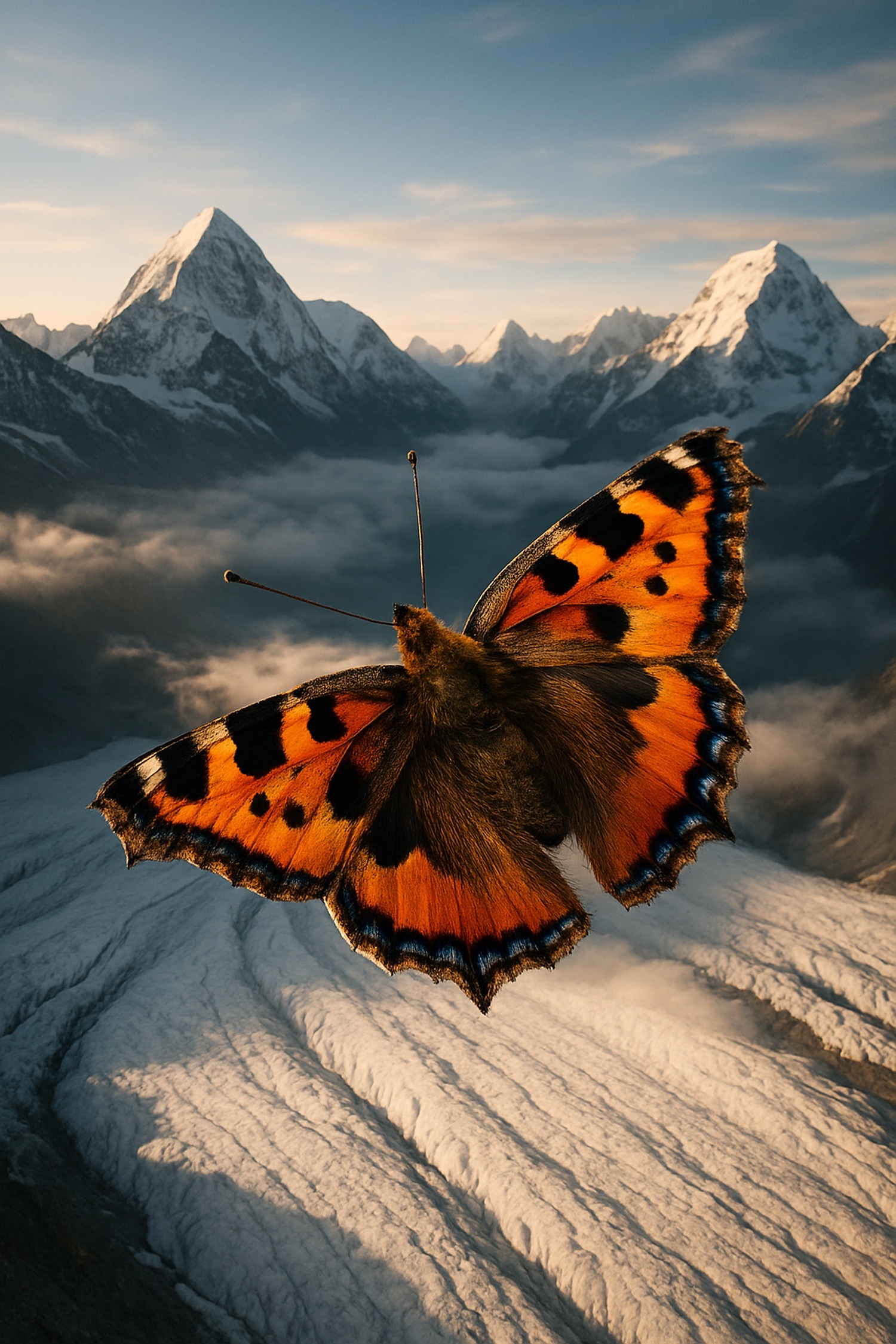
The Small Tortoiseshell Is Tougher Than It Looks
Here’s the thing about Aglais urticae — it’s one of the most familiar butterflies in the world. You’ve probably seen it on buddleia bushes in a British garden or fluttering through alpine meadows in Austria. Orange-and-black. Common. Ordinary-looking. But its physiology is quietly extreme in ways that don’t announce themselves until you dig into the research.
Studies on its cold tolerance have shown it can survive near-freezing temperatures for extended periods without cellular damage — a trait that likely underpins its ability to function where the air is brutally thin and temperature drops fast. At altitude, cold is actually the second problem. The first is lift itself.
Insect wings generate flight through rapid, precise oscillations. Thinner air means each wingbeat generates less upward force. The tortoiseshell compensates partly through those thermal currents, but also potentially through a wing-loading ratio that’s more efficient than scientists previously modeled. There’s active research happening right now to understand the aerodynamics involved. The butterfly is, unintentionally, teaching us something about flight itself.
Wing loading is the quiet hero here. It’s a measure of how much body weight each square inch of wing has to support, and butterflies sit at the gentle end of that spectrum — they carry very little mass on a generously broad wing. That makes them clumsy and slow in still air, easy prey for a bird, easily knocked off course by a breeze. But it also makes them superb gliders. A low wing-loading insect is exactly the kind of creature that can stay aloft on the faintest rising current, trading the muscular power it can’t supply at altitude for the buoyancy its broad wings hand it for free. The same body plan that makes a tortoiseshell look fragile in a garden is what lets it ghost through air far too thin for a sturdier flier.
By the Numbers
- 18,950 feet (5,794 meters) — the confirmed altitude where the small tortoiseshell was found in the Hindu Kush-Himalayan range, making it the highest insect flight ever formally documented by mountain biodiversity researchers. The previous record was held by bumblebees at around 18,000 feet.
- 35% of sea-level oxygen
- That’s less oxygen than Everest Base Camp, which sits at 17,600 feet — and the butterfly exceeded even that by nearly 1,000 feet.
- Wingspan: just 1.7 to 2.3 inches (45–62mm). The aerodynamic achievement becomes even more remarkable when you consider the surface area available to generate lift in thin air.
- Himalayan thermal updrafts can reach vertical speeds of over 1,000 feet per minute on clear afternoons, meaning a butterfly entering one near the valley floor could be lifted to extreme altitude within minutes without expending significant energy.
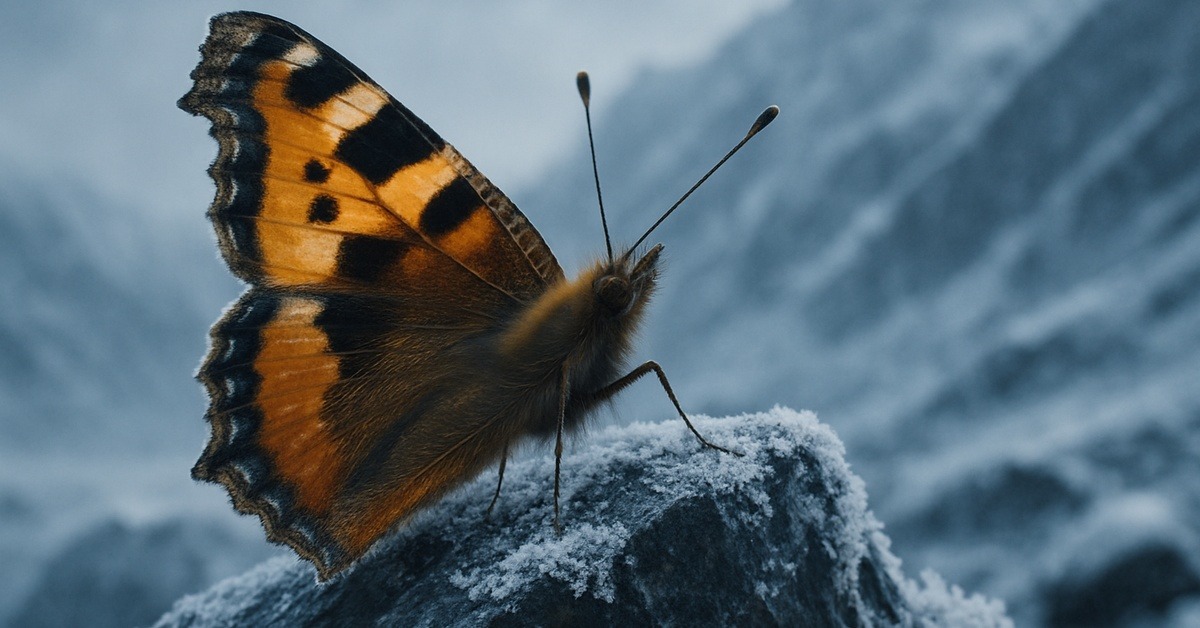
The Frozen World It Briefly Joined
What’s easy to forget is that the butterfly wasn’t drifting into a barren void. The high Himalayas, for all their lethal cold, host a thin but real community of living things — and the tortoiseshell was, for a few minutes, a visitor to it. On the glaciers themselves, in a habitat almost no one outside specialist circles ever thinks about, there is a working food web built entirely on what the wind delivers.
Scientists call it an aeolian ecosystem, after Aeolus, the Greek keeper of the winds. The base of this food chain isn’t a plant rooted in soil; it’s a steady rain of pollen, dead insects, seeds, and fragments of leaf litter lofted from the green valleys far below and dropped onto the ice. Tiny scavengers — springtails barely visible to the eye, hardy beetles, certain flies — make their living off this airborne grocery delivery, and predators eat the scavengers. The whole system runs on imports. Nothing grows up here, yet things still hunt, breed, and die on the surface of the ice.
A butterfly passing through that zone is something else again — not a resident but a high-altitude tourist, swept up and through by forces it didn’t choose. Still, its presence underlines how much life clings to the edges of the possible in places we instinctively write off as dead. The frozen high country isn’t empty. It’s just sparse, and quiet, and stranger than it looks.
Field Notes
- Adult hibernation is almost unheard of in butterfly families. The small tortoiseshell is one of the few species that overwinters as a fully formed insect rather than as a pupa or egg — it can remain dormant for months, then resume normal activity when temperatures rise.
- High-altitude insect surveys across the Hindu Kush have also recorded springtails, beetles, and fly species living directly on glaciers themselves, feeding on algae and wind-blown organic matter. Scientists call this an “aeolian ecosystem” — an entire food web that exists almost entirely on material delivered by wind from lower elevations.
- Aglais urticae ranges across Europe and Asia. It’s distributed widely enough that mountain populations have been adapting to high-altitude conditions for thousands of years, but nobody expected those adaptations to be this effective.
Why This Discovery Quietly Changes Everything
The highest flying insect on record isn’t just trivia. It’s a window into how life negotiates with extreme environments — and how those negotiations are actively changing right now. As Himalayan ecosystems shift under warming temperatures, the biological boundaries that kept certain species in certain zones are becoming porous. Insects are among the most sensitive indicators of environmental change precisely because they’re so tightly tuned to temperature, air pressure, and wind pattern. When they start showing up somewhere new, something upstream has changed.
There’s a practical reason to care, too. The Hindu Kush-Himalayan glaciers feed the great rivers of Asia — the Ganges, the Indus, the Yangtze, the Mekong — and the water security of nearly two billion people downstream rides on what happens in this high country. The same warming that lifts a butterfly’s ceiling is melting the ice that those rivers depend on. A tortoiseshell at 19,000 feet is, in a small and unexpected way, a messenger from a system under stress. It tells us the thermals are running stronger, the cold zones are softening, and the whole vertical machinery of the mountains is shifting beneath us while we mostly look the other way.
The tortoiseshell at 19,000 feet might be an outlier. A single individual caught in an unusually strong thermal on an unusually warm afternoon. Or it might be the first data point in a trend we haven’t fully recognized yet. Either way, it’s asking a question we should be taking seriously: where are the actual limits of life, and are they moving?
That’s what makes this stay with you. Not just the image of a butterfly at altitude — wings open, orange and black against white glaciers — but the implication behind it. If something this ordinary can do something this extraordinary, what else are we underestimating? What other creatures are quietly operating at the edge of what we think is possible, in places we haven’t thought to look?
Frequently Asked Questions
Q: How can a butterfly breathe in air with so little oxygen? It mostly doesn’t have to work hard for it. Insects don’t have lungs — air diffuses straight into their tissues through tiny tubes called tracheae. At 19,000 feet that diffusion is far weaker than at sea level, which is exactly why the find is so surprising. The likely answer is that the tortoiseshell isn’t powering an exhausting climb on its own muscles. By gliding on rising thermal currents, it keeps its oxygen demand low enough that even the thin air at the top of the world can supply it.
Q: Did the butterfly fly all the way up there on its own? Almost certainly not. The leading explanation is that it caught an anabatic wind — a warm updraft that funnels up between the peaks as the valleys heat through the day. Those currents can rise more than 1,000 feet per minute, so an insect that locks into one near the valley floor can be carried to extreme altitude within minutes, spending almost no energy of its own. The mountain does the lifting; the butterfly just holds its wings open and rides.
Q: Is the small tortoiseshell a rare or special species? Not at all, and that’s the strange part. Aglais urticae is one of the most common butterflies across Europe and Asia — an orange-and-black regular on garden buddleia and alpine meadows alike. What sets it apart isn’t rarity but toughness. Unlike most butterflies, it overwinters as a fully formed adult, surviving months of near-freezing dormancy without cellular damage. That built-in cold tolerance is almost certainly what lets it function in the brutal conditions above the glaciers.
Q: Does this record mean climate change is involved? It’s part of the conversation, though one butterfly can’t prove a trend. What scientists can say is that warming is altering Himalayan thermal patterns and softening the cold boundaries that used to pin species to particular elevations. Insects are sensitive enough to temperature, pressure, and wind that they often show up in new places before larger animals do. This sighting may be a lone outlier — or an early sign that the vertical limits of life are quietly being redrawn.
A two-inch butterfly riding thermals above 18,000 feet doesn’t ask permission. It doesn’t consult the limits we’ve set for it. It just flies. And somewhere in that simple fact is something worth sitting with — about resilience, about the stubborn persistence of life in places it has no business being, and about how much of the natural world is still exceeding our expectations in silence. You can find more stories like this at this-amazing-world.com, where the next one is even stranger.
Illustrations are AI-generated. Article fact-checked and human-edited. Our editorial standards.