Hummingbird Nest and Eggs: Inside a Coffee-Bean Cradle
A hummingbird nest and eggs together weigh less than a US penny — somewhere around two grams of plant down, lichen, spider silk and two pale shells the size of coffee beans. The cup is roughly the diameter of a quarter. The eggs inside are about a centimeter long. Almost everything about this object reads as physically implausible, and almost all of it is, in fact, engineered.
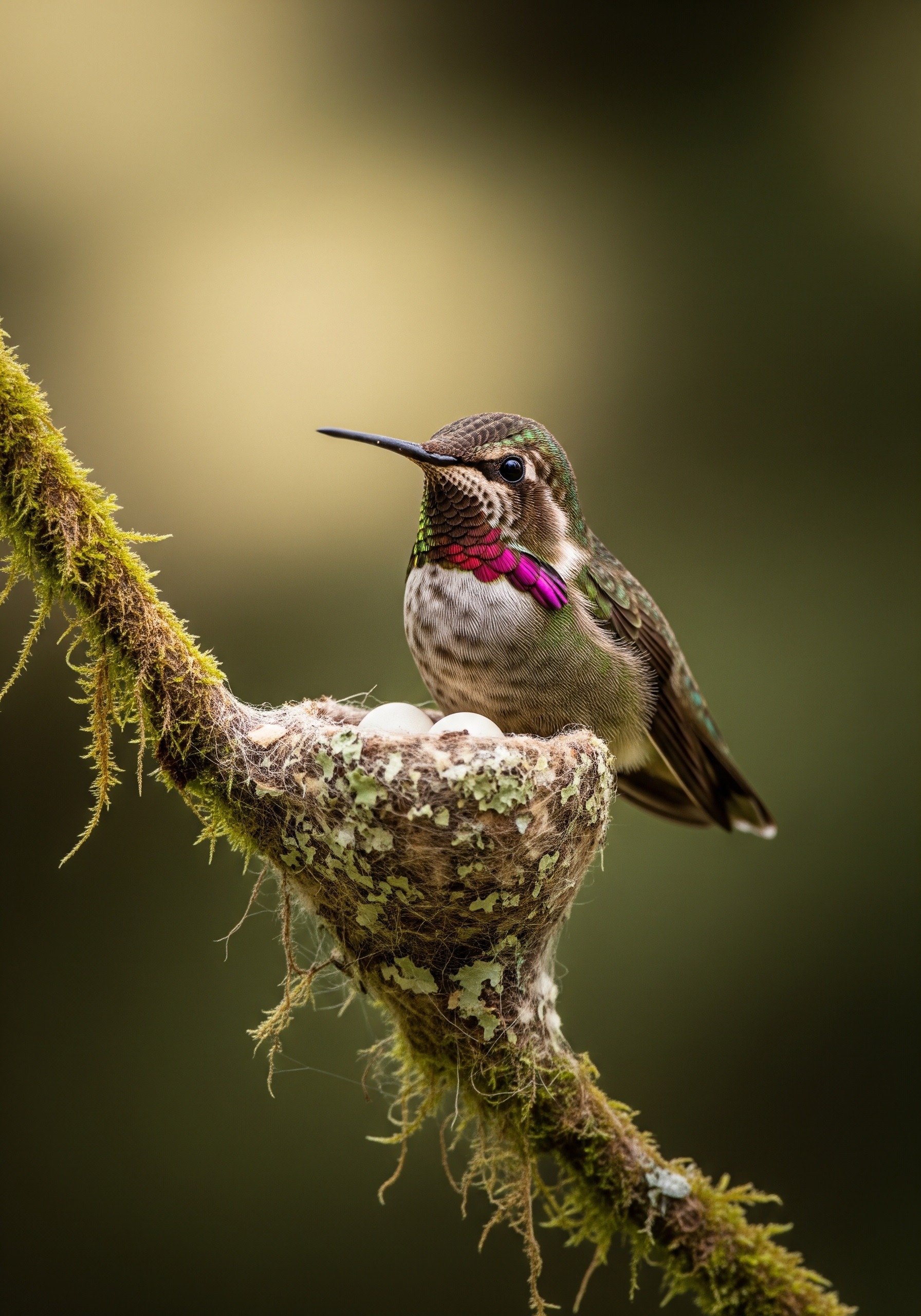
Key Facts
- Most hummingbirds lay 2 eggs per clutch; occasionally one or three.
- Eggs are roughly 12-14 mm long and about 0.5 g — close to a navy bean.
- The Bee Hummingbird of Cuba lays the world’s smallest bird egg: about 7 mm and 0.3 g.
- Nests are typically 1.5-2 inches (3.8-5 cm) across, walled with spider silk so they stretch as the chicks grow.
- Incubation lasts 14-19 days; nestlings fledge 18-28 days after hatching.
In short: A hummingbird nest is a thimble-sized cup of plant down, lichen and spider silk; inside it sit two eggs roughly the size of coffee beans. Incubation runs about two weeks, the chicks leave the nest at three to four weeks old, and the mother keeps feeding them in flight for another fortnight.
Key Facts
- Most hummingbirds lay 2 eggs per clutch, each roughly 12-14 mm long and about 0.5 g, close to the size of a navy bean.
- The Bee Hummingbird (Mellisuga helenae) of Cuba lays the world’s smallest bird egg, about 7 mm long and 0.3 g, though the Vervain Hummingbird (Mellisuga minima) recorded an even smaller egg in October 1998.
- A finished nest weighs around 2.8 grams (the mass of a copper penny) and is typically 1.5-2 inches (3.8-5 cm) across.
- Nests are walled with dragline spider silk, which is roughly five times stronger than steel and can stretch about a third of its length, so the cup expands as the chicks grow.
- Incubation lasts 14-19 days and nestlings fledge 18-28 days after hatching, with the female keeping eggs near 96 degrees F (about 35.5 C).
In short: A hummingbird nest is a thimble-sized cup of plant down, lichen and spider silk, holding two eggs roughly the size of coffee beans. Incubation runs about two weeks, the chicks leave the nest at three to four weeks old, and the mother continues feeding them in flight afterward.
What a hummingbird nest and eggs actually look like
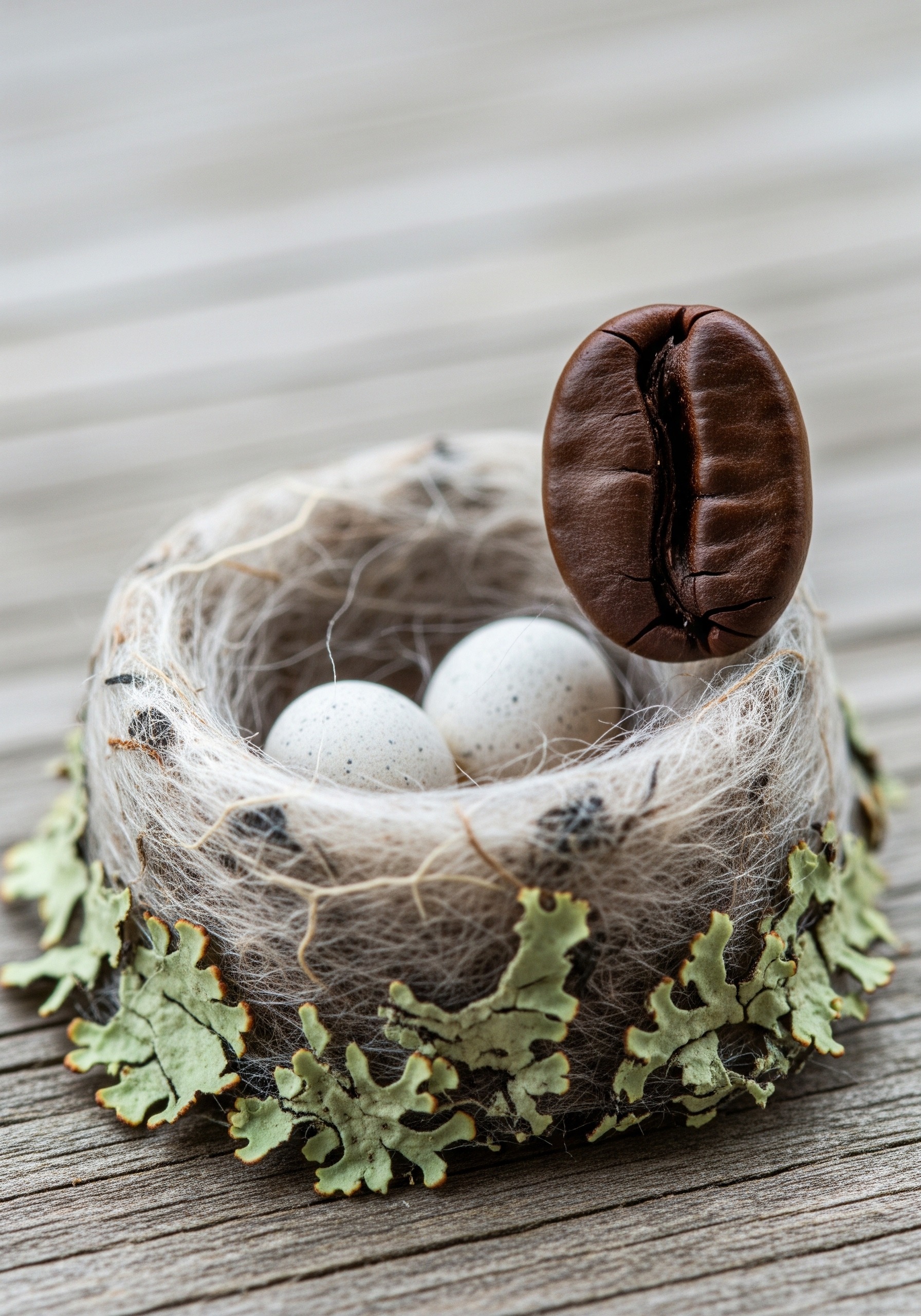
Picture a cup roughly the diameter of a US quarter. Inner depth, about one centimeter. Outer wall, a felted mat of milkweed down, thistle floss, dandelion fluff and tiny scraps of moss. The whole exterior is shingled in flakes of pale grey-green lichen, glued on with saliva and silk so that the nest looks, from any angle, like nothing more interesting than a knot on the branch.
Weight matters here. A finished hummingbird nest comes in at around a tenth of an ounce — about 2.8 grams, the mass of a copper penny. The two eggs inside add roughly another gram between them. So the entire cradle, with its full clutch, is lighter than a paperclip and a postage stamp put together. Set it on a kitchen scale and you might wonder whether the scale is broken.
Eggs smaller than a coffee bean — and who really holds the record
An average North American hummingbird egg measures about 12-14 millimeters long and 8-9 millimeters wide — close to a navy bean, just a touch shorter than a Tic Tac. Each one weighs roughly half a gram. Place one beside a chicken egg and the chicken egg looks, accurately, about a hundred times larger.
Then there is the Bee Hummingbird (Mellisuga helenae) of Cuba, the smallest bird on Earth and the holder of one of nature’s stranger title disputes. Its eggs measure roughly 7 millimeters long and weigh somewhere around 0.3 grams. For decades, Guinness records and most field guides have credited the Bee Hummingbird with the world’s smallest bird egg. Turns out, the Caribbean has competition: the closely related Vervain Hummingbird (Mellisuga minima) of Jamaica and Hispaniola was recorded in October 1998 producing an egg even smaller — under 10 millimeters and well under half a gram. The two species swap the record back and forth depending on which clutch the literature happens to be quoting, and the difference is within a coffee-bean width.
It is, in any case, the smallest egg laid by any bird on this planet.
{IMAGE_2}
The spider-silk trick — why the nest stretches
Spider silk is the part of this story most popular write-ups undersell. A female hummingbird does not just decorate her nest with it. She uses silk as the structural binder — the thread that holds every other ingredient in place and anchors the entire cup to its supporting twig. The behavior was described as early as the 18th century by the French naturalist Georges-Louis Leclerc, Comte de Buffon, and entered the formal scientific record in the 1880s.
Why silk and not, say, plant fibre alone? Two reasons, both mechanical. Pound for pound, dragline spider silk is roughly five times stronger than steel, so a few micrograms of it can carry the load of a mother and two growing chicks bouncing on a thin branch in the wind. More crucially, silk is elastic. It can stretch by about a third of its length without breaking. That second property is the quiet genius of the nest: as the two chicks balloon from raisin-sized hatchlings to feathered fledglings nearly the size of their mother, the cup expands with them. A rigid nest of pure plant down would split. A silk-bound one simply gets wider.
The female collects the silk by raiding active spider webs — and sometimes the silk-lined egg sacs of orb-weavers. She works it into the rim with her beak and pressed against her breast, anchoring outward to the twig with sticky guy-lines you can see, if you ever get close enough, glinting in low sun.
How long the eggs stay eggs — species by species
Most popular write-ups give a single answer (“about two weeks”), which is fine and also not really true. Incubation length varies meaningfully by species, by latitude and by weather. Here is the cleaner version drawn from peer-reviewed and museum sources:
| Species | Clutch | Egg size | Incubation | Fledging |
|---|---|---|---|---|
| Ruby-throated | 2 | ~13 × 8 mm | 12-14 days | 18-22 days |
| Anna’s | 2 | ~13 × 8 mm | 14-19 days | ~20 days |
| Rufous | 2 | ~13 × 8 mm | 15-17 days | 18-20 days |
| Broad-tailed | 2 | ~13 × 9 mm | 16-19 days | 21-26 days |
| Bee (Cuba) | 2 | ~7 × 5 mm | 17-19 days | 18-22 days |
One pattern is sharper than it looks: the colder and higher the nesting site, the longer the eggs typically take. A 2025 preprint on bioRxiv from researchers studying tropical montane and temperate species reported that high-elevation hummingbird females incubate in short, repeated installments — sitting tight for a few minutes, leaving briefly to feed, then returning — and that this stop-start strategy can stretch effective incubation by several days compared with lowland populations. The textbook number is an average covering a real biological scatter.
Inside the egg — two weeks of hidden work
The female keeps her eggs at a remarkably steady temperature — close to 96°F (about 35.5°C), measured by ornithologists using fine-wire thermistors and infrared cameras on monitored nests. Her brood patch, a bare strip of skin under her breast, presses directly to the shells. She rotates each egg with her beak several times an hour so the embryo does not stick to the inside of the membrane.
Here’s the thing about that internal week: a hummingbird embryo is doing roughly the same biological work — forming a four-chambered heart, the eyes, the bones, the feather follicles — that a chicken embryo does in three weeks, only inside a vessel a fraction of the size. The metabolic intensity is staggering. By the time the egg “pips” (the chick’s first crack of the shell with a temporary egg tooth on the upper beak), the bird inside fills the chamber almost completely, folded knee-to-beak.
It has roughly twelve hours to break out.
From hatch to first flight
A newly hatched hummingbird is the size of a coffee bean and weighs less than a paperclip. It is naked, blind, dark-grey, and looks more reptilian than bird. For the next three to four weeks the mother — there is no male help; he left after mating — flies in regurgitated nectar-and-insect slurry every fifteen to twenty minutes during daylight. Insect protein, more than sugar, is what builds feathers and muscle. A diet of pure nectar would, contrary to backyard intuition, starve the chicks.
Between days 18 and 28, depending on species and weather, the young birds fledge. The first flight is rarely graceful — short, low, often into a nearby shrub. The mother continues to feed them on the wing for another 10 to 14 days while they learn to find flowers, hold territory, and read the wind. Then the family quietly comes apart.
Why you’ll almost never find a hummingbird nest
The whole architecture is built around invisibility. The lichen shingles are the same lichen growing on the branch around it. The cup diameter matches the twigs the female chooses. Nests sit anywhere from a couple of metres to thirty metres above the ground — Ruby-throated females mostly pick the lower end of that range, Anna’s of coastal California will tuck into porch lights and patio rafters, and several tropical species nest under the broad shelter of large leaves to keep rain off the eggs.
If you do find one, the kindest thing you can do is leave it alone. Hummingbird mothers are skittish about disturbance; repeated approach by a person — or worse, a phone camera held a foot away — can cause her to abandon the clutch. Watch from a real distance, do not touch the nest, and resist the urge to “help” if a chick seems alone. The mother is usually feeding nearby and returns within minutes. Most popular nature articles skip this part; on a young domain trying to publish honest natural history, leaving it out feels wrong.
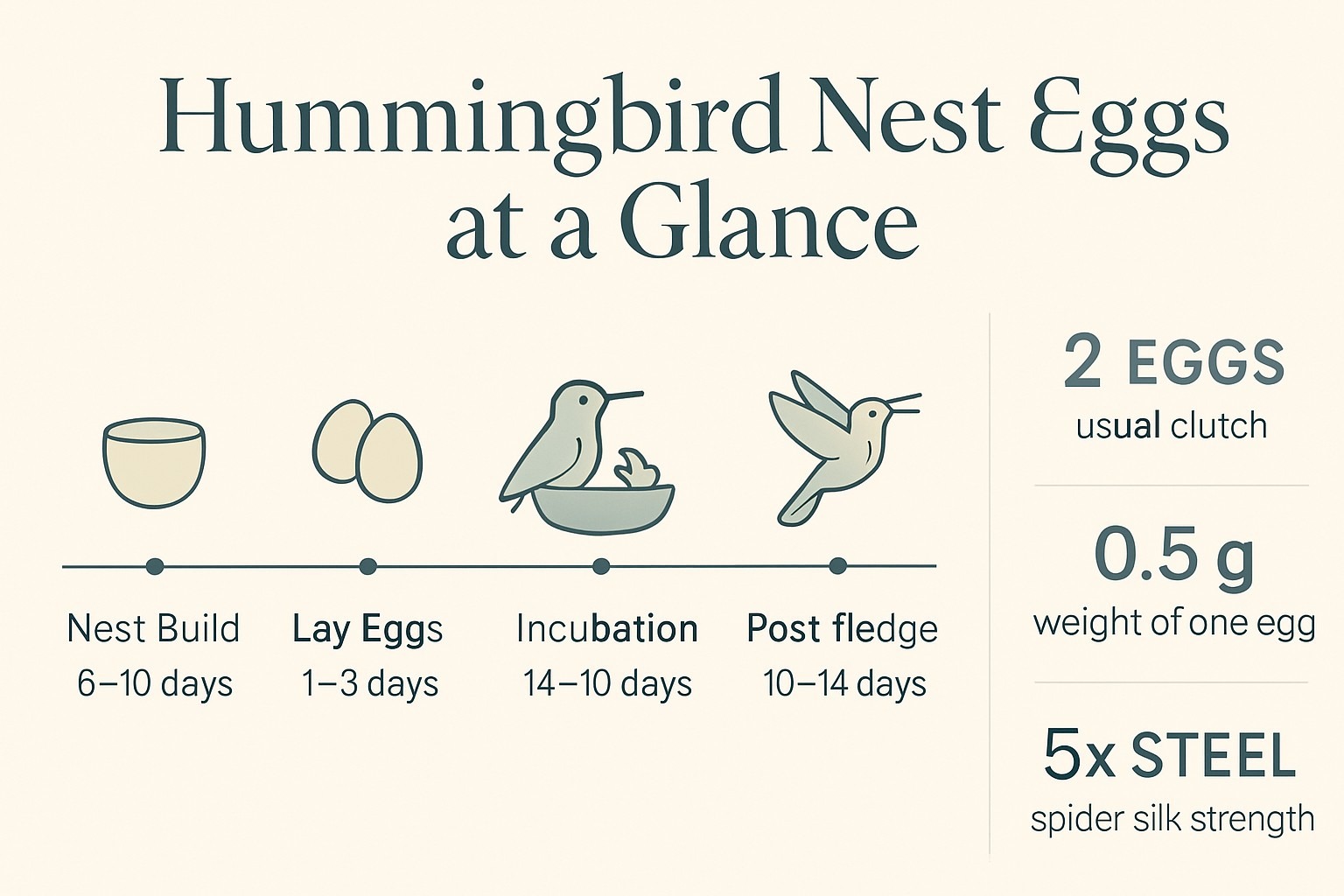
Hummingbird nest and eggs — by the numbers
- Nest cup: 1.5-2 in / 3.8-5 cm diameter, ~1 cm deep
- Nest weight (empty): ~2.8 g — about a US penny
- Egg dimensions: ~12-14 × 8-9 mm
- Egg weight: ~0.4-0.6 g per egg
- Bee Hummingbird egg: ~7 mm, ~0.3 g (smallest bird egg)
- Clutch size: almost always 2
- Brood temperature: ~96°F / 35.5°C
- Spider silk tensile strength: ~5× steel (pound-for-pound, dragline silk)
Frequently Asked Questions
Q: How big is a hummingbird egg compared with everyday objects?
A: About the size of a coffee bean, navy bean or jellybean. Most North American hummingbird eggs are 12-14 millimeters long and weigh roughly half a gram. The Bee Hummingbird of Cuba lays even smaller eggs — around 7 millimeters long and 0.3 grams, comparable to a small green pea.
Q: How many eggs do hummingbirds lay?
A: Almost always two. Clutches of one or three are recorded but unusual, and three is rare enough that some ornithologists treat it as either a measurement error or the result of two females laying in the same nest. The two eggs are typically laid one to two days apart.
Q: How long does it take a hummingbird egg to hatch?
A: Between 12 and 19 days, depending on species, latitude and weather. Ruby-throated Hummingbirds hatch fastest (12-14 days); higher-elevation or colder-climate species like the Broad-tailed run 16-19 days. A 2025 bioRxiv study found that high-altitude females extend effective incubation by sitting in short, repeated bouts rather than continuously.
Q: What is a hummingbird nest made of?
A: A felted matrix of plant down — milkweed, dandelion, thistle — bound together with spider silk and shingled on the outside with flecks of lichen for camouflage. Spider silk is both the glue and the load-bearing structure, and its elasticity lets the cup widen as the chicks grow.
Sources
- Cornell Lab of Ornithology — Birds of the World species accounts and the NestWatch nest-records database
- Smithsonian National Museum of Natural History — North American bird egg collection records
- Georges-Louis Leclerc, Comte de Buffon — Histoire Naturelle des Oiseaux, 18th-century original observations of hummingbird nest construction
- National Audubon Society — North American hummingbird species guides
- “Tropical montane and temperate hummingbirds incubate in small installments over long periods” — 2025 preprint, bioRxiv
A hummingbird nest is an object on the wrong end of every scale we use — too small, too light, too soft to do what it does. And yet, twice a summer across much of the Americas, a 3-gram bird carries a half-gram egg into a 2.8-gram cup of spider silk and, three weeks later, hands a flying animal to the world. Whatever else “well engineered” means in nature, it means that.
Illustrations are AI-generated. Article fact-checked and human-edited. Our editorial standards.