Ancient Technology of China: 10 Inventions That Built the Modern World
The ancient technology of China is, quite simply, one of the great engines of human progress — a 2,000-year run during which a single civilization invented paper, the magnetic compass, gunpowder, movable-type printing, the mechanical clock, the cast-iron blast furnace, the seismograph, the wheelbarrow, the crossbow trigger, and deep-drilling for natural gas, often centuries (sometimes a full millennium) before any of these appeared in Europe.
Key Facts
- Paper was refined by the eunuch official Cai Lun in AD 105, but archaeological fragments of plant-fibre paper from Fangmatan tomb push the technology back to roughly 2nd century BC.
- The earliest dated, printed book in the world is the Chinese Diamond Sutra of AD 868, woodblock-printed nearly 600 years before Gutenberg’s Bible.
- Bi Sheng invented movable-type printing around AD 1040 — about four centuries before Johannes Gutenberg adapted a similar idea in Mainz.
- Zhang Heng built the world’s first seismoscope in AD 132; it reportedly detected an earthquake 600 km west of the capital before riders arrived with the news.
- Chinese ironworkers were casting iron in blast furnaces by the 5th century BC — roughly 1,800 years before Europeans mastered the same process.
In short: The ancient technology of China was not a scattering of clever curiosities but a deep, sustained scientific tradition that produced the four inventions that arguably remade the modern world — paper, printing, gunpowder, and the compass — plus a long list of marvels Western readers rarely hear about. The real puzzle, as historian Joseph Needham asked, is not why China invented so much, but why the scientific revolution finally happened in Europe instead.
Key Facts
- Paper was refined by the eunuch official Cai Lun in AD 105, but plant-fibre paper fragments from the Fangmatan tomb push the technology back to roughly the 2nd century BC.
- The Chinese Diamond Sutra of AD 868 is the world’s earliest dated printed book, woodblock-printed nearly 600 years before Gutenberg’s Bible.
- Bi Sheng invented movable-type printing around AD 1040 using carved ceramic characters, about four centuries before Johannes Gutenberg.
- Zhang Heng built the world’s first seismoscope in AD 132, which reportedly detected an earthquake 600 km west of the capital before riders arrived with the news.
- Chinese ironworkers were casting iron in blast furnaces by the 5th century BC, roughly 1,800 years before Europeans mastered the same process.
In short: For about fourteen centuries, from the Han Dynasty through the Song, China was the most technologically advanced society on Earth, inventing paper, the magnetic compass, gunpowder, and movable-type printing among many other marvels. These innovations often appeared centuries or even a millennium before Europe. The deeper puzzle, posed by historian Joseph Needham, is why the scientific revolution ultimately happened in Europe rather than China.
Why the Ancient Technology of China Still Matters
For about fourteen centuries — roughly from the Han Dynasty (206 BC – AD 220) through the Song (960 – 1279) — China was the most technologically advanced society on Earth. Its engineers cast iron when Romans were still hammering it. Its astronomers logged supernovae that European clerics dismissed as omens. Its sailors crossed the Indian Ocean in nine-masted treasure ships that dwarfed Columbus’s Santa María. When the historian of science Joseph Needham began cataloguing these accomplishments at Cambridge in the 1940s, his project ballooned into the multi-volume Science and Civilisation in China — and it is still being completed today.
The popular shorthand for all of this is the “Four Great Inventions” — paper, printing, gunpowder, and the compass — a Western coinage popularized by the philosopher Francis Bacon, who wrote in 1620 that these three (he listed only the latter three) “have changed the whole face and state of things throughout the world.” Bacon did not know they were Chinese. We do.
The Four Great Inventions: A Short Inventory
The Four Great Inventions are the headline acts of Chinese science, and for good reason: each one rewired a fundamental piece of human life — communication, navigation, warfare, the spread of ideas. But the dates and details are routinely garbled in Western retellings, so it is worth setting the record straight.
Paper is the oldest of the four. Court annals credit the eunuch official Cai Lun with presenting a refined papermaking process to Emperor He of Han in AD 105, pulping mulberry bark, hemp, old rags, and fishing nets into a slurry, screening it on a flat mesh, and drying the sheets in the sun. Archaeology, however, has pushed paper itself back further: hemp-fibre fragments found in a Western Han tomb at Fangmatan date to roughly the 2nd century BC, suggesting Cai Lun standardized and improved a craft already a few centuries old.
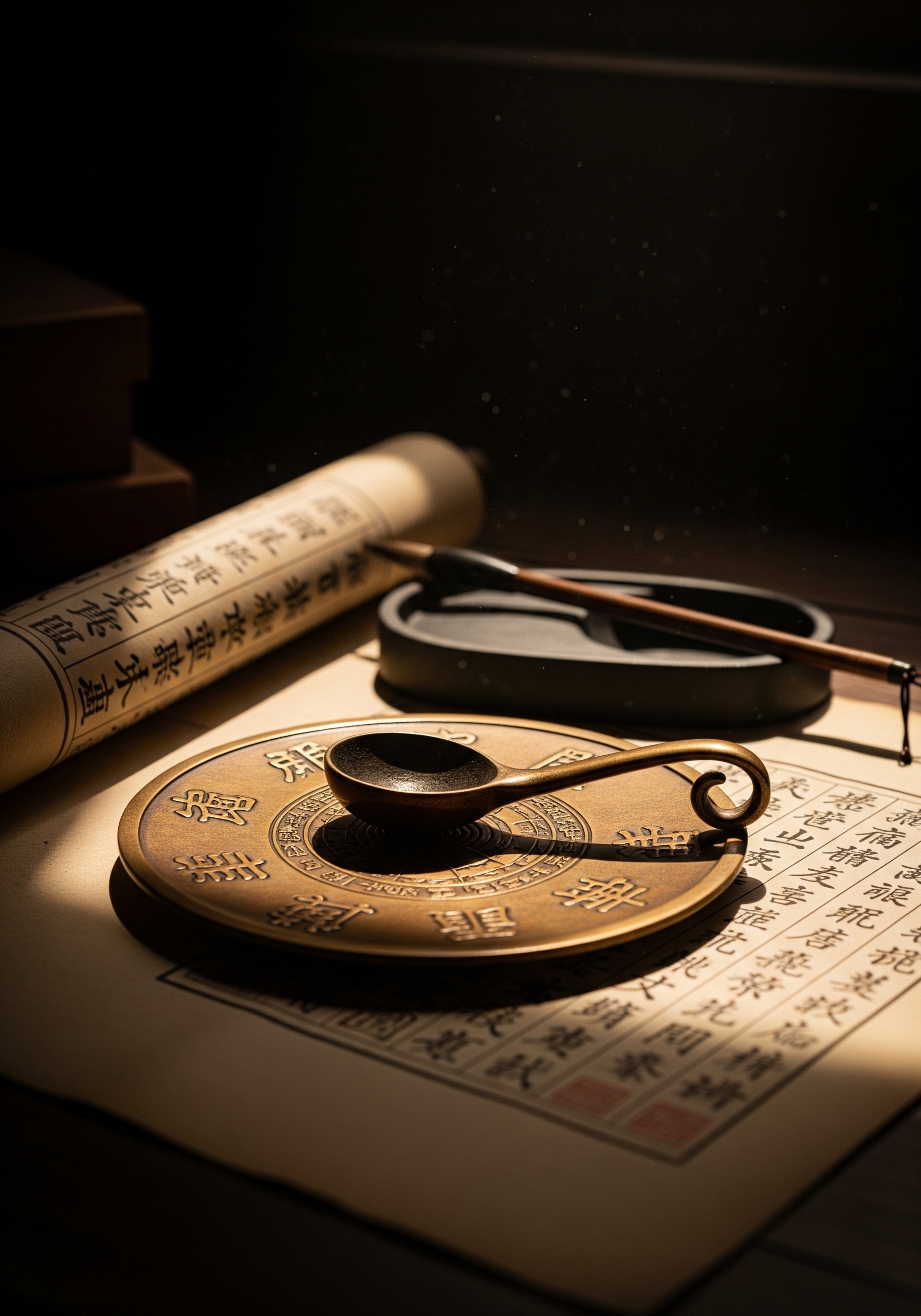
The compass began life not as a navigation tool but as a divination instrument. By the Warring States period (475 – 221 BC) Chinese geomancers were using si nan (“south-pointer”) spoons — ladles carved from naturally magnetic lodestone — to align buildings and graves with cosmic forces. The first unambiguous description of a magnetic needle used for navigation appears in Shen Kuo’s Dream Pool Essays in AD 1088, and within a century Chinese merchant junks were using floating-needle compasses to sail to the Persian Gulf.
{IMAGE_2}
Gunpowder and Movable Type: Two Tang and Song Revolutions
Gunpowder was a Taoist accident. Alchemists hunting for elixirs of immortality discovered, sometime in the 9th-century Tang Dynasty, that mixing sulfur, saltpetre (potassium nitrate), and charcoal produced something dramatically the opposite of long life. A Taoist text from around AD 850 warns initiates not to mix these ingredients, “lest the substance flare up and burn down the laboratory.” By 1044 the military manual Wujing Zongyao (“Essentials of the Military Classics”) was publishing recipes with nitrate concentrations of 27 to 50 percent, and within two centuries Song armies were defending besieged cities with fire-lances, bombs, and the first true gun barrels.
Printing arrived in two waves. Woodblock printing — entire pages carved in mirror-image relief and inked — was perfected by the Tang Dynasty (618 – 907) and produced, on 11 May 868, what remains the world’s earliest dated, printed book: a copy of the Buddhist Diamond Sutra now in the British Library, complete with an exquisite frontispiece of the Buddha at Jetavana. About 170 years later, around AD 1040, an obscure commoner named Bi Sheng invented movable type using carved ceramic characters set in an iron frame coated with resin and wax. We know about him only because Shen Kuo — that polymath compiler of the Dream Pool Essays — happened to record his neighbour’s invention. Bi Sheng predated Gutenberg by roughly four centuries.
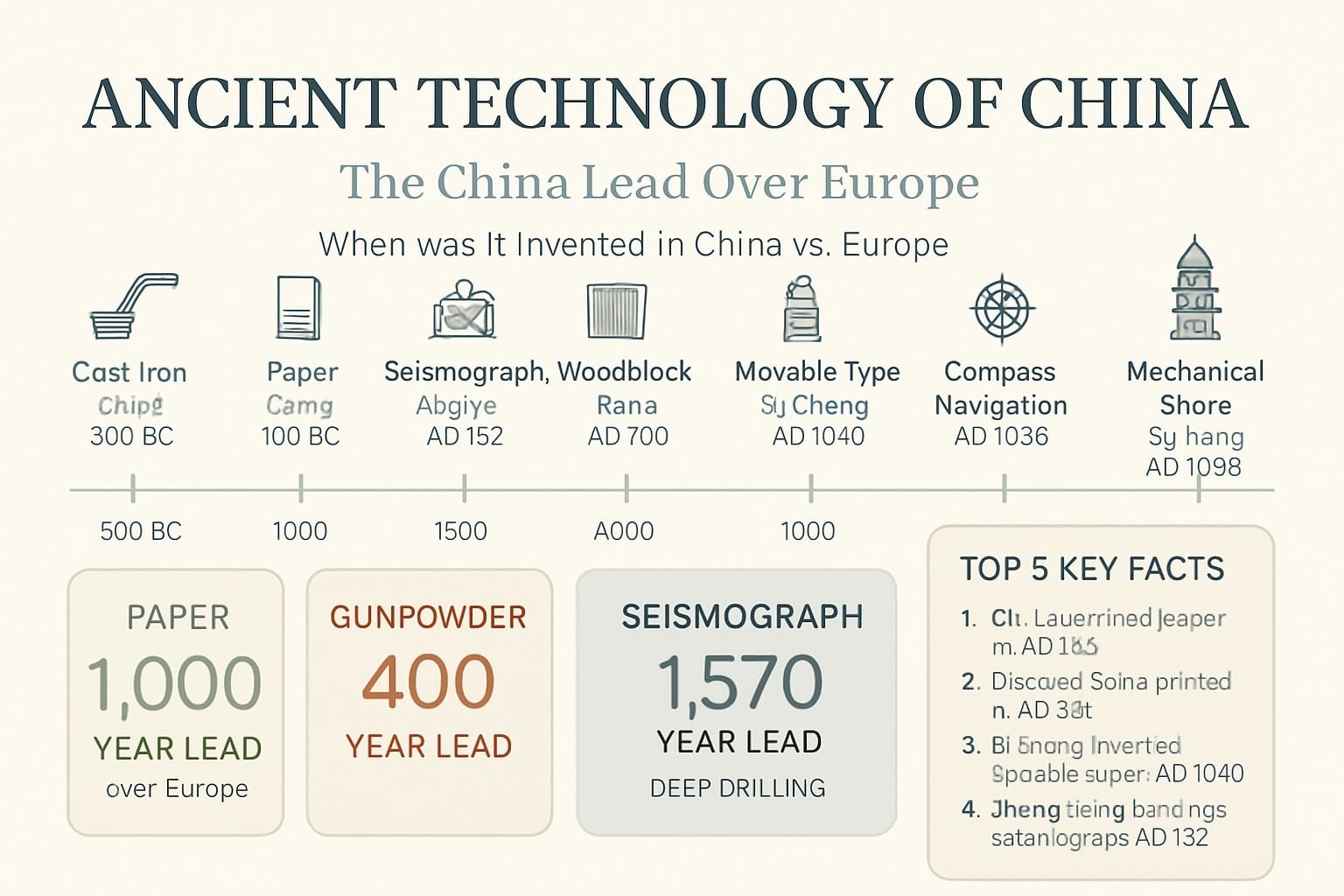
The China Lead: When Was It Invented Here vs. Europe?
- Cast iron / blast furnace — China: ~5th c. BC · Europe: ~14th c. AD · Lead: ~1,800 years
- Paper — China: 2nd c. BC – AD 105 · Europe: ~AD 1150 (via Arab Spain) · Lead: ~1,000 years
- Magnetic compass (navigation) — China: by 1088 · Europe: ~1190 · Lead: ~100 years
- Gunpowder — China: 9th c. · Europe: 13th c. · Lead: ~400 years
- Woodblock printing — China: by 7th c. · Europe: 14th c. · Lead: ~700 years
- Movable type — China (Bi Sheng): ~1040 · Europe (Gutenberg): ~1450 · Lead: ~400 years
- Seismograph — China (Zhang Heng): AD 132 · Europe: 1703 · Lead: ~1,570 years
- Deep drilling for brine / natural gas — China: 1st c. BC, Sichuan · West: 19th c. (Pennsylvania, 1859) · Lead: ~1,900 years
- Mechanical escapement clock — China (Su Song): 1088 · Europe: ~1275 · Lead: ~200 years
- Cast-iron suspension bridges — China: by 6th c. AD · Europe: 1820s · Lead: ~1,200 years
Beyond the Four: Marvels Most Histories Forget
The Four Great Inventions are only the most famous chapter of a much longer book. Pull any thread and you find another world-first.
Zhang Heng’s seismoscope (AD 132). A bronze urn six feet across, ringed by eight dragon heads each holding a ball above the open mouth of a bronze toad. When a distant earthquake jolted an internal pendulum, the dragon facing the source dropped its ball into the toad with a loud clang, pointing the imperial court toward the disaster. The Book of the Later Han records that in AD 138 the device announced a quake near Longxi — 600 kilometres west of Luoyang — days before mounted couriers arrived to confirm it.
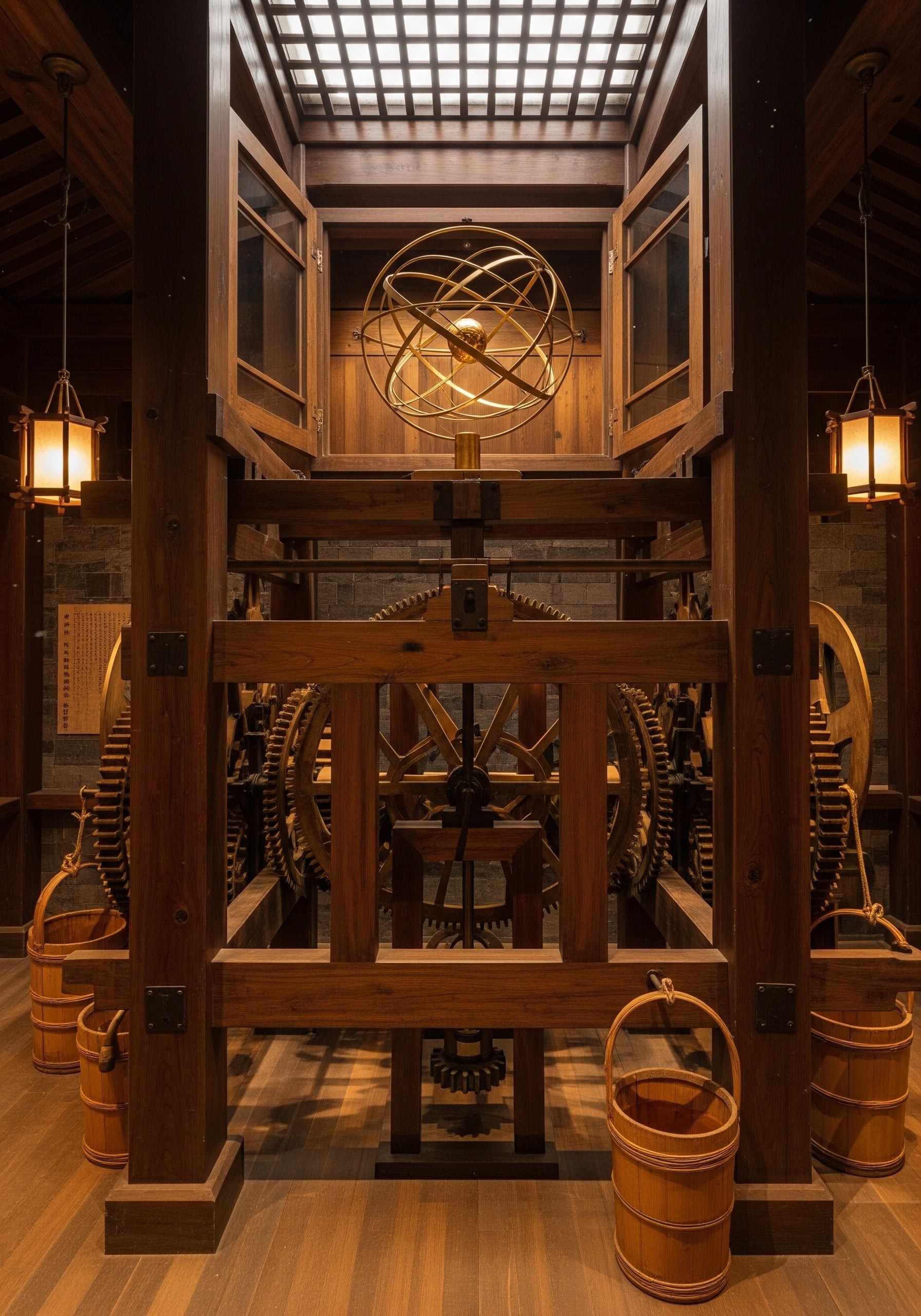
Su Song’s astronomical clock tower (AD 1088). A 12-metre-tall water-powered observatory in the Song capital of Kaifeng, with a rotating armillary sphere on top, a clockwork celestial globe inside, and a five-storey pagoda of jacquemarts that beat drums and rang bells to mark the hours. Crucially, Su Song’s clock used a true escapement mechanism — the same principle that, two centuries later, would make European tower clocks possible.
Deep drilling for brine and natural gas. By the 1st century BC, salt-makers in the Sichuan basin were drilling percussion wells with bamboo casing, heavy iron bits, and pulley-and-bullock rigs. By the Song they were going past 900 metres; by 1835 a well at Zigong reached 1,001 metres — the deepest borehole on Earth until Pennsylvania’s oil men caught up. The same wells tapped natural gas, which the Chinese piped through bamboo to evaporate brine, inventing on-purpose industrial use of fossil gas roughly nineteen centuries before Texas.
Cast iron, the blast furnace, and the wheelbarrow. Chinese metallurgists were pouring molten iron into moulds by the 5th century BC, using vertical blast furnaces fed by water-powered bellows — the technology Europe finally reinvented in the 14th century. The humble wheelbarrow, dated by the historian Zhuge Liang’s biographers to the 3rd century AD, increased a labourer’s haul-and-distance productivity perhaps fivefold and became standard military logistics for the Three Kingdoms armies.
The crossbow, the stirrup, and the harness. A bronze crossbow trigger with a precision-cast sear mechanism — found in tombs as early as the 5th century BC — let a peasant conscript punch through aristocratic armour. The stirrup, in use by AD 322, gave cavalry the leverage to wield a lance from horseback. And the collar harness, in use by the Han, let a horse pull at the shoulder instead of strangling on a throat-strap, multiplying agricultural and transport draft power.
Engineering at Imperial Scale
Chinese technology was not only inventive; it was also colossal. The Great Wall, in its various dynastic incarnations, runs more than 21,000 kilometres. The Grand Canal, completed in AD 609 under the Sui, links Beijing to Hangzhou over 1,776 kilometres — still the longest artificial waterway in the world. The Anji Bridge in Hebei, finished around AD 605, is the oldest open-spandrel segmental arch bridge anywhere on the planet, and the architect Li Chun’s design influenced bridge-builders for the next 1,400 years.
At sea, the great Ming admiral Zheng He led seven expeditions between 1405 and 1433 in fleets of up to 300 ships and 28,000 men. His treasure ships, by contemporary Chinese accounts, were 120 metres long — more than four times the length of Columbus’s Santa María. They sailed with watertight bulkheads (a Chinese invention later credited to Marco Polo’s reports) and stern-mounted axial rudders, both of which Europe would adopt only generations later.
You can sense the cumulative effect of this technological estate in the way it reshaped daily life — and you can see the same imperial appetite for scale in the engineering programs we cover in our cluster on the engineering of the Great Wall and on the trade arteries of the Silk Road.
The Needham Question: Why Did the Lead Slip Away?
If China was so far ahead for so long, why did the scientific revolution and the Industrial Revolution happen in Europe? Joseph Needham himself posed this puzzle, and historians have argued over it ever since.
The honest answer is: nobody knows for certain, but several factors overlap. The Confucian-Imperial examination system rewarded literary and philological mastery, not engineering. After the Yongle Emperor’s death in 1424, China’s outward-facing maritime program was abandoned and the treasure-ship fleet rotted at anchor; the Ming and Qing turned inward. Europe, by contrast, was a patchwork of competing states that could not afford to ignore any productive idea — and its merchant classes, unlike China’s shi-nong-gong-shang hierarchy, sat near the top of the social order. Capital, competition, and crucially, the printing press (now mass-produced and Latin-alphabet-friendly) compounded into a feedback loop China’s bureaucracy never quite caught.
Whatever the cause, the inheritance is undeniable. The Cambridge-based Needham Research Institute still maintains Needham’s archive and continues the work, and major museum collections such as those at the British Museum hold the very Diamond Sutra printed in AD 868. The artifacts are real, the dates are documented, and the story keeps getting larger.
Frequently Asked Questions
Q: What are the Four Great Inventions of ancient China?
A: Paper (refined by Cai Lun in AD 105), printing (woodblock by the 7th century, movable type by Bi Sheng around AD 1040), gunpowder (9th-century Tang Dynasty), and the magnetic compass (used for navigation by AD 1088). The grouping was popularised in the West by Francis Bacon in 1620 and codified for Chinese readers by missionaries and historians in the late 19th century.
Q: Did the ancient Chinese really invent gunpowder before Europe?
A: Yes — by about four centuries. Chinese Taoist alchemists describe the explosive sulfur-saltpetre-charcoal mixture in texts from the mid-9th century, and by 1044 the formula was already in printed military manuals. Gunpowder reached the Islamic world in the 13th century and Europe shortly afterwards, where it was rapidly adapted into cannons and handguns.
Q: What ancient Chinese inventions are most underrated outside China?
A: Zhang Heng’s seismograph (AD 132), Su Song’s escapement clock (1088), Sichuan’s percussion deep-drilling for natural gas (1st century BC), the cast-iron blast furnace (5th century BC), watertight bulkheads on ships, the collar harness for horses, and the suspension bridge. Each predates its European counterpart by centuries, sometimes more than a millennium.
Q: Why did China’s technological lead end?
A: The “Needham Question” has no single answer. Most historians point to a combination: the Confucian exam system rewarded classical learning over engineering, the Ming Dynasty abandoned its ocean-going fleet after 1433, merchant capital was constrained by the imperial bureaucracy, and Europe’s competitive multi-state system plus the Gutenberg press compounded innovation in a way the unified Chinese empire did not. None of this erases the prior 1,500-year run of Chinese primacy in technology.
The Long Shadow
Every time you flip on a light switch and read a printed page; every time a phone in your pocket uses its magnetometer to orient a map; every time a bridge’s iron understructure carries a train; every time a doctor reads a seismogram — you are using, in a translated form, ancient Chinese technology. The four-syllable phrase “ancient technology of china” is doing a lot of work. It is shorthand for two thousand years of cumulative human ingenuity, an inheritance shared by every literate civilization on Earth.
The next time someone calls our era the “age of invention,” it is worth remembering that the Han dynasty got there first, the Tang and Song deepened it, and our entire modern world is still riding on the rails they laid down.
Illustrations are AI-generated. Article fact-checked and human-edited. Our editorial standards.