The Beetle Larvae That Impersonate Bees to Steal Their Nests
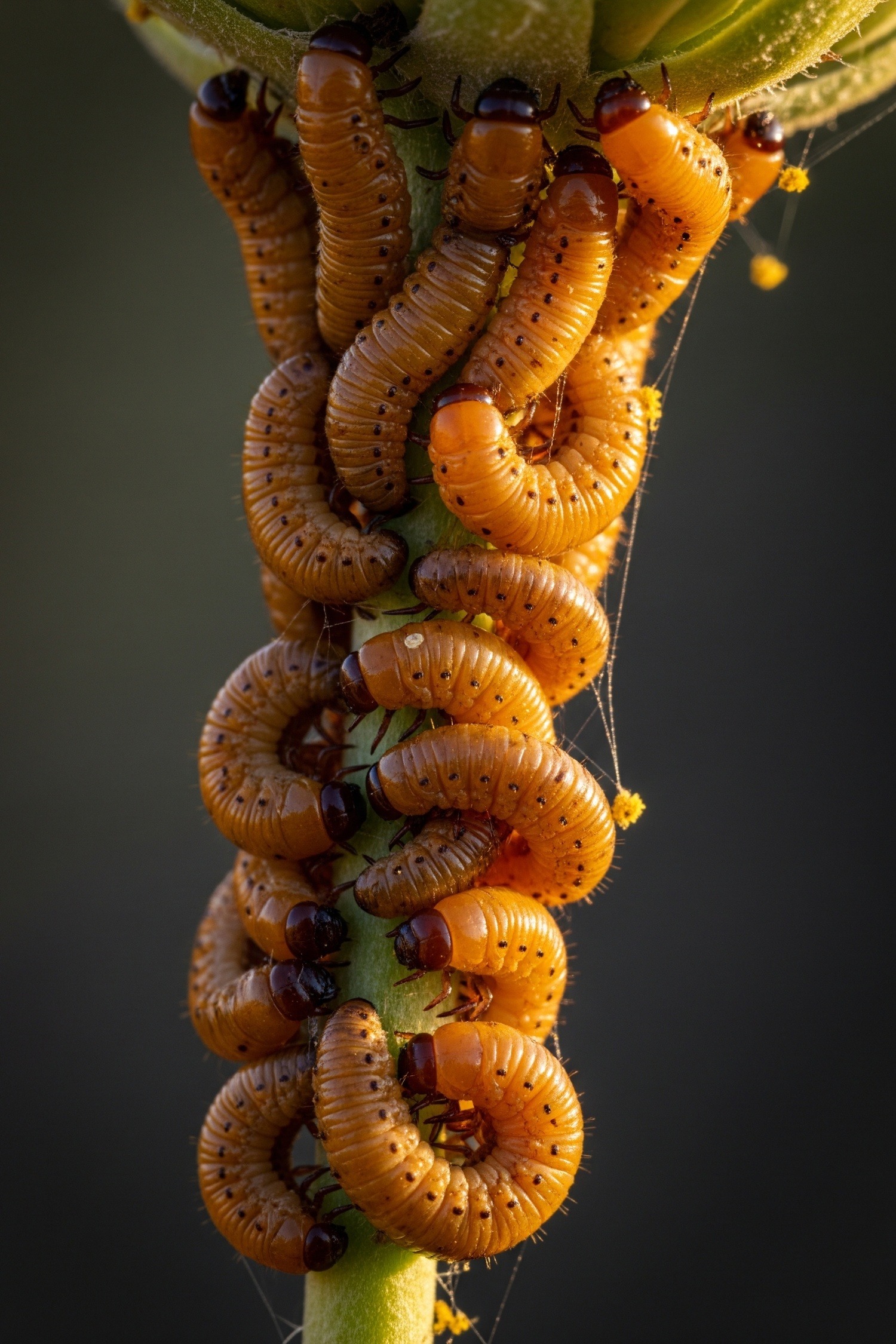
In California’s arid scrublands, something moves on flower stems that shouldn’t be moving at all — a writhing cluster of larvae no larger than a grain of rice, executing one of nature’s most ruthless cons. Blister beetle larvae chemical mimicry has been fooling solitary bees for millions of years using nothing but molecular deception and a brain that barely qualifies as a brain. They’re not lost. They’re not resting. They’re running a con so precise that scientists needed gas chromatography equipment just to prove it was happening.
The orchestrator is Meloe franciscanus, a blister beetle native to the American Southwest. Its larvae — called triungulins — live in groups of dozens, sometimes hundreds. They don’t feed alone. They don’t survive alone. Alone, they’re nothing. Together, they produce one of the most precisely engineered deceptions in the insect world, and nobody fully understands how a creature operating on genetic instruction rather than thought manages something this sophisticated.
Key Facts
- Entomologist Leslie Saul-Gershenz and Jocelyn Millar published the landmark Meloe franciscanus chemical mimicry findings in 1999 in PNAS.
- A single larval aggregation can contain up to 700 individuals on one flower stem (Saul-Gershenz & Millar, 1999).
- Meloe franciscanus larvae hatch within a 3–5 day window timed to coincide with male Habropoda pallida bee emergence each spring.
- A 2016 University of California, Berkeley study confirmed the larvae produce pheromone compounds in host-matched ratios.
- Blister beetles in the genus Meloe occur across 6 continents with over 300 described species.
In short: Blister beetle larvae mimicry is one of nature’s most precise cons: Meloe franciscanus triungulins synthesize chemicals replicating female digger bee pheromones, tricking males into carrying them to a nest. First documented by Saul-Gershenz in 1999, aggregations of up to 700 larvae match the host bee’s pheromone blend in exact ratios.
How Blister Beetle Larvae Chemical Mimicry Actually Works
The first researcher to prove what was actually happening on those flower stems was entomologist Leslie Saul-Gershenz at the University of California and the U.S. Geological Survey’s Western Ecological Research Center. In 1999, she published findings that stopped the entomological community cold in the Proceedings of the National Academy of Sciences. The larvae were producing a precise chemical cocktail — a blend of long-chain hydrocarbons — that mimicked the sex pheromones of Habropoda pallida, the digger bee that serves as their primary host. Not approximately. Not vaguely. With a specificity that required sophisticated gas chromatography equipment to even confirm. Pheromones are the chemical signals animals use to broadcast reproductive status. These larvae were counterfeiting them at a level precise enough to fool a male bee operating on instinct refined over millions of years of evolution.
But the mechanism doesn’t stop at chemistry. Movement matters just as much.
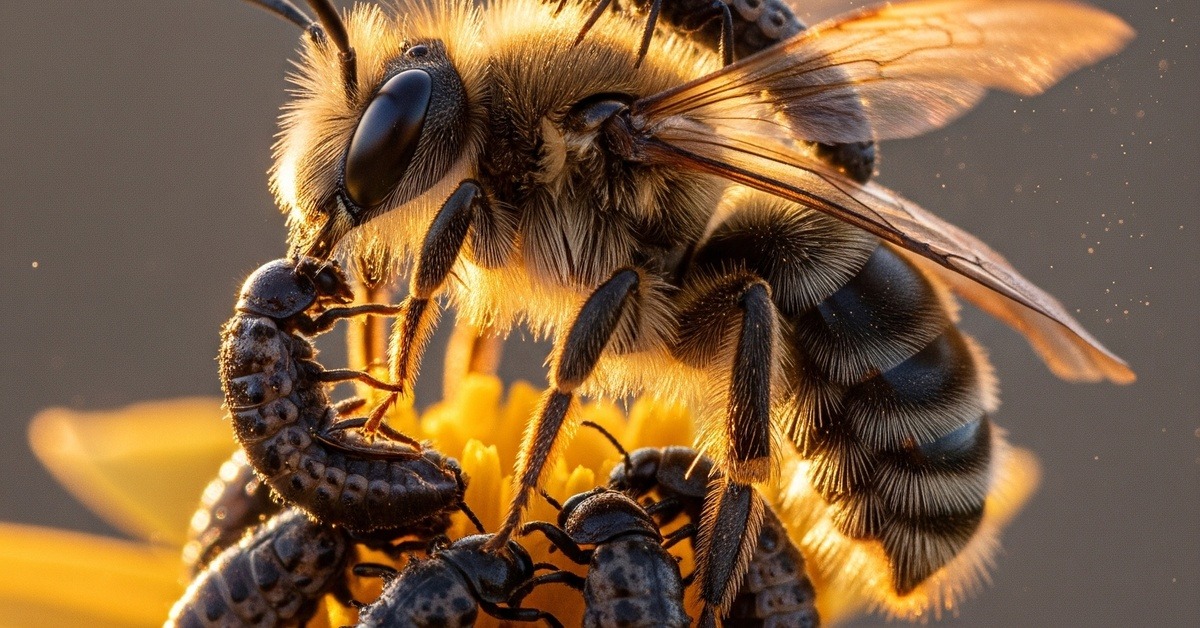
The larvae writhe and pulse. They cluster in a shape that approximates a female bee’s silhouette from above — which is exactly the angle from which a hovering male approaches. Multi-modal deception: the right smell, the right shape, the right movement, arriving simultaneously. A male digger bee, following chemical signals he has no evolutionary reason to distrust, descends and attempts to mate. The larvae swarm him instantly, gripping his body hairs with specialized claws. He can’t shake them off. He flies away carrying passengers he doesn’t know exist, and the trap has already closed before he understands he’s been caught.
The timing here is everything — and it reveals something unsettling about how precisely these larvae have adapted to a schedule they can’t possibly read. Habropoda pallida males emerge from the ground several days before females each spring. The larvae hatch exactly during peak male searching behavior, exactly when males are hungriest for any signal of a female. It’s an ambush built around a calendar.
The Transfer — And What Happens Inside the Nest
What the male bee does next is grimly efficient and entirely unwitting. He carries the triungulins until he encounters a real female and mates with her — at which point the larvae transfer, swiftly and silently, onto her body. She doesn’t notice. Doesn’t sense them. She goes about her business excavating a nest burrow in dry soil, collecting pollen, provisioning individual cells for eggs that won’t ever hatch.
This parallels something worth thinking about across the animal kingdom: when strategy operates without a strategist. When you watch a species exploit another species’ behaviors for pure benefit without any neural architecture directing it, the line between instinct and deliberate action gets genuinely difficult to draw. Consider how crows exploit other species’ behaviors, explored in depth in the article on crow anting behavior — there too, the animal appears purposeful without possessing anything we’d normally call purpose. In both cases, selection pressure has written a script so detailed it looks like someone wrote it.
Once inside the bee’s nest, here’s where the ruthlessness becomes complete.
A single provisioned cell contains one bee egg and a mass of pollen — everything the mother bee spent days or weeks gathering. The triungulin eats the egg first. Always the egg first. Then it consumes the pollen cache, molts through multiple larval stages, and eventually pupates in the stolen cell. The whole developmental sequence — from egg-eating larva to adult beetle — plays out in what amounts to a tomb the host bee built for her own offspring. The beetle never digs its own burrow. Never collects its own food. It inherits everything through fraud, and watching a species execute this strategy at this scale, you realize how little most of us actually understand about what ruthlessness looks like when it’s written into DNA rather than chosen by a mind.
Saul-Gershenz’s 1999 work documented that a single aggregation could contain up to 700 individuals. Many of them don’t make it to a host. Many fall off during the chaotic transfer. Many land on the wrong species entirely and die. The strategy works because the numbers are overwhelming — it’s a bet that enough will survive to complete the life cycle.
The Evolutionary Arms Race Behind the Deception
Chemical mimicry this precise doesn’t evolve overnight. What Saul-Gershenz documented represents the visible endpoint of an arms race almost certainly spanning millions of years — a back-and-forth in which each evolutionary improvement in bee discrimination potentially selects for greater chemical accuracy in the larvae. The broader phenomenon of brood parasitism exists across insects, birds, and fish, but few examples match the molecular precision seen here. Smithsonian Magazine describes Meloe franciscanus as operating under “one of the most sophisticated examples of chemical deception known in the insect world” — and that phrase lands harder when you consider how many deceptive insects are out there. Blister beetle larvae chemical mimicry stands out in that crowded field.
Yet here’s what makes the arms race particularly strange: Habropoda pallida hasn’t obviously won.
The beetle hasn’t been driven to extinction. The bee hasn’t evolved perfect discrimination. Both species persist in the same scrubland habitat, with the beetle apparently locked into a relationship tight enough that if the bee declines, the beetle crashes with it. Why does this asymmetry exist? Because the relationship cuts both ways — it makes the beetle exquisitely vulnerable to anything that threatens its host. Habitat loss, pesticide exposure, or climate-driven phenological shifts that desynchronize the larvae’s emergence from the bees’ breeding cycle could sever the relationship entirely.
Some researchers now argue this co-dependency makes Meloe franciscanus an unintentional indicator species — a biological alarm for the health of native bee populations in California’s Central Valley and Mojave Desert scrublands. When the beetle disappears from a site, the bee has often already gone. The fraud only works when there’s still something left to steal from.
What Blister Beetle Larvae Chemical Mimicry Reveals About Insect Intelligence
A 2016 study by researchers at the University of California, Berkeley, revisited Saul-Gershenz’s original findings using updated chemical analysis techniques. They confirmed that the hydrocarbons produced by Meloe franciscanus triungulins weren’t just structurally similar to Habropoda pallida female pheromones — they were present in the exact ratios that matched the natural blend produced by mated females. The larvae weren’t just producing the right molecules. They were producing them in the right proportions. This kind of ratio-matching hadn’t been documented before in a brood-parasitic insect operating at the larval stage. It raised a question that still doesn’t have a satisfying answer: how does a newly hatched larva, without any individual learning, produce a compound mixture fine-tuned to the chemistry of a bee it has never encountered?
The answer is almost certainly genetic — the biosynthetic pathway encoded in DNA, refined across thousands of generations through natural selection.
Larvae that produced a slightly less accurate pheromone blend attracted fewer male bees, transferred to fewer females, produced fewer offspring. Larvae with more accurate blends did the opposite. Over enough generations, you get something that looks indistinguishable from engineering. There’s no intention involved. No learning. No memory. Just pressure, time, and death doing the work that intelligence would do in a species capable of thinking.
That realization — that complexity at this level doesn’t require a mind — is what makes Meloe franciscanus so uncomfortable to consider. It suggests our instinct to look for intelligence behind sophisticated behavior is itself a bias, something we project onto nature because we can’t imagine achievement without consciousness. Sometimes the explanation is colder and stranger than that. Sometimes it’s just selection writing better code than any engineer could.
How It Unfolded
- Late 1800s: Early naturalists observe blister beetle larvae clinging to bees in Europe and North America but interpret the behavior as simple hitchhiking, missing the chemical deception entirely.
- 1983: Italian entomologist Manfred Bolognari documents aggregation behavior in European Meloe species, noting the larvae cluster on flower heads during peak bee activity — the first serious hint of coordinated luring behavior.
- 1999: Leslie Saul-Gershenz and Jocelyn Millar publish the landmark PNAS paper identifying the precise chemical mimicry of Habropoda pallida pheromones in Meloe franciscanus triungulins, transforming the field’s understanding of insect chemical deception.
- 2016: Updated chemical analysis by University of California, Berkeley researchers confirms that the larvae produce pheromone compounds in host-matched ratios — a level of precision previously undocumented in brood-parasitic insects.
By the Numbers
- Up to 700 individual larvae documented in a single aggregation cluster on one flower stem (Saul-Gershenz & Millar, 1999, PNAS).
- Meloe franciscanus larvae hatch within a 3–5 day window timed to coincide with male Habropoda pallida emergence each spring.
- The host bee’s pheromone blend contains at least 8 distinct hydrocarbon compounds — the larvae replicate the critical attractant subset with measurable ratio accuracy.
- Habropoda pallida females provision each nest cell with pollen gathered over 2–3 weeks of foraging — all of which a single larva consumes in days.
- Blister beetle species in the genus Meloe are found across 6 continents, with over 300 described species, many suspected but not yet confirmed to use blister beetle larvae chemical mimicry strategies.
Field Notes
- In 2003, researchers observing Meloe franciscanus larvae in the Mojave Desert noted that larval aggregations consistently formed on flowers positioned 20–40 cm above the ground — precisely the height at which male Habropoda pallida conduct searching flights. Whether this height preference is genetically encoded or environmentally cued remains unresolved.
- Blister beetles get their common name not from their larvae’s behavior but from cantharidin — a toxic compound the adults secrete that causes severe blistering of human skin. The larvae don’t produce it. The chemical arsenal shifts entirely between life stages.
- The same deceptive pheromone strategy has been independently discovered in at least two European Meloe species targeting entirely different bee genera — suggesting blister beetle larvae chemical mimicry has evolved multiple times within the genus, not just once.
- Researchers still can’t fully explain how a larva ‘knows’ when to transfer from a male bee to a female during mating. Contact chemical cues are the leading hypothesis, but the precise trigger hasn’t been isolated. It’s one of the more embarrassing gaps in what is otherwise a well-documented system.
Frequently Asked Questions
Q: What exactly is blister beetle larvae chemical mimicry, and how is it different from other types of mimicry?
Blister beetle larvae chemical mimicry involves larvae of Meloe franciscanus synthesizing compounds that replicate the sex pheromones of a female digger bee, tricking male bees into carrying them to a host nest. Unlike visual mimicry — where an animal resembles something else in appearance — this is olfactory deception operating at the molecular level. First rigorously documented in 1999, it’s considered one of the most precise examples of chemical deception known in insects because the larvae match not just the right compounds but the right proportional blend.
Q: Does the host bee ever detect the larvae and remove them?
No documented evidence exists that Habropoda pallida females detect or respond to larvae that have transferred onto their bodies. The larvae are small — roughly 1–2 mm at hatching — and grip body hairs using specialized hooked claws that make them extremely difficult to dislodge mechanically. More importantly, because the larvae have already transferred from the male during mating, the female bee has no obvious behavioral context to associate the sensation with a threat. By the time she’s back at the nest, they’re already inside.
Q: Are blister beetles dangerous to humans, and should people worry about encountering them?
Adult blister beetles produce cantharidin, a toxic compound that causes painful chemical burns and blistering on skin contact — it’s potent enough to have caused livestock deaths when beetles contaminate hay bales. The larvae don’t produce cantharidin, so direct handling risk is lower at that stage. However, the adults are genuinely hazardous and should never be crushed on skin. In the American Southwest, they’re most commonly encountered in late spring and summer. Awareness, not alarm, is the appropriate response — they don’t seek out humans and the risk is easily avoided.
Editor’s Take — Alex Morgan
What stays with me isn’t the chemical precision — it’s the ratio-matching. Producing the right molecules is one thing. Producing them in the exact proportions that a specific bee species finds irresistible is something else entirely. No brain. No memory. No trial and error within a single lifetime. Just selection pressure writing a recipe across thousands of generations until it’s indistinguishable from expertise. If that doesn’t make you slightly uneasy about how we define intelligence, you’re not paying close enough attention to what evolution is actually capable of.
Every spring in the California desert, the same con plays out in the dry scrub. Hundreds of larvae pile onto a stem, quiver in unison, and wait. A bee arrives. The trap closes. It’s been closing, in essentially the same way, for millions of years — long before there were eyes to watch it, long before there were words to describe it. The question isn’t just what other insects are running schemes we haven’t detected. It’s how many of those schemes are already more sophisticated than anything we’ve thought to look for.
Illustrations are AI-generated. Article fact-checked and human-edited. Our editorial standards.