Copilia: The Copepod Scanning Eye That Works Like a TV
The copepod scanning eye of Copilia does something no other animal eye is known to do: instead of grabbing a whole picture at once, it drags a single living light-receptor back and forth across the image, line by line, the way an old television camera builds a frame. One pixel, watching the ocean.
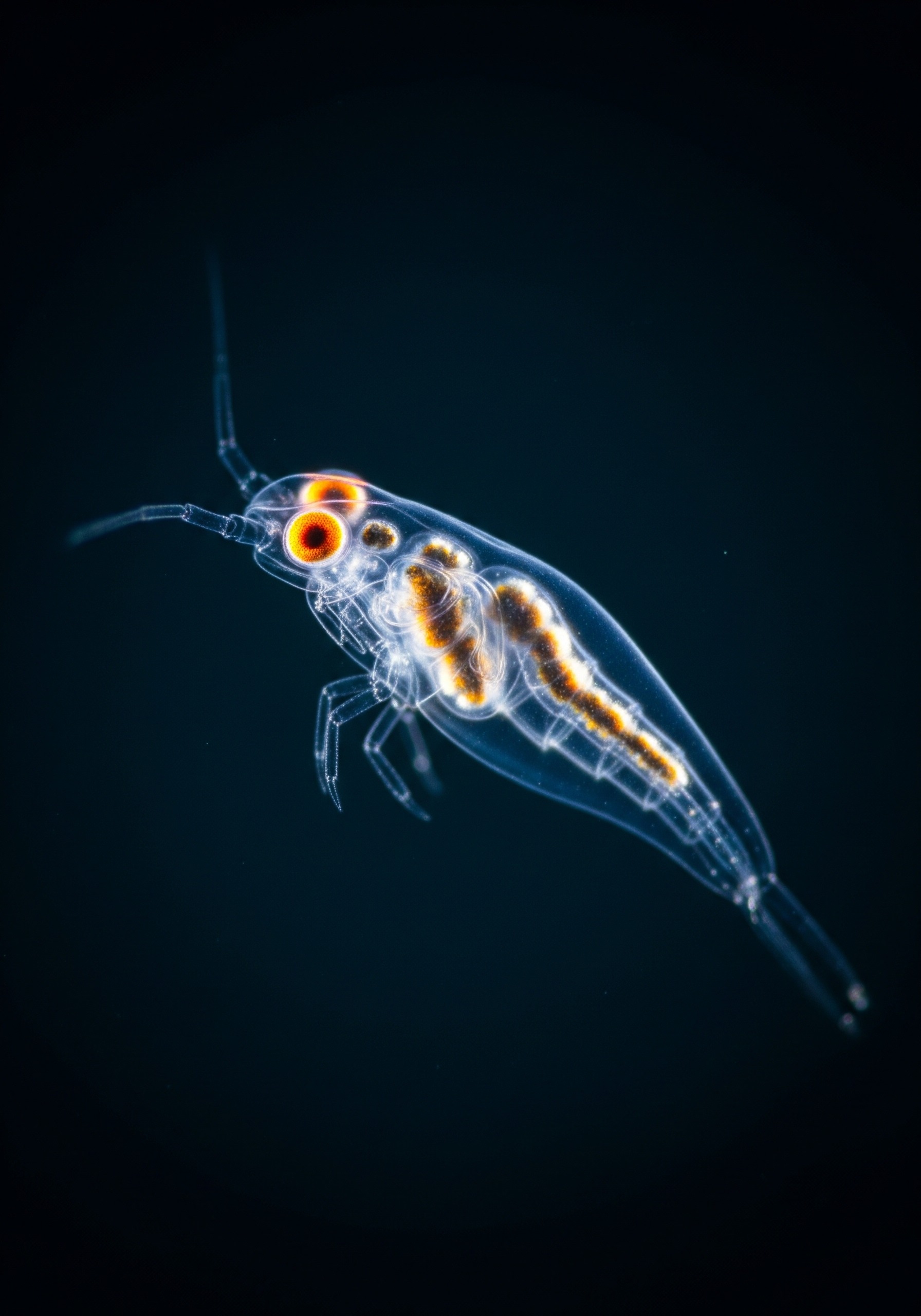
Key Facts
- Copilia is a roughly 3-millimetre, transparent, planktonic copepod crustacean (family Sapphirinidae), found in the Mediterranean — famously the Bay of Naples — and the Caribbean, swimming at depths around 200 metres.
- Each large lateral eye has just two lenses arranged like a telescope and effectively a single functional photoreceptor unit — not the roughly 120 million in a human eye.
- That receptor sweeps the image in a sawtooth motion — fast inward, slow return — at up to about 15 scans per second in Copilia quadrata, measured by A. C. Downing in 1972.
- The strange eye was first described by Sigmund Exner in 1891 and brought to wide attention by Gregory, Ross and Moray in Nature in 1964.
- It is the most extreme known example of an optical scanning visual system in nature — biology’s working version of a 1950s vidicon TV tube.
In short: Most eyes are cameras that capture a whole scene in parallel across millions of receptors. Copilia appears to do the opposite — it serialises vision, scanning one receptor across the image over time to save on receptors, wiring and brain. It is, in effect, a living television camera the size of a grain of rice.
Key Facts
- Copilia is a roughly 3-millimetre, transparent, planktonic copepod crustacean (family Sapphirinidae), found in the Mediterranean and the Caribbean, swimming at depths around 200 metres.
- Each large lateral eye has just two lenses arranged like a telescope and effectively a single functional photoreceptor unit, compared with roughly 120 million receptors in a human eye.
- That receptor sweeps the image in a sawtooth motion – fast inward, slow return – at up to about 15 scans per second in Copilia quadrata, measured by A. C. Downing in 1972.
- The eye was first described by Sigmund Exner in 1891 and brought to wide attention by Gregory, Ross and Moray in Nature in 1964.
- It is the most extreme known example of an optical scanning visual system in nature, biology’s working version of a 1950s vidicon TV tube.
In short: Most eyes are cameras that capture a whole scene in parallel across millions of receptors, but Copilia appears to do the opposite by serialising vision, dragging one receptor across the image over time to save on receptors, wiring and brain. It is, in effect, a living television camera the size of a grain of rice. This makes it the most extreme known optical scanning eye in nature.
Meet Copilia: a sliver of living glass
Scoop a jar of seawater off Naples on the right night and you might be holding one without knowing it. Copilia is almost perfectly transparent — a swimming pane of glass about the length of a sesame seed, with two startling orange dots glowing near the front. Those dots are the lenses of its eyes, and they are the only part of the animal you can easily see.
It belongs to the copepods, the most numerous multicellular animals on Earth — the near-invisible drifters that make up much of the ocean’s plankton. Within that vast group, Copilia sits in the family Sapphirinidae, alongside its glittering cousin Sapphirina, the “sea sapphire.” Like the skeleton shrimp and other transparent ocean creatures, its see-through body is camouflage: in open water, the best way to hide is to let the light pass straight through you.
The females are the stars here. In Copilia, the male and female carry different visual hardware, and it is the female who sports the famous pair of widely spaced, telescope-like eyes that drew scientists to her in the first place.
The two-lens telescope inside a 3-millimetre body
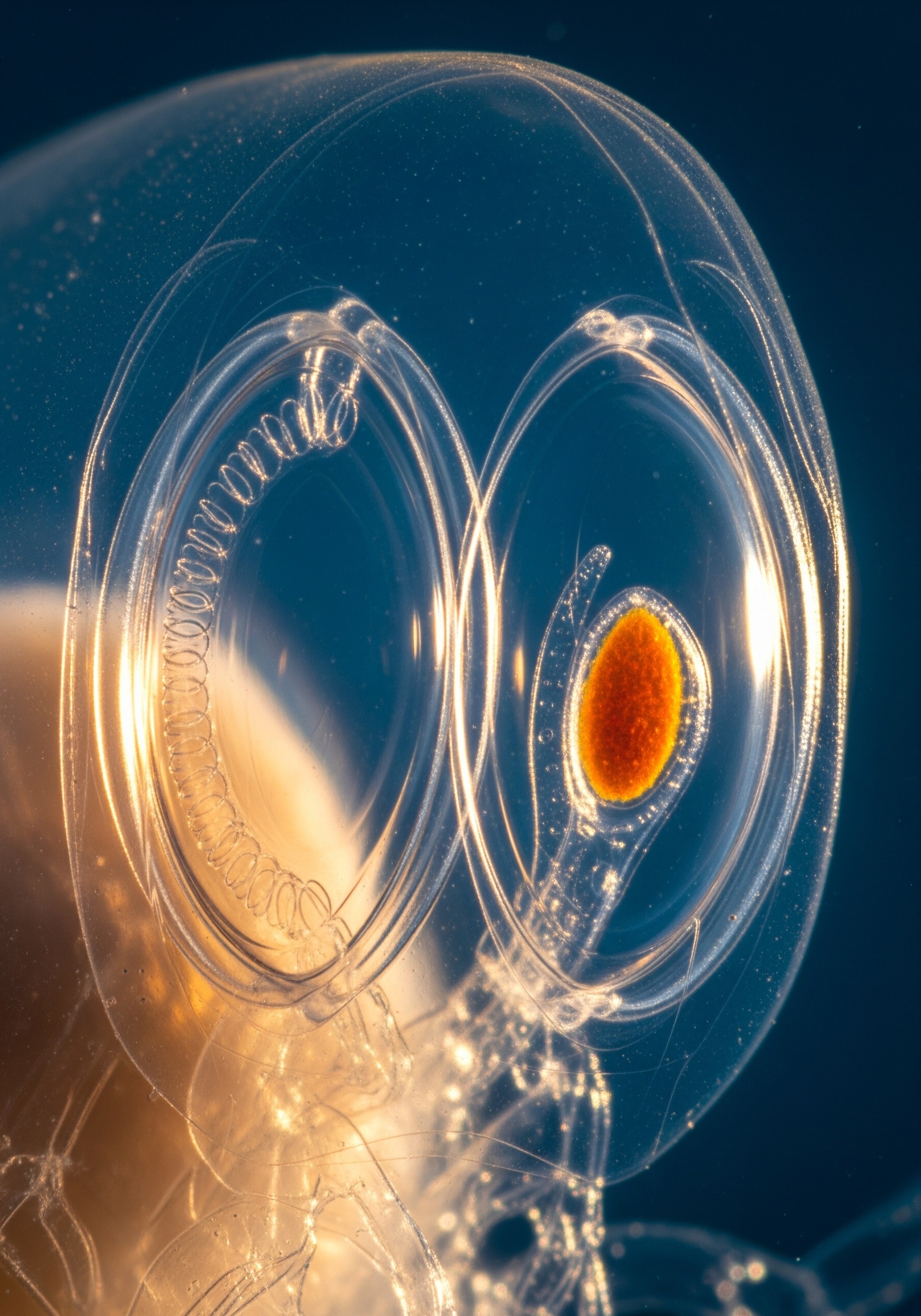
Open up that eye and the architecture is genuinely bizarre. There are two lenses, but they are not stacked together the way they are in your eye. They are separated — the length of the animal’s own body — like the objective and eyepiece of a small refracting telescope.
At the front sits a large, fixed cuticular lens, roughly 0.15 millimetres across, built into the carapace. Far behind it — about halfway down the body — is a second, internal lens around 0.65 millimetres wide. The front lens gathers light and throws an image inward; the rear lens sits near where that image forms. The 1969 electron-microscope study by Jerome Wolken and Robert Florida, published in The Journal of Cell Biology, mapped this two-element optical system in detail and confirmed just how few receptors lay behind it.
{IMAGE_2}
And behind the rear lens is the punchline: a small, heavily pigmented, bow-shaped patch of orange photoreceptor, feeding into a single optic nerve that runs to the animal’s main brain ganglion. Where your retina spreads 120-odd million receptors across a wide sheet to catch the whole image at once, Copilia has, functionally, one. That is not a typo. One.
How the copepod scanning eye of Copilia actually works
Here’s the problem that single receptor has to solve. A telescope forms a full two-dimensional image at its focal plane — a little picture floating in space inside the animal. But there is almost nothing there to read it. A single receptor can only report one thing: how bright is the spot of light falling on me, right now?
The apparent solution is motion. Under the microscope, the rear lens-and-receptor unit does not sit still. It twitches — rhythmically, rapidly — and it does so in a distinctive sawtooth rhythm: a quick sweep in one direction, then a slower drift back, over and over. In 1972 the Bristol physiologist A. C. Downing measured this carefully in Copilia quadrata and put numbers on it. The receptor moved through an amplitude of roughly four times the diameter of its own light-gathering cone, and it could repeat the cycle up to about 15 times a second.
Think about what that buys the animal. By dragging its one receptor across the focal-plane image, Copilia samples the picture point by point, over time, rather than all at once. A whole row of the image gets converted into a sequence of brightness readings streaming down that single nerve — a picture turned into a signal in time. Richard Gregory, who studied it at Cambridge, described it exactly this way: a single-channel scanning eye, “like a simple mechanical television camera.”
120 million to one — the receptor budget that explains everything
Why would evolution build something so strange when compound eyes and camera eyes already work beautifully? The answer is a budget problem, and it is worth stating in the bluntest terms anyone has.
- Human eye: ~120 million rods + ~6 million cones ≈ 126 million receptors, read out in parallel.
- Copilia eye: effectively ~1 functional receptor unit, read out over time.
- The trade: ~120,000,000-to-1 — pixels swapped for time.
- Scan rate: up to ~15 sweeps per second (Copilia quadrata).
- Whole animal: ~3 mm long, with a nervous system orders of magnitude smaller than a single human retina’s wiring.
A human retina doesn’t just need 120 million receptors. It needs roughly a million nerve fibres leaving each eye, and a sizeable chunk of brain to make sense of them. That is an enormous bandwidth bill — and a millimetre-scale planktonic animal, with a nervous system that may run to only a few thousand neurons, simply cannot pay it.
So Copilia appears to do what 1950s television engineers did when they had one wire and a whole moving picture to send: it serialises. Rather than running 120 million channels in parallel, it runs essentially one channel and spreads the image out in time. The information-theory logic is the same one Claude Shannon formalised for any communication line — you can trade spatial detail against temporal sampling and squeeze a two-dimensional scene through a single narrow pipe. For an animal this small, that is not a crude eye; it is arguably the most elegant answer to a hard problem that evolution has produced.
From Exner to Downing: 130 years chasing a living scanner
This is an old mystery, and a slow one. The Austrian physiologist Sigmund Exner, the great pioneer of insect and crustacean vision, described Copilia‘s peculiar eye in 1891 from specimens netted in the Bay of Naples. He saw the strange two-lens arrangement. He could not have guessed it might move.
The breakthrough came in 1964, when Richard Gregory, Heather Ross and Neville Moray published a short, electric paper in Nature titled simply “The Curious Eye of Copilia.” Working with live specimens, they watched the receptors twitch and proposed the heretical idea: this eye might scan, feeding spatial structure down one neural channel as a signal in time. Five years later, Wolken and Florida supplied the fine anatomy. Then, in 1972, Downing supplied the numbers — the sawtooth, the amplitude, the ~15 Hz ceiling.
The newest serious synthesis is recent. In 2023, a team led by Edward Buskey and J. Rudi Strickler reviewed copepod vision in a Springer volume on the evolution of compound eyes, placing Copilia‘s scanner at the far extreme of what eyes have ever become. More than fifty years on, it is still the textbook example — Land and Nilsson’s standard reference Animal Eyes uses it as the canonical “scanning eye.”
Nature’s prior art: vidicon tubes, LiDAR and single-pixel cameras
What makes Copilia more than a curiosity is that human engineers keep reinventing its trick, apparently without knowing the ocean got there first. Every device below solves the same puzzle — turn a full image into a signal carried by one channel — and every one of them, in hindsight, is doing what this copepod may already do.
| System | Era | How it builds an image | Sensors |
|---|---|---|---|
| Copilia eye | Described 1891–1972 | One receptor swept across the focal-plane image | ~1 |
| Vidicon TV tube | 1950s | Electron beam rasters across a photoconductive target | 1 readout |
| MEMS LiDAR | 2010s | A tiny mirror sweeps a laser across the scene | 1 detector |
| Single-pixel camera | 2000s on | One detector plus changing masks reconstruct the image | 1 |
The vidicon comparison is not a loose metaphor — it is the exact one Gregory reached for in 1964, before MEMS mirrors or single-pixel cameras existed. The copepod is, in a real sense, biological prior art for raster scanning. Turns out the cheapest way to see, when you can afford only one receptor, is to keep moving it.
Copilia, Sapphirina, and what we still don’t know
First, a clarification the internet badly needs. Copilia is constantly confused with Sapphirina, the “sea sapphire” — the copepod that flashes brilliant blue iridescence and goes viral every few years. They share a family, Sapphirinidae, but they are famous for opposite reasons: Sapphirina for how it looks, Copilia for how it sees. If you came here from a glittering blue video, that was the cousin.
Now the honest part. Is the scanning real? The evidence is strong but indirect. Downing watched the receptor structure move in a scanning rhythm, and that motion responded to a moving striped pattern presented to the eye — exactly what you’d expect if the animal were tracking and sampling an image. But, as of 2026, no one has directly imaged the actual image being scanned across the living photoreceptor in a freely behaving Copilia. The famous “television eye” remains a powerful, well-supported inference rather than a filmed fact.
That gap is not a failure of the story. It is the story. A creature smaller than this letter “i” posed a question in 1891 that our microscopes still haven’t fully closed — and that is exactly the kind of honest, open mystery worth keeping an eye on.
Frequently Asked Questions
Q: What is the copepod scanning eye of Copilia?
A: It is an eye that, instead of capturing a whole image across millions of receptors at once, uses two telescope-like lenses to form an image and then sweeps a single light-receptor back and forth across that image — sampling the scene point by point over time, like a scanning TV camera.
Q: How fast does the Copilia eye scan?
A: In Copilia quadrata, A. C. Downing measured a sawtooth movement — a quick sweep and a slower return — repeating up to about 15 times per second, across an amplitude of roughly four times the receptor’s own cone diameter.
Q: Is Copilia the same as the “sea sapphire”?
A: No. The iridescent blue “sea sapphire” is Sapphirina, a relative in the same family (Sapphirinidae). Copilia is famous for its scanning eye, not for colour. They are routinely confused online.
Q: Why does such a tiny animal have such an unusual eye?
A: Bandwidth. A full camera-style eye would need millions of receptors, nerves and brain tissue that a 3-millimetre animal cannot afford. Scanning one receptor across the image trades spatial detail for time, squeezing vision through a single channel.
Sources
- Gregory, R. L., Ross, H. E. & Moray, N. (1964). “The Curious Eye of Copilia.” Nature 201, 1166–1168.
- Wolken, J. J. & Florida, R. G. (1969). “The Eye Structure and Optical System of the Crustacean Copepod, Copilia.” The Journal of Cell Biology 40(1): 279–285.
- Downing, A. C. (1972). “Optical Scanning in the Lateral Eyes of the Copepod Copilia.” Perception 1(3): 247–261.
- Land, M. F. & Nilsson, D.-E. (2012). Animal Eyes (2nd ed.). Oxford University Press.
- Buskey, E. J., Strickler, J. R. et al. (2023). “The Cornucopia of Copepod Eyes,” in Evolution of Compound Eyes. Springer Nature.
Next time you read about an engineer’s clever new single-pixel camera or a LiDAR micromirror sweeping a laser across a road, remember the 3-millimetre drifter in the Bay of Naples that may have filed the patent 100 million years early — and is still keeping part of the secret to itself.
Illustrations are AI-generated. Article fact-checked and human-edited. Our editorial standards.