The Tiny Desert Cat That Hunts Vipers Barefoot
There’s a cat smaller than your house pet walking across sand hot enough to cook meat, and it does this while actively hunting snakes that could kill you. Nobody talks about it because the cat is basically invisible.
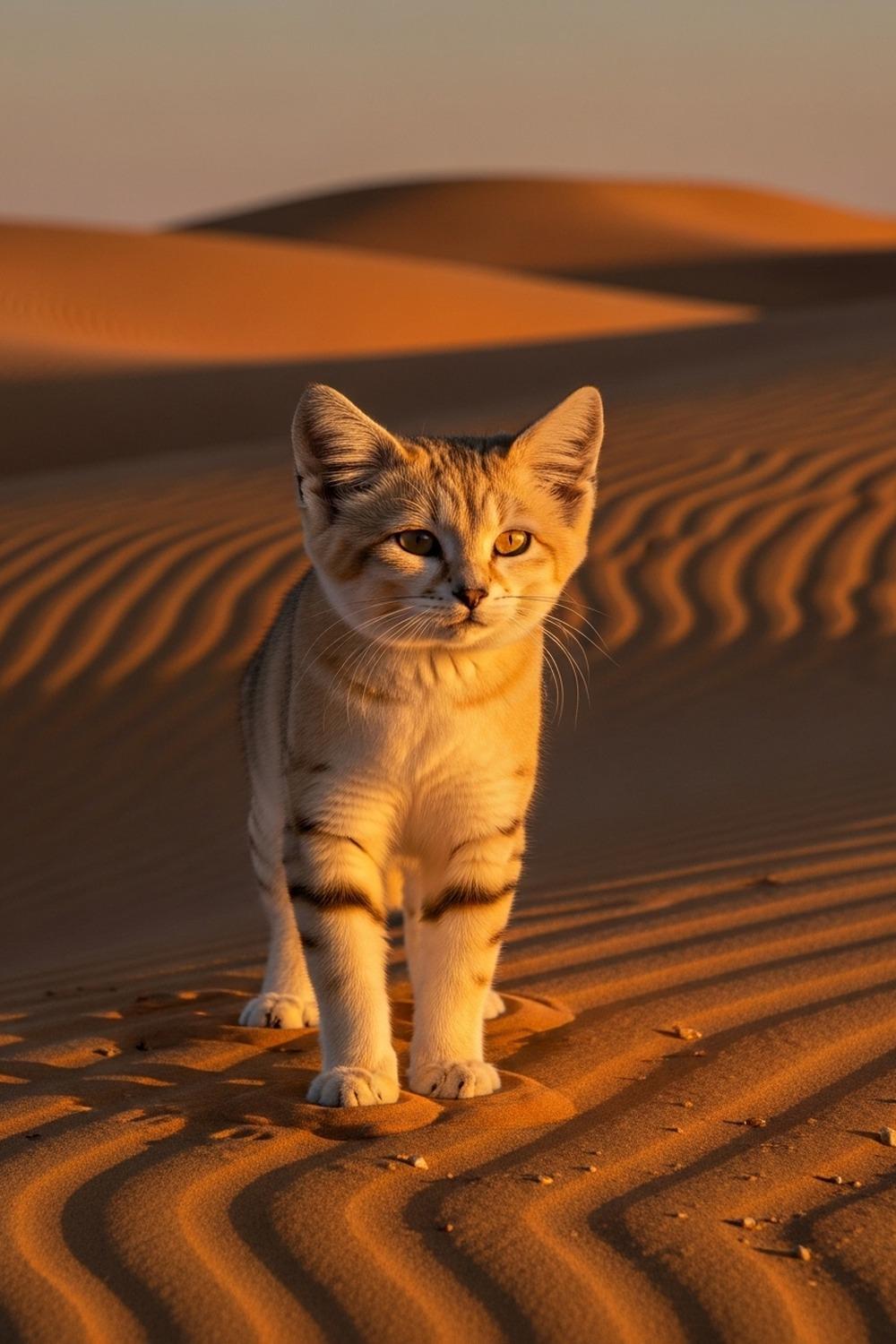
Somewhere in the Sahara, Felis margarita — the sand cat — is padding across dunes at temperatures that would hospitalize a human in minutes. Not running. Not panicking. Just… existing. Hunting. Surviving in a place where survival seems genuinely impossible. And here’s the thing: it’s doing all of this with paws so specialized that they’ve basically become a case study in how evolution solves unsolvable problems.
Key Facts
- Saharan sand reaches a documented surface temperature of 124 degrees F, which sand cats traverse daily
- Desert temperatures swing about 93 degrees F within a single 24-hour cycle, from 124 degrees F to 31 degrees F
- Sand cats cover up to 5.4 miles per night while hunting, despite weighing under 7 pounds
- Sand cats actively hunt venomous saw-scaled and horned sand vipers, pinning the snake’s head before disabling it
- Fewer than 200 sand cats exist in accredited zoo programs globally
In short: Sand cat desert survival hinges on fur-padded paws that walk across 124-degree-F Saharan sand and a coat that handles a 93-degree daily temperature swing. Weighing under 7 pounds yet covering 5.4 miles a night, Felis margarita hunts venomous vipers and vanishes so well that its wild population remains unknown.
Those Paws Aren’t Just Cute — They’re Literally Heat-Proof
The sand cat’s feet are covered in dense, stiff fur. Not just the top. The entire sole. Every millimeter. Dr. Alexander Sliwa, a wildlife researcher who’s spent decades actually watching these cats in the wild, describes their paws as “among the most specialized adaptations in the entire felid family” — which is saying something when you’re talking about a group that includes lions and snow leopards.
That fur works like a pot holder.
Except it evolved over millions of years and works at full sprinting speed. The mechanism is almost embarrassingly simple: it traps a thin layer of air between the paw pad and the scorching surface. Same physics as insulation. Except this insulation can walk across 124°F sand without flinching, without slowing down, without even appearing to register that the ground temperature is approaching what would literally cook human flesh on contact.
I kept reading about this part specifically for an extra hour. The math didn’t add up until I actually understood how the air pocket works.
The Desert Temperature Swings 93 Degrees in a Single Day
Here’s what makes the Sahara genuinely hostile: it’s not just hot. During the day, sand hits 124°F. At night, temperatures can drop to 31°F. That’s a 93-degree thermal swing happening inside 24 hours. For most animals, that kind of chaos is fatal.
Sand cats don’t migrate when winter bites.
They don’t hibernate. They don’t seek warmer climates or shelter in caves for months. They’re year-round residents of one of Earth’s most unstable thermal environments, and according to researchers, they’ve never seemed particularly bothered by the arrangement. Their thick, dense coat works both ways — insulating against the scorching afternoon sun while trapping warmth during those brutal desert nights when the temperature plummets.
Which honestly? Respect.
And Then They Hunt Venomous Snakes. On Purpose.
This is the part that takes a moment to process. Sand cats don’t just tolerate saw-scaled vipers and horned sand vipers in their territory. They actively hunt them. Both species are capable of delivering potentially lethal bites to humans. The sand cat’s technique involves rapid, precise strikes to pin the snake’s head, then swift biting to disable it. It’s not accidental. It’s a refined, repeatable hunting method that researchers have now documented multiple times in actual field studies.
The speed involved is what matters. Sand cats can strike faster than a human eye can track. By the time a viper’s threat response registers as a problem, the cat has already neutralized it. Speed isn’t an advantage here — it’s the entire strategy.
You can read more about extraordinary predators at this-amazing-world.com.
The Ghost Species Nobody Can Actually Study
Sand cat survival in the wild is genuinely difficult to study. The Sahara is enormous, yes. But that’s almost not the problem. The real issue is that these cats are supernaturally good at disappearing.
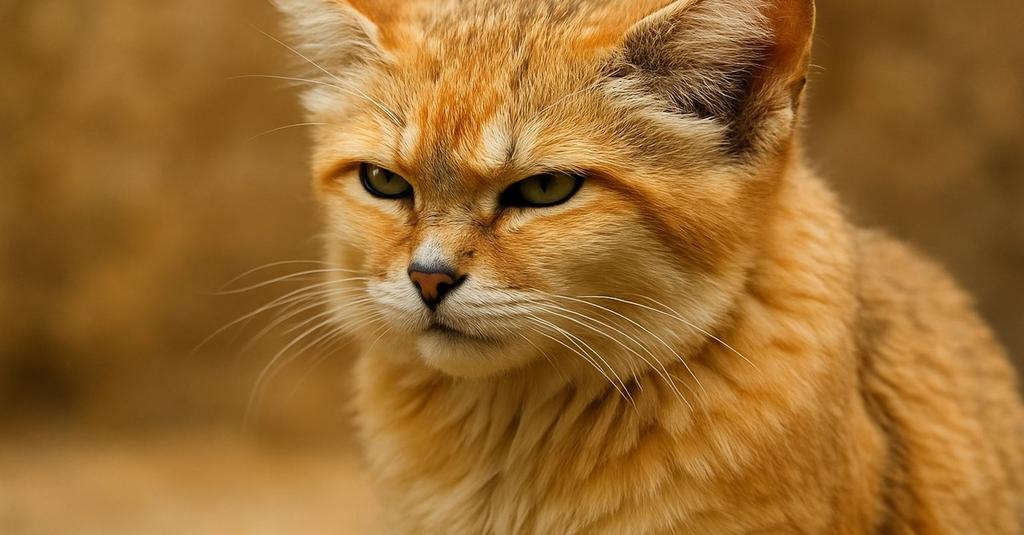
Their low-set ears flatten against their head when they crouch — eliminating the silhouette that gives most predators away. Their pale, sandy coat doesn’t just blend in passively; it actively breaks up their outline against the terrain in a way that makes camera traps produce mostly empty frames. Seasoned field researchers working with GPS-tagged individuals have walked within meters of a resting sand cat without spotting it.
They also avoid leaving tracks.
Sand cats walk on the balls of their feet, and that thick fur masks the claw impressions that would normally betray a cat’s path through soft sand. They’re like a ghost species — present, widespread, and almost totally invisible to observation. Even their vocalizations stay hidden. During mating season, sand cats produce a barking call that researchers initially attributed to foxes. It took years of fieldwork to correctly identify the source, because the cats producing the sound were never visible when it was recorded.
Their Range Is Enormous. Their Population? Nobody Knows.
Turns out, the sand cat’s actual population and range are hard to pin down with confidence. They’re spread across North Africa, the Arabian Peninsula, and parts of Central Asia — a distribution spanning thousands of miles — yet their total wild population remains uncertain enough that the IUCN lists them as “Least Concern” while simultaneously acknowledging that data is sparse.
That’s a strange combination: officially fine, but largely unstudied.
Some researchers suspect the population is healthier than feared because sand cats actively avoid areas humans monitor. There are sand cats living in habitats that have never had a field study conducted on them. Entire sub-populations that have never been tagged, GPS-tracked, or photographed. For a wild animal in 2024, that level of obscurity is genuinely unusual — and it makes every piece of data researchers do manage to collect disproportionately valuable.
By the Numbers
- 124°F — the documented surface temperature of Saharan sand that sand cats traverse daily; human skin sustains burns at 131°F within seconds, making this adaptation borderline impossible from a physics standpoint
- Sand cats cover up to 5.4 miles per night during hunting activity
- Remarkable for an animal weighing under 7 pounds, according to GPS tracking data from Dr. Sliwa’s field research teams over the past two decades
- 93-degree Fahrenheit temperature swing within a single 24-hour cycle — one of the most extreme thermal environments inhabited by any small wild cat on Earth
- Fewer than 200 sand cats in accredited zoo programs globally, making captive breeding data one of the primary sources for behavioral research
Field Notes
- Sand cats almost never drink standing water. They extract virtually all the moisture they need from prey — rodents, lizards, and snakes — an adaptation that lets them survive in regions with no reliable water source for months.
- Kittens are born with spotted coats that fade as they mature, providing additional camouflage during vulnerable early months when they’re still learning to hunt in an environment where invisibility matters.
- Their vocalizations are surprisingly loud for their size.
Why Sand Cat Survival Actually Matters Right Now
This isn’t just a remarkable biological footnote. It’s a blueprint. As climate change pushes temperatures in already-extreme environments even higher, understanding how animals like Felis margarita have engineered solutions to thermal stress becomes genuinely useful science.
Biomimicry researchers have already looked at the sand cat’s paw structure when designing heat-resistant materials. The mechanisms that keep this small cat alive could inform everything from desert survival gear to protective footwear engineering. And beyond the practical applications, there’s something important about the mere existence of an animal this capable. The Sahara is often framed as empty, inhospitable, incompatible with life. The sand cat is a standing argument against that framing.
Life doesn’t just tolerate extreme environments — sometimes it specializes in them so thoroughly that the extreme becomes home.
A cat the size of a house pet, walking barefoot across scorching sand, hunting vipers, vanishing into landscapes it has spent millions of years learning to read. That’s not survival. That’s mastery. If this keeps you scrolling at 2am, there’s more at this-amazing-world.com — and the next one is even stranger.
Frequently Asked Questions
Q: How do sand cats survive walking on hot desert sand?
Sand cats have dense, stiff fur covering the entire sole of each paw, which works like a pot holder by trapping a thin layer of air between the pad and the ground. This insulation lets them walk across Saharan sand that reaches a documented 124 degrees F without slowing down, even at full sprinting speed. For context, human skin sustains burns at around 131 degrees F within seconds, making the adaptation remarkable.
Q: Do sand cats really hunt venomous snakes?
Yes. Sand cats actively hunt venomous saw-scaled vipers and horned sand vipers, both capable of delivering potentially lethal bites to humans. Their technique uses rapid, precise strikes to pin the snake’s head, followed by swift biting to disable it. Researchers have documented this refined, repeatable method multiple times in field studies. The cats strike faster than a human eye can track, so speed is the entire strategy rather than just an advantage.
Q: How extreme is the temperature where sand cats live?
Sand cats inhabit one of Earth’s most unstable thermal environments. During the day, Saharan sand hits 124 degrees F, while at night temperatures can drop to 31 degrees F, a 93-degree swing within a single 24-hour cycle. Sand cats do not migrate, hibernate, or seek long-term shelter. Their thick, dense coat insulates against scorching afternoon sun while trapping warmth during the brutally cold desert nights.
Q: How many sand cats are left in the wild?
Nobody knows the exact wild population. Sand cats range across North Africa, the Arabian Peninsula, and parts of Central Asia, spanning thousands of miles, but they are extraordinarily difficult to study because they excel at staying hidden. The IUCN lists them as Least Concern while acknowledging the data is sparse. Fewer than 200 exist in accredited zoo programs globally, making captive breeding one of the primary sources of behavioral research data.
Illustrations are AI-generated. Article fact-checked and human-edited. Our editorial standards.