Japan’s Hydrogen Train Is Rewriting Clean Rail Travel
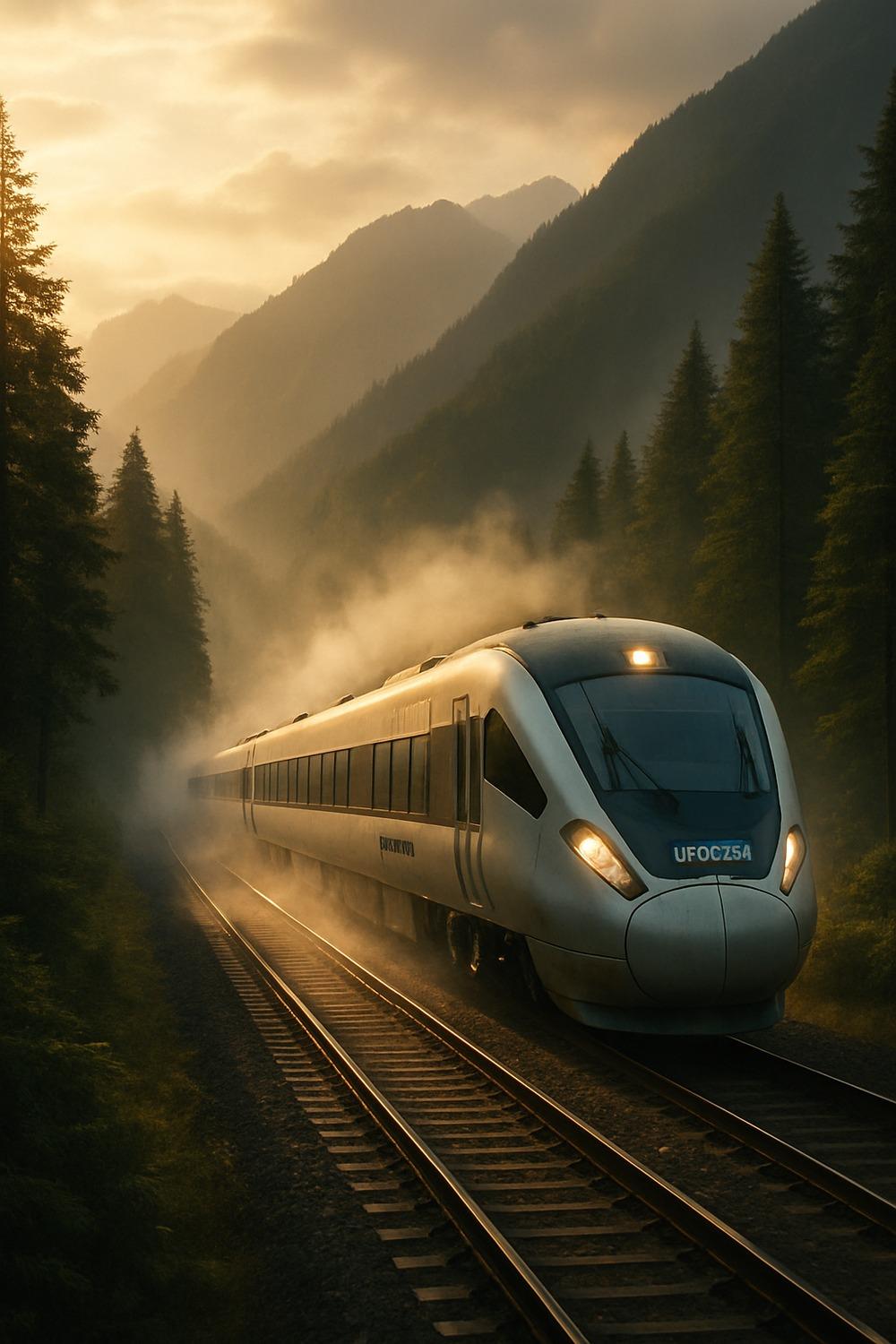
Somewhere in the Japanese mountains, a train arrives at a station platform and releases nothing into the air but water vapor. No exhaust. No carbon. Just the quiet hiss of clean air and the rhythm of steel on rail. This isn’t a test. It’s Tuesday morning. People are commuting on the Japan hydrogen-powered passenger train right now.
Japan’s rail network carries roughly 25 billion passengers every year — one of the most heavily used systems on the planet. A single shift in how those trains are powered doesn’t just change a commute. It rewrites an entire energy equation. Why does this matter? Because the real question isn’t whether hydrogen rail works anymore — it clearly does. The harder question is whether the world’s aging rail networks can move fast enough to catch up with what Japan just proved.

Key Facts
- Japan’s rail network carries roughly 25 billion passenger journeys every year, one of the highest-volume systems on Earth, per the Ministry of Land, Infrastructure, Transport and Tourism, 2023
- JR East’s FV-E991 series, nicknamed HYBARI, stores hydrogen at 70 megapascals of pressure for practical regional range
- Germany’s Alstom Coradia iLint entered commercial service in Lower Saxony in 2018, and 14 iLint trains formed a fleet by 2022
- As of 2024, roughly 96% of globally produced hydrogen comes from fossil fuel processes, per the International Energy Agency
- Japan committed 20 trillion yen over ten years through its 2023 Green Transformation (GX) policy to fund low-carbon energy infrastructure
In short: The Japan hydrogen-powered passenger train, JR East’s FV-E991 HYBARI series, uses hydrogen fuel cells to emit only water vapor while serving regional routes. Building on Germany’s 14-train Alstom iLint fleet, it stores hydrogen at 70 megapascals and supports a rail network carrying 25 billion annual journeys, though green hydrogen supply remains the open challenge.
How Japan’s Hydrogen Rail Technology Actually Works
A hydrogen fuel cell draws hydrogen from onboard tanks and combines it with oxygen pulled from the surrounding air. That electrochemical reaction generates electricity. The electricity drives the motors. The only exhaust produced is water vapor — molecularly identical to the moisture already hanging in the mountain air outside the window.
East Japan Railway Company (JR East) designed its FV-E991 series specifically for regional lines where overhead electrification infrastructure is absent or prohibitively expensive to install. The engineering principle behind the Japan hydrogen-powered passenger train is, at its core, elegantly straightforward: a self-contained clean energy system that doesn’t need a wire strung above it to function. The company formally intensified its hydrogen rail research program around 2019, moving from prototype exploration to committed development.
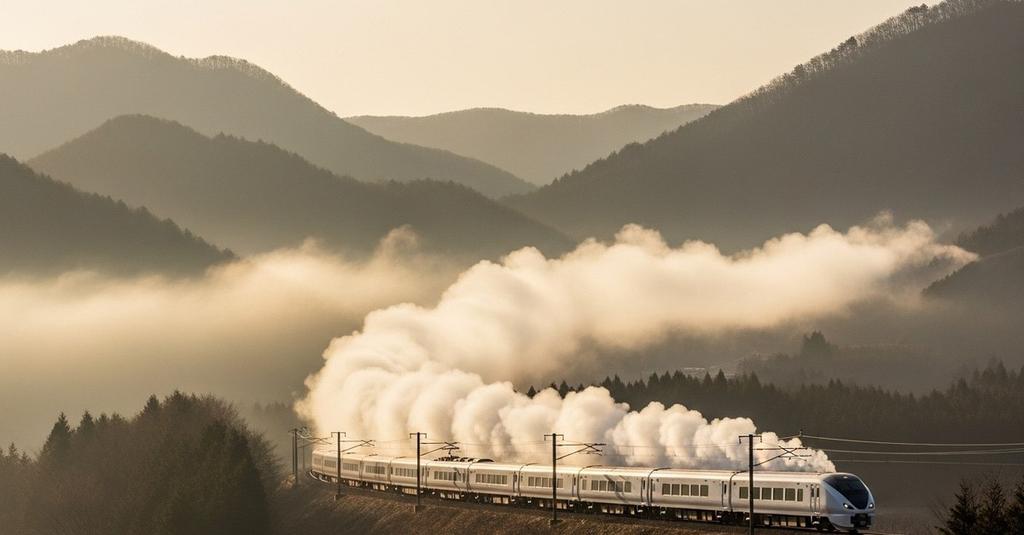
What surprises most people is how much quieter hydrogen trains run compared to diesel. Diesel engines combust fuel under pressure — a mechanically violent process that vibrates through the carriage floor and into the bones of anyone sitting above the wheel bogies. Hydrogen fuel cells produce electricity through chemistry, not combustion. There’s no piston. No ignition. The dominant sound becomes the rail itself.
Passengers in early trial runs reported the experience as noticeably calmer, almost disorienting in its stillness.
Maintenance demands drop too. Fewer moving parts means fewer failure points over a train’s service life, which typically spans two to three decades. On grades through mountain terrain, the trains also recover energy during descent through regenerative braking — storing electricity back into onboard batteries. Every steep descent becomes a small act of recapture, which is how you wring additional efficiency from terrain that once simply cost diesel fuel.
Germany Proved It First — Japan Is Scaling It
Germany’s Alstom Coradia iLint entered commercial service in Lower Saxony in 2018, becoming the world’s first hydrogen fuel cell passenger train operating on a public network. By 2022, a full fleet of 14 iLint trains had replaced diesel units on the Buxtehude-Bremervörde-Bremerhaven-Cuxhaven line. Those trains logged hundreds of thousands of kilometers under real-world conditions — rain, frost, peak summer heat — without the performance failures skeptics had predicted.
The data that came back from those German operations gave engineers at JR East and Japan’s Ministry of Land, Infrastructure, Transport and Tourism the confidence to move from prototype testing to committed deployment. Here’s the thing: that technological leap wasn’t just about engineering. It was about permission. The moment another country proved the technology worked at commercial scale, Japanese planners could stop defending the concept and start defending the decision to build it.
Japan’s deployment differs from Germany’s in both scale and density. Germany’s initial hydrogen lines operated in relatively rural corridors with modest passenger loads. JR East’s Kanetsu and Joetsu corridor trials, which began ramping up through 2023 and 2024, operated under higher-demand conditions — the kind of passenger volumes that would qualify as major arteries in most European countries. The trains maintained schedule adherence comparable to diesel equivalents while consuming hydrogen stored at 70 megapascals of pressure, a storage density that makes the range per tank genuinely practical for regional service without mid-route refueling stops.
A station master interviewed during early trials at one rural platform described watching the train arrive as unexpectedly moving. “You hear it come in,” he said, “but there’s nothing coming out of it. Just air.” That’s not a minor detail.
The Air Quality Argument Nobody Is Making Loudly Enough
The climate case for hydrogen trains gets most of the attention. But the immediate, street-level case may matter more in densely populated Japan. Diesel rail exhaust in enclosed station environments — underground platforms, short tunnels, canyon-cut urban cuttings — accumulates particulate matter at concentrations that affect commuter health over years of daily exposure. A 2021 study published by BBC Future examining European hydrogen rail adoption highlighted that nitrogen dioxide levels in station environments served by diesel trains consistently exceeded WHO air quality guidelines during peak hours. Japan’s urban and semi-urban stations share that problem.
Replacing diesel with hydrogen on regional routes doesn’t just reduce carbon output tallied in distant spreadsheets. It changes what a commuter breathes during the four minutes they spend waiting on the platform each morning, five days a week, for thirty years of working life. That’s a public health intervention dressed up as a transport upgrade, and watching health outcomes shift this measurably in a nation of 125 million people, you stop calling it an environmental policy improvement.
The Japan hydrogen-powered passenger train also operates in a country acutely aware of energy dependency. Japan imports nearly all of its fossil fuels. Every liter of diesel burned on a regional rail line represents a geopolitical exposure — a supply chain that runs through shipping lanes and price negotiations Japan doesn’t control. Hydrogen, by contrast, can be produced domestically using renewable electricity, or imported from partners like Australia, which has invested heavily in green hydrogen export infrastructure since 2020. The train itself becomes an argument for energy sovereignty.

Japan Hydrogen-Powered Passenger Train’s Unresolved Challenge: Green Hydrogen Supply
Here’s where the story gets complicated, and where honest reporting demands some friction. The train itself is zero-emission. The hydrogen it burns produces nothing but water vapor. But hydrogen doesn’t occur freely in the quantities rail operations require. It has to be produced.
How it’s produced determines whether the entire system is genuinely clean or simply relocates the emissions upstream. As of 2024, the majority of hydrogen produced globally — roughly 96 percent, according to figures from the International Energy Agency — comes from natural gas reforming, a process that releases carbon dioxide. This is what the industry calls “grey hydrogen.” Green hydrogen, produced by splitting water using renewable electricity, is the version that makes the full life-cycle equation work.
Japan’s government has committed to a green hydrogen supply chain strategy through its 2023 Green Transformation (GX) policy framework, allocating 20 trillion yen over a decade toward low-carbon energy infrastructure. But supply chains take time. The trains are ready before the clean hydrogen production capacity has fully arrived to fuel them at scale — a gap that rail operators and energy planners are managing carefully, sourcing from the cleanest available hydrogen blends while permanent green supply chains are built out. And this gap, uncomfortable as it is, reveals the honest timeline: the technology precedes the fuel infrastructure that makes it truly clean.
The cost curve is also still steep. Hydrogen fuel cells remain significantly more expensive per unit than diesel powertrains. Alstom’s iLint units in Germany came in at roughly double the capital cost of equivalent diesel trains in 2018. That gap has narrowed as manufacturing scales up, but it hasn’t closed.
JR East and Japan’s national rail planners are betting — with considerable evidence behind them — that the cost trajectory follows the same path solar panels and lithium batteries traveled: expensive at launch, then dramatically cheaper as volume increases and manufacturing matures. Engineers at Japan’s Railway Technical Research Institute have been modeling fleet transition scenarios since 2021. Their projections suggest that if hydrogen costs fall to target levels by 2030 — achievable if domestic production scales as planned — hydrogen trains become cost-competitive with diesel on a total lifecycle basis. Not just environmentally preferable. Economically rational. That’s the tipping point the entire industry is watching for.
What Happens If Asia’s Rail Networks Don’t Follow Japan’s Lead
Japan’s commitment is real, but it represents a fraction of Asia’s total rail diesel consumption. China operates the world’s largest rail network by total track length — over 155,000 kilometers as of 2023 — and the majority of regional and freight lines still rely on diesel traction. India’s rail system, the fourth largest on Earth by size, carries over eight billion passengers annually on a network where electrification remains incomplete across significant rural stretches. If those networks don’t transition away from diesel within the next two to three decades, the carbon locked into their operations will continue accumulating regardless of what any single country achieves.
Japan’s hydrogen trains matter most not as a solution in isolation, but as a proof of concept that removes the excuse that hydrogen rail isn’t ready. The stakes compound in a specific way that’s easy to miss. Rail infrastructure built today locks in its energy model for 30 to 40 years. A diesel train ordered in 2025 will still be operating in 2055. A hydrogen train ordered in 2025 will still be operating in 2055.
The decision made in a procurement office this year isn’t an abstract policy choice — it’s a physical commitment that will either emit carbon or water vapor for the next four decades.
Every year of delay in transitioning new orders toward hydrogen or battery-electric propulsion adds another cohort of diesel assets to fleets that won’t retire until the climate math has already closed in on us. Stand on the platform at Takasaki on a clear winter morning. The mountains behind the city carry snow on their ridges. A train slides in, almost silent, and opens its doors. No smell. No haze. The air is exactly as it was before the train arrived.
How It Unfolded
- 2018 — Germany’s Alstom Coradia iLint becomes the world’s first hydrogen fuel cell passenger train to enter commercial service, operating in Lower Saxony on public routes.
- 2019 — JR East formally intensifies its hydrogen rail research program, initiating development of what would become the FV-E991 series test train, nicknamed “HYBARI.”
- 2022 — HYBARI completes initial test runs on the Tsurumi and Nambu lines near Tokyo, demonstrating viable speeds and range for regional rail applications under real-world load conditions.
- 2024-2025 — Japan’s first hydrogen-powered passenger train transitions from extended testing to active passenger service on regional routes, marking the operational beginning of hydrogen rail at scale in Asia.
By the Numbers
- 25 billion — approximate annual passenger journeys on Japan’s rail network, making it one of the highest-volume systems on Earth (Japan Ministry of Land, Infrastructure, Transport and Tourism, 2023)
- 70 MPa — hydrogen storage pressure in JR East’s FV-E991 series fuel tanks, enabling practical range for regional service without mid-route stops
- 14 — number of Alstom iLint hydrogen trains operating commercially in Germany by 2022, the largest hydrogen passenger fleet in service at that time
- 96% — share of globally produced hydrogen derived from fossil fuel processes as of 2024 (International Energy Agency), underscoring the urgency of green hydrogen supply chain development
- 20 trillion yen — Japan’s government commitment over ten years through the 2023 Green Transformation policy to fund low-carbon energy infrastructure, including hydrogen production and transport
Field Notes
- JR East’s HYBARI test train conducted passenger-free trial runs on the Tsurumi and Nambu lines starting in 2022, reaching speeds of up to 100 km/h — faster than the minimum threshold for regional service viability — without any recorded fuel cell performance failures across multiple seasons of testing.
- Hydrogen fuel cell trains actually perform better in cold weather than battery-electric alternatives in many conditions. Cold temperatures reduce battery capacity significantly, but fuel cell efficiency is less temperature-sensitive, giving hydrogen trains a meaningful advantage on high-altitude or winter mountain routes.
- Japan’s hydrogen train program is part of a broader national hydrogen strategy that includes hydrogen-powered buses, ships, and eventually steel production — the train is one node in a planned economy-wide shift, not a standalone transport project.
- Researchers at Japan’s Railway Technical Research Institute still can’t fully predict how hydrogen refueling infrastructure costs will scale across rural station networks — the economics of building and maintaining small-scale hydrogen supply points at dozens of regional depots remains one of the genuinely open engineering and financial questions in the program.
Frequently Asked Questions
Q: How does a Japan hydrogen-powered passenger train differ from an electric train?
A conventional electric train draws power from an overhead wire or electrified rail connected to the grid. A Japan hydrogen-powered passenger train generates its own electricity onboard using hydrogen fuel cells, requiring no external power infrastructure. This makes it viable for regional routes where installing overhead wires is impractical or too expensive. The train carries hydrogen in pressurized tanks and refuels at depot stations, much like a diesel train refuels with fuel.
Q: Is the water vapor released by hydrogen trains harmful to the environment?
No. The water vapor emitted from hydrogen fuel cell trains is chemically identical to atmospheric moisture — it’s the same H₂O that evaporates from rivers, oceans, and your morning coffee. At the scale of regional rail operations, the quantity released is negligible relative to ambient humidity levels. Unlike carbon dioxide, water vapor doesn’t accumulate persistently in the atmosphere in ways that drive long-term warming at these emission scales. The only meaningful environmental variable is whether the hydrogen itself was produced cleanly.
Q: Doesn’t producing hydrogen still create emissions, making these trains not truly clean?
This is the most important misconception to address. The train’s operation is genuinely zero-emission — water vapor only. But hydrogen production currently relies heavily on natural gas in most global markets, which does produce CO₂. Japan’s strategy involves transitioning to “green hydrogen” made using renewable electricity, which closes the loop entirely. Until that supply chain is complete, hydrogen trains operate on a spectrum from low-emission to zero-emission depending on their fuel source. It’s an honest limitation — and one that Japan’s 2023 GX policy is specifically designed to resolve within this decade.
Editor’s Take — Dr. James Carter
What strikes me most isn’t the technology — fuel cells have been technically viable for decades. It’s the shift in language. Japan isn’t calling this a pilot. It isn’t calling it a demonstration. It’s calling it a train. That framing matters enormously, because the moment clean rail becomes ordinary infrastructure rather than a science exhibit, procurement officers in Seoul, Mumbai, and Chicago start asking different questions. The hydrogen train’s most powerful emission might be the precedent it sets for everyone else’s next budget cycle.
Rail infrastructure is generational. The tracks laid today will carry weight — literal and atmospheric — for the next four decades. Japan’s hydrogen trains are running now, proving what was disputed for years: that clean propulsion at regional scale isn’t aspirational, it’s operational. The harder reckoning belongs to every rail ministry that hasn’t yet decided what powers its next fleet order. Because somewhere in Niigata this morning, a train arrived at a mountain platform leaving nothing behind — and the air at that station smelled exactly like the mountains surrounding it. What would your city’s air smell like if that became the standard?
“
Illustrations are AI-generated. Article fact-checked and human-edited. Our editorial standards.