Germany’s Last Fur Farm Closed — And the Mink Won
What does it mean when a cage stops opening? In 2019, Germany’s final fur farm closed its operation—not through protest or scandal, but through something quieter and more permanent: a Germany fur farm ban engineered so precisely that no operator could afford to comply. No last animal carried away in anyone’s arms. Just the cage doors staying shut, and an industry that had spent decades breeding animals specifically to die suddenly producing nothing at all.
The regulatory process had been building since 2017, when Germany overhauled its animal welfare standards with surgical precision. What’s less understood is what that actually meant for the animals involved, the farmers who walked away, and the countries watching from across the border—still running the same wire cages, still counting the same pelts.
Key Facts
- Germany’s last fur farm closed in 2019, ending an industry that had operated in the country since the mid-20th century
- In 2017 Germany revised its Tierschutz-Nutztierhaltungsverordnung with welfare standards so strict no fur operation could economically comply
- European mink pelt production fell from about 40 million pelts annually in the early 2010s to under 20 million by the early 2020s
- Approximately 17 million mink were culled in Denmark in late 2020 following COVID-19 outbreaks
- At least 14 European countries had implemented full or partial fur farming bans as of 2024, up from just 2 in the year 2000
In short: The Germany fur farm ban was not a direct prohibition but a 2017 welfare-standards overhaul of the Tierschutz-Nutztierhaltungsverordnung so strict that no operation could comply, closing the last farm by 2019. It reflects a Europe-wide wave, with at least 14 countries banning fur farming as of 2024.
How Germany’s Fur Industry Finally Met Its End
The Germany fur farm ban didn’t arrive as a single dramatic vote. It was engineered through attrition. In 2017, the German government revised its animal welfare regulations—specifically the Tierschutz-Nutztierhaltungsverordnung, the livestock protection ordinance—and inserted requirements so precise and so expensive that no existing fur operation could realistically comply. Minimum cage dimensions increased substantially. Enrichment structures became mandatory. Mink had to have access to water for swimming. The Federal Ministry of Food and Agriculture, which oversaw the changes, set a transitional period, but no operator moved to upgrade. One by one, farms closed. By 2019, the last had gone dark.
The history of fur farming in Europe stretches back over a century—Germany’s industry had been operating since the mid-20th century—and it ended not with a scandal but with paperwork. That mechanism matters. A direct ban can be challenged in court. Minimum welfare standards, written strictly enough, achieve the same outcome without the legal exposure.
Austria used a similar approach in 1998. Croatia followed. The Netherlands took the more explicit route—it passed a direct mink fur farming ban in 2013—but the result in every case was identical: the cages emptied. Here’s the thing about Germany’s approach: it treated the industry as reformable right up until reform became impossible.
Farmers didn’t receive dramatic buyouts. The transition came with some financial compensation, but the industry’s advocates had spent years arguing that compliant facilities were theoretically possible.
When no one built one, the argument collapsed quietly. That silence, in retrospect, was the industry’s actual ending.
What a Mink’s Life in a Cage Actually Looks Like
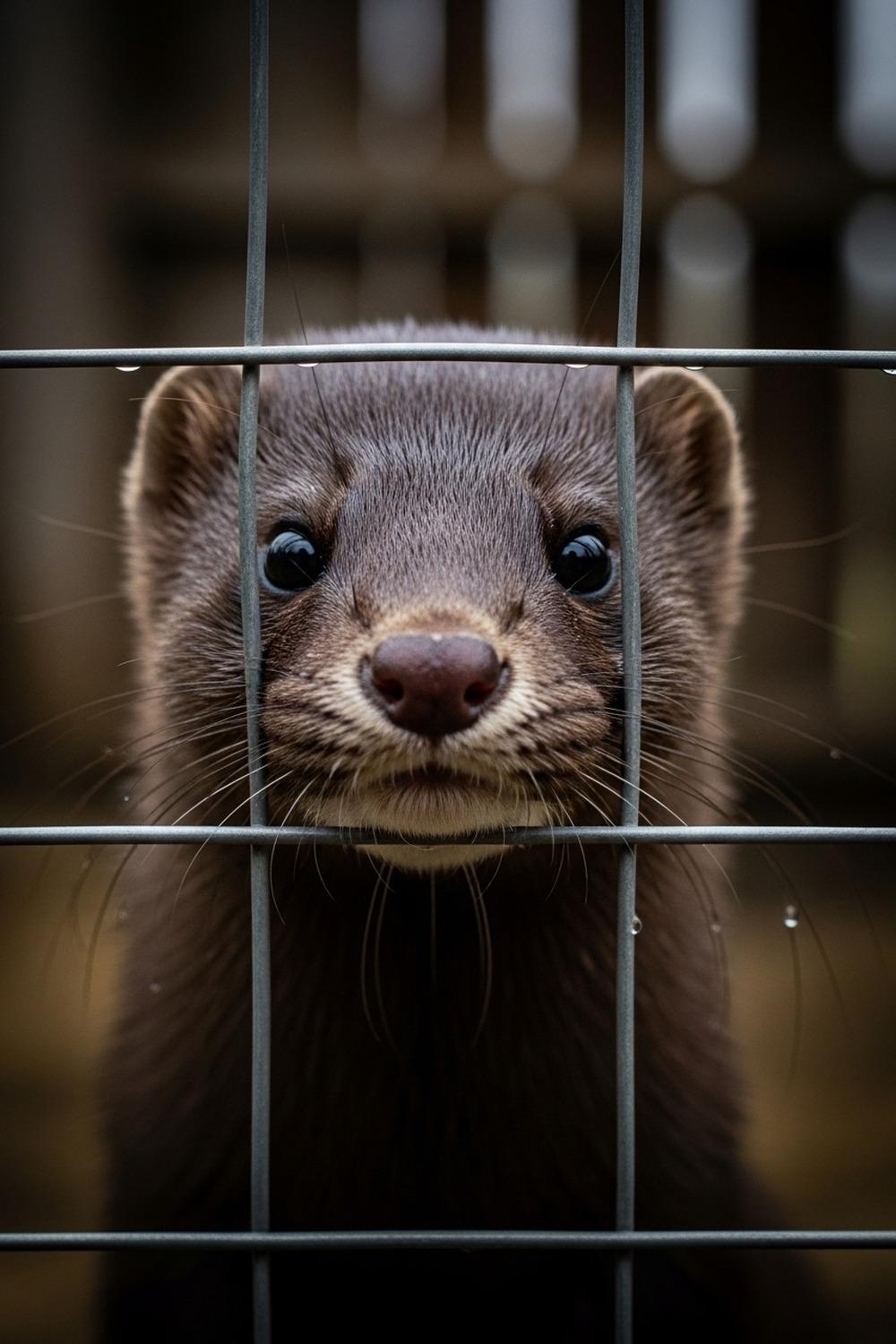
To understand why the Germany fur farm ban carried moral weight beyond economics, you need to understand what captivity does to a mink. These aren’t domesticated animals. They haven’t been selectively bred for docility the way dogs or cattle have. A wild mink, Neovison vison, will range up to 5 kilometers per day along waterways, hunting, scent-marking, defending territory. They’re intensely solitary. They don’t form groups. They don’t seek proximity to other mink.
Placed in a wire cage roughly 30 by 90 centimeters—standard fur farm dimensions—they have nowhere to direct any of those drives. The result is stereotypy: repetitive, purposeless movement with no environmental function. Pacing. Circling. Head-bobbing. It’s the same compulsive loop seen in zoo animals kept without enrichment, and it speaks to something genuinely distressing about animals experiencing what biologists at the University of Copenhagen, studying mink welfare as early as 2003, described as chronic frustration of natural motivation systems. You see something similar in the early research on how primates cope with social isolation—the instinct to attach, to move, to act on the environment, finding no outlet. It’s not unlike the way a baby monkey clings to a stuffed surrogate when its actual needs can’t be met—a behavior that looks almost normal until you understand what’s driving it.
Physical consequences aren’t subtle. Mink on fur farms show elevated cortisol, adrenal hyperplasia, gastric ulcers, and abnormal dental wear from biting at cage wire. A 2009 study published in Applied Animal Behaviour Science found that a majority of farm mink displayed stereotypic behavior regardless of cage enrichment level—suggesting that even improved conditions couldn’t fully offset the fundamental mismatch between the animal’s biology and the captive environment. These are animals that evolved to live in three dimensions, near water.
Wire floors and no horizon aren’t a compromise. They’re a contradiction.
German veterinary associations had flagged these welfare concerns for years before the 2017 regulations made them legally binding. The science existed. What changed was political will—and the moment someone finally decided to act on what the evidence had been showing all along.
The Larger Wave Sweeping Fur Farming Across Europe
Germany’s closure was significant because of its size, but it wasn’t anomalous. Across Europe, fur farming has been contracting under a combination of regulatory pressure and collapsing consumer demand. The shift has been steep. According to BBC News reporting, European mink pelt production dropped from approximately 40 million pelts annually in the early 2010s to less than half that figure by the early 2020s, as bans accumulated and fashion brands publicly exited the category.
Why does this matter? Because fashion followed, and fashion followed because customers finally started asking questions. Italy, the heart of European luxury fashion, saw brands including Gucci, Versace, and Armani announce fur-free policies between 2017 and 2022. That didn’t happen because executives had an ethical awakening. It happened because their customers started asking uncomfortable questions, and the answers were uncomfortable.
The Germany fur farm ban operated inside this broader shift—it was cause and effect simultaneously, both a response to changing attitudes and a signal that accelerated them elsewhere.
What the Germany fur farm ban demonstrated, practically, was that a major European economy could exit the sector without visible economic disruption. Germany was never the largest producer—Denmark held that position for decades—but it was large enough that its exit carried symbolic weight. If Germany’s farms couldn’t survive upgraded welfare standards, the implicit message to remaining producers was pointed.
Denmark, still processing millions of pelts annually, took note. When COVID-19 outbreaks tore through Danish mink farms in 2020—ultimately leading to the culling of approximately 17 million animals and a temporary suspension of the industry—the reputational damage accelerated conversations that welfare advocates had been trying to have for years. Ireland, France, and Estonia have all announced or implemented phase-out timelines. Each one adds pressure on the others still operating. The geography of European fur farming is contracting, and it’s contracting fast.
Germany Fur Farm Ban: What Happened to the Animals
Here’s where the story becomes genuinely complicated. The Germany fur farm ban protected mink from future captivity. It didn’t rescue the ones already there. Animals on operational fur farms at the time of closure weren’t transferred to sanctuaries. There are no large-scale mink sanctuaries—the infrastructure doesn’t exist, the cost would be prohibitive, and mink are notoriously difficult to handle and rehome.
What happened in practice, in most cases, is that animals completed their natural farm cycle and weren’t replaced. The breeding stopped. The cages weren’t refilled. A generation of mink lived out their lives, and then no new generation arrived. That’s a form of victory, but it’s a quiet one that doesn’t photograph easily. The Deutscher Tierschutzbund, Germany’s national animal welfare federation, acknowledged as much in communications during the transition period—emphasizing that the ban’s value was prospective, not retroactive. Future animals, the argument went, would simply never enter those cages.
For foxes, the situation was marginally different. Fox farming in Germany had already declined sharply before the 2017 regulations arrived—consumer pressure had made it commercially marginal—but the new welfare standards effectively finished it. Foxes, unlike mink, can occasionally be rehomed when socialized young enough, and some animals from closing operations were transferred to wildlife parks or educational facilities. Numbers were small.
Researchers at the German Federal Institute for Risk Assessment, the BfR, continued monitoring zoonotic disease pathways that fur farms had historically represented. (Mink, it turns out, are known vectors for several influenza strains.) The closure removed that particular exposure point from the German landscape entirely—a quiet public health benefit that almost no one noticed.
What Comes Next for the European Fur Industry
The countries still farming fur in Europe are watching the same data Germany’s lawmakers watched in 2017. The question is no longer whether consumer attitudes toward fur are changing—they are, measurably, and the fashion industry’s mass departure from the category has accelerated a process that welfare advocates spent decades trying to move. The question is timing and political leverage.
Denmark’s mink industry, the world’s largest before COVID collapsed it, has been attempting a controlled restart while simultaneously facing pressure from animal welfare groups and a domestic public increasingly uncomfortable with what industrial mink farming requires. Finland and Poland, still significant producers, are under active regulatory review. The European Fur Breeders’ Association, which represents remaining producers, has argued that improved welfare standards—rather than bans—represent the appropriate policy response.
Critics point out that this is precisely the argument Germany’s industry made before 2017, right until the standards arrived and no farm could meet them. And that’s the pattern worth watching across the continent: every time regulators ask whether an animal’s welfare can actually be met, the economics shrivel.
Alternative materials are capturing market share that fur once held. Both synthetic and bio-based options are improving. Lab-grown leather is beginning to attract serious investment. The replacement isn’t perfect—the environmental footprint of synthetic fur carries its own complications—but the direction of travel in luxury fashion is unmistakable: fur is being treated as a liability, not a premium signal.
A single mink in a compliant, enriched, spacious enclosure—one that actually met what the animal’s biology requires—would need cage space that made commercial farming economically irrational. That’s the arithmetic the industry couldn’t solve.
How It Unfolded
- 1998 — Austria becomes one of the first European countries to ban fur farming outright, setting an early legislative precedent for welfare-based restrictions.
- 2013 — The Netherlands passes a direct mink farming ban with a 10-year phase-out, marking a major shift in how EU member states approached the issue.
- 2017 — Germany revises its Tierschutz-Nutztierhaltungsverordnung, introducing welfare standards for fur-bearing animals so stringent that no existing operation could comply.
- 2019 — Germany’s last fur farm closes, ending an industry that had operated in the country since the mid-20th century.
- 2020 — COVID-19 outbreaks force the culling of approximately 17 million mink in Denmark, dramatically accelerating European-wide debate about the industry’s future.
By the Numbers
- European mink pelt production fell from approximately 40 million pelts annually in the early 2010s to under 20 million by the early 2020s, driven by bans and market contraction.
- A wild mink naturally ranges up to 5 kilometers per day—a standard fur farm cage offers roughly 0.27 square meters of floor space.
- 17 million mink were culled in Denmark in late 2020 following COVID-19 outbreaks across the country’s fur farm network.
- At least 14 European countries have implemented full or partial fur farming bans as of 2024, up from just 2 in the year 2000.
- The global fur trade was valued at approximately $22 billion USD at its early 2010s peak; market analysts at Euromonitor estimated it had contracted by over 40% by 2023.
Field Notes
- A 2003 study from the University of Copenhagen found that mink raised on farms without water access for swimming showed significantly higher rates of stereotypic behavior—yet water access was standard only in a minority of European facilities at the time. The finding helped anchor welfare arguments that eventually shaped Germany’s 2017 regulations.
- Mink fur requires approximately 11 kilograms of feed per pelt produced—most of it fish byproduct—making it one of the more resource-intensive luxury materials by weight of finished product.
- The same mink species farmed for fur, when escaped from operations, becomes an invasive predator across Europe. Feral American mink have devastated water vole populations in the UK and are classified as a threat to multiple native species—a consequence that began long before welfare debates reached mainstream politics.
- Researchers still can’t fully predict whether mink stereotypy is reversible once established—it’s unclear whether an animal that has developed compulsive pacing behavior can return to anything like normal movement patterns even in enriched or open conditions. The neurological question remains open.
Frequently Asked Questions
Q: What exactly triggered the Germany fur farm ban, and was it a direct prohibition?
The Germany fur farm ban wasn’t a direct prohibition but a welfare-standards mechanism. In 2017, Germany revised its livestock protection ordinance to include requirements for fur-bearing animals—specific minimum cage sizes, mandatory enrichment, and swimming water access for mink—that set bars no operational farm could economically meet. The transition period ended in 2019, when the last farm closed. It’s a regulatory distinction that matters legally, but the practical outcome was identical to an outright ban.
Q: What happened to the mink that were on farms when they closed?
Animals already on fur farms at closure weren’t transferred to sanctuaries—large-scale mink rescue infrastructure doesn’t exist anywhere in Europe. In most cases, existing animals lived out their current farm cycle and weren’t replaced. Breeding stopped, new generations weren’t produced, and the population simply didn’t continue. It’s a prospective victory rather than a retroactive rescue, which the Deutscher Tierschutzbund acknowledged during the transition. The animals that were already in the system remained in it until natural attrition ended that cohort.
Q: Isn’t synthetic fur just as environmentally harmful as real fur?
This is a genuine complication that the fur industry has leaned on heavily. Synthetic fur is typically made from petroleum-derived polymers, sheds microplastics, and doesn’t biodegrade. Real fur, by contrast, is a natural protein fiber. But the comparison is more complex than either side tends to admit. The resource intensity of fur farming—water use, feed conversion, waste runoff, and disease risk—is substantial. The environmental calculus depends heavily on what you’re measuring and over what time horizon. Neither option is clean. The honest answer is that both carry costs, and the welfare dimension of real fur adds a variable that life-cycle analysis alone doesn’t capture.
Editor’s Take — Alex Morgan
What I keep returning to is the mechanism. Germany didn’t ban fur farming. It required fur farming to be humane. And then fur farming ceased to exist, because humane fur farming is a contradiction the math can’t resolve. That’s either a loophole or a blueprint, depending on which side you’re standing on. Watching an industry disappear because the numbers stopped working—because someone finally asked what animals actually need and then made it the law—that’s a different kind of ending than scandal provides. For the animals, the distinction is academic. But for every industry still arguing that better standards, not bans, are the appropriate response, Germany’s empty cages are a data point worth sitting with.
The story of the Germany fur farm ban is really a story about what regulation looks like when it takes animal cognition seriously—when it asks not just whether an animal is alive and fed, but whether it can actually live. That question is spreading. It’s appearing in legislation about broiler chicken density, about pig gestation crates, about the space a zoo enclosure owes its occupant. Once you ask it honestly, the answers tend to be uncomfortable. Somewhere in an empty German facility, wire cages sit in the dark. The last mink that paced them is gone. And the question has already moved on to somewhere new.
Illustrations are AI-generated. Article fact-checked and human-edited. Our editorial standards.