The Skyscrapers Covered in Trees Cleaning City Air
Twenty-five tons of CO₂ disappear from the Nanjing skyline every year, pulled directly from the air by vertical forest skyscrapers — not through machines or filters, but through something far older. Two towers rise from one of China’s most congested cities, and they’re breathing. Literally. The trees that cover their facades aren’t decoration. They’re doing the work we forgot buildings could do.
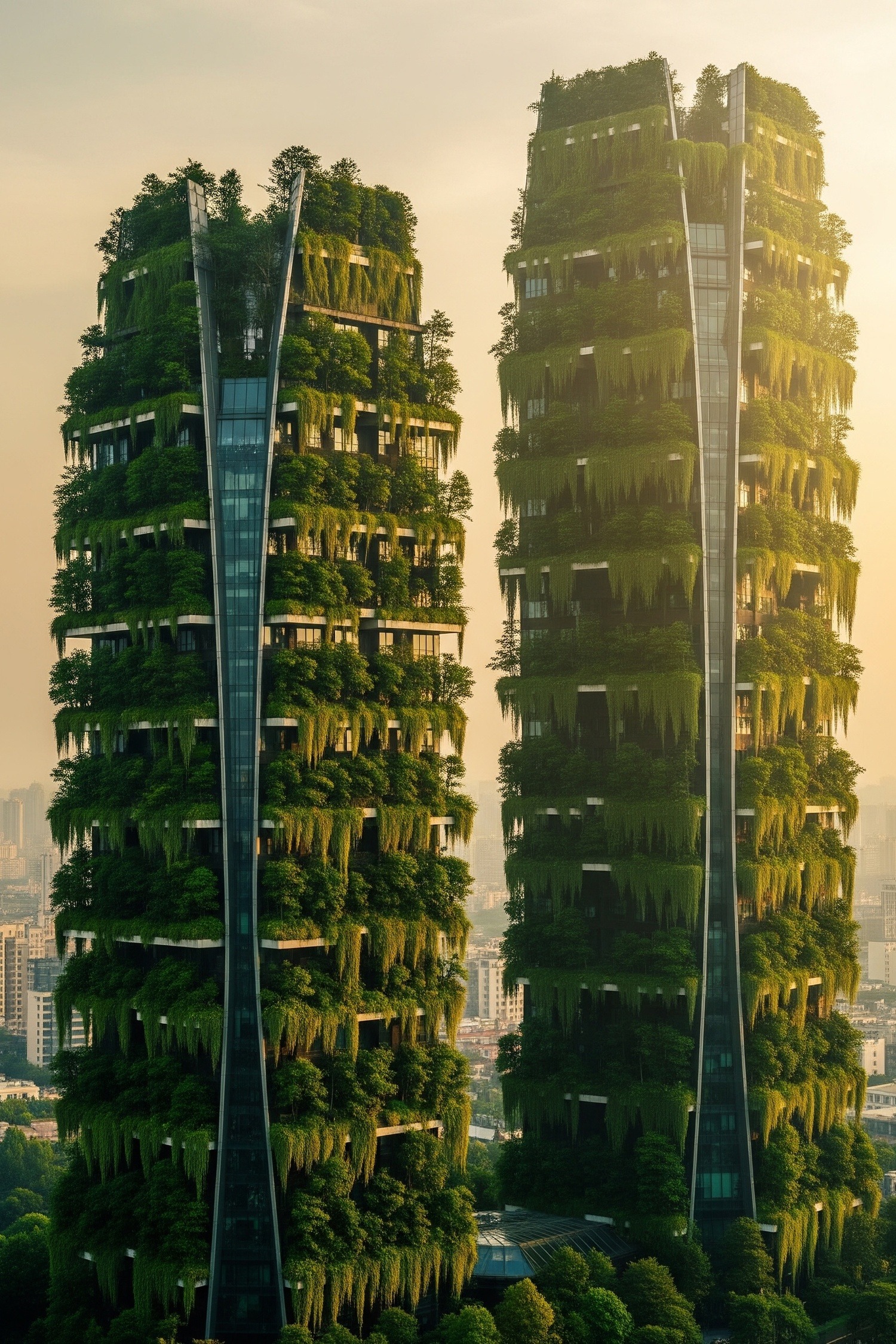
Italian architect Stefano Boeri designed the Nanjing Green Towers, completed in 2018, to carry 1,100 trees and 2,500 shrubs across their facades. The buildings look less like structures and more like something a forest quietly swallowed whole. Why it took us this long to build them — and how far the idea can actually scale — are the questions that matter now.
Key Facts
- The Nanjing Green Towers, completed in 2018, are designed to absorb approximately 25 tons of CO2 per year.
- The two towers carry 1,100 trees and 2,500 shrubs across roughly 23 species, with the taller tower reaching 200 meters and the shorter 108 meters.
- Italian architect Stefano Boeri designed the Nanjing project, building on his earlier Bosco Verticale in Milan’s Isola district, completed in 2014.
- The Milan Bosco Verticale hosts around 800 trees, 4,500 shrubs, and 15,000 perennial plants and won the International Highrise Award.
- A 2020 study in Nature Sustainability found widespread facade greening in temperate and subtropical cities could lower peak urban temperatures by 1.5 to 3 degrees Celsius.
In short: Stefano Boeri’s vertical forest skyscrapers, including the Nanjing Green Towers completed in 2018 and Milan’s Bosco Verticale from 2014, integrate over a thousand trees into building facades to absorb CO2, cool urban air, and host biodiversity. A 2020 Nature Sustainability study confirmed that scaled facade greening can cut peak city temperatures by 1.5 to 3 degrees Celsius.
How Vertical Forest Skyscrapers Actually Work
Boeri Architetti didn’t simply bolt planters to a building facade. The engineering required years of structural calculation, accounting for root mass, soil substrate, wind load, and the shifting weight as trees mature over decades. Each terrace was designed to bear the full mature weight it carries. Botanists and soil scientists weren’t brought in as consultants at the end — they were core members of the design team from the beginning.
The concept draws directly from urban heat island research, which has documented since the 1980s how cities trap heat in concrete and asphalt, raising local temperatures by as much as 7°C above surrounding rural areas. Boeri’s solution wasn’t to build parks next to buildings. It was to make the building itself a forest.
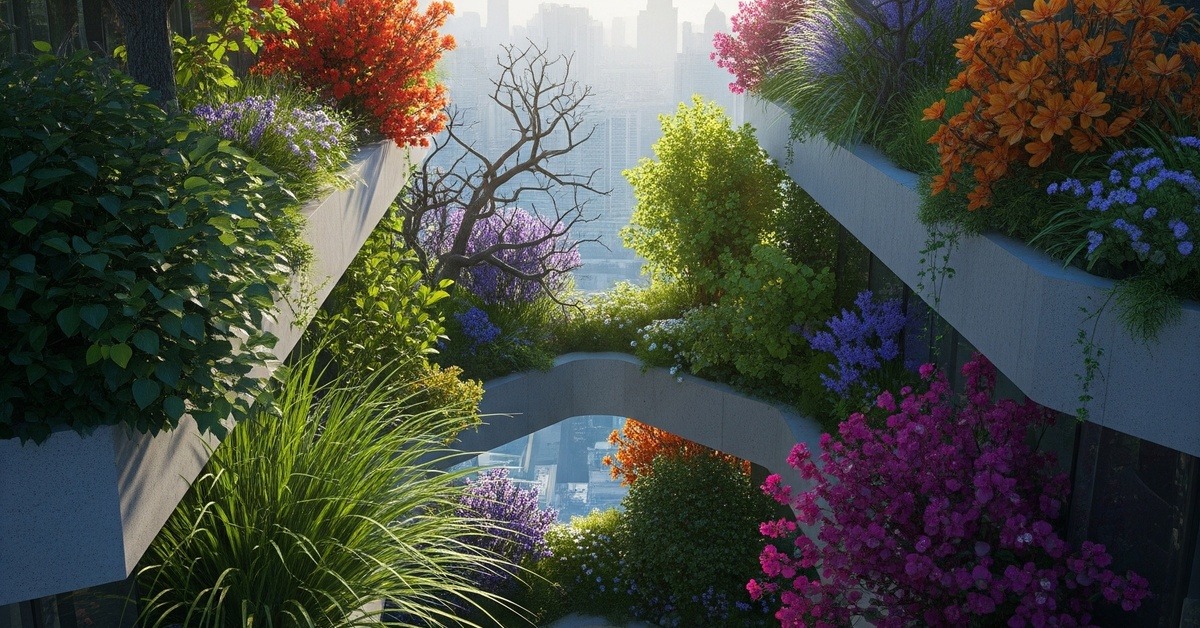
What actually happens on these facades is more elegant than it first appears. The trees shade the building’s glass, cutting the solar heat gain that forces air conditioning systems to strain through summer. They transpire — releasing water vapor that cools the surrounding air. They intercept rainfall, reducing runoff into already-stressed urban drainage systems. And they absorb particulate matter, the fine-grained pollution that causes respiratory disease across Asian megacities.
The taller of the two Nanjing towers reaches 200 meters. The shorter stands at 108 meters. Together, they host approximately 23 species of trees — chosen not for beauty, but for their ability to survive wind, temperature extremes, and the limited soil depth of a high-rise environment. The botanists picked the toughest ones that could also do the most ecological work.
One tower doesn’t reverse a city’s pollution crisis, but it doesn’t need to work alone.
Milan First, Then the World Followed
Before Nanjing, Boeri’s Bosco Verticale opened in the Isola district in 2014, and it changed the conversation about what a residential tower could be. The two towers carry around 800 trees, 4,500 shrubs, and 15,000 perennial plants. Since completion, the project has won the International Highrise Award and been cited by urban planners from Singapore to São Paulo as a model worth studying.
What vertical greening actually does to biodiversity in a city is where things get interesting. The Milan towers have become a documented habitat for birds and insects that wouldn’t otherwise survive in that district. Here’s the thing: cities aren’t just hostile to humans when they overheat. They hollow out the ecological fabric that every living system depends on. The impulse that drives architects to design living buildings — the desire to restore what urban expansion erased — connects directly to how we think about trees as memorials, as anchors of meaning in landscapes stripped bare (and this matters more than it sounds), the way living memorial trees grown from human ashes are reshaping how communities relate to forests they nearly lost.
Between 2014 and 2023, Boeri Architetti expanded the concept to projects on four continents. A vertical forest tower opened in Lausanne, Switzerland in 2019. Plans were drawn for Eindhoven, Antwerp, and Utrecht. In China alone, the studio has been engaged in designing what Boeri calls the “Forest City” — an entire planned city of 30,000 residents near Liuzhou, in Guangxi province.
Every building surface, road median, and public space in that development is integrated with living vegetation. The projected CO₂ absorption for the full Forest City when complete is approximately 10,000 tons per year. That’s not a park. That’s a carbon sink built into the urban fabric itself.
Singapore’s government mandated green building standards in 2008 that include vertical greening as a measurable component — decades before the concept captured global attention. By 2030, the Building and Construction Authority projects that 80 percent of all buildings in the city-state will carry a green certification that includes vegetated surfaces. The city most associated with glass and steel is quietly becoming one of the world’s most systematically green. Why does this speed of adoption matter? Because it proves this isn’t a luxury for wealthy districts anymore.
The Science Behind Living Building Facades
A 2020 study published in Nature Sustainability examined the cooling potential of urban vegetation at scale. Researchers found that widespread greening of building facades in temperate and subtropical cities could reduce peak urban temperatures by 1.5°C to 3°C — numbers that translate directly into reduced heat mortality, lower energy demand, and a measurable slowdown in the feedback loop where cities generate heat that forces more air conditioning that generates more heat. The environmental claims around vertical greening aren’t just architectural ambition. They’re measurable, and they’ve been tested.
Scale determines whether these effects register. One building changes its microclimate. A district of living buildings begins to change the city.
Vertical forest skyscrapers interact with air quality in ways that ground-level parks simply can’t replicate. Tree canopy at height intercepts particulate matter before it disperses at street level — where humans actually breathe. Research from Politecnico di Milano, published in 2017, modeled the air quality effect of the Bosco Verticale towers. It found measurable reductions in PM10 concentrations in the immediate surrounding blocks, not just at the building’s surface. The mechanism is straightforward: leaves have surface area, surface area catches particles, and rain washes them to soil. At scale, that’s filtration without infrastructure.
Watching a city accept that its buildings should absorb its own pollution rather than contribute to it, you realize how radically the frame has shifted in a single decade.
Critics have raised legitimate counterpoints. The embodied carbon cost of constructing reinforced terraces strong enough to hold mature trees is significant — some analyses suggest it takes years of the building’s operational carbon savings to offset the construction premium. But it’s also the wrong frame. These buildings aren’t just carbon calculators. They’re demonstrations of what cities can look like when nature is treated as infrastructure rather than ornament.
Vertical Forest Skyscrapers and the Future of Dense Cities
By 2050, the United Nations projects that 68 percent of the global population will live in urban areas — up from roughly 55 percent today. The pressure on dense cities to innovate isn’t easing. The cities absorbing that growth are concentrated in South and Southeast Asia, sub-Saharan Africa, and Latin America: regions already under severe climate stress, where heat-related mortality is rising and urban green space is chronically underfunded. A study by the C40 Cities Climate Leadership Group in 2022 found that expanding urban tree canopy by 30 percent in the world’s 100 largest cities would prevent an estimated 40,000 heat-related deaths annually. Vertical forest skyscrapers can’t replace urban parks or street trees — but they can bring canopy into the vertical dimension of a city, into the space above ground level where density makes horizontal greenery mathematically impossible.
For years, the primary obstacle to wider adoption of living building facades was cost. The structural reinforcement required to support mature trees, the specialized irrigation systems embedded in facade substrates, the arborist contracts required for maintenance at height — all of it added 10 to 15 percent to construction costs in early projects. But something shifted. By 2022, several Chinese developers were reporting cost premiums closer to 6 percent for vertical greening projects, as supply chains for specialist components matured and design expertise became less rare. When you factor in reduced air conditioning loads over the building’s lifetime, the economics of vertical forest skyscrapers are beginning to work without subsidy.
In a 2019 lecture at the Politecnico di Milano, Boeri was direct about the stakes. The choice architects face isn’t between green buildings and efficient buildings — it’s between cities that can survive the next fifty years and cities that can’t. That’s not hyperbole dressed up as vision.
How It Unfolded
- 2008 — Singapore’s Building and Construction Authority introduces the Green Mark scheme, one of the world’s first national standards to formally recognize and incentivize vegetated building facades.
- 2014 — Boeri Architetti completes Bosco Verticale in Milan’s Isola district, the first full-scale residential vertical forest and the project that defines the concept globally.
- 2018 — The Nanjing Green Towers are completed, becoming the largest vertical forest skyscraper complex in Asia and the first to absorb a documented 25 tons of CO₂ annually.
- 2022 — Boeri’s Forest City project near Liuzhou, Guangxi, enters active development, scaling the vertical forest concept from individual towers to an entire planned urban district.
By the Numbers
- 25 tons — CO₂ absorbed annually by the Nanjing Green Towers, equivalent to removing roughly five passenger cars from the road permanently (Boeri Architetti, 2018).
- 1,100 trees and 2,500 shrubs across two towers in Nanjing, representing approximately 23 distinct tree species selected for wind tolerance and air-filtering capacity.
- 7°C — maximum recorded temperature differential between city centers and surrounding rural areas due to urban heat island effect, according to U.S. Environmental Protection Agency data.
- 40,000 estimated heat-related deaths annually that could be prevented by expanding urban tree canopy by 30 percent in the world’s 100 largest cities (C40 Cities Climate Leadership Group, 2022).
- 68 percent — share of global population projected to live in urban areas by 2050 (United Nations Department of Economic and Social Affairs), driving demand for integrated urban greening at scale.
Field Notes
- The Bosco Verticale towers in Milan attracted nesting populations of kestrels and peregrine falcons within two years of opening in 2014 — species not previously recorded breeding in the Isola district. Ecologists from the Politecnico di Milano have been monitoring the towers as an unplanned urban rewilding experiment ever since.
- The trees on vertical forest skyscrapers are pre-grown in specialist nurseries for three to five years before installation — partly to ensure structural root maturity, and partly because a newly transplanted sapling at 150 meters above a city street has essentially no margin for error.
- Singapore’s Jewel Changi Airport, completed in 2019, incorporates a 40-meter indoor waterfall surrounded by forest — demonstrating that the principles behind vertical greening can be adapted to interior commercial spaces, not just residential tower facades.
- Researchers still can’t fully model the long-term soil microbiome dynamics inside the engineered substrate systems used on living facades at height — it’s unclear whether the bacterial communities that make ground-level forest soil so ecologically productive can replicate themselves in the compressed, wind-exposed root environments of skyscraper terraces.
Frequently Asked Questions
Q: How are vertical forest skyscrapers different from ordinary green roofs or wall gardens?
Green roofs and wall gardens typically use low-growing plants — sedums, grasses, climbing vines — with minimal structural integration. Vertical forest skyscrapers are engineered from the foundation up to support the full weight of mature trees at height, including root mass and soil substrate. The Nanjing towers carry trees that reach up to nine meters tall on their terraces, requiring a fundamentally different structural approach than attaching a trellis to an existing facade.
Q: Do the trees on these buildings actually survive long-term?
Evidence from Milan’s Bosco Verticale, now over a decade old, suggests they do — with active management. Each tree on a living building requires regular inspection by specialist arborists, often working from rope access. Irrigation is embedded in the substrate and precisely controlled. Tree mortality does occur — typically around 5 to 8 percent in the first three years after installation — but survival rates stabilize once root systems establish in the engineered growing medium. The Milan towers have trees that have grown substantially since 2014.
Q: Aren’t vertical forest skyscrapers just for wealthy cities — too expensive for the places that need them most?
This is the most common and most important misconception. Early projects like Bosco Verticale were premium residential developments, and their price tags reflected that. Construction costs for vertical greening have dropped significantly as the supply chain matured — from roughly 15 percent premium in 2014 to closer to 6 percent by 2022 in China. Researchers at institutions including the World Resources Institute have argued that modular, lower-cost vertical greening systems — using shrubs and climbing plants rather than full trees — could be deployed affordably in rapidly urbanizing cities across Africa and South Asia within this decade.
Editor’s Take — Alex Morgan
What strikes me most about this story isn’t the architecture. It’s the admission embedded in it. We spent a century designing cities that treated nature as something to be managed at the margins — a park here, a street tree there, a strip of grass beside the highway. Vertical forest skyscrapers are a public acknowledgment that we got the ratio wrong. The trees aren’t decoration on these buildings. They’re doing structural work. And if it takes a skyscraper covered in forest to remind a city that air is something you breathe, then so be it.
Cities are living systems whether we design them that way or not. The concrete heats. The air thickens. The species quietly leave. What Boeri and the architects following his lead are proposing isn’t a romantic return to nature — it’s an engineering correction, applied to the places where half the human species now lives. The Nanjing towers absorb 25 tons of CO₂ a year from a skyline that produces millions. That gap is humbling. But it’s also an invitation. What does a city look like when every surface is asked to do ecological work — and what grows in us when the buildings around us are, finally, alive?
Illustrations are AI-generated. Article fact-checked and human-edited. Our editorial standards.