The Roman Mosaic That Recorded an Earthquake
Beneath the soil of western Turkey lies something that shouldn’t exist: a Roman mosaic floor that didn’t shatter when an earthquake hit. Instead, it rippled. The tessellated surface froze mid-motion, preserving a seismic ground movement in stone the way a photograph catches water the instant before it falls. This single, impossible wave running across the Roman mosaic earthquake record is not damage. It’s a geological diary entry written in tesserae.
In the 1st or 2nd century AD, artisans laid decorative stone across a villa floor in ancient Anatolia. They used lime mortar, hand-cut pieces, layered substrates — the standard toolkit of eastern Mediterranean mosaic craftsmanship. Then the earth moved beneath them. And the mosaic held.
Archaeologists working in western Turkey uncovered what may be one of the most unusual seismic records from the ancient world. The tessellated surface didn’t simply survive an earthquake — it documented one. The question that follows is quietly extraordinary: what else did Roman builders understand that we’ve spent two thousand years relearning?
Key Facts
- A Roman mosaic floor in western Turkey (ancient Anatolia), dated to the 1st through 3rd century AD, preserved a smooth seismic ripple rather than shattering.
- The North Anatolian Fault, which the mosaic’s ripple direction aligns with, runs roughly 1,500 km across northern Turkey.
- The 1999 Izmit earthquake (magnitude 7.6) along the North Anatolian Fault caused 17,480 confirmed deaths (USGS, 1999).
- Roman mosaic floors used 3 to 4 distinct substrate layers, letting the surface flex like a composite material rather than a rigid slab.
- The floor’s most probable construction window is the Antonine-Severan period, 138 to 235 AD, based on comparative pottery and coin evidence.
In short: The Roman mosaic earthquake record in western Turkey is a 1st-to-3rd-century AD villa floor that rippled instead of shattering when the ground moved. Its smooth, directional wave aligns with the North Anatolian Fault, and the layered substrate, three to four levels of flexible lime mortar, let the tessellated surface ride a seismic pulse as one composite unit.
How a Mosaic Floor Became a Seismic Record
Ancient Anatolia — modern western Turkey — sits on restless geology. The North Anatolian Fault, a 1,500-kilometre transform fault running roughly east to west across northern Turkey, has generated some of the most destructive earthquakes recorded in human history. The 1999 İzmit earthquake killed more than 17,000 people. But seismic activity along this fault network stretches back long before any measuring instrument existed.
Roman engineers building here in the 1st century AD were constructing on ground that moved. They knew it.
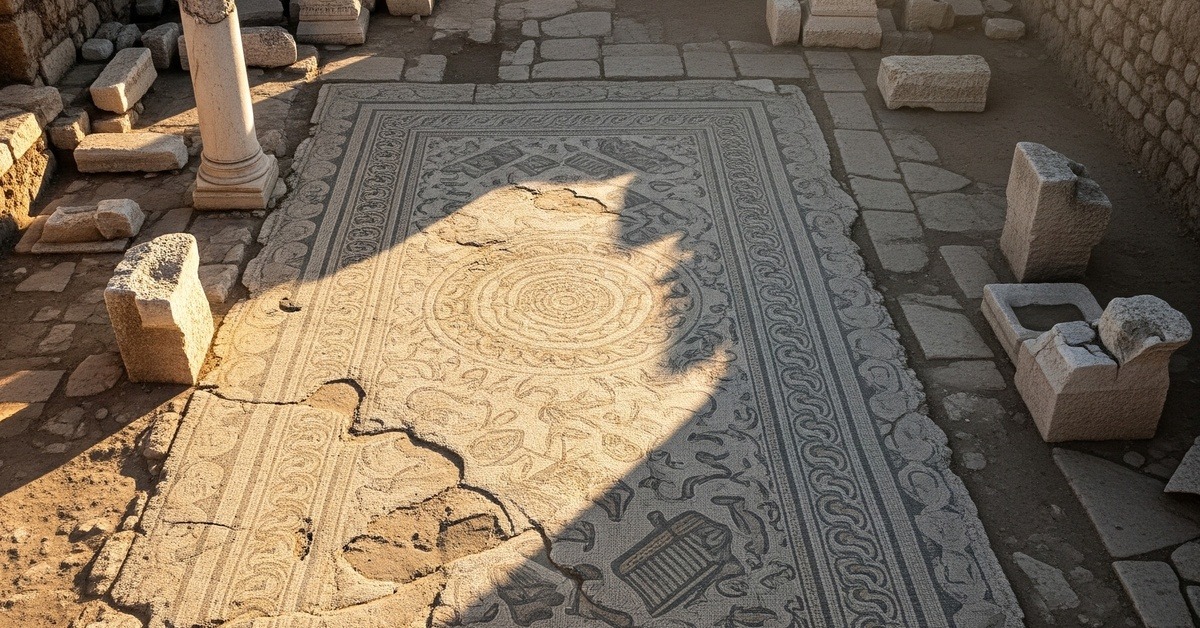
When archaeologists carefully removed the overlying soil, what they found stopped the excavation. The mosaic’s surface carried a visible undulation — a slow, organic wave running diagonally across the floor. No individual tesserae were missing from the wave’s path. No mortar lines had split. The ripple’s direction, when mapped against regional fault surveys, aligned with documented fault activity in the zone. That correlation elevated this find from architectural curiosity to potential palaeoseismic record: physical evidence of ground displacement, locked into a surface and preserved for somewhere between 1,700 and 1,900 years.
The colors, once excavated, were still vivid. Ivory, ochre, deep blue-black. Whatever happened beneath that floor happened gently enough — or quickly enough — that oxidation never found a foothold. The question is how consciously Roman builders designed around seismic risk — and what this particular mosaic tells us about the answer.
The Engineering Logic Hidden Beneath the Stones
What saved the mosaic wasn’t luck. It was layering. Roman mosaic construction typically involved three or four distinct substrate levels beneath the decorative surface: a rough base of broken stone or rubble, a thick bed of lime mortar mixed with crushed ceramic, a finer setting layer, and then the tesserae themselves, each piece cut and pressed by hand. This system — refined across centuries of Roman construction — created a floor that behaved more like a composite material than a rigid slab. It could flex.
That flexibility is the same principle modern civil engineers apply in earthquake-resistant base isolation systems, where a building’s foundation is deliberately decoupled from the ground beneath it to absorb lateral movement without transmitting the full force upward. Here’s the thing: the Romans arrived at a version of that solution not through mathematical modeling, but through centuries of empirical craft knowledge. They built what worked. They discarded what didn’t. No architect’s treatise survives. Only the evidence.
When the ground shifted beneath the villa — likely a single seismic event rather than gradual subsidence, given the clean directionality of the wave — the mortar layers allowed the mosaic canvas to ride the movement as a unit. Think of it as a raft rather than a plate. A ceramic tile floor set directly onto concrete would have fractured at the grout lines. This floor behaved like fabric. Individual tesserae measuring as small as 5 millimeters across remained interlocked because the material between them — lime mortar with a specific flexibility coefficient — absorbed the differential stress before it could concentrate at any single joint. Engineers today use accelerometers to measure ground displacement during seismic events.
The Romans, inadvertently, used marble and limestone.
What the Villa Tells Us About the People Who Lived There
A mosaic of this quality doesn’t appear in an ordinary home. Why does this matter? Because Roman Anatolia in the 1st through 3rd centuries AD was an extraordinary crossroads of wealth — trade routes from Rome to Persia, from the Black Sea ports to Alexandria, funneled goods and money through cities like Ephesus, Sardis, and Pergamon. The villa this floor belonged to would have reflected that prosperity directly.
Coins found in the surrounding excavation layers, along with fragments of imported wall plaster and fine-ware pottery, suggest a household connected to long-distance commerce. This was the kind of family that could commission artisans to spend months hand-cutting tesserae into geometric or figural patterns. Researchers from Turkey’s broader mosaic heritage programs, which have been cataloguing Anatolian Roman floors since the 1970s, note that the density and quality of mosaic programs in this region rivals anything found in the western empire. It’s a reminder that “Roman” was not a geography. It was a network — and Anatolia was one of its most dynamic nodes.
The same ancient reverence for preserving warning signs in stone shows up in other parts of the world too: in Japan, stones carved with flood warnings centuries ago still stand along coastlines, placed there by communities who had survived catastrophe and wanted to speak across time.
Geometric conventions in the mosaic’s pattern — where it’s been partially reconstructed from photographic documentation — follow designs common to the eastern Mediterranean in the Antonine and Severan periods, roughly 138 to 235 AD. That narrowed date range coincides with documented seismic unrest in the region. Historical sources from the 2nd century AD, including correspondence and administrative records preserved in later Byzantine compilations, mention earthquakes affecting Anatolian cities with some regularity. The mosaic may not record a single catastrophic rupture. It may record something quieter: a moderate tremor, a ground roll measured in centimeters rather than meters, the kind of event that rings wine cups against shelves and then passes.
Did the person who walked across this floor afterward notice the new curve beneath their feet? Did they call for the craftsman? Or did they simply adapt, the way people who live in seismic zones always do?
What the Roman Mosaic Earthquake Discovery Changes
Palaeoseismology — the study of prehistoric earthquakes through geological and archaeological evidence — has been a growing discipline since the 1980s, but it has relied heavily on natural records: fault scarps, offset stream channels, liquefaction features in soil. Archaeological structures have been used more cautiously, partly because of the difficulty of separating seismic damage from human destruction, fire, or gradual settlement.
A 2019 review by the Geological Survey of Turkey’s Earthquake Research Department confirmed that Anatolia holds some of the highest concentrations of archaeoseismic evidence anywhere in the world — damaged column drums, tilted walls, offset foundation lines. But intact surfaces that record movement rather than rupture are extraordinarily rare. The Roman mosaic earthquake documented here belongs to a very short list of floors anywhere in the Mediterranean that have been interpreted as functional seismic records rather than mere casualties of seismic activity. Damage is passive. A record is something else entirely.
What makes this floor different from every cracked pavement at every earthquake-leveled Roman site is the completeness of the deformation. Nothing is missing. The wave is smooth, not jagged. That means the ground movement that caused it was either very slow — gradual fault creep over months or years — or very coherent: a single seismic wave that passed beneath the villa fast enough that the entire floor moved together before any individual section could fail. Researchers favor the latter interpretation, because creep events rarely produce the clean directional ripple this floor shows. And yet watching a floor preserve ground displacement across nearly two millennia, you realize how rarely we see evidence that lets us read the ancient earth’s behavior this directly — this honestly.
A pulse moved through the substrate. The floor rode it. Everything stopped exactly as it was.
The ripple’s preserved direction gives geologists something they almost never have: a specific seismic vector from a pre-instrumental era. That’s the kind of data point that can refine fault behavior models for one of the most seismically hazardous regions on Earth.
How It Unfolded
- 1st–3rd century AD — The villa mosaic is laid in Roman Anatolia, constructed using multi-layer lime mortar substrates consistent with high-status eastern Mediterranean workshop traditions.
- Late antiquity — The villa is abandoned; accumulated soil and debris bury the mosaic floor, preserving the seismic deformation event locked within its surface.
- 1970s–1990s — Turkish archaeological survey teams begin systematic cataloguing of Roman mosaic sites across Anatolia, establishing baseline records for assessing unusual finds.
- 2010s–2020s — Excavation reveals the mosaic; researchers correlate the floor’s ripple direction with regional fault data, proposing classification as a rare intact archaeoseismic record rather than simple structural damage.
By the Numbers
- 1,500 km — the approximate length of the North Anatolian Fault, one of the world’s most seismically active transform faults.
- 17,480 — confirmed deaths from the August 1999 İzmit earthquake (magnitude 7.6) along the North Anatolian Fault system (USGS, 1999).
- 5 mm — approximate minimum size of individual tesserae in high-quality Roman mosaics of this period; smaller pieces indicate higher workshop skill and labor investment.
- 3–4 substrate layers — typical Roman mosaic construction depth, each with distinct mechanical properties contributing to composite floor seismic flexibility.
- 138–235 AD — the Antonine-Severan period, most probable construction window for this floor, based on comparative pottery and coin evidence from stratigraphic site layers.
Field Notes
- Mortar beneath Roman mosaic floors in seismically active regions often contains higher proportions of volcanic ash — pozzolana — which creates hydraulic cement that cures harder than standard lime but retains elasticity longer. At several Anatolian sites excavated in the 2000s, this mixture appears locally adapted, suggesting Roman craftsmen in earthquake-prone regions deliberately adjusted their recipes.
- The ripple’s peak height — the difference between wave crest and trough — is measured in millimeters, not centimeters. That subtlety is why the floor survived intact: seismic displacement was real, but within the elastic range of the composite substrate.
- Several other Roman mosaic floors in Turkey show scattered, irregular fracture patterns — expected outcomes of seismic damage. This floor’s clean, directional deformation is anomalous and analytically valuable: pattern versus chaos marks the entire distinction.
- Researchers still can’t determine with certainty whether the seismic event occurred while the villa was occupied or after abandonment — (and this matters more than it sounds). A person who walked that floor after the earthquake and chose not to repair it might tell us as much about Roman attitudes toward geological risk as the engineering does.
Frequently Asked Questions
Q: How does a Roman mosaic earthquake in Turkey get identified as a seismic record rather than ordinary damage?
Pattern is the key distinction. Ordinary seismic damage — seen at dozens of Roman sites across Anatolia — produces random fracturing, displaced tesserae, and broken mortar lines. The floor found in Turkey shows smooth, unidirectional wave deformation with no missing pieces and no crack propagation. Geologists mapped the ripple’s orientation against known fault lines in the region; the alignment matched documented fault strike directions. That combination — intact deformation plus directional match — distinguishes a seismic record from a casualty.
Q: What made Roman mosaic construction resilient enough to survive ground movement?
Roman mosaic floors were built as layered composite systems, not single rigid surfaces. A typical high-quality floor used three to four substrate layers between bedrock and decorative tesserae: rough rubble base, thick lime-mortar bed, fine setting layer, then the mosaic surface itself. Each layer had slightly different mechanical properties — stiffness, elasticity, moisture response — which meant seismic energy moving upward through the stack was progressively absorbed rather than transferred intact to the surface. Tesserae themselves, set in flexible lime mortar rather than rigid cement, could shift microscopically relative to each other without unlocking.
Q: Does this discovery mean Roman engineers deliberately designed for earthquakes?
Almost certainly not in the formal sense — no surviving Roman treatise addresses seismic-resistant mosaic construction, and Vitruvius, writing around 30 BC, discusses structural engineering without framing earthquake resilience as a design objective. What the evidence suggests is empirical adaptation. Roman builders in seismically active regions repeatedly selected materials and construction methods that happened to perform well under seismic loading, likely because those methods also produced durable floors under everyday use. Resilience emerged from quality. It’s a distinction worth keeping — the Romans weren’t earthquake engineers, but they were extraordinarily good builders in places where the ground moved.
Editor’s Take — Sarah Blake
What unsettles me about this story isn’t the engineering — impressive as it is. It’s the ripple itself. We spend enormous resources trying to read the deep past through fragments: a coin, a potsherd, a charred seed. Here is a building material that recorded a geological event in real time, in three dimensions, and then waited nearly two thousand years underground to be found. The Romans didn’t intend to leave us a seismograph. They just built well. That’s either humbling or instructive, depending on how honestly you look at what we build today.
The ground beneath western Turkey hasn’t stopped moving. It shifted in the 2nd century under a Roman villa. It shifted again in 1999 with catastrophic force. And it will shift again — that much is certain. What this mosaic offers isn’t just a record of one ancient tremor. It’s a reminder that the boundary between art and science, between craft and engineering, between beauty and survival, has always been thinner than it looks. Somewhere under those still-vivid colors, a Roman artisan’s hand mixed lime and ash in proportions that the earth itself would eventually test. The floor passed. What does that ask of everything we’re building right now?
Illustrations are AI-generated. Article fact-checked and human-edited. Our editorial standards.