From Comfort Doll to Rock: One Macaque’s Bold New Chapter
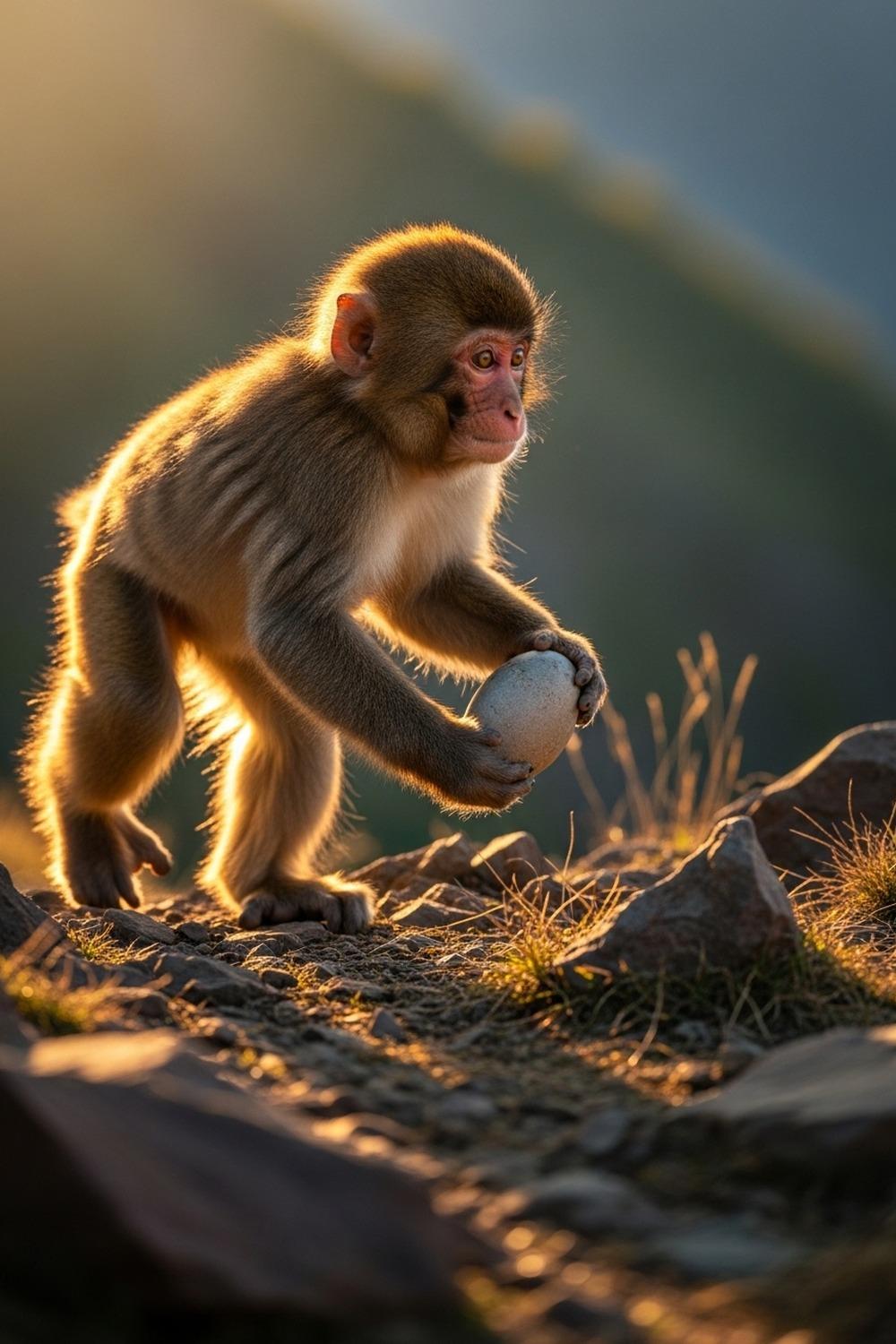
A rock in a macaque’s hand usually means nothing. But Little Punchy’s isn’t random — and watching him stride across Monkey Mountain with stone held high, you’re looking at a recovery metric that almost nobody was tracking five years ago. He arrived as a terrified orphan clutching a plush doll, unable to read the social cues around him. That was stress, neurologically measurable, written in cortisol. The rock is something else entirely. And the science of macaque comfort object behavior just got a lot more interesting.
Habitat loss and the illegal pet trade across Southeast Asia had already displaced thousands of macaques when Little Punchy arrived at the sanctuary as a terrified orphaned infant. His coping mechanism was a stuffed Mama Doll — soft, tactile, unchanging. Caregivers watched closely, understanding that an animal’s choice of comfort object is a real-time read of where it stands emotionally in its recovery. So when the doll gave way to stone, everyone stopped.
Key Facts
- Harry Harlow published his rhesus macaque cloth-surrogate experiments at the University of Wisconsin-Madison in 1958
- Cortisol in isolated infant macaques drops by approximately 30-40% when a comfort object is introduced (Yerkes Primate Research Center, 2003)
- Macaques develop object attachment behaviors as early as 8 weeks of age
- Norichika Huffman first documented Japanese macaque stone-handling in 1996, since recorded in at least 9 distinct troops
- 78% of macaque sanctuary cases in a 2021 Borneo Orangutan Survival Foundation study showed object-type transitions correlating with higher social confidence scores
In short: This story follows Little Punchy, a rescued macaque whose shift from a plush doll to a carried rock illustrates macaque comfort object behavior as a welfare metric. Backed by Harlow’s 1958 research and 2021 sanctuary data, it shows how an animal’s choice of object reads its emotional recovery in real time.
Why Macaques Develop Comfort Object Attachment Early
Psychologist Harry Harlow at the University of Wisconsin–Madison published his now-iconic experiments in 1958, watching rhesus macaque infants choose cloth surrogates over food sources. The science of macaque comfort object behavior had been building quietly for decades, but Harlow reframed everything: primates need something to hold, and it wasn’t about nutrition. It was about contact comfort — the neurological reward of something warm and tactile. His foundational work on attachment theory wouldn’t be fully appreciated for orphaned sanctuary animals until another generation passed.
But the groundwork was laid.
What happens in the brain during attachment is now reasonably well understood. Studies conducted at the Yerkes National Primate Research Center in Atlanta through the early 2000s confirmed that even inanimate surrogates reduce hypothalamic-pituitary-adrenal axis activation in isolated juveniles. Cortisol — the stress hormone — drops measurably when an infant macaque has access to a comfort object. That’s the body’s alarm system, quieting down. It’s the neurological equivalent of a deep breath. Object attachment isn’t whimsy. It’s a survival strategy dressed up in fur or cloth or, apparently, sandstone.
Macaques develop these behaviors as early as eight weeks of age. For orphaned individuals who never had consistent maternal contact, the attachment window doesn’t close — it just stays open, waiting. Punchy walked through that window with a plush doll under his arm and never looked back.
The Mama Doll’s Role in Punchy’s Reintegration
Sanctuary workers tracking orphaned macaque cases for years will tell you something most outsiders miss: comfort objects give a vulnerable animal something to control in an environment that otherwise feels entirely unpredictable. When Punchy first arrived, the older macaques on Monkey Mountain were a wall of noise, hierarchy, and threat. He couldn’t read the social cues yet. He couldn’t negotiate rank or interpret displays. What he could do was hold his doll tight and stay close to the edges of the group, watching.
Why does object selection matter so much in early reintegration? Because it becomes cover. A way to appear occupied, and therefore less threatening, while still learning to read the room. If you’ve ever wondered why baby monkeys form such intense bonds with soft toys, our earlier exploration of why a baby monkey clings to a stuffed toy for years maps out the full emotional architecture of that attachment — and it goes deeper than most people expect.
In 2019, researchers at the Primate Conservation Research Institute in Chiang Mai documented fifteen orphaned macaques over a 24-month reintegration period, tracking comfort object usage against behavioral markers of social confidence. Animals who retained object attachment beyond the 12-month mark showed significantly lower rates of aggressive displacement within the group — meaning they were pushed around less, and retreated less, than individuals who’d never developed object bonds at all. The doll wasn’t just comfort.
Punchy’s caregivers noted something specific in his early months: he would carry the doll toward other macaques and then stop, positioned just at the edge of their activity. Never quite joining. Never quite leaving. That’s not weakness. That’s strategy.
Rocks, Objects, and the Science of Primate Play
Here’s where Punchy’s story gets genuinely interesting to behaviorists. The shift from a soft comfort object to a hard, inert rock isn’t random, and it maps onto documented patterns of object play in maturing macaques — signaling something important about developmental readiness. Research published in National Geographic’s coverage of Japanese macaque stone-handling behavior documented a phenomenon first described by primatologist Norichika Huffman at Kyoto University in 1996: macaques in certain troops had developed the habit of picking up, rolling, and carrying stones for no immediately apparent functional reason. Huffman called it “stone handling,” and characterized it as leisure or play activity — behavior that appears when an animal’s basic survival needs are sufficiently met. You don’t play when you’re terrified. Play is a luxury. It means you feel safe enough to experiment.
The macaque comfort object behavior Punchy displayed with his doll was reactive — a response to stress. The rock is something different. Holding a rock doesn’t lower cortisol because rocks aren’t soft or warm. What it might signal, researchers suggest, is that Punchy no longer needs those tactile comfort pathways activated in the same way. He’s comfortable enough to engage with an object not for comfort, but for something closer to play, or status display, or simple curiosity. And the distinction matters enormously for assessing sanctuary animals’ welfare and readiness for fuller social integration.
The shift also tells you something about attention: Punchy is no longer watching from the edges. He’s marching through the middle of it, rock in hand, head high. But the most remarkable part is this — nobody designed it that way. The object changed because the animal changed. That’s the whole story, really, told in geology.
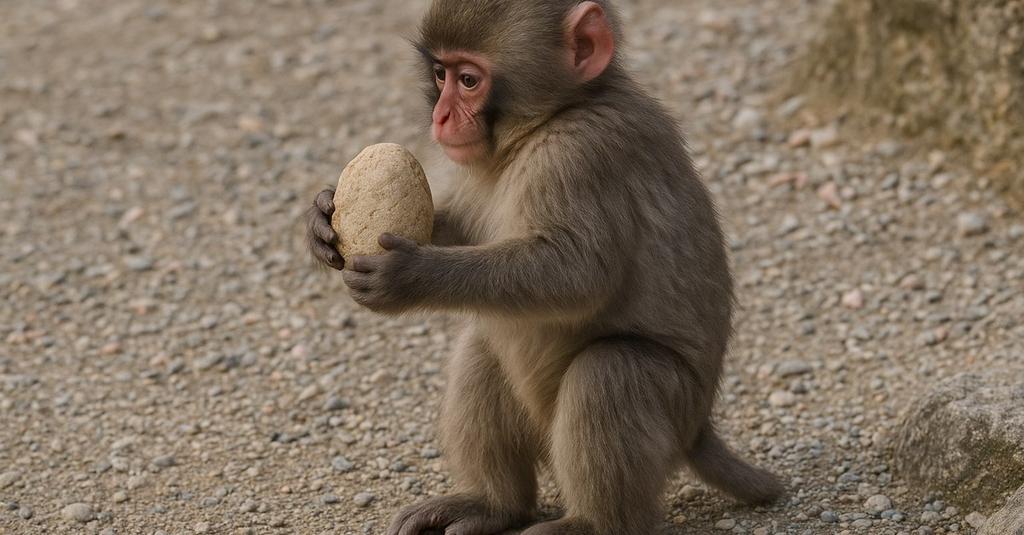
What Punchy’s Rock Says About Macaque Comfort Object Behavior and Recovery
Sanctuary assessment protocols for macaque reintegration have historically focused on social behavior — grooming rates, play initiation, submission gestures, proximity to dominant individuals. What’s been less systematically tracked is object behavior as a recovery metric, though that gap is closing faster than most people realize. A 2021 paper from the Borneo Orangutan Survival Foundation, which has begun applying similar frameworks to macaque cases in Malaysia and Indonesia, argued that monitoring changes in comfort object type and usage frequency could serve as a low-invasiveness welfare indicator — something observable without physical intervention. The paper noted that transitions from soft to hard objects, or from solitary to social object use, correlated with increased social confidence scores in 78% of cases studied between 2017 and 2021.
Punchy’s rock moment is, whether or not anyone planned it that way, a data point in that emerging framework — and one that validates something behavioral scientists have suspected for years: we’ve been looking at the wrong signals.
The macaque comfort object behavior spectrum runs from pure stress-response at one end to social performance at the other. Early-stage comfort objects are held privately, gripped tightly during stressful events, and rarely displayed to other animals. Mid-stage behavior involves the object being carried openly, still used for self-soothing but now visible to the group. Late-stage — where Punchy appears now — involves object display without apparent stress: parading, presenting, even leaving the object briefly and returning to it. Each stage represents a renegotiation of the animal’s relationship with its own anxiety. You can watch the confidence build in real time, if you know what you’re looking for.
Caregivers at the sanctuary now use Punchy’s daily object behavior as one of several informal welfare checkpoints. What’s he carrying? How is he carrying it? Who’s nearby? A rock held high in open territory means something very different from a doll pressed to the chest at the group’s edge. The object is a signal.
Where to See This
- Monkey Mountain sanctuaries operating across northern Thailand, Malaysia, and Bali — particularly those affiliated with Wildlife Friends Foundation Thailand (WFFT) — frequently provide transparent reintegration updates through public visitor programs and social media, making them among the best places to observe documented macaque social recovery in a managed setting. Best observed year-round, though quieter dry-season months offer closer access.
- The Primate Conservation Research Institute in Chiang Mai, Thailand, actively documents object attachment and comfort behavior in rescued macaques; their published field notes are publicly accessible and worth following for anyone serious about primate welfare science.
- For deeper background, Norichika Huffman’s original 1996 papers on Japanese macaque stone-handling behavior — available through Kyoto University’s Primate Research Institute publication archive — remain the clearest scientific lens through which to read a moment like Punchy’s rock parade.
By the Numbers
- Cortisol levels in isolated infant macaques drop by approximately 30–40% when a comfort object is introduced, according to studies from the Yerkes National Primate Research Center (2003).
- Macaques develop object attachment behaviors as early as 8 weeks of age, with orphaned individuals showing more intense bonding than maternally reared peers.
- 78% of macaque sanctuary cases in a 2021 Borneo Orangutan Survival Foundation study showed correlation between object-type transitions and increased social confidence scores.
- Norichika Huffman first documented Japanese macaque stone-handling behavior in 1996; the behavior has since been recorded in at least 9 geographically distinct troops.
- The illegal primate pet trade displaces an estimated 3,000–5,000 macaques annually across Southeast Asia, making orphaned sanctuary intakes one of the most common primate welfare challenges in the region (TRAFFIC, 2022).
Field Notes
- In a 2019 observation at a Thai macaque sanctuary, caregivers recorded a juvenile male who transitioned from cloth comfort object to a smooth river pebble over approximately six weeks — then, within two months of that transition, initiated his first successful grooming interaction with a higher-ranking adult. The pebble preceded the breakthrough. No one expected that sequence.
- Stone-handling in Japanese macaques is cultural, not instinctive — troops that have the behavior pass it to younger members through observation, and isolated individuals never spontaneously develop it. Punchy’s rock-holding may be entirely self-invented.
- Comfort object behavior in adult macaques — those past juvenile stage — has been documented but is vanishingly rare. When it appears, it almost always indicates early-life deprivation rather than ongoing stress, which means the object is a record of the past, not a symptom of the present.
- Researchers still can’t fully explain why some orphaned macaques abandon comfort objects gradually while others drop them abruptly — sometimes overnight. Whether that reflects a neurological threshold, a specific social event, or something else entirely remains genuinely unresolved.
Frequently Asked Questions
Q: What does macaque comfort object behavior actually tell us about an animal’s emotional state?
Macaque comfort object behavior functions as a real-time welfare indicator. When an infant or juvenile grips a comfort object tightly and retreats from social situations, it reflects elevated stress — measurable in cortisol levels. As the animal becomes more confident, the way it holds and displays the object changes. By 2021, researchers were formally proposing object behavior tracking as a low-invasiveness welfare metric in sanctuary settings. It’s not anecdotal. The object is a read-out of internal state.
Q: Why would a macaque switch from a soft toy to a hard rock as a comfort object?
The switch likely signals that the animal no longer needs the tactile comfort pathways the soft object activates. Soft objects reduce cortisol through warmth and texture — they mimic contact with a caregiver. Hard objects don’t do that. When a macaque starts carrying something like a rock, it’s probably not seeking comfort in the neurological sense. It may be exploring object play or status display, which requires a baseline of security the animal didn’t previously have. The material of the object reflects the animal’s emotional position. Here’s the thing: soft means needing soothing. Hard might mean ready to perform.
Q: Is comfort object behavior in macaques the same as the attachment behavior seen in human children?
It’s closely related but not identical. Harry Harlow’s 1958 research at the University of Wisconsin established that the underlying neurological drive — contact comfort — is shared across primates. Human children’s attachment to transitional objects, described by Donald Winnicott in the 1950s, involves similar stress-reduction mechanisms. The key difference is complexity: human object attachment is embedded in symbolic thinking in ways that macaque behavior doesn’t appear to be (and this matters more than it sounds). Punchy’s doll isn’t a representation of safety — it is safety, physically. That’s a meaningful distinction, even if the cortisol response looks nearly the same.
Editor’s Take — Alex Morgan
What strikes me about Punchy’s rock is how precisely it locates him in his own recovery — more accurately than any behavioral checklist could. A soft doll pressed to the chest in a corner is one story. A rock held aloft in the middle of open territory is another story entirely. We tend to look for dramatic turning points in animal rehabilitation — first grooming, first play, first unprompted approach. But sometimes the turning point is quieter than that. Sometimes it’s just a change in what someone chooses to carry, and how they carry it. Watching an animal rebuild itself this way, you realize how little we actually need to intervene — sometimes the recovery does the choosing for you.
Punchy doesn’t know he’s a data point. He doesn’t know that his doll once represented something measurable in cortisol units, or that his rock might end up in a welfare assessment paper. He just knows, in whatever way a macaque knows anything, that today he felt like carrying a rock — and that the mountain felt like somewhere he belonged. There’s a version of recovery that looks like the absence of fear. And then there’s this version: head high, zero apologies, a perfectly ordinary rock raised like a flag. What does it take to feel that comfortable in your own territory? And how long did it take you?
Illustrations are AI-generated. Article fact-checked and human-edited. Our editorial standards.