The Satyr Tragopan: Himalayas’ Most Dazzling Bird
Imagine a bird so visually extravagant that field researchers genuinely stop mid-sentence when witnessing its courtship display. The Satyr Tragopan — Tragopan satyra — does exactly this, inflating vivid blue wattles and spreading crimson wings at 12,000 feet on Himalayan slopes where almost no one is watching. Yet for a species this spectacular, we understand remarkably little about what actually drives its choices up there in the cold mountain air.
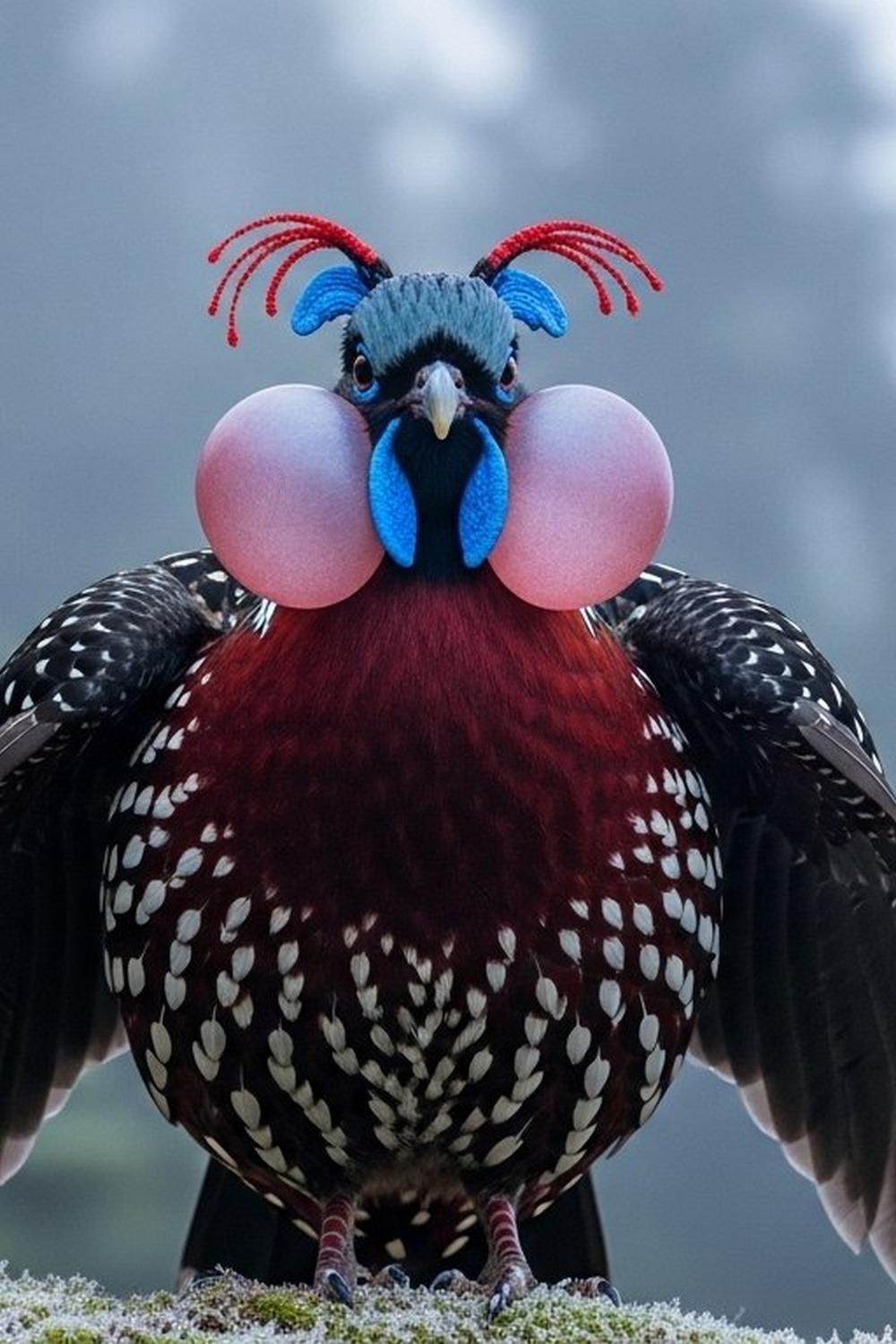
Deep crimson plumage streaked with black. White ocelli scattered across the body like coins catching light. A vivid blue face. Fleshy, inflatable wattles. Males carry all of this — saturated, almost digitally enhanced — and then perform courtship displays so theatrical they’ve stopped ornithologists cold. The females, meanwhile, are cryptic brown with pale streaking, invisible in the undergrowth where they nest and incubate eggs. This sexual dimorphism is extreme even by pheasant standards, suggesting female choice operating at maximum intensity.
Key Facts
- British naturalist Brian Houghton Hodgson formally described the Satyr Tragopan (Tragopan satyra) in 1829 from specimens collected in Nepal.
- Satyr Tragopans climb to 4,300 meters (14,107 feet) in summer, making them one of the highest-ranging pheasants in Asia.
- There are 5 tragopan species worldwide, all restricted to Asian mountain forest, with the Satyr being the most widely distributed.
- A 2017 Nature Conservation Foundation camera trap study in Himachal Pradesh found females select nest sites with around 70% minimum canopy closure; incubation lasts approximately 28 days.
- The IUCN lists the species as Least Concern with a decreasing population trend, while the Himalayas warm at roughly twice the global average rate (ICIMOD).
In short: The Satyr Tragopan (Tragopan satyra), formally described in 1829, is a Himalayan pheasant whose crimson males inflate blue wattles and erectile horns during courtship at up to 4,300 meters. Wildlife Institute of India researchers documented males repeating the full display seven times in a single morning, an extraordinary metabolic investment in thin mountain air.
An Engineering Masterpiece Hidden in the Himalayas
Brian Houghton Hodgson, a British naturalist, formally described the Satyr Tragopan in 1829 from specimens collected in Nepal — a region that remains one of the bird’s strongholds today. What struck early observers wasn’t just the color, but the structure of the plumage itself. According to research from the Natural History Museum in London, which maintains extensive tragopan specimen collections, the structural arrangement of feather barbules contributes to how the white ocelli reflect light, creating an almost three-dimensional visual effect that shifts depending on viewing angle. Each spot is ringed in black, amplifying contrast dramatically. The result is a bird that seems to glow in dappled forest light — a living optical illusion. You can read more about the genus on the Wikipedia page for Tragopan, which covers the full range of species and their distributions across South and East Asia.
The crimson base color runs deepest on the breast and flanks, fading toward olive-brown on the back — a gradient that no paint manufacturer has ever quite replicated.
Field researchers working in Sikkim and Bhutan have reported that even experienced trackers can walk within three meters of a feeding female without detecting her. The males, by contrast, call from exposed rocky outcrops in early morning. And it says something profound about what selection pressure looks like when it operates at full intensity: one sex takes every risk, while the other becomes invisible.
What the Display Actually Reveals
No photograph prepares you for a live Satyr Tragopan display. When a male detects a female nearby, transformation happens fast — almost violent in its intensity. The fleshy lappet beneath the bill inflates from wrinkled skin into a vivid blue and red structure patterned with intricate markings. Two small blue horns above the eyes engorge with blood and extend upward. The wings drop and spread sideways. The bird nods, shuffles, calls. Here’s the thing: the whole performance can last minutes, and if a female remains nearby, researchers at the Wildlife Institute of India documented that males will repeat the full display sequence up to seven times in a single morning. That’s extraordinary sustained energy investment at altitude, in cold air, on a metabolic budget that doesn’t easily accommodate extravagance.
Why does the lappet’s patterning matter so much to females?
In 2014, a study published by the Bombay Natural History Society compared lappet coloration across museum specimens and found measurable individual variation in both the blue intensity and the red bordering. If females are using that variation to assess male quality — as theory predicts — then the Satyr Tragopan is essentially running a live art show, with the audience scoring on criteria we don’t yet fully understand. The patterns aren’t random. They’re information. What information, precisely, is still being decoded.
Locals in the Uttarakhand region sometimes call the bird jujurana — “king of birds” in some dialects. It’s not hard to see why.
Altitude as Both Refuge and Trap
During summer months, Satyr Tragopans climb to 4,300 meters (14,107 feet) in the central and eastern Himalayas, feeding on leaves, berries, insects, and moss in subalpine meadows where few predators bother to follow. Come winter, they descend into denser temperate forest, where oak and rhododendron provide both cover and food. This altitudinal migration is relatively short in distance but enormous in ecological significance — it means the bird occupies two completely different habitat types across a single year, creating a correspondingly complex set of conservation needs.
According to a conservation status assessment by the International Union for Conservation of Nature and reported across wildlife monitoring networks including National Geographic’s animal database, the Satyr Tragopan is listed as Least Concern with a decreasing population trend. That distinction masks a more complicated reality on the ground.
Habitat fragmentation is the central pressure. As logging, livestock grazing, and agricultural expansion push higher into the Himalayas — accelerating with climate-driven shifts in where crops can grow — the corridors between summer and winter habitat narrow. The Satyr Tragopan can’t simply reroute around a cleared hillside the way a migratory waterfowl might. It’s a bird of dense, intact forest structure. When that structure breaks down, the bird doesn’t adapt to open ground. It disappears. Population density studies conducted by the Zoological Survey of India in 2009 in the Singalila Ridge area of West Bengal found locally patchy distributions correlating tightly with canopy cover and undergrowth density.
Watching a species get squeezed from both ends of its elevational range simultaneously, with nowhere else to go, you stop calling it a trend and start calling it a crisis in slow motion.
The Himalayas are warming at roughly twice the global average rate, according to assessments by the International Centre for Integrated Mountain Development. Tree lines are shifting upward. What was subalpine meadow is becoming forest. What was forest is becoming farmland.
The Bird Keeps Its Secrets
For a bird this visually spectacular, the Satyr Tragopan has been remarkably successful at keeping secrets. Ground-nesting behavior means females lay three to five eggs in a shallow scrape lined with leaves and moss, typically on a rocky ledge or beneath a fallen log. Incubation lasts approximately 28 days. Chicks are precocial, leaving the nest within hours of hatching. That’s where documented certainty largely ends.
A long-term camera trap study launched in 2017 by the Nature Conservation Foundation in collaboration with the Himachal Pradesh Forest Department produced the first systematic documentation of nest site selection behavior in the wild. Females consistently chose sites with a specific minimum canopy closure of around 70 percent, suggesting a hard threshold below which nesting success plummets. That single data point has significant implications for defining habitat quality in conservation planning.
Breeding success varies dramatically with spring snowfall timing. Late snowfalls in April or May can kill newly hatched chicks or destroy nests before incubation completes. A single bad spring can effectively zero out local recruitment for that year. Across multiple bad springs — which climate models suggest will become more frequent at high elevations — cumulative population effects could be substantial even in the absence of direct habitat destruction.
Researchers at the Wildlife Institute of India have begun using acoustic monitoring equipment — passive recording units left at survey stations across multiple seasons — to track male calling rates as a proxy for population density. It’s an elegant workaround for a bird that won’t cooperate with direct observation. The science of studying the Satyr Tragopan is still in its early, inventive stages. The data are still accumulating.
Where to See This
- Kedarnath Wildlife Sanctuary in Uttarakhand, India, offers some of the best documented sightings of male Satyr Tragopan during the April to June breeding season — the window when males are most vocally and visually active. Guides based in Chopta village specialize in early-morning forest walks targeting the species.
- The Nature Conservation Foundation (ncf-india.org) conducts ongoing Himalayan bird research and publishes field reports that include tragopan encounter data — their work in Spiti Valley and surrounding ranges represents some of the most current population monitoring available.
- For deeper reading: Salim Ali’s The Book of Indian Birds, now in its thirteenth edition, remains the foundational field reference — and reading his original descriptions of tragopan behavior is a reminder of how much was understood intuitively, long before the data existed to prove it.
By the Numbers
- 4,300 m (14,107 ft) — maximum recorded elevation for Satyr Tragopan during summer months, making it one of the highest-ranging pheasants in Asia.
- 5 species — the total number of tragopan species worldwide, all restricted to Asian mountain forest; the Satyr is the most widely distributed of the five.
- 28 days — incubation period for Satyr Tragopan eggs, comparable to domestic chickens but completed in far harsher environmental conditions.
- 70% canopy closure — the minimum threshold for nest site selection identified by the Nature Conservation Foundation’s 2017 camera trap study in Himachal Pradesh.
- 2× the global average — the rate at which the Himalayas are warming relative to global mean temperatures, according to the International Centre for Integrated Mountain Development (ICIMOD).
Field Notes
- In 2011, Wildlife Institute of India researchers working in Uttarakhand recorded a male Satyr Tragopan performing a full lappet-inflation display sequence seven times in a single morning session — each display lasting between four and nine minutes — suggesting that sustained courtship effort at altitude carries significant metabolic cost that has never been formally quantified.
- The “horns” that extend above a displaying male’s eyes aren’t feathers — they’re bare, blood-engorged skin structures that retract completely between displays, leaving the bird looking entirely different within minutes of the performance ending.
- Despite being a pheasant, the Satyr Tragopan regularly roosts in trees rather than on the ground, a behavior that sets it apart from most of its relatives and likely reflects predator pressure from Himalayan foxes and yellow-throated martens.
- Researchers still cannot reliably determine the age of a wild Satyr Tragopan from external appearance alone, which means longevity data from natural populations essentially don’t exist — making it impossible to model population dynamics with the precision that conservation planning ideally requires.
Frequently Asked Questions
Q: Is the Satyr Tragopan endangered?
The Satyr Tragopan is currently classified as Least Concern on the IUCN Red List, but the population trend is listed as decreasing. That distinction matters. Least Concern reflects current abundance relative to extinction thresholds — it doesn’t mean the bird is thriving. Ongoing habitat fragmentation in the Himalayas, accelerating since the 1990s, and climate-driven shifts in snowfall timing both represent genuine long-term pressures that the current status doesn’t fully capture.
Q: Why do male Satyr Tragopans inflate their wattles during courtship?
The lappet and the small erectile “horns” are vascularized skin structures — meaning they fill with blood when the bird is aroused, much like the comb of a domestic rooster but far more elaborate in patterning. The inflation is controlled by the autonomic nervous system and appears to be triggered by the proximity of a female. The resulting display gives females a close-range view of highly individual color patterns that likely convey information about male health, parasite load, and genetic quality — though the exact assessment mechanism isn’t yet understood.
Q: Are Satyr Tragopans related to peacocks?
Both species belong to the family Phasianidae — the pheasants — so they’re relatives, but not especially close ones. A common misconception is that all spectacularly plumaged birds in this family share recent ancestry. In fact, the extraordinary displays of peacocks, tragopans, and argus pheasants evolved independently across different lineages, driven by the same fundamental force: female choice. Sexual selection is so powerful that it produces convergent solutions — elaborate, honest signals of male quality — across wildly different branches of the bird family tree.
Editor’s Take — Alex Morgan
What stays with me about the Satyr Tragopan isn’t the color — it’s the metabolic audacity. Seven full display sequences in one morning, at 12,000 feet, in cold thin air, for a female who may or may not be paying attention. That’s not instinct operating at a baseline level. That’s an animal running everything it has at full intensity, repeatedly, because the cost of not doing so is reproductive extinction. We talk a lot about animal beauty. We talk less about what that beauty actually costs the animal producing it. The Satyr Tragopan makes the price visible.
Somewhere above 10,000 feet in the rhododendron forests of Sikkim or Bhutan, a male Satyr Tragopan is probably calling right now — a series of deep, mournful wails that carry through cold morning air to a female who may be thirty meters away or three hundred. He can’t know which. The wattles inflate anyway. The wings drop. The whole extraordinary apparatus engages. And in that moment, in terrain that most humans will never reach, one of the most visually complex courtship displays on Earth plays out for an audience of one — if she’s even there at all. What else is happening up in those forests, above the clouds, that no field researcher has ever been positioned to witness?
“
Illustrations are AI-generated. Article fact-checked and human-edited. Our editorial standards.