Bronze Age Dagger Emerges From Polish Baltic Cliffs
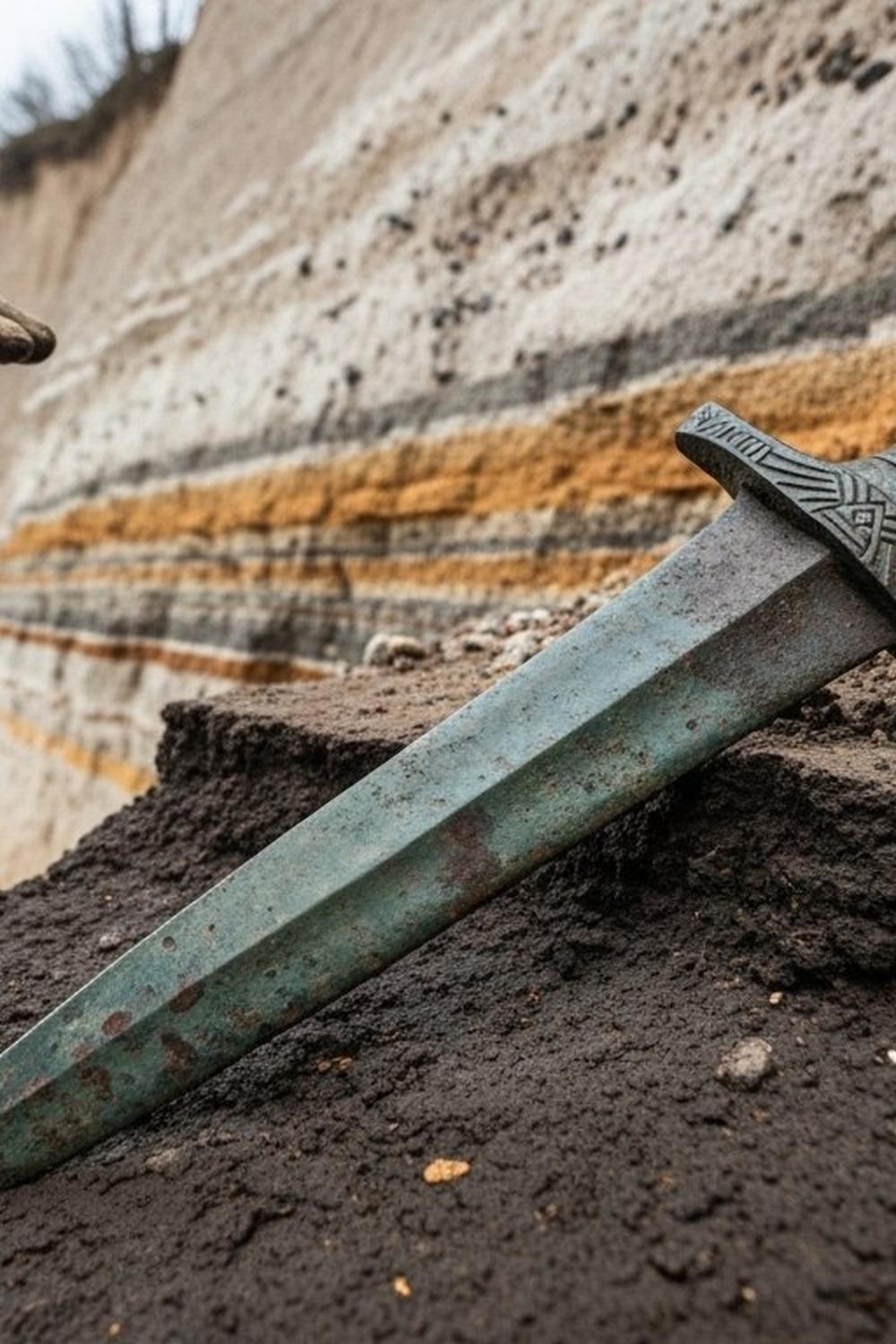
Three thousand years underground, and nobody was looking at the right place. A Bronze Age dagger Baltic coast Poland lay sealed in clay along an eroding shoreline, waiting for a storm to do what archaeology cannot plan: crack open the earth and deliver an artifact so intact that its decorative markings were still legible, its hilt details still readable, as though time had simply paused around it rather than passing through.
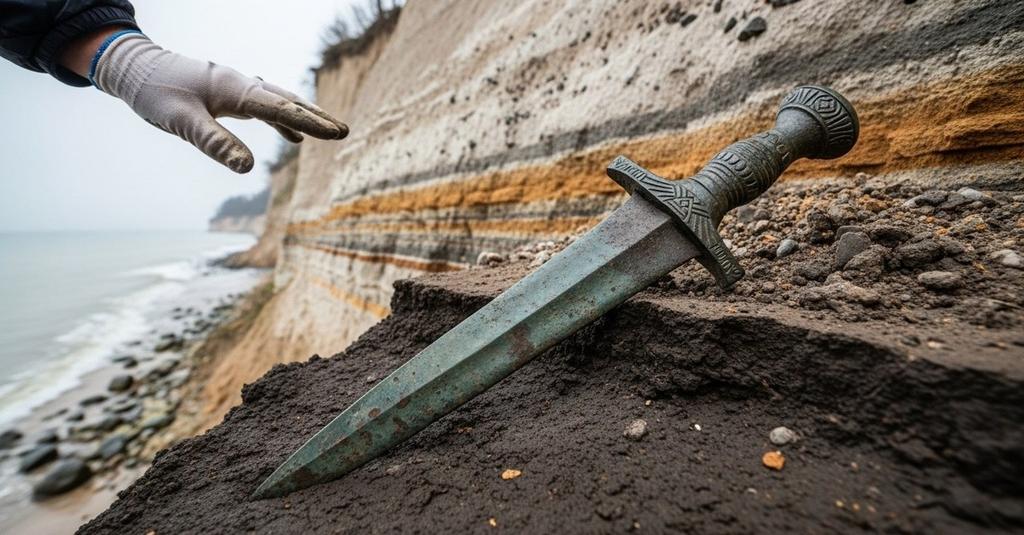
Somewhere along Poland’s Baltic shoreline, a storm did what no archaeologist had planned. A cliff gave way. And cradled in the exposed clay was a dagger forged around 900–1000 BCE, its hilt details and decorative markings still legible — as though whoever placed it there had simply stepped away. Who were they? Why did they leave it? And how many more objects are still waiting, sealed inside those eroding bluffs?
Key Facts
- A bronze dagger dated to approximately 900-1000 BCE emerged intact from eroding glacial till clay along Poland’s Baltic coast, exposed by cliff erosion in 2024.
- Poland’s most exposed Baltic cliff sections lose between 0.5 and 1 meter of land to the sea each year, tracked by the Maritime Institute in Gdansk since the 1970s.
- The dagger survived more than 3,000 years sealed in clay, longer than the entire recorded history of Poland as a political entity.
- Bronze Age votive deposition of valuable metal objects spanned roughly 1200-600 BCE across bogs, rivers, lakes, and coastal zones of Europe.
- Dense glacial till clay’s near-zero oxygen permeability makes it one of the most effective natural preservation media for metal artifacts on Earth.
In short: A Bronze Age dagger Baltic coast Poland erosion exposed in 2024 survived more than 3,000 years sealed in glacial till clay. Dated to roughly 900-1000 BCE, the intact blade with legible decorative markings suggests deliberate votive deposition, even as 0.5 to 1 meter of Polish coastline vanishes into the sea every year.
What the Cliff Gave Up: A Baltic Dagger Appears
Along Poland’s Baltic coast, half a meter to a full meter of land disappears into the sea each year in the most exposed sections. The Maritime Institute in Gdańsk has tracked this retreat since the 1970s — a steady, measurable loss that erases the shoreline month by month. What is new — what stops everyone in their tracks — is what the retreating land occasionally reveals. In this case, a bronze dagger, dated to approximately 900–1000 BCE, emerged from the clay matrix intact. No corrosion had reached the blade’s surface in any meaningful way. No crushing from the sediment above.
The object simply appeared, still oriented, still whole, as though the cliff had been holding it in trust. Bronze artifacts from this period are not common finds along the Baltic shore, and intact ones are rarer still. Researchers at the Polish Academy of Sciences have noted that conditions in the region’s coastal clay deposits are unusually favorable for metal preservation. Low oxygen permeability, stable pH, and consistent moisture levels combine to create what is effectively a natural sealed environment.
Three thousand years is a long time. But it’s not, apparently, long enough to defeat good clay.
The blade’s decorative markings were still visible at the time of recovery. Wear patterns on the edge were measurable. This isn’t a corroded shadow of an object — it’s the object itself, carrying information no laboratory could have manufactured.
Clay, Chemistry, and an Accidental Time Capsule
Why does preservation in clay work so much better than dry-land burial? Because oxygen is the enemy of metal. Take it away — seal an object in dense, anaerobic sediment — and the electrochemical reactions that produce corrosion slow to nearly nothing. The Baltic coastal cliffs contain a specific type of glacial till clay, deposited during the last ice age and compressed over millennia into something that functions almost like a vault. It’s the same principle behind the extraordinary preservation of wooden ships and leather goods found in Baltic and North Sea contexts — environments where some of the world’s best-preserved ancient objects have come from sites that, on the surface, looked like nothing at all.
The story is not unlike what scientists encounter in other oxygen-poor coastal systems, where preservation conditions consistently defy expectations, as researchers studying prehistoric fossils along Australia’s most popular beaches have found in similarly unassuming stretches of shoreline. And the clay encasement did something else too — it kept the artifact spatially stable. It didn’t tumble. It didn’t shift with groundwater movement. The orientation at recovery was likely close to the original placement orientation, which tells researchers something critical: this wasn’t an object dropped, lost, or forgotten in the usual sense.
The positioning suggests deliberate placement. Someone put this dagger here, in this clay, in this way. That’s a different kind of story entirely.
Bronze Age Ritual: When Daggers Meant More Than Weapons
Across Bronze Age Europe, metal objects — particularly blades — occupied a symbolic space that modern categories of “weapon” or “tool” don’t easily capture. The period spanning roughly 1200–600 BCE saw the widespread emergence of what archaeologists describe as votive deposition: the deliberate burial or submersion of valuable objects in bogs, rivers, lakes, and coastal zones as ritual offerings. Smithsonian Magazine has covered the broader pattern of Bronze Age votive hoards across Scandinavia and the British Isles, noting that the density of such deposits suggests ritual practice was embedded in daily economic and social life, not confined to elite ceremony. Read more about Bronze Age ritual deposition at Smithsonian Magazine.
In the Baltic region specifically, solar symbolism dominated. Circular motifs, sun-wheel engravings, and gold-foil disc ornaments appear repeatedly in northern European Bronze Age assemblages, suggesting communities organized significant portions of their spiritual lives around celestial cycles. Bronze Age daggers weren’t exclusively weapons in the modern military sense. Many show minimal use-wear, suggesting they were made for display, ceremony, or deposition — objects whose value lay in what they represented rather than what they did. In several well-documented Scandinavian cases (researchers actually call this the “parade economy”), identical blade types were found deposited in pairs, or alongside amber beads and bronze pins, in arrangements that imply careful, intentional ceremony rather than hasty disposal.
What’s striking about the Polish Bronze Age dagger Baltic coast find is that the clay encasement itself may have been part of the ritual logic. Sealing an object. Entrusting it to the earth. Making it permanent. That gesture has meaning — even if the specific meaning is three thousand years out of reach.
What the Wear Patterns on This Bronze Age Dagger Reveal
Modern archaeological analysis has become extraordinarily precise. Use-wear analysis — the microscopic study of edge damage, polish patterns, and residue traces on ancient blades — can distinguish between an object used to cut animal hides, an object used in contact with wood or bone, and an object that was, essentially, never used at all. But here’s the thing: for the Polish Baltic dagger, wear analysis could answer a question that sounds simple and carries enormous weight. Did this blade ever do anything?
The Laboratory of Archaeometry at the University of Warsaw has applied these techniques to Bronze Age metal finds from Polish sites since at least the early 2000s, and the methodology has only grown more sensitive. If wear patterns show minimal or no functional use, the ritual hypothesis strengthens considerably. An unused blade — forged with skill, decorated with care, then buried — speaks to a society investing significant resources in objects that were never meant to be practical. Watching a society allocate this much skilled labor and material to something deliberately unused, you stop calling it frivolous — you call it a priority.
Conversely, if the blade shows use-wear consistent with cutting organic materials, the object may have had a working life before its deposition. Possibly retired after ceremony. Possibly placed in the earth after its owner’s death. Either outcome changes the picture. Researchers don’t yet have a final answer. The analysis is ongoing, and that uncertainty is not a failure — it’s the work in progress.
How It Unfolded
- 900–1000 BCE: Communities of the northern European Bronze Age forge and deposit metal objects along Baltic coastal zones, likely as part of votive ritual practices tied to solar or water-deity worship.
- Late Holocene: Glacial till clay deposits along Poland’s Baltic coastline gradually compact around buried artifacts, creating near-anaerobic conditions that slow corrosion to almost nothing over successive millennia.
- 1970s onward: The Maritime Institute in Gdańsk begins systematic monitoring of Polish Baltic coastal erosion rates, establishing the baseline data that now allows researchers to calculate how quickly archaeological layers are being exposed — and lost.
- 2024: Cliff erosion on Poland’s Baltic coast exposes the Bronze Age dagger, intact and still encased in clay, triggering formal recovery and analysis by Polish archaeological authorities.
By the Numbers
- 900–1000 BCE: Estimated date of the dagger’s manufacture and deposition, based on typological comparison with Bronze Age assemblages from northern Europe.
- 0.5–1 metre: Average annual coastal retreat along Poland’s most exposed Baltic cliff sections, according to the Maritime Institute in Gdańsk.
- 3,000+ years: Duration of the Bronze Age dagger Baltic coast preservation inside glacial till clay — longer than the entire recorded history of Poland as a political entity.
- Hundreds of known votive deposits: Bronze Age metal objects recovered from Baltic and North Sea coastal and wetland contexts across Denmark, Sweden, and Germany — the regional pattern this find now extends southward into Poland.
- Near-zero oxygen permeability: The defining characteristic of dense glacial till clay that makes it one of the most effective natural preservation media for metal artifacts on Earth.
Field Notes
- The clay encasement around the dagger wasn’t just sediment that happened to accumulate — its density and composition suggest the artifact may have been packed deliberately, a detail that Polish archaeologists noted immediately upon recovery and that distinguishes this find from casual loss deposits.
- Bronze Age daggers in the Baltic region are frequently found with no associated skeletal material nearby, suggesting they weren’t grave goods in the conventional sense but were deposited independently — possibly as offerings to water, earth, or solar forces rather than to accompany the dead.
- Cliff erosion in Poland is accelerating. Storm intensity in the Baltic has increased measurably since the 1990s, meaning the window between artifact exposure and destruction by wave action is narrowing — finds like this one are becoming simultaneously more likely and more precarious.
- Researchers still can’t determine whether the dagger was deposited by an individual acting alone, by a community in formal ceremony, or by a specialist — a smith, a priest, a chieftain — whose social role gave the act its meaning. The object survives. The context around it does not.
Frequently Asked Questions
Q: Where exactly was the Bronze Age dagger Baltic coast Poland discovery made?
The precise location has not been publicly disclosed in detail, a standard precaution in Polish archaeological practice to prevent unauthorized excavation at or near the recovery site. The find occurred along Poland’s Baltic coastline, where glacial till cliffs are actively eroding. Polish archaeological law requires that any such discovery be reported immediately to regional heritage authorities, who then coordinate formal analysis and site documentation.
Q: Why did the clay preserve the dagger so well for three thousand years?
Dense glacial till clay has extremely low oxygen permeability. Corrosion in metals is an electrochemical process that requires oxygen and moisture interacting at the metal surface — remove the oxygen, and the reaction slows dramatically. The Baltic coastal cliffs contain compressed glacial clay deposited during the last ice age, which creates near-anaerobic pockets where buried objects are effectively sealed off from the atmosphere. Combined with stable temperatures and consistent moisture levels underground, the result is one of the most effective natural preservation environments for bronze and other metals.
Q: Does the intact condition of the dagger prove it was a ritual object rather than a weapon?
Not definitively — that’s a common misconception about this type of find. Intact preservation tells us about burial conditions, not original function. What actually indicates ritual use is a combination of factors: the deliberate encasement, the decorative markings, the regional pattern of votive deposits, and crucially, the use-wear analysis still being conducted. A well-preserved object could be a discarded tool, a treasured possession, or a deliberate offering. The wear patterns on the blade’s edge will be far more diagnostic than the condition of the object alone.
Editor’s Take — Sarah Blake
What keeps pulling me back to this story is the clay packing. If it was deliberate — and the density suggests it was — then someone three thousand years ago understood, on some level, that sealing this object mattered. They didn’t know about oxygen permeability or electrochemical corrosion. They knew about permanence. They were trying to make something last. And they succeeded, in ways they could never have imagined, by precisely the amount of time it took for us to arrive and find it.
Poland’s Baltic cliffs are retreating. Every storm season takes more land, more sediment, more of whatever was buried when this coastline looked entirely different and a Bronze Age community was alive enough to leave things in the earth on purpose. The dagger survived because the clay held. But the clay is falling into the sea now, year by year, meter by meter. How many objects are in there — still sealed, still intact, still waiting — that will be claimed by waves before any archaeologist gets the chance to look? The sea that threatened this dagger for thirty centuries is the same sea that finally brought it to light. That’s not a metaphor. That’s just the Baltic, doing what it’s always done.
“
Illustrations are AI-generated. Article fact-checked and human-edited. Our editorial standards.