The Rescue Monkey Who Traded His Comfort Doll for a Rock
A baby macaque doesn’t need reasons to cling to something. When the real mother’s gone, a plush doll becomes survival. But here’s what nobody tells you — that doll is temporary. Punchy learned that the hard way, and what happened next is still making researchers rethink how primates heal.
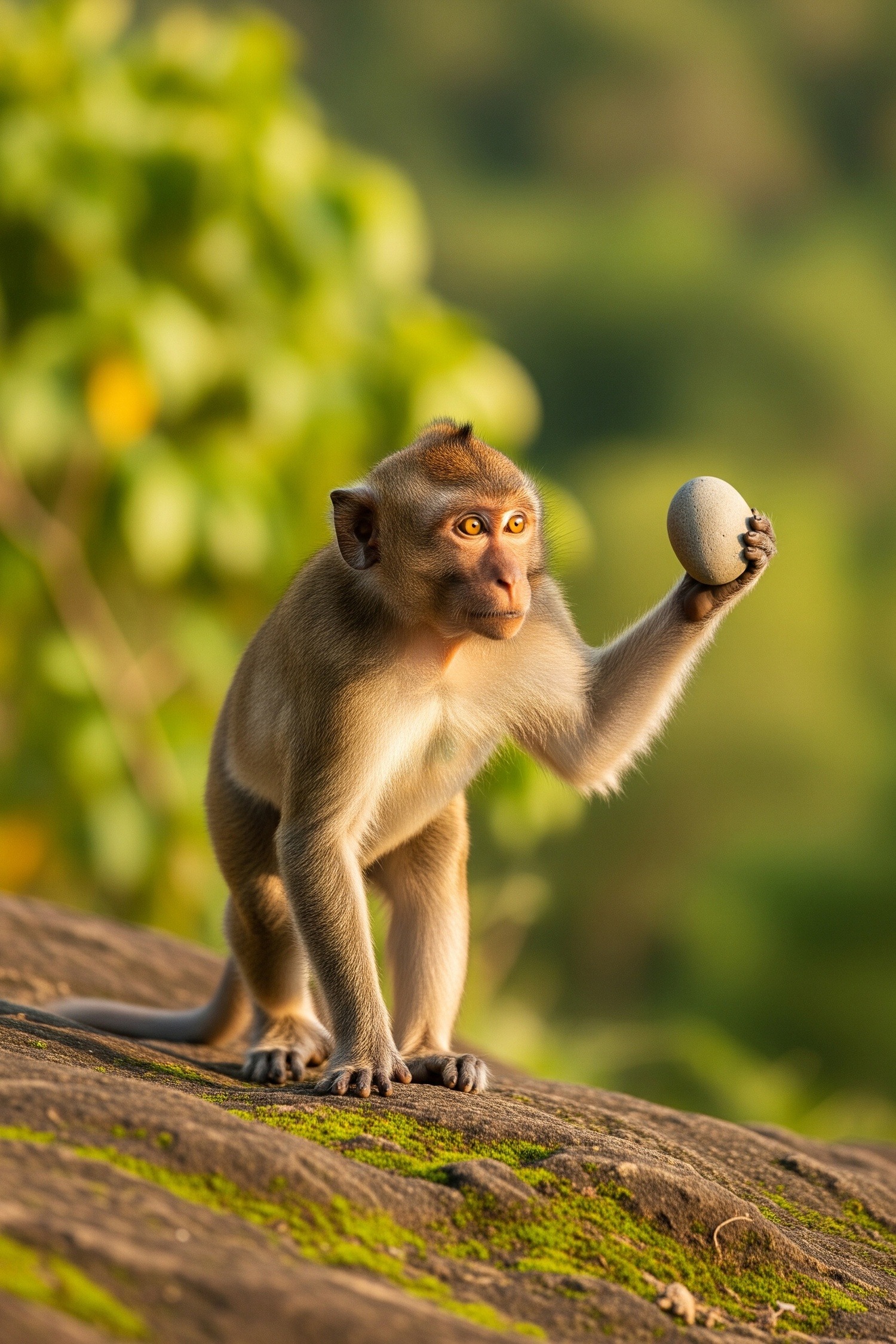
Somewhere on Monkey Mountain, a young macaque named Punchy walks around carrying a rock. Not dragging it. Not playing with it. Carrying it like he’s made a decision about who he is now. The sanctuary staff watched this happen in real time — watched a terrified orphaned infant trade his stuffed Mama Doll for a fist-sized piece of geology, head high, zero hesitation. Most people would miss what that means. Most people would just see a monkey with a rock.
They’d be wrong.
Key Facts
- Dr. Stephen Suomi’s research at the National Institutes of Health showed that giving an orphaned rhesus macaque a soft object measurably drops stress hormones.
- Macaque infants begin forming object attachments as early as 8 weeks old.
- Cortisol levels in isolated infant macaques drop measurably when soft tactile comfort items are introduced, in some conditions comparable to brief maternal contact.
- Long-tailed macaques in Thailand have had stone manipulation documented for over a decade, suggesting culturally transmitted behavior.
- At the sanctuary, an orphaned macaque named Punchy traded his plush Mama Doll for a rock as a sign of social confidence and emotional growth.
In short: Orphaned macaque comfort behavior shows how a soft surrogate object regulates an infant’s fear response and lowers cortisol, as Stephen Suomi’s NIH research documented. At a sanctuary, the orphaned macaque Punchy traded his plush Mama Doll for a rock he displayed with confidence, marking his transition from trauma to independence.
Orphaned macaque comfort behavior — the actual science
Primates don’t randomly grab things. When an infant macaque loses its mother, something has to fill that void, or the nervous system starts to collapse. That’s not metaphorical. We’re talking cortisol spikes, reactive aggression, failure to thrive. Dr. Stephen Suomi’s work at the National Institutes of Health showed something almost too simple to believe: give an orphaned rhesus macaque a soft object, and stress hormones drop measurably. Give it nothing, and the baby starts to break.
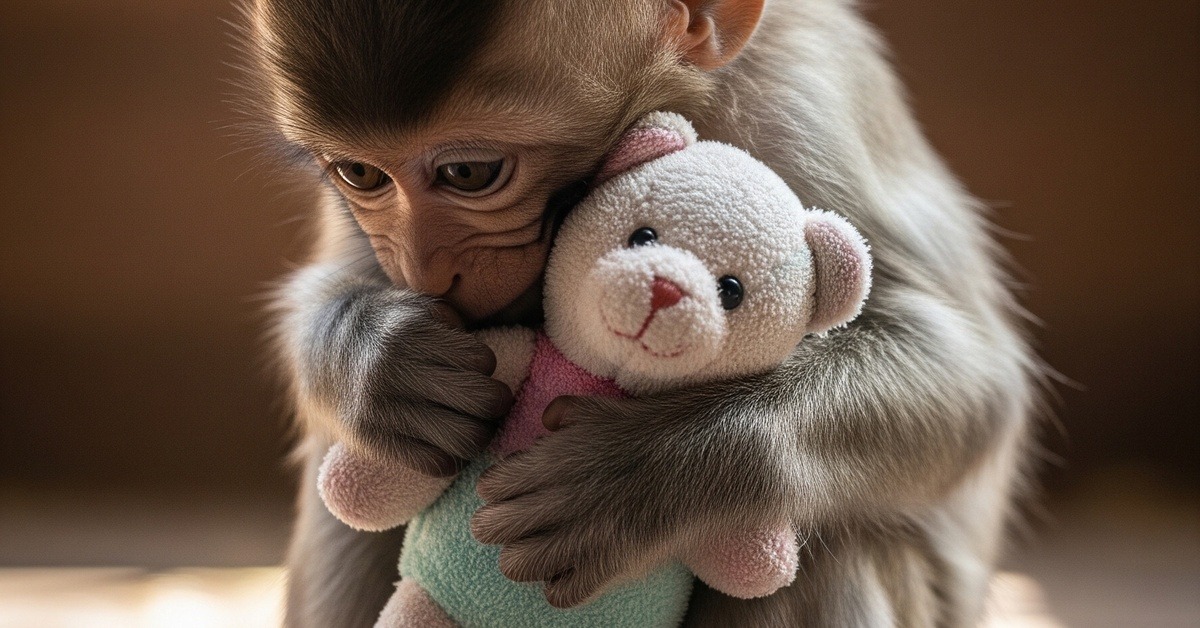
Punchy arrived at the sanctuary as a terrified infant clinging to his plush Mama Doll.
The doll wasn’t cute. It was a neurological lifeline. Attachment theory — the framework John Bowlby built on human infants — applies to macaques in ways that make you realize how close we actually are to these animals. The doll regulated his fear response. It meant he could be around other macaques without spiraling. It gave him an anchor in an environment where everything else was chaos.
For weeks, he carried it everywhere.
Then something shifted
Sanctuary workers watched it happen gradually. Punchy got older. Bolder. He started wandering further from his comfort zone, testing the social hierarchy with the other macaques, holding his ground just a little more each week. The Mama Doll showed up less in those moments. One day it didn’t show up at all.
Instead, he had a rock.
And he wasn’t hiding behind it — he was displaying it. Chest out. Head up. Walking across the mountain like someone who’d just figured out exactly who he was. That last fact kept me reading for another hour, because it’s not just a behavioral switch. It’s a window into something deeper about how primates move through trauma and come out the other side.
Why the rock changes everything
Here’s where this gets genuinely fascinating. As macaques mature, their attachment behaviors don’t disappear. They transform. The soft, maternal surrogate becomes something heavier. Harder. More assertive. Some primatologists believe object-carrying in maturing macaques signals a shift from pure anxiety regulation to social signaling — the object stops being a security blanket and starts being a statement. That’s emotional growth made visible in stone.
Punchy wasn’t scared of the rock.
He was announcing something.
Researchers have documented this pattern across multiple macaque species. Long-tailed macaques in Thailand carry stones with no functional purpose — no tool use, no food gathering, nothing practical — and yet the behavior persists across generations within the same groups. It correlates with social confidence. With rank. With belonging. When a juvenile macaque carries an object that way, other macaques read it immediately. They notice the behavioral shift. They adjust their interactions accordingly. Punchy wasn’t just holding a rock. He was telling everyone: I made it through. I’m not that scared infant anymore. I own this space now.
By the Numbers
- Macaque infants begin forming object attachments as early as 8 weeks old
- Orphaned individuals show significantly stronger surrogate bonding behaviors — Suomi’s NIH research documented this across decades of primate studies, establishing a reproducible baseline that most sanctuaries now use for assessment
- Cortisol levels in isolated infant macaques drop measurably when soft tactile comfort items are introduced. In some study conditions, the effect was comparable to brief maternal contact — a finding that made researchers rethink how they approach infant recovery protocols entirely
- Long-tailed macaques in Thailand: stone manipulation documented for over a decade in ongoing field research, suggesting the behavior is culturally transmitted
- Sanctuary data shows faster socialization timelines for orphaned primates reintegrated with comfort object support versus without — sometimes a difference of several critical developmental weeks
What the field actually knows
- Macaque stone-handling has been documented in wild populations with zero human contact, which means the behavior emerges organically rather than through imitation of people
- Most people assume comfort object attachment is purely about softness and texture. Turns out weight and solidity matter too — which explains why a heavy rock carries different psychological meaning for a maturing macaque than a plush toy ever could
- Sanctuary workers treat the moment a recovering infant begins voluntarily releasing its comfort object — even briefly — as a genuine developmental milestone
- The behavioral transformation from clinging behavior to object display correlates with measurable increases in social interaction and decreases in avoidant behaviors
What Punchy’s rock actually means
This isn’t a feel-good animal story. It’s a case study in resilience. Orphaned macaque comfort behavior works because the doll does exactly one job: it holds the animal together long enough to build internal confidence. Then it becomes obsolete. That’s the entire point. Support isn’t supposed to be permanent. It’s supposed to make itself unnecessary.
Punchy’s Mama Doll did that. It bridged the gap between trauma and independence. And when he traded it for a rock and started walking across the mountain like he owned it, that gap had been crossed. The doll worked. Now he’s something else — a survivor with a rock in his hand and nowhere more important to be than exactly where he is.
He made it through.
Punchy is still out there, rock in hand, doing what animals who’ve survived actually do — moving forward like it was never in question. His story shifts something about how we understand recovery, not just in primates but maybe in ourselves too. For more on sanctuary psychology and animal cognition that will genuinely keep you up, this-amazing-world.com has documented cases even stranger than Punchy’s. Go down that rabbit hole. You won’t regret it.
Frequently Asked Questions
Q: What is orphaned macaque comfort behavior?
Orphaned macaque comfort behavior describes how an infant macaque that loses its mother latches onto a surrogate object to regulate its fear response. Without it, the nervous system can collapse into cortisol spikes, reactive aggression, and failure to thrive. Dr. Stephen Suomi’s research at the National Institutes of Health showed that giving an orphaned rhesus macaque a soft object measurably drops stress hormones. Macaques begin forming object attachments as early as 8 weeks old.
Q: Why did Punchy trade his Mama Doll for a rock?
Punchy arrived at the sanctuary as a terrified infant clinging to a plush Mama Doll that acted as a neurological lifeline, regulating his fear so he could be near other macaques. As he matured and grew bolder over weeks, he began carrying a fist-sized rock instead, displaying it with his chest out and head high. Primatologists believe object-carrying in maturing macaques shifts from anxiety regulation to social signaling, marking emotional growth made visible in stone.
Q: Do wild macaques also carry stones?
Yes. Long-tailed macaques in Thailand carry stones with no functional purpose, no tool use or food gathering, and the behavior has been documented for over a decade in ongoing field research. It persists across generations within the same groups and correlates with social confidence, rank, and belonging. Crucially, macaque stone-handling has been documented in wild populations with zero human contact, meaning the behavior emerges organically rather than through imitation of people, suggesting it is culturally transmitted within groups.
Q: What does Punchy’s story reveal about recovery?
Punchy’s story works as a case study in resilience: the doll did one job, holding the animal together long enough to build internal confidence, then became obsolete. Sanctuary data shows faster socialization timelines for orphaned primates given comfort object support, sometimes a difference of several critical developmental weeks. Sanctuary workers treat the moment a recovering infant voluntarily releases its comfort object as a genuine developmental milestone.
Illustrations are AI-generated. Article fact-checked and human-edited. Our editorial standards.