The Peregrine Falcon’s Stoop: Earth’s Fastest Predator
Wings folded. Eyes locked. One clenched foot ready to end everything in a single, concussive instant — this is the peregrine falcon fastest animal on Earth, and it hasn’t missed in 25 million years. A rock drops from a clear sky. That rock is gravity-fed speed, architecture refined so completely that the sky itself becomes a weapon. Most people picture speed as something horizontal — a cheetah burning across savanna, a sailfish cutting through open water. But the peregrine falcon rewrote the rules entirely.
Its speed is vertical. Architectural. Strange in ways that catch aeronautical engineers off guard when they actually run the numbers. The physics behind that dive are more violent, more precisely engineered than almost any other predatory act in the animal kingdom. How does a bird weighing less than a kilogram become the fastest thing alive on this planet? Why does that answer matter more than you’d think? Because the peregrine doesn’t just move fast — it moves with a control that shouldn’t exist at those velocities.
Key Facts
- In 1999, falconer Ken Franklin recorded a trained peregrine named Frightful diving at 389 km/h (242 mph) using an onboard altimeter and data recorder.
- A 2016 University of Bristol study found the peregrine’s swept-wing stoop posture reduces drag by more than 50% compared to a gliding position.
- Peregrine populations in the eastern United States fell to near zero as a breeding population by 1964 due to DDT-related eggshell thinning, before the species was removed from the US Endangered Species List in 1999.
- By 2021 the global peregrine population was estimated at approximately 140,000 mature individuals, according to BirdLife International.
- In 2016, UNESCO added falconry to its list of Intangible Cultural Heritage of Humanity, citing traditions maintained across 18 countries.
In short: The peregrine falcon fastest animal title is no exaggeration: in 1999, Ken Franklin clocked a trained peregrine diving at 389 km/h. Refined over 25 million years, the bird’s tucked-wing stoop, nasal baffles, and twin foveas let it strike prey with control no other animal matches, even after near-extinction from DDT.
How the Peregrine Falcon Fastest Animal Title Was Earned
For decades, the peregrine’s speed was estimated rather than confirmed — a figure based on eyewitness accounts from falconers and ornithologists who watched the stoop and tried to calculate it by triangulation. That changed in 1999. Ken Franklin, an amateur falconer and aviation enthusiast based in California, strapped a small altimeter and data recorder to a trained peregrine named “Frightful” and sent her into a stoop above a skydiver. The recorded speed: 389 km/h (242 mph).
Franklin’s data, later published and widely referenced by ornithologists, pushed the official ceiling higher than anyone had previously claimed. The peregrine falcon had not just reclaimed its title as the world’s fastest bird — it had confirmed itself as the fastest animal on Earth, in any medium, under self-generated or gravity-assisted locomotion. This wasn’t incremental. This was categorical.
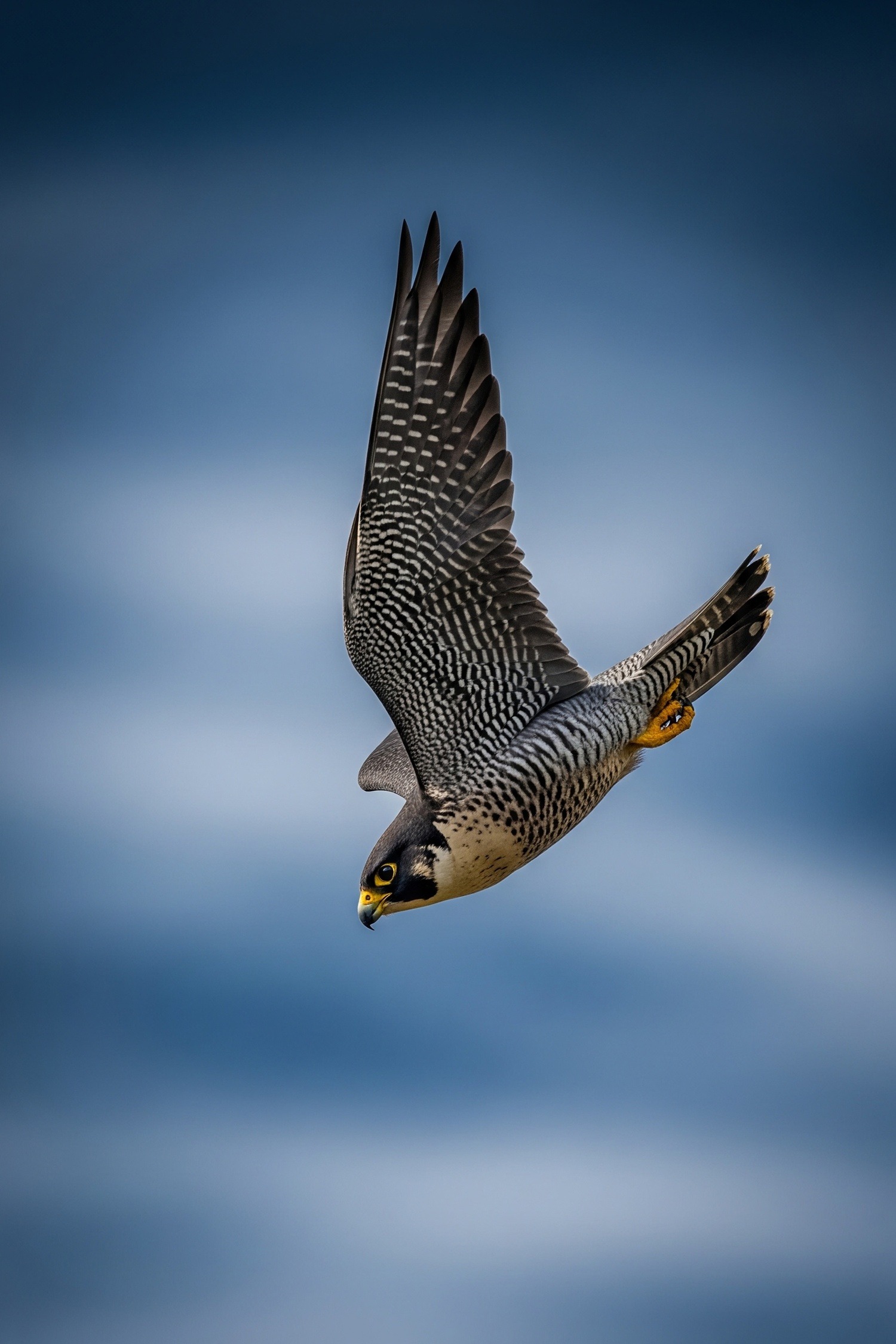
The stoop itself is a masterclass in applied physics. The bird climbs first — sometimes to 1,000 meters or more — and then it tips. Wings fold against a body that has been shaped, over millions of years, into something close to an ideal projectile. The chest keel is deep, anchoring enormous flight muscles. The tail narrows. The head tucks into a profile that minimizes drag. What makes the peregrine extraordinary isn’t just raw speed — it’s that the bird maintains full biological function at speeds that would incapacitate a less adapted animal. The heart doesn’t burst. The eyes don’t fail. The bones don’t shatter on impact.
Speed without control is just falling. Here’s the thing: the peregrine doesn’t fall — it steers. Tiny adjustments in tail and wing angle redirect the dive mid-flight with a responsiveness that aeronautical engineers have studied seriously. At 300 km/h, a correction measured in centimeters is the difference between a kill and a miss. The margin is almost impossibly small. The falcon hits it almost every time.
The Body Built Specifically to Break the Rules
Start with the beak. That small notch on the upper mandible — the tomial tooth — isn’t just for gripping; it’s used to sever the spinal cord of prey with a single bite when the initial strike doesn’t kill outright. The eyes: proportionally enormous, with two foveas per eye instead of the single fovea found in human vision. This gives the peregrine a degree of binocular precision in the center of its visual field that’s roughly eight times sharper than ours, allowing it to track a pigeon moving at speed across a broken, cluttered sky while simultaneously calculating intercept angles. Falconers — people who’ve spent their careers studying avian predators — describe watching a stoop as something closer to witnessing physics than watching an animal. If you’re interested in how birds push the boundaries of biological architecture, consider what nature does with the other end of the spectrum: the keel-billed toucan’s beak — one-third of its entire body — is another extraordinary example of form shaped entirely by function.
The nictitating membrane — that transparent third eyelid mentioned in every account of the stoop — does double duty. At terminal velocity, even small particles of debris carry enough energy to damage the cornea. The membrane sweeps across the eye up to three times per second during a dive, clearing the surface without interrupting vision. It also prevents the eye from drying out in high-speed airflow.
Bony tubercles inside the nostrils — the nasal baffles — slow incoming air before it reaches the lungs, preventing pulmonary damage from the pressure differential. Every system has a counterpart. Nothing is incidental. (And this matters more than it sounds: these aren’t decorative features, they’re load-bearing parts of a creature designed to survive speeds that would destroy less specialized animals.)
In 2016, a team at the University of Bristol ran computational fluid dynamics models on peregrine morphology, specifically studying how the bird’s swept-wing geometry reduces drag across a range of velocities. Their models suggested the stoop posture reduces drag by more than 50% compared to a gliding position. Fifty percent. That’s not incremental optimization — that’s a full redesign, encoded over millions of generations into muscle memory and bone geometry that the bird executes instinctively, every single time.
Near Extinction, Remarkable Return, Unchanged Speed
By the 1960s and early 1970s, peregrine populations across North America and Europe had collapsed catastrophically. Not because anything could outrun them — but because of a chemical they couldn’t see, smell, or evade. DDT, the pesticide that accumulated up the food chain, caused eggshell thinning so severe that breeding pairs crushed their own eggs during incubation. In the eastern United States, wild populations were effectively extinct as a breeding population by 1964. The Cornell Lab of Ornithology, which has tracked North American bird populations since 1915, documented the collapse in detail — and later, the recovery.
Following the U.S. ban on DDT in 1972 and subsequent conservation breeding programs, peregrine numbers slowly climbed back. By 1999, the species was removed from the U.S. Endangered Species List. A National Geographic profile of the peregrine’s recovery describes it as one of the most dramatic conservation comebacks in American wildlife history. And yet — here’s where it gets strange.
Evolution spent 25 million years building this machine. A few decades of pesticide pressure couldn’t undo that architecture.
None of this ecological trauma changed the bird’s fundamental capabilities. What’s remarkable — and what the peregrine falcon fastest animal designation makes even more striking — is that the stoops recorded in the 2000s and 2010s match the physics of what falconers documented centuries earlier. The falcon’s design is so stable, so refined, that even a population bottleneck severe enough to wipe out entire regional gene pools didn’t degrade its core performance. Today, peregrines nest on skyscrapers in New York, London, and Sydney. They’ve colonized ledges on suspension bridges and cathedral towers. The fastest animal on Earth has adapted to concrete canyons without missing a beat.
The Peregrine Falcon Fastest Animal in Human Culture and Science
Mesopotamian carvings from around 2000 BCE show the evidence: falconry — the practice of hunting with trained raptors — is one of the oldest human relationships with a wild predator, documented continuously across Central Asia, the Middle East, and Europe for millennia. The peregrine was the prestige bird. In medieval European falconry, strict hierarchies governed which species a person of a given rank was permitted to fly. Peregrines were reserved for princes and knights — a recognition, embedded in law, that this was something different from other falcons. In 2016, UNESCO added falconry to its list of Intangible Cultural Heritage of Humanity, citing traditions maintained across 18 countries.
The bond between falconer and peregrine is a strange and specific thing: a predator adapted for solitary aerial pursuit, trained to return to a human fist, executing a stoop refined over millions of years and then landing, calm, on a leather glove. Science has borrowed heavily from the peregrine’s design. Aerospace engineers have studied the stoop geometry when modeling high-speed vehicle aerodynamics. The nasal baffle structure influenced early jet engine intake designs, where controlling airflow at high speeds was a critical engineering challenge.
In 2017, researchers at Eindhoven University of Technology in the Netherlands published a paper on bio-inspired drone design, specifically drawing on peregrine wing morphology to improve stability in high-speed unmanned aerial vehicles. The peregrine isn’t just the fastest animal — it’s a functioning prototype for machines we’re still trying to build. We spend enormous resources designing speed, and the best version already exists. It weighs 900 grams. It hunts above every major city on Earth. And it’s been doing this, essentially unchanged, since before our genus existed. Watching a species execute the same predatory maneuver with near-perfect consistency across five decades and three continents — you start to understand why engineers call it genius.
Where to See This
- Acadia National Park, Maine, USA (spring and autumn migration seasons) and the chalk cliffs of Beachy Head, East Sussex, UK (April through July breeding season) are two of the most reliable locations globally for observing peregrine stoops in wild conditions.
- The Peregrine Fund, based in Boise, Idaho (peregrinefund.org), has operated captive breeding and reintroduction programs since 1970 and maintains active research on wild populations across North America, Europe, and Central Asia.
- For an extraordinary visual record, search for Ken Franklin’s “fastest bird” footage on video platforms — the 1999 stoop with Frightful remains one of the most-watched pieces of wildlife speed documentation ever recorded.
By the Numbers
- 389 km/h (242 mph): top stoop speed recorded by Ken Franklin with a trained peregrine in 1999, using onboard altimeter data — the highest confirmed speed for any animal on Earth.
- Peregrine populations in the eastern United States fell to near zero as a wild breeding population by 1964 due to DDT-related eggshell thinning.
- By 2021, the global peregrine population was estimated at approximately 140,000 mature individuals (BirdLife International), up from population lows in the 1960s.
- The peregrine’s visual acuity is estimated at 8× sharper than human vision in its binocular field — equivalent to reading a newspaper from 90 meters.
- Falconry has a documented continuous history of at least 4,000 years, making the human-peregrine relationship one of the longest-running interspecies working partnerships on record.
Field Notes
- In 2013, ornithologists monitoring a pair of urban peregrines nesting on the Tate Modern building in London recorded a successful stoop at an estimated 270 km/h over the River Thames — the first time a high-speed urban stoop had been tracked using building-mounted cameras calibrated for distance measurement.
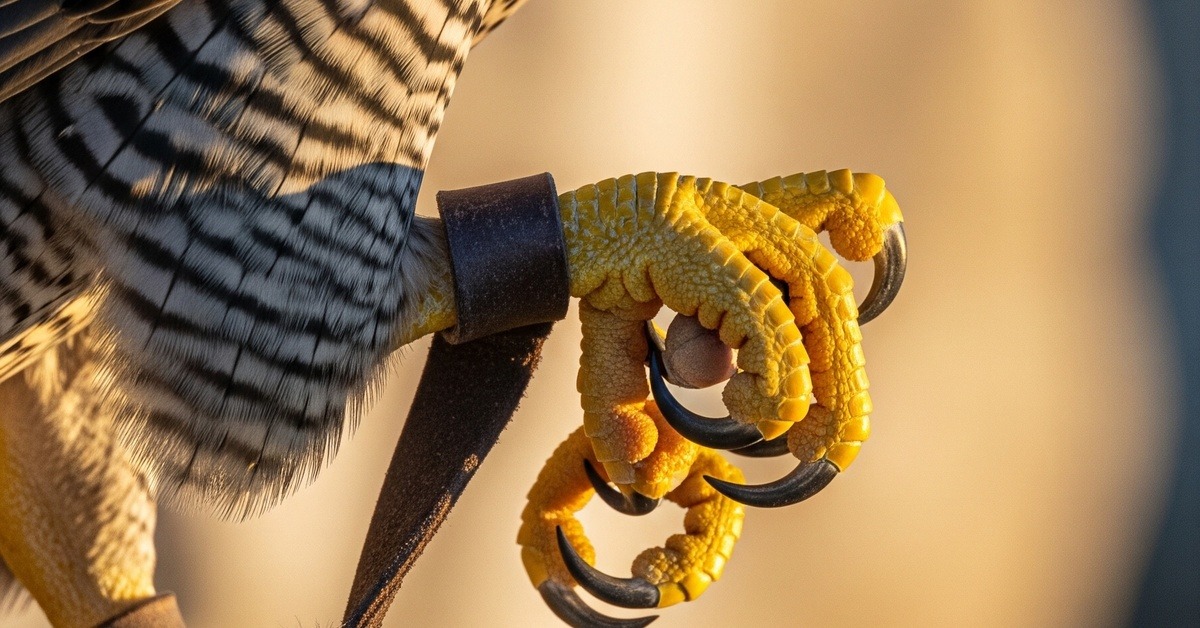
- The peregrine’s strike doesn’t typically use the full spread of talons — it’s delivered as a closed fist, using the enlarged rear talon as the primary impact point, which concentrates force rather than distributing it. The distinction matters: it’s closer to a punch than a grab.
- Peregrines have been documented hunting bats at dusk by flying directly into roost-exit streams and striking mid-air — a behavior first recorded systematically in 1998 in Spain’s Ebro Delta, revealing that the stoop isn’t the only hunting mode in their repertoire.
- Researchers still can’t fully explain how peregrines maintain targeting accuracy at speeds above 300 km/h, given known limits of avian neural processing speed — the reaction time required to correct a stoop trajectory at that velocity appears to push against the theoretical ceiling of vertebrate neurology.
Frequently Asked Questions
Q: Is the peregrine falcon the fastest animal on Earth in every category?
The peregrine falcon fastest animal title applies specifically to self-powered locomotion — it reaches over 389 km/h in a stoop. A cheetah tops out around 112 km/h on land. The sailfish reaches approximately 110 km/h in water. No animal in any medium comes close to the peregrine’s recorded speed, though the qualification “gravity-assisted” is sometimes raised, since the stoop uses altitude converted to velocity rather than pure muscle power alone.
Q: How does the peregrine survive the physical impact of hitting prey at that speed?
It doesn’t hit head-on. The stoop trajectory is carefully angled so the falcon strikes from slightly above and behind, delivering a glancing blow rather than a direct collision. The closed-fist strike distributes force through the bird’s heavily muscled leg and a reinforced skeletal structure around the foot. The prey absorbs most of the kinetic energy. The falcon is moving fast enough that it often has to circle back to collect a bird that’s already dead or dying before it reaches the ground.
Q: Don’t peregrines mostly miss? Isn’t the stoop actually less effective than it looks?
This is a common misconception. Success rates vary by prey type and terrain, but studies of urban peregrines tracked by the British Trust for Ornithology found strike success rates ranging from 47% to over 70% depending on context — considerably higher than most avian predators achieve. The stoop appears dramatic precisely because it’s so fast, but that speed is the point: prey animals have almost no reaction window. A pigeon at rest has roughly 0.3 seconds to respond from the moment a stoop becomes visually detectable. That’s not enough.
Editor’s Take — Alex Morgan
What stays with me isn’t the speed record. It’s the closed fist. The peregrine doesn’t rake or grab — it punches. Somewhere in 25 million years of refinement, evolution landed on what is essentially a flying boxer with perfect aim. We nearly erased all of that with one agricultural chemical in about two decades. The fact that the bird came back, redesigned nothing, and is now nesting on skyscrapers above cities we built — hunting at 300 km/h over places called Manhattan and London — is either deeply reassuring or deeply strange. Possibly both.
The peregrine falcon doesn’t know it’s the fastest animal on Earth. It doesn’t need to. That designation belongs to us — our instruments, our measurements, our categories. What the falcon knows is simpler: climb high enough, tuck tight enough, and the sky becomes a weapon. Every continent except Antarctica has peregrines. Every major city with tall buildings probably has a nesting pair right now, invisible above the street noise. Look up on a clear afternoon above any urban skyline. Somewhere up there, something is calculating angles and distances at a speed the human eye can’t follow. The stoop has already begun.
Illustrations are AI-generated. Article fact-checked and human-edited. Our editorial standards.