The Sheep Carrying 80 Pounds of Wool It Couldn’t Shed
Eighty pounds. That’s what one sheep in rural Australia was hauling around on its back — dead weight, literally, because the animal couldn’t see anymore, couldn’t move without crushing effort, and definitely couldn’t ask anyone for help before it got that bad.
The thing nobody tells you about sheep wool overgrowth: it doesn’t happen overnight. It creeps. For years, sometimes. An animal just keeps growing fleece while everyone assumes someone else is handling the shearing, and then one day a rescuer shows up and finds something that barely looks alive anymore. This is domestication without a safety net. This is what happens when we breed animals that can’t survive without us, and then we forget to show up.
Key Facts
- Domestic Merino sheep have been bred to grow wool continuously and cannot shed it naturally — unshorn, a single animal can accumulate over 40 pounds of fleece.
- The record belongs to Baarack, a Merino found near Lancefield, Victoria, in 2021 carrying 78.26 pounds (35.4 kg) of wool.
- An overgrown fleece traps heat, blinds the animal, hosts parasites, and can leave a fallen sheep “cast” — unable to right itself, which is frequently fatal.
- Wild ancestors like the Mouflon shed every spring; the Merino’s runaway coat is a product of roughly 200 years of intensive selective breeding.
Key Facts
- Unshorn domestic Merino sheep can accumulate over 40 pounds of fleece because they have been bred to grow wool continuously and cannot shed it naturally.
- Baarack, a Merino found near Lancefield, Victoria, in 2021, carried 78.26 pounds (35.4 kg) of wool, setting the recorded benchmark for fleece weight.
- Shrek, a Merino wether from New Zealand’s South Island, evaded mustering near Bendigo Station for six years and was finally shorn in 2004 of roughly 60 pounds of fleece by champion shearer Peter Casserly.
- Chris, found near Canberra in 2015, was carrying roughly 40 pounds of wool when RSPCA workers reached him, and former Australian champion shearer Ian Elkins was called in to remove it.
- Shearing a severely overgrown sheep can take an hour or more per animal, compared with the two to three minutes a professional needs for a routine shear.
In short: Domestic Merino sheep have been selectively bred for about 200 years to grow wool continuously, switching off the seasonal moult their wild Mouflon ancestors retain. Without shearing, fleece traps heat, blinds the animal, hosts parasites, and can leave it cast. Famous cases include Shrek (2004), Chris (2015), and record-holder Baarack (2021, 78.26 pounds).
How Sheep Wool Overgrowth Becomes a Crisis
Domestic Merino sheep don’t stop growing wool. Their wild ancestors — the Mouflon — shed naturally every spring, dropping a winter undercoat once warmer weather arrives. But we wanted more. Centuries of selective breeding meant we kept picking the sheep that grew the thickest coats, and kept breeding those sheep together, until eventually we created an animal whose biology had no off switch. According to Wikipedia’s overview of the Merino breed, these animals are among the most prolific wool producers ever bred. Dr. Jim Watts of the Australian Wool Innovation program has noted what happens next: without annual shearing, the math gets ugly fast.
To understand the mechanism, it helps to know that a sheep’s fleece grows from follicles much the way human hair grows from the scalp — continuously, with no seasonal halt. Wild sheep evolved a moult, triggered by lengthening days and rising temperatures, that sheds the dense winter fibre and regrows a lighter summer coat. The Merino’s moult gene was effectively switched off by breeders who, generation after generation, kept the animals that simply never let go of their wool. The result is a fibre factory that runs year-round and never empties itself.
Fleece creeps over the eyes first. Then it packs around the legs, getting tighter with every step because the wool never dries, never stays clean. It collects mud and urine and feces and becomes this matted, heavy thing hosting parasites and infections. The weight compounds — every month adds another layer that the previous layers can no longer support, until the coat stops behaving like hair and starts behaving like a cast.
Think about carrying a child on your back every second of every day. Now never put them down.
That’s roughly what these sheep endure. The fleece traps heat so efficiently that even mild weather becomes dangerous. A coat designed by nature to keep an animal warm through an alpine winter becomes a furnace in spring. Breathing grows labored. The animal pants, seeks shade it often cannot reach, and slowly cooks inside its own insulation. And there’s something else — something that almost nobody talks about unless you’re deep in animal welfare reports — these sheep can’t get back up if they fall. It’s called being “cast.” The weight pins them down. A cast sheep can suffocate under its own bulk within hours, as the pressure on its lungs and the build-up of gases in its rumen overwhelm it. On a hillside? That’s usually where the story ends.
The Famous Cases That Put Sheep Wool Overgrowth on the Map
Shrek was a Merino wether from New Zealand’s South Island who spent six years hiding in caves around Bendigo Station near Tarras, evading every mustering attempt. When farmers finally caught him in 2004, he was carrying roughly 60 pounds of fleece — so densely matted it had formed its own shape, almost independent of the animal underneath. They broadcast his shearing on national television, performed by champion shearer Peter Casserly. New Zealand treated it like a state event. By the time he was done, the small grey-faced animal that walked out looked like it had shed half of itself.
He wasn’t the only one.
Chris wandered near Canberra in 2015, his roughly 40-pound coat so thick that RSPCA workers approached him with real uncertainty — wondering if anything was actually alive inside. He was. Barely. Visibly distressed. Seconds away from heat exhaustion that could’ve killed him. A shearer named Ian Elkins, a former Australian champion, was called in specifically because removing that much wool from a stressed animal is dangerous work. That last fact kept me reading for another hour, trying to understand how an animal gets that far gone before someone notices.
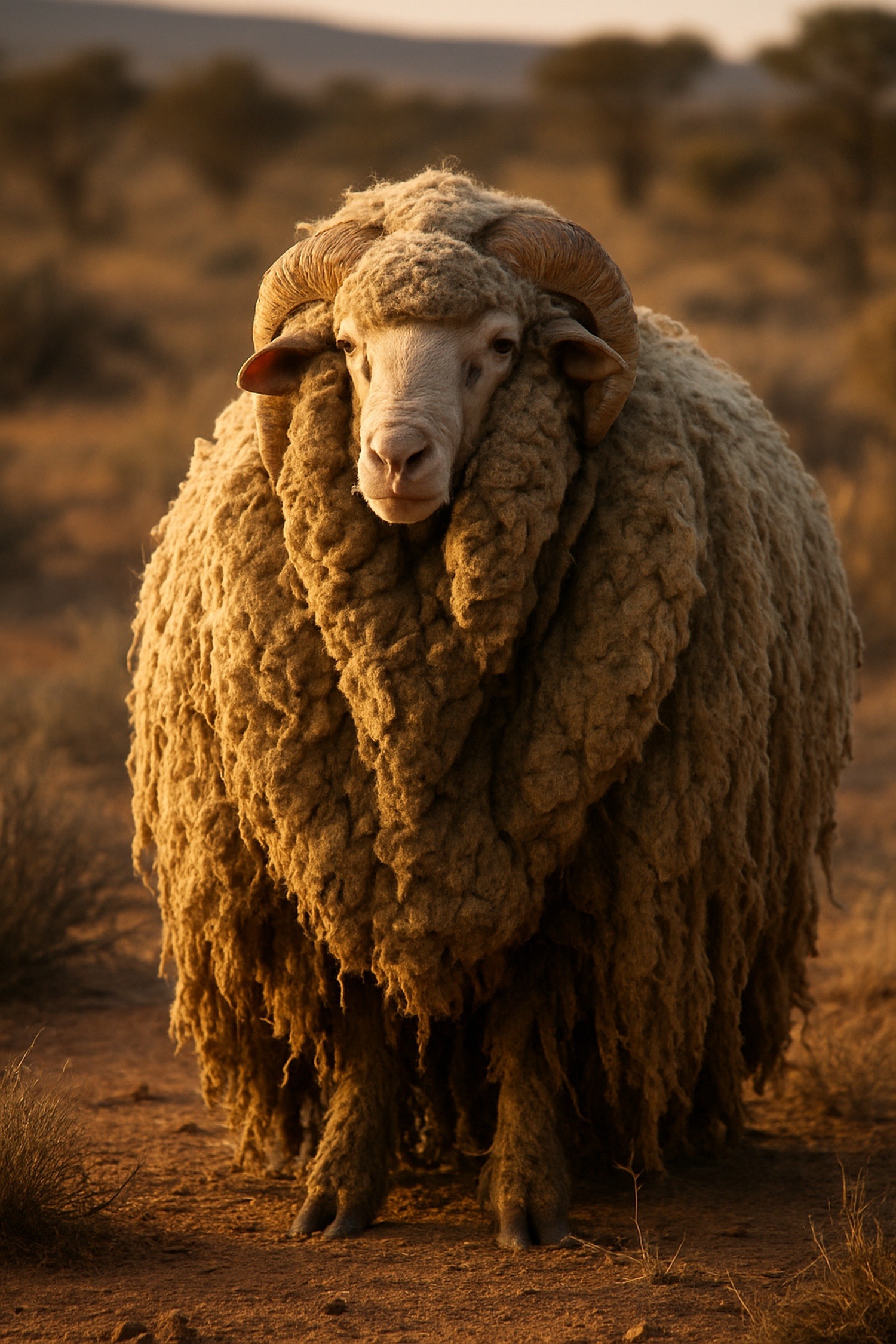
Then there was Baarack, found wandering a forest near Lancefield in central Victoria in early 2021. Rescued by the volunteer group Edgar’s Mission, he was shorn in February of that year. His fleece hit 78.26 pounds — breaking the previous record held by Chris. That’s not a wool coat anymore. That’s structural failure. Veterinarians who examined Baarack found that his vision had been so obscured he could barely navigate, and that the weight had begun to deform how he moved.
The Moment of Shearing Changes Everything
Here’s what watching an overgrown sheep get shorn actually looks like: the process takes far longer than a routine shear — sometimes an hour or more for a single animal — because shearers have to feel through layers of compacted fiber, hunting for skin. A healthy sheep is shorn in two or three minutes by a professional; a neglected one is a slow, careful excavation. One wrong angle and the blade cuts flesh instead of fleece. The wool comes off in massive chunks — dense, yellowed, reeking — still structurally intact as if it had built itself into architecture.
Then the animal emerges.
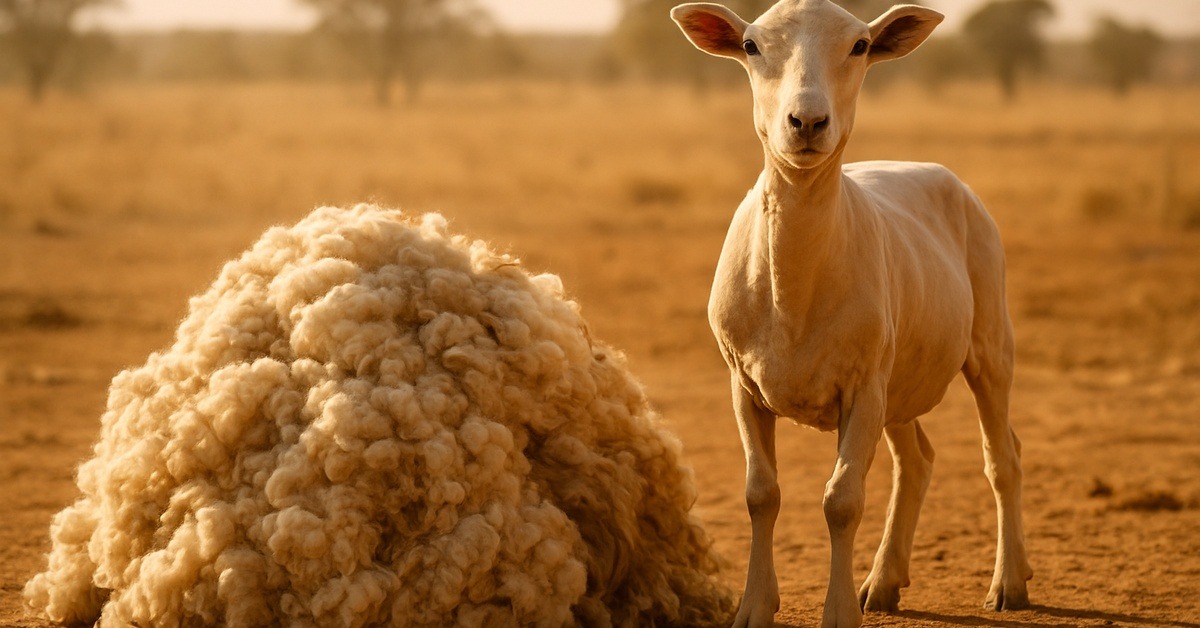
Smaller than expected. Blinking. Confused. Often a third lighter than it was minutes earlier, suddenly able to see the people around it for the first time in years.
And something shifts immediately. Sheep that couldn’t lift their heads start looking around. Animals that shuffled start trotting. They’ve just remembered what their body was supposed to feel like. Light. Free. Theirs. Handlers describe a near-instant change in posture, as though a switch has flipped from survival to curiosity.
The behavioral change is what stays with you long after the numbers fade.
By the Numbers
- Shrek’s 2004 shearing produced roughly 60 pounds of fleece — enough, by New Zealand wool industry estimates, for around 20 large men’s suits.
- A well-managed Merino produces about 10–18 pounds of wool annually. An unshorn sheep can accumulate several times that over six years.
- Chris the sheep held the Guinness World Record at 40.45 pounds until Baarack broke it in 2021 carrying 78.26 pounds.
- One pound of fine Merino wool contains an extraordinary length of fiber — by some industry estimates on the order of 100 miles — meaning a record fleece represents thousands of miles of thread, which somehow makes the whole thing even stranger when you think about it.
Field Notes
- Wild sheep naturally shed each spring. Merinos have been bred to suppress shedding entirely, making human intervention a biological necessity — not farming convenience, but an actual survival requirement.
- Experienced shearers can detect a badly neglected sheep before seeing it. The smell — lanolin mixed with ammonia and decomposing organic material — is that distinctive.
- Fly strike happens when blowflies lay eggs in moist wool and the larvae eat into living flesh. It’s one of the leading causes of death in unshorn sheep, and wool overgrowth creates the exact warm, damp environment flies want.
Why a Lost Sheep Spirals So Fast
It’s tempting to picture an overgrown sheep as merely uncomfortable, the way a person might feel in too many layers on a warm day. The reality is a cascade of compounding failures, each one feeding the next. The first problem is thermoregulation. Wool is a near-perfect insulator — that’s precisely why we prize it — and a fleece several times the normal thickness means the animal cannot dump body heat in summer. Sheep don’t sweat efficiently; they rely on panting and on shedding heat through thinly-furred areas. Wrap all of that in pounds of matted fibre and even a temperate afternoon can push the animal toward fatal hyperthermia. Several of the famous rescues happened in spring or early summer for exactly this reason: the animal was running out of time.
The second problem is mobility, and it is mechanical. A 40- to 78-pound coat is not distributed neatly; it bunches at the legs, the belly, and around the neck, restricting the joints and throwing off balance. A sheep that cannot move freely cannot graze well, cannot reach water reliably, and cannot escape a predator or right itself when it tips over. The third problem is hygiene. Because the fleece never dries and never falls away, it becomes a reservoir for urine, faeces, mud, and moisture — the ideal nursery for blowflies. Fly strike in a heavily fleeced animal can kill within days, and the wool’s bulk hides the damage until it is severe. Put plainly: an overgrown coat doesn’t just burden the sheep, it disables nearly every system the animal needs to keep itself alive.
What Responsible Shepherding Actually Requires
None of this means wool itself is the villain, or that keeping sheep is inherently cruel. Across well-run farms, the answer is simple and ancient: shear at least once a year, usually in spring, before the heat arrives and before the fly season peaks. A competent flock manager also keeps the fleece around the hindquarters trimmed — a practice called crutching — to reduce the moisture and soiling that invite fly strike. The catastrophic cases almost always trace back to a single failure: an animal that slipped out of the system. Shrek hid in caves. Chris and Baarack appear to have strayed or been abandoned and gone feral, surviving alone long enough for their coats to balloon. The lesson woven through every one of these stories is that the Merino is a managed animal by design, and the moment management stops, the clock starts ticking.
We Built This Problem — And We Keep Forgetting That
Sheep wool overgrowth isn’t a freak accident. It’s the predictable endpoint of a breeding program that ran for centuries without asking what happens when the system breaks. Ancient and then modern farmers wanted more wool, so they selected for sheep that grew the most. Then they did it again. And again. Until they created an animal whose biology had completely overshot the parameters of independent survival. The Merino is, in a very real sense, a creature of pure human intention.
Beautiful. Productive. Entirely dependent on us.
That dependency isn’t the sheep’s failure. We engineered it. The extreme cases — Shrek, Chris, Baarack — are what happens when the maintenance contract lapses. When nobody shows up. The animal just keeps growing. Keeps struggling. Keeps carrying the weight of choices made centuries before it was born.
It raises an obvious question: how many other animals are carrying burdens we designed into them, burdens so ordinary we’ve stopped seeing them as burdens at all? Broiler chickens bred to grow so fast their legs can barely hold them. Pugs and bulldogs engineered toward faces that can’t quite breathe. The answer isn’t comfortable. But asking it is probably where we start.
Frequently Asked Questions
Q: Why can’t Merino sheep shed their wool like other animals? Their wild ancestors, including the Mouflon, moult every spring in response to longer days and warmer weather. Over generations of selective breeding, humans favoured Merinos that grew thicker coats and never let go of them, effectively switching off the natural moult. The breed now grows wool continuously, with no seasonal stop, which is why annual shearing isn’t a luxury for these animals — it’s a survival requirement.
Q: How much wool is dangerous, and what actually harms the sheep? A healthy Merino carries only a year’s growth, roughly 10–18 pounds, before being shorn. When a coat reaches 40 pounds or more, the dangers stack up: the fleece traps body heat and risks fatal overheating, restricts movement, hides skin infections and parasites, and can leave the animal “cast” — stuck on its back or side, unable to rise. Blowfly strike, where maggots feed on living flesh in the damp wool, is among the deadliest complications. It’s not the wool’s weight alone but everything that weight enables.
Q: What happened to the record-holding sheep like Shrek and Baarack? Shrek, found in New Zealand in 2004 with about 60 pounds of fleece, recovered fully and became a beloved public figure before dying peacefully in 2011. Baarack, rescued near Lancefield, Victoria, in 2021 with a record 78.26 pounds, was safely shorn by the rescue group Edgar’s Mission and lived out his days in care. In every well-documented case, once the fleece comes off, the transformation is immediate and dramatic — the animal can see, move, and cool itself again within minutes.
Shrek lived eight more years after that famous shearing, appearing at charity events and meeting schoolchildren. He died peacefully in 2011. The wool from his one great shearing raised thousands for charity — so there’s that. But the story itself isn’t finished. Animals like him are still out there. The systems that create them are still running. If this keeps you curious, there’s more at this-amazing-world.com — and the next one is even stranger.
Illustrations are AI-generated. Article fact-checked and human-edited.