Jawfish Mouthbrooding Behavior: A Father Who Holds On
The first thing you notice about jawfish mouthbrooding is the mouth. A male opens his jaws as wide as they’ll physically go — not as a threat, but as a love song. Inside, soon enough, will sit dozens of his own fertilized eggs.
Meet the gold-specs jawfish (Opistognathus randalli), a small reef fish with an outsized approach to fatherhood. No nest. No burrow nursery. Just dad, holding his breath and his babies at once. But before any of that, he has to win her over — and the way he does it is genuinely strange.
Key Facts
- Male jawfish are mouthbrooders — they carry fertilized eggs inside their mouths until the young are ready to hatch.
- The brooding period can last up to two weeks, during which the male rarely eats.
- The family Opistognathidae contains over 90 described species, many still being formally catalogued.
- The gold-specs jawfish (Opistognathus randalli) lives in sandy-bottomed burrows on tropical and subtropical reefs.
- Courtship involves looping swims through the water column and rapid flashes of the fins.
In short: Jawfish mouthbrooding is a parenting strategy where male jawfish hold their fertilized eggs inside their mouths for up to two weeks, gently rolling them to keep them oxygenated and barely eating the entire time. It’s one of the coral reef’s quietest, most demanding acts of devotion.
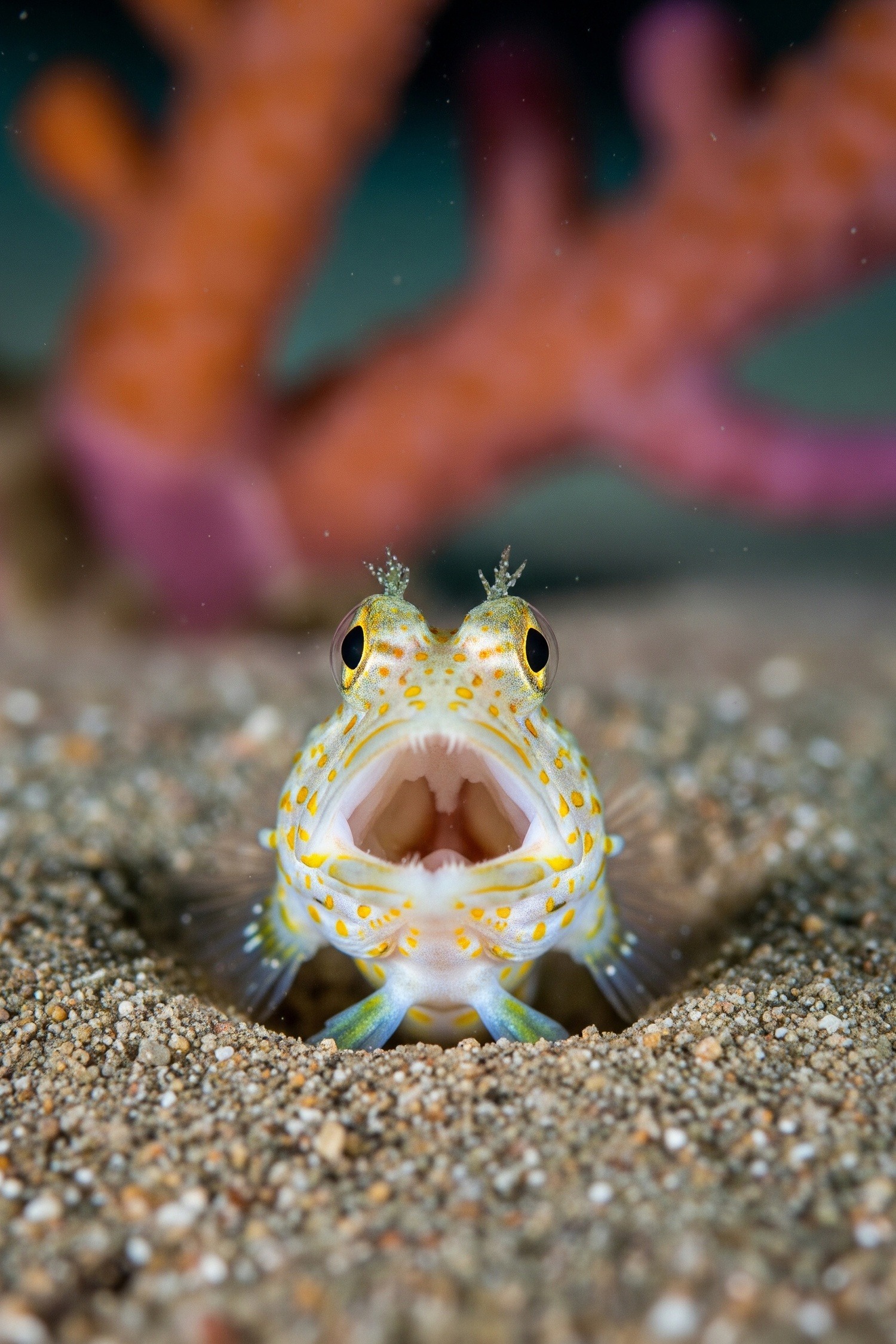
What is jawfish mouthbrooding, exactly?
Mouthbrooding is parenting by inconvenience. The male takes the fertilized eggs into his buccal cavity — the inside of his mouth — and keeps them there, churning and aerating them, until the larvae are developed enough to swim free. Among the family Opistognathidae, this is the standard playbook, and it’s the father who does the work, not the mother. According to the jawfish family description, there are more than 90 recognized species, with new ones still being formally named as divers and ichthyologists comb tropical reefs. The gold-specs jawfish, Opistognathus randalli, was itself only described relatively recently, in 2009.
A brooding male is unmistakable once you know what to look for. His jaw bulges, his cheeks puff, and he seems to be perpetually mid-yawn. He can’t feed normally with a mouth full of eggs, so for the duration he runs on reserves. The clutch can number in the hundreds, packed into a space barely larger than a thumbnail. Periodically he opens wide and churns the whole mass — a behavior that looks almost like spitting them out before he draws them back in. That isn’t carelessness. It’s how he flushes fresh, oxygen-rich water across every egg in the bundle, the same job a bird does by turning eggs in a nest.
It’s tender. It’s also exhausting.
How does a jawfish win a mate?
Before the eggs comes the audition. Male jawfish court with a sweeping, looping dance through the water column, rising from their burrows and punctuating the display with quick, deliberate flashes of the fins. The grand finale is the gape — jaws thrown open to their absolute limit. He isn’t trying to scare anyone. He’s advertising real estate and capacity, as if to say: look how much room I have, look how big my burrow is, trust me with your eggs. If you want more reef behavior that rewards a closer look, This Amazing World keeps cataloguing the small, easily missed dramas playing out on the seabed.
The strategy is honest signaling, in biological terms. A male who can open wide and defend a deep, clean burrow is demonstrating fitness a female can read in seconds. The dance costs energy and exposure to predators, which is exactly why it carries information — a weak fish couldn’t fake it for long. Biologists borrowed the idea from peacock tails and stag antlers: a display only means something if it’s expensive to produce. A jawfish hovering exposed above its hole, flashing fins where any passing predator can see, is putting its own safety on the line to prove it’s worth a female’s eggs.
Female choice does the rest. She inspects, she decides, and the courtship either advances or fizzles.
The biology behind the gape
Jawfish are built around their burrows. They’re tireless excavators, hauling mouthfuls of sand and shell rubble to construct and reinforce vertical tunnels in the reef floor, sometimes lining the entrance with pebbles for stability. The broader practice of mouthbrooding appears across unrelated fish lineages, from cichlids to cardinalfish, which tells biologists it’s a convergent solution — different families arriving independently at the same answer for protecting vulnerable eggs in a predator-dense environment. Reef-fish reproductive strategies documented by institutions such as the Smithsonian show just how varied parental care can be beneath the surface. The reef is hungry; a clutch left exposed on sand rarely survives the night.
Carrying eggs internally solves that. The father becomes a mobile, oxygen-pumping incubator that can retreat into a tunnel at the first sign of danger. He rolls the eggs periodically to keep water and oxygen circulating across the developing embryos, a behavior caretakers and aquarists have documented in detail under controlled observation.
The burrow and the mouth work as a single defensive system. By day the male hovers just above his hole, jaws full, ready to drop straight down out of sight. By night he can seal himself inside, the clutch tucked safely below the seabed where almost nothing can reach it. Few other reef fish combine architecture and anatomy this tightly — the jawfish essentially carries its nursery with it and parks it in a fortress it dug by hand. It’s a two-layer insurance policy against a reef where almost everything is trying to eat almost everything smaller than itself.
The trade-off is brutal but elegant: extreme effort from one parent in exchange for sharply higher survival odds.
Why jawfish mouthbrooding fascinates researchers
Paternal care this intense is uncommon in the animal world, where mothers usually shoulder the cost. Jawfish flip that script entirely, and that makes them a useful model for scientists studying the evolution of male parental investment. Marine researchers have long documented reef-fish reproductive strategies, and mouthbrooding sits among the more extreme examples of how far a parent will go. The male’s near-total fasting during brooding — up to two weeks of self-imposed hunger — is a measurable, quantifiable sacrifice. You can weigh it: a fish that loses condition over a fortnight of not eating is paying a price you could chart on a graph.
There’s a cost-benefit calculation buried in every gaping jaw. A father who broods cannot mate again until the clutch hatches, and he risks his own condition for the brood. He’s also more vulnerable — a mouth packed with eggs can’t bite, can’t feed, and slows his retreat into the burrow. Yet the strategy persists across the family, which means the math works: more surviving offspring outweighs the father’s hardship over evolutionary time. Natural selection doesn’t reward tenderness for its own sake. It rewards the version of devotion that puts the most young into the next generation, and in jawfish, that version runs through the father’s mouth.
So when divers watch a male roll a mouthful of eggs, they’re seeing arithmetic written in muscle and patience.
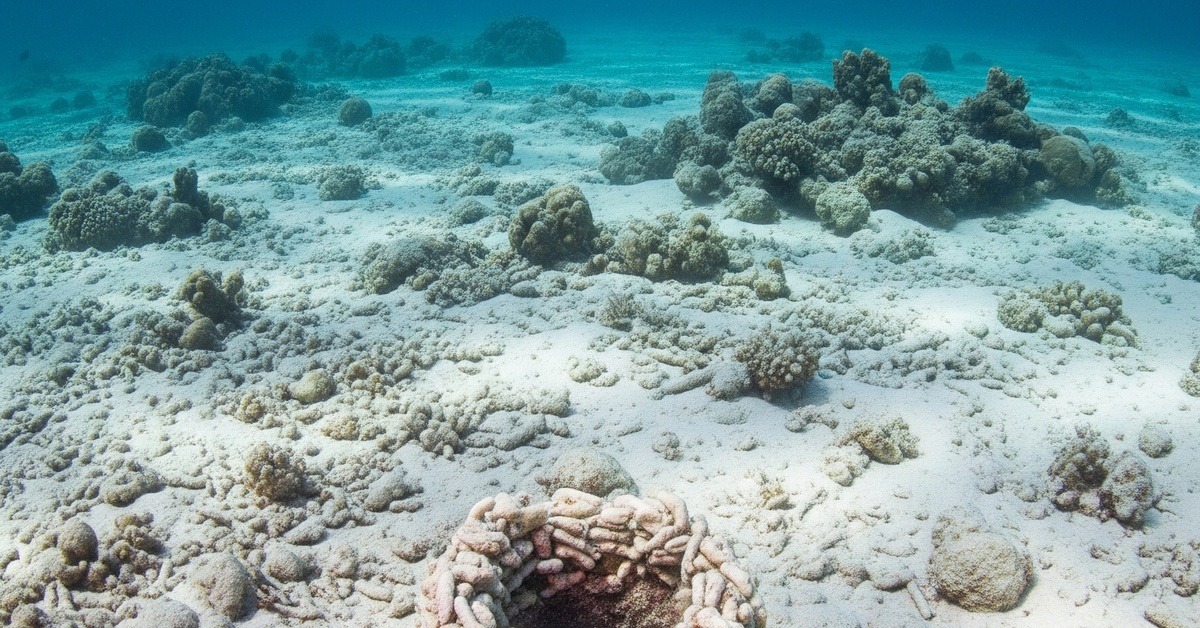
Where to See This
- Sandy-bottomed coral reefs across the Indo-Pacific, including the Philippines, Indonesia, and parts of the Red Sea — best observed on calm-water dives over rubble and sand flats.
- Public aquariums and research institutions such as regional marine labs occasionally display jawfish, where their burrowing and brooding can be watched up close.
- For curious divers: hover still and low. A jawfish will duck into its burrow if you crowd it, but patience often earns a long, open-jawed display.
By the Numbers
- 90+ — described species in the family Opistognathidae, with more still being named.
- Up to 2 weeks — duration a male may carry eggs while barely eating.
- 2009 — year the gold-specs jawfish, Opistognathus randalli, was formally described.
- Hundreds — typical number of eggs a single male may brood at once.
- Centimeters — the scale of most jawfish, among the smaller burrowing reef fish.
Field Notes
- Jawfish are obsessive housekeepers. They constantly rebuild collapsing burrow walls, ferrying sand and shell fragments in their mouths — the same mouths that later become nurseries.
- Some jawfish anchor the burrow entrance with a small “door” of pebbles or shell, pulling it shut behind them at night.
- Mouthbrooding evolved independently in cichlids, cardinalfish, and jawfish — a textbook case of convergent evolution toward the same parenting trick.
- Researchers still debate exactly how a brooding male balances oxygen for the eggs against his own breathing needs over many days. The fine mechanics of that two-week fast remain incompletely understood.
Frequently Asked Questions
Q: Why does the jawfish carry eggs in its mouth instead of building a nest?
Jawfish mouthbrooding protects eggs in one of the most dangerous places on the reef. A clutch left on open sand would be eaten within hours. By holding the eggs internally, the male keeps them oxygenated and can dart into his burrow when a predator appears. The cost is steep — he can barely eat for up to two weeks — but survival rates for the brood climb dramatically compared with exposed eggs.
Q: Is it always the male jawfish that broods?
Yes. In jawfish, paternal mouthbrooding is the rule, not the exception. The female deposits her eggs, the male fertilizes and takes them into his mouth, and he carries them alone until they hatch. This flips the usual pattern, where females shoulder most parental care. Biologists treat it as a striking example of high male parental investment, which is relatively rare across the animal kingdom.
Q: Does the wide-open jaw mean the jawfish is aggressive?
Usually not. The dramatic gape that looks threatening is most often courtship advertising. The male is showcasing the size and capacity of his mouth and burrow to attract a female, signaling that he can house a clutch safely. Jawfish do defend their burrows from rivals, but the trademark wide-open display tied to mating is closer to a performance than a fight.
Q: How big is a gold-specs jawfish?
The gold-specs jawfish is small, measured in centimeters rather than inches of length, and spends most of its life half-hidden in a sandy burrow. Despite its size, it commands a surprisingly large vertical territory in the water column above its hole. Its modest dimensions are exactly why the brooding feat is so striking — a tiny fish performing an outsized act of care.
Editor’s Take — Alex Morgan
We hand out “good dad” awards in the animal kingdom too easily, but the jawfish earns it the hard way — by going hungry. Two weeks of fasting, jaw packed with eggs, retreating into a self-dug tunnel at every shadow. There’s no cuddling here, no warmth in the mammal sense. Just relentless, unglamorous effort. It’s the kind of devotion that doesn’t photograph as cute, which is precisely why it deserves more attention than it gets.
Somewhere on a sand flat right now, a male jawfish is rolling a mouthful of eggs, hungry and unseen, doing the most important work of his life with his jaws clamped shut around the future. The reef is full of these quiet performances — devotion measured not in display but in days of patient sacrifice. How many other acts of parenthood are playing out down there, completely beyond what we’ve ever thought to look for?
Illustrations are AI-generated. Article fact-checked and human-edited. Our editorial standards.