Why Sea Otters Hold Hands: A Survival Strategy
Why sea otters hold hands is the question that stops people mid-scroll. Two small paws lock together. An entire ocean tries to pull them apart. They aren’t being sweet. They’re solving a problem the Pacific never stops posing: how do you sleep on water that won’t sit still?
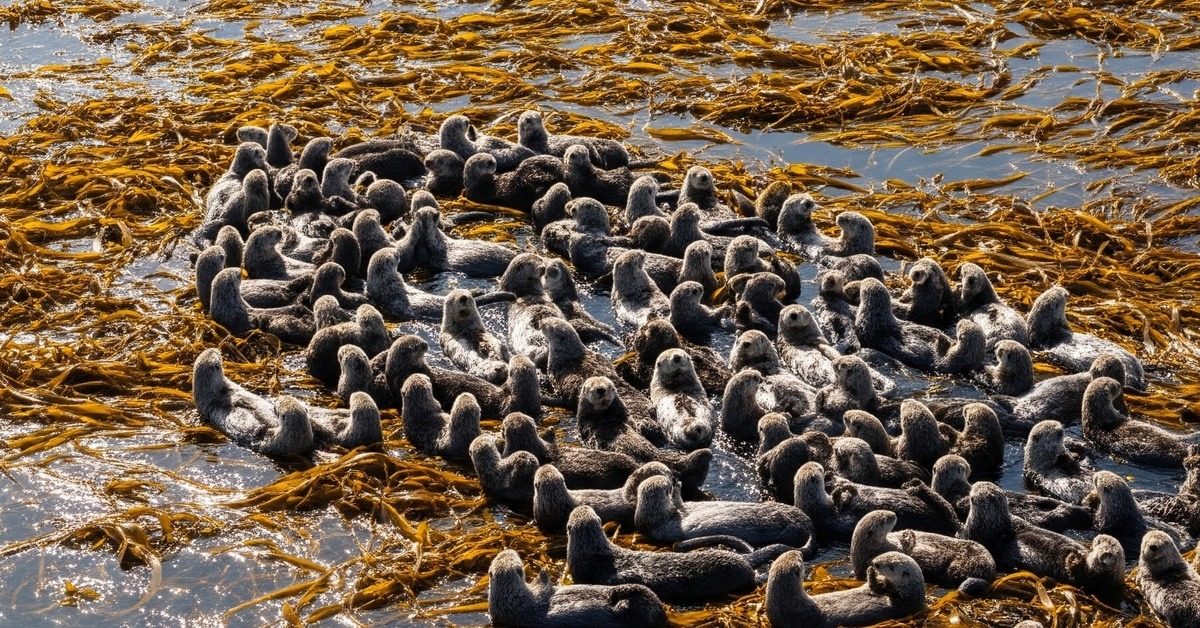
Off California’s Monterey Bay, sea otters gather in floating groups researchers call rafts — sometimes dozens of animals drifting together in the kelp, rising and falling with the swell. Each one is anchored, not by rock or rope, but by another otter’s grip, or by a strand of kelp wound across its belly. Look closer and the cuteness turns into engineering.
Key Facts
- Sea otters rest in groups called rafts, sometimes numbering dozens of animals, to avoid drifting apart while they sleep.
- An otter will wrap itself in giant kelp, which can grow up to 18 inches per day, to stay anchored.
- Southern sea otters were hunted to near-extinction; fewer than 50 animals remained along the California coast by the early 1900s.
- Today the southern sea otter population numbers around 3,000 along the central California coast.
- Sea otters have the densest fur of any mammal — up to one million hairs per square inch.
In short: Why sea otters hold hands comes down to survival, not affection. Resting otters grip each other’s paws and wrap themselves in kelp to keep from drifting apart on the open Pacific. The behavior helps rafts of dozens stay together — a strategy built on connection rather than strength.
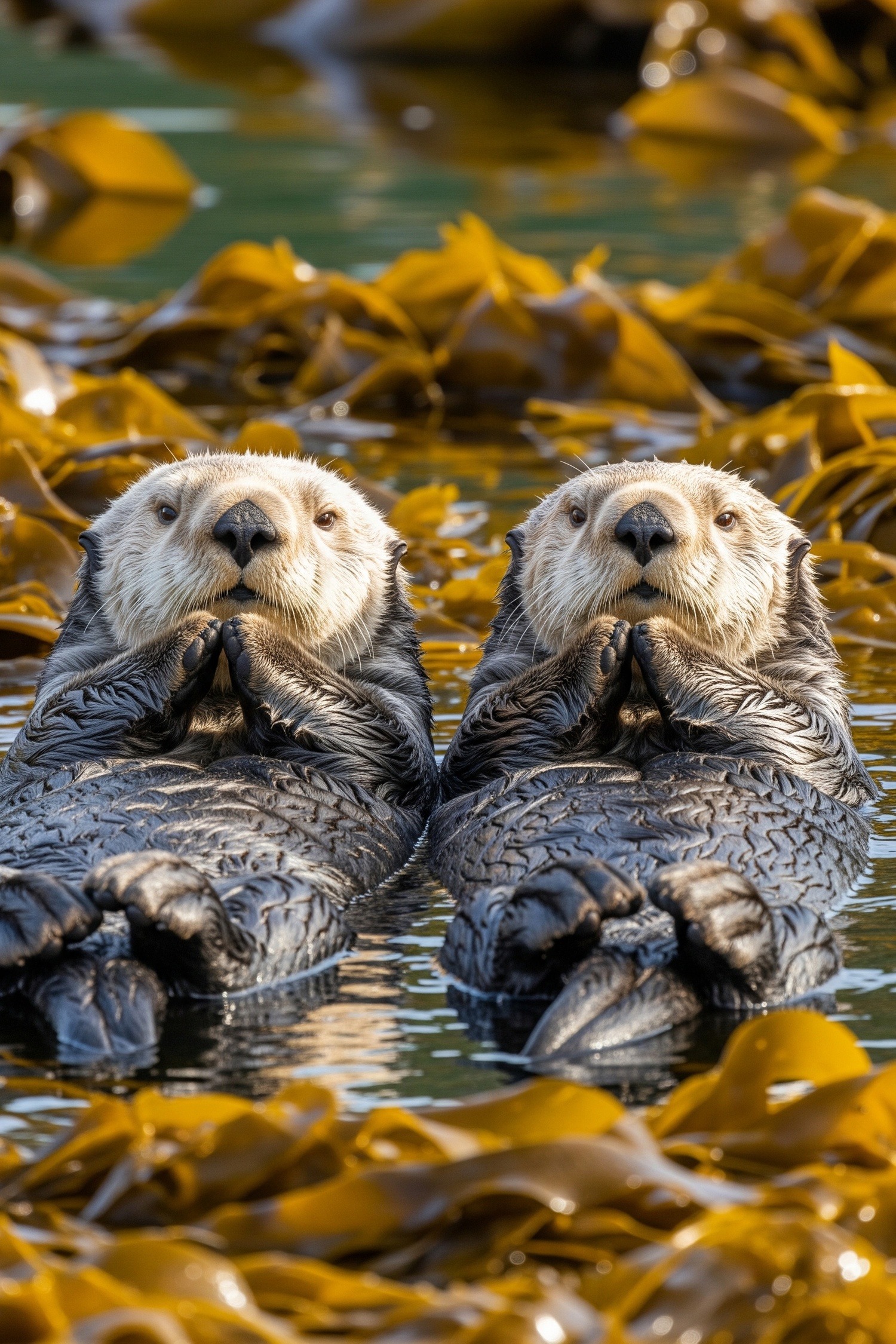
Why sea otters hold hands: the survival logic
The honest answer is drift control. A sleeping otter on open water has no way to hold position — no fins braced against rock, no burrow to retreat into. Left alone, it could float miles from its group before dawn, away from food and away from the safety of numbers. So otters raft up, and within the raft they often link paws. The sea otter is a creature of the surface in ways most marine mammals aren’t; it eats, grooms, mates, and sleeps while floating on its back. Field observers along Monterey Bay, where research has run for decades since the 1980s, have documented rafts holding their formation through tides and shifting wind, the hand-holding acting as a literal tether between bodies.
Rafts also tend to sort by sex — males in one group, females and pups in another. The grouping isn’t random sentiment; it’s spatial strategy. Stay together, stay near the kelp, stay near the food. A mother with a pup gains an extra layer of protection inside a raft: more eyes on the water, less chance of a great white shark singling out a lone, distracted swimmer.
The hand-holding itself is gentle but deliberate. Observers describe otters reaching for a neighbor’s paw as they settle, the way you might grab a railing on a moving boat. When the raft is large, animals on the edges sometimes link to the kelp directly while those in the middle link to each other, forming a loose, drifting mat that holds its shape through the night.
Turns out the heart-melting photo is really a survival diagram.
What is the kelp seatbelt that anchors a sleeping otter?
Hand-holding isn’t the only trick. A single otter can twist strands of giant kelp around its body like a living seatbelt before closing its eyes. Giant kelp grows up to 18 inches a day, among the fastest-growing organisms on Earth, forming dense underwater forests that double as both pantry and mooring. Wrapped in a few fronds, an otter can sleep without drifting, its anchor renewing itself with the tide. The relationship runs both ways — otters protect the kelp by eating the sea urchins that would otherwise mow it down. If you’ve followed the way single species can hold an entire ecosystem together, the stories collected at This Amazing World trace exactly these kinds of hidden dependencies.
This makes the sea otter a textbook keystone species. Remove it and urchin populations explode, the kelp forest collapses into a barren, and the dozens of species that depend on that forest lose their home. The hand-holding otter, in other words, is propping up far more than its own nap. Kelp forests also lock away carbon and buffer coastlines from storm surge, so the otter’s appetite ripples outward into climate and coastal protection most beachgoers never connect to a floating animal cracking a clam on its chest.
One animal. An entire forest leaning on its appetite.
How did the sea otter come back from the brink?
The species nearly vanished. Hunted relentlessly for its extraordinarily dense fur during the maritime fur trade, the southern sea otter was reduced to fewer than 50 known animals along the California coast by the early 1900s — a remnant population clinging on near Big Sur. According to IUCN assessments, the sea otter remains classified as Endangered globally, even as the California group has recovered to roughly 3,000 individuals. That rebound came partly from legal protection and partly, you could argue, from the otters’ own social biology — rafts that keep pups warm, fed, and accounted for.
Recovery hasn’t been smooth. The population has plateaued in recent years, hemmed in by sharks at its range edges, by pollution, and by the slow pace of fur regrowth in a cold sea. Each otter must eat roughly a quarter of its body weight daily just to stay warm, because unlike whales it has no blubber — only that fur.
White sharks are the quiet limit on the southern otters’ spread. The sharks don’t even eat them; they bite, taste, and release, but a single exploratory bite is often fatal to a 65-pound animal. That predation pressure pins the otters into the central stretch of the California coast, unable to recolonize the northern and southern ranges they once occupied. The map of where otters live today is, in part, a map of where great whites patrol — a boundary drawn in teeth, not in habitat.
What conservationists do now is protect the kelp and the coastline that protect the otter right back.
What sea otters hold hands to survive — and what it teaches us
Strip away the charm and you find a clean piece of natural problem-solving. An animal facing a restless ocean didn’t evolve brute power or a fortress; it evolved cooperation. The Monterey Bay Aquarium, which has studied and rehabilitated stranded otters since the 1980s, has shown how deeply social these animals are — orphaned pups raised by surrogate females, behaviors passed between individuals, rafts that function as floating communities. The hand-holding is the visible tip of a far larger social architecture.
It reframes how we read survival. We tend to celebrate the fastest, the strongest, the fiercest. The otter quietly makes the opposite case: that the most durable strategy can be holding on to your neighbor. A 65-pound animal versus the North Pacific is no contest on muscle alone. The otter wins on connection.
That cooperation shows up in smaller moments too. Otters groom obsessively, working air back into the fur that keeps them alive, and within a raft they tolerate close contact that would spark conflict in many other animals. A mother will leave her pup floating among the kelp, trusting the raft and the anchor to hold it in place while she dives for food, sometimes for minutes at a time. The pup, too buoyant to sink, bobs at the surface and waits. It’s a system that only works because every otter, in effect, agrees to it — a quiet social contract written into how the species rests, feeds, and raises its young on water that never holds still.
That’s worth sitting with the next time the swell comes up.
Where to See This
- Monterey Bay, California — the most reliable place on Earth to watch wild southern sea otters raft and feed; best viewed from Cannery Row, Moss Landing, or Elkhorn Slough.
- The Monterey Bay Aquarium runs a long-standing sea otter research and surrogacy program and displays rescued otters that can’t return to the wild.
- For respectful viewing: stay at least several meters back and never approach a resting raft — disturbed otters burn precious energy they can’t spare.
By the Numbers
- <50 — sea otters left along the California coast by the early 1900s after the fur trade.
- ~3,000 — approximate southern sea otter population today.
- 18 inches/day — growth rate of giant kelp, the otter’s anchor and habitat.
- ~1,000,000 hairs per square inch — the densest fur of any mammal.
- ~25% of body weight — the amount a sea otter must eat daily to stay warm.
Field Notes
- Sea otters keep favorite tools — a particular rock for cracking shellfish — tucked in a loose pouch of skin under the foreleg, reusing the same stone for days.
- A pup’s fur is so buoyant it physically cannot dive until it sheds its baby coat; mothers park floating pups in kelp while they hunt below.
- Rafts often segregate by sex, with males and females resting in separate groups along the same stretch of coast.
- Researchers still can’t fully explain why otter recovery has stalled near 3,000 despite decades of protection. Shark bites, disease, and food limits all play a part, but the exact balance remains unsettled.
Frequently Asked Questions
Q: Why do sea otters hold hands while they sleep?
Sea otters hold hands to keep from drifting apart on the open ocean while they rest. With no way to anchor to the seabed, a sleeping otter can float far from its group overnight. By gripping paws within a raft, sometimes dozens of animals strong, they stay together near food and safety. Many also wrap themselves in giant kelp as an additional tether before closing their eyes.
Q: Do all sea otters raft together, or only some?
Most southern sea otters rest in rafts, though groups tend to separate by sex, with males in one raft and females with pups in another. Raft sizes range from a few animals to dozens. The behavior offers safety in numbers and helps the otters stay near the kelp forests they depend on. A lone otter is more vulnerable to drift, predators, and cold than one resting in a group.
Q: How did sea otters recover from near-extinction?
By the early 1900s, the maritime fur trade had cut the California population to fewer than 50 animals. Legal protections in the 20th century, including the 1911 fur seal treaty and later endangered-species safeguards, gave the survivors room to rebound. The population has climbed to around 3,000, though it remains classified as Endangered. Their tight social structure — warm, well-fed rafts — likely helped pups survive the slow recovery.
Q: Why do sea otters need to eat so much?
Sea otters have no insulating blubber, unlike seals or whales. Instead they rely entirely on the densest fur of any mammal, up to a million hairs per square inch, trapping air against the skin. Maintaining that warmth in cold Pacific water burns enormous energy, so an otter must eat roughly a quarter of its body weight each day. Constant grooming to keep the fur clean and waterproof is equally vital to survival.
Editor’s Take — Alex Morgan
I’ve watched a raft hold formation through a rising swell off Moss Landing, and what struck me wasn’t the cuteness — it was the discipline. These animals have engineered a solution to a problem far bigger than they are, and they did it with cooperation instead of force. A 65-pound creature shouldn’t be able to sleep safely on the North Pacific. It manages anyway, by refusing to face the ocean alone. That’s not adorable. That’s brilliant.
Next time the heart-melting photo crosses your feed, look past the paws. You’re seeing an animal that solved one of the ocean’s oldest problems not with strength but with connection — and in doing so quietly holds up an entire kelp forest behind it. What other survival strategies are drifting out there in the swell, hidden in plain sight, waiting for someone to finally think to look?
Illustrations are AI-generated. Article fact-checked and human-edited.