How Did Ancient Cities Get Buried? The Slow Tide
To understand how did ancient cities get buried, you only need to walk down a Roman side street and look up at a doorway floating two storeys above the pavement of the Forum — a city that has not so much sunk as been climbed over, century after century, until the world its people knew lay a full nine metres beneath the world we walk today. The same slow tide buried Troy under sixteen metres of itself, swallowed the Sphinx up to the neck, drowned Pompeii in a single afternoon, and turned entire Mesopotamian capitals into grassy hills you would mistake for natural terrain. Cities, it turns out, do not stay where we build them.
Key Facts
- Since the fall of the Western Roman Empire in 476 CE, Rome’s ground level has risen by an average of roughly 9 metres (about 30 feet), which is why the Roman Forum now sits in a sunken hollow below the modern streets that surround it.
- At Hisarlik in modern Türkiye — the site identified as Troy — Heinrich Schliemann’s trench (1871–1873) cut through nine major settlement layers stacked across about 16–17 metres, from Bronze Age Troy I at the bedrock to the Roman-era city at the summit.
- The Neolithic town of Çatalhöyük in central Türkiye, occupied roughly 7400–6200 BCE, accumulated 18 layers of mud-brick houses and rose about 21 metres (70 feet) above the original plain — a hill built entirely out of demolished homes.
- Pompeii was buried catastrophically in a single eruption of Mount Vesuvius in 79 CE, under roughly 4–6 metres of pumice, ash and pyroclastic surge — the rare case of a city sealed in days rather than centuries.
- Archaeologists call these layered mounds “tells” (from the Arabic tall, “hill”), and the discipline of reading their stacked floors, hearths and rubbish lenses is called stratigraphy — a method borrowed directly from geology.
In short: Ancient cities did not sink. They were buried by a slow, mostly human-made tide of demolition rubble, flood silt, wind-blown dust, decayed wood and rotting vegetation, while new generations built straight on top of the old. A few sites (Pompeii, Akrotiri, Herculaneum) were sealed by sudden catastrophe; most rose underfoot, one floor at a time, over a thousand years.
Key Facts
- Since the fall of the Western Roman Empire in 476 CE, Rome’s ground level has risen by an average of roughly 9 metres, which is why the Roman Forum now sits in a sunken hollow.
- At Hisarlik in modern Türkiye, the site identified as Troy, Schliemann’s trench (1871–1873) cut through nine major settlement layers stacked across about 16–17 metres.
- The Neolithic town of Çatalhöyük in central Türkiye, occupied roughly 7400–6200 BCE, accumulated 18 layers of mud-brick houses and rose about 21 metres above the original plain.
- Pompeii was buried in a single eruption of Mount Vesuvius in 79 CE under roughly 4–6 metres of pumice, ash and pyroclastic surge.
- Layered mounds are called “tells” (from the Arabic tall, “hill”), and the discipline of reading their stacked floors and hearths is called stratigraphy, borrowed from geology.
In short: Ancient cities did not sink; they were buried by a slow, mostly human-made tide of demolition rubble, flood silt, wind-blown dust, decayed wood, and rotting vegetation as new generations built on top of the old. A few sites such as Pompeii and Herculaneum were sealed by sudden catastrophe, but most rose underfoot one floor at a time over a thousand years. The article identifies at least seven distinct burial mechanisms, with recycled rubble and decayed mud-brick being the dominant causes.
A Question That Bites You in Rome
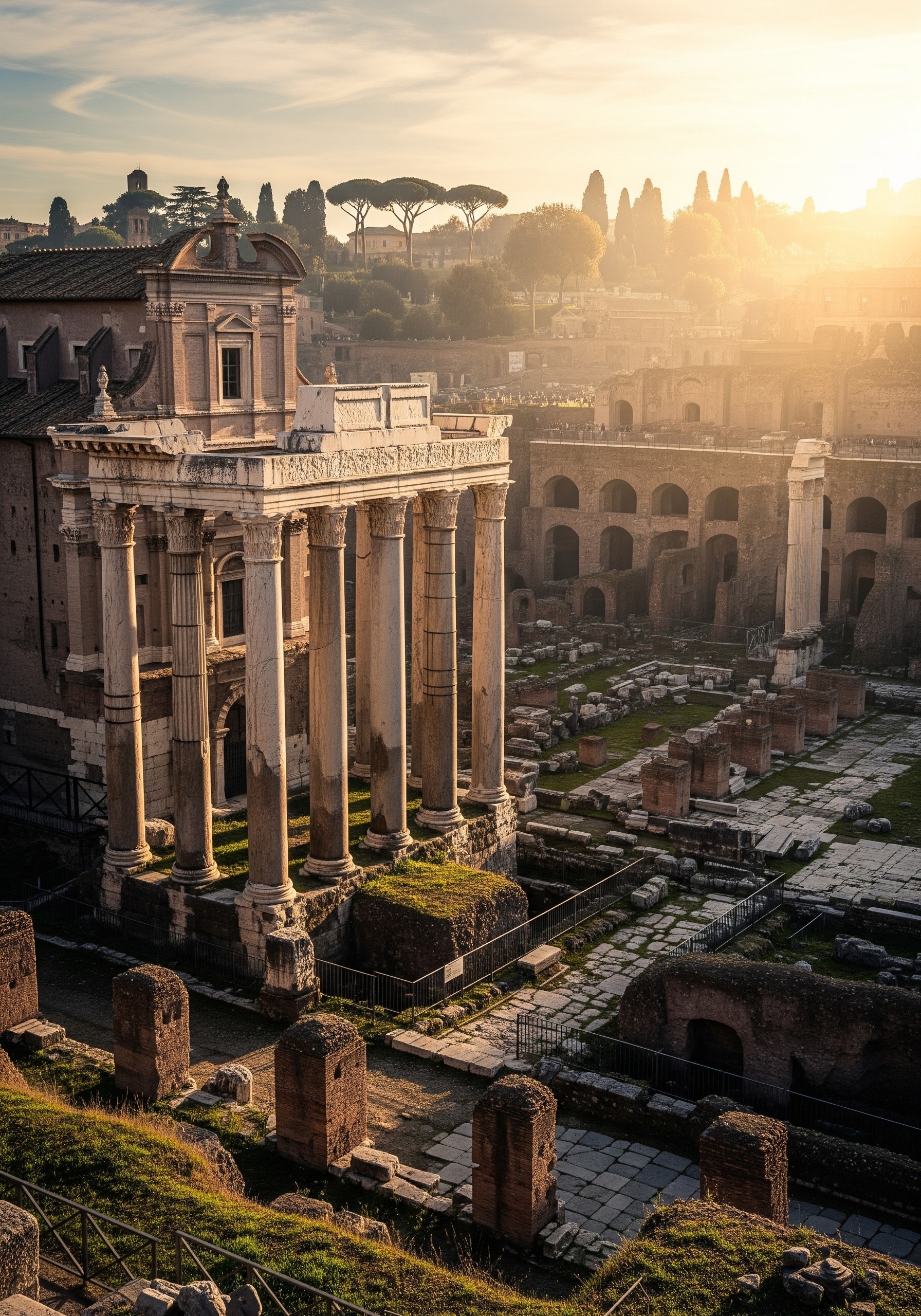
Stand on the Via dei Fori Imperiali in central Rome and you can see it with your own eyes: the columns of the Temple of Saturn rise out of a pit. The Forum, the political heart of an empire of roughly 60 million people, lies in what looks like a sunken garden. Step into the Basilica di San Clemente nearby and a staircase takes you down through a medieval church, into a 4th-century basilica, and then deeper still into a 1st-century Mithraic temple and a Roman alley — four storeys of city, stacked vertically.
It is a confusing sight, because nothing has actually fallen. The ancient ground has not dropped. The medieval and modern ground has risen, on top of it. The interesting question is not why the Forum is so low. It is why everything else is so high.
How Did Ancient Cities Get Buried? Seven Forces, One Slow Tide
Most popular explanations name two or three causes and stop. In reality, a city is buried by at least seven distinct mechanisms acting in parallel, and the proportions shift dramatically by climate, geology and historical accident.
- Demolition rubble, recycled in place. When a Roman insula (apartment block) or a Mesopotamian mud-brick house collapsed, hauling the broken stone, brick and plaster out of town was prohibitively expensive. The cheapest solution was to level the rubble, raise the street, and build on top. Multiply by a thousand years and you have a hill.
- Mud-brick decay. Across the Near East and the Indus Valley, houses were built from sun-dried earth bricks. Once abandoned, a single wet winter softened them into a low mound. The next generation flattened that mound and built their walls on it.
- Flood silt. Cities cluster on rivers. The Tiber flooded Rome with monotonous regularity, depositing fine silt; the Nile fed Memphis; the Tigris-Euphrates buried Ur, Babylon and Nineveh under layers of grey alluvium that geologists can read like tree rings.
- Wind-blown dust and sand. In arid regions the wind acts as a slow conveyor belt. The Great Sphinx of Giza was buried to its neck by Saharan sand and had to be cleared in part by Giovanni Battista Caviglia in 1817; it has been re-excavated multiple times since antiquity, including by Thutmose IV around 1400 BCE.
- Vegetation and organic build-up. Once a town is abandoned, plants colonise it within a season. Their roots stabilise dust and rubble; their leaves and stems decay into topsoil. A century of weeds, scrub and forest can wrap a stone temple in half a metre of earth — which is largely how Maya cities such as Tikal and Palenque vanished beneath the Petén jungle.
- Volcanic and tectonic catastrophe. The dramatic exception. Pompeii (79 CE) and Herculaneum were buried in a single eruption; Akrotiri on Santorini disappeared under the Bronze Age Thera explosion around 1600 BCE; Helike on the Gulf of Corinth was swallowed by an earthquake-driven submergence in 373 BCE. These sites are atypical — and they are over-represented in our museums precisely because catastrophe preserves everything.
- Deliberate burial. A large fraction of what archaeologists find was always meant to be underground: graves and tombs, building foundations, cellars, storage pits, wells, post-holes, drainage and sewer lines. These survive simply because they were below the surface to begin with.
Of these seven, the first two — recycled rubble and decayed mud-brick — are by far the dominant cause of urban burial in continuously occupied cities. Catastrophe is cinematic; sediment is statistical.
The “Pile-Up” Principle: Why Cities Climb Toward the Sky
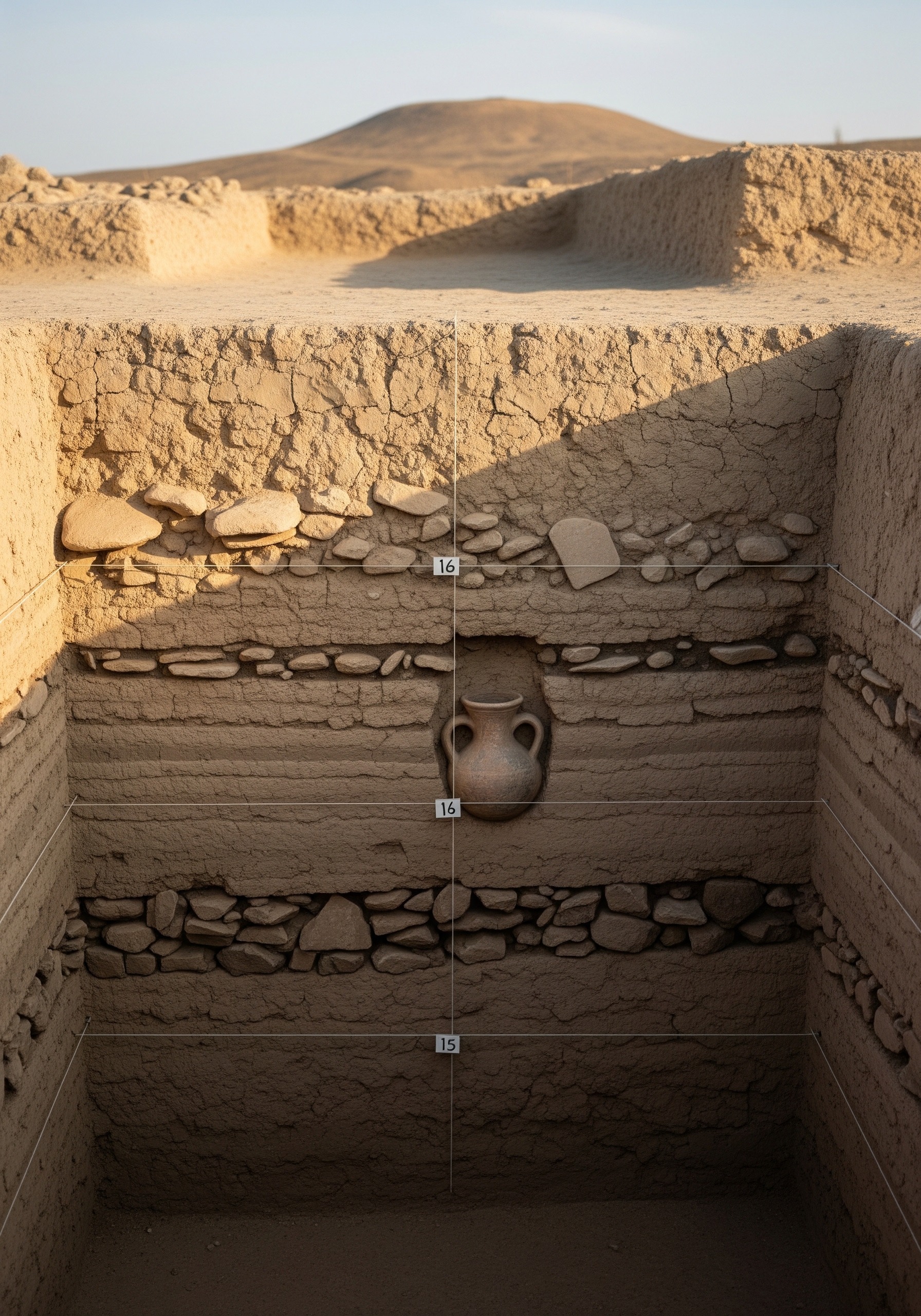
The British Geological Survey now formally maps an urban stratum called “made ground” — anthropogenic deposits laid down by human activity. Under modern London this layer is typically 3–7 metres thick; in places along the Thames it exceeds 10. Rome averages roughly 9 metres of made ground; Istanbul, Athens, Aleppo, Cairo and Damascus all carry several metres of their own past beneath their pavements.
{IMAGE_2}
The arithmetic is brutal once you do it out. A modest ancient town generates, conservatively, a few millimetres of new urban deposit per year through ordinary life — broken pottery trodden into mud floors, swept ash from hearths, demolished walls of failed houses, animal bones thrown into yards, the constant grinding production of micro-debris that any settlement creates. A few millimetres a year is one metre per three or four centuries. Ur was occupied for nearly three thousand years. Rome has been continuously inhabited for nearly twenty-eight. The numbers add up the way compound interest adds up: slowly, then suddenly.
And crucially, this only happens to cities. A single farmhouse in open country does not accumulate metres of “made ground”, because there are no neighbours building on top of it. Urban burial is a population-density phenomenon.
Two Modes of Burial: A Catastrophic Day vs. a Quiet Century
Almost every famous “buried city” belongs to one of two patterns, and they preserve the past in radically different ways.
The catastrophic mode is what most people picture: Pompeii on 24 August (or, by modern scholarship, 24 October) of 79 CE, sealed under 4–6 metres of pumice and ash within roughly 18 hours. The result is a freeze-frame — loaves of bread still in the oven, a dog still chained to a doorway, election graffiti still legible. Catastrophic burial is rare in absolute terms, but it disproportionately feeds our imagination and our museums.
The gradual mode is what actually buried most ancient cities. Imagine instead a slow, century-by-century rise of about three millimetres a year — barely visible inside a human lifetime. Doors get raised, then doorways get walled up entirely and re-cut higher in the next building campaign. Streets are repaved a hand’s-breadth above the old surface, then again, and again. A Roman senator who fell asleep in 50 CE and woke five centuries later would not recognise the city not because it had moved, but because the city had climbed past it.
The Tell: A Hill Built Entirely of People
In tells archaeology, the artificial mounds of the Near East are not metaphors for layered history — they are layered history, in literal soil. The word tell (Arabic tall; Hebrew tel; Turkish höyük) means simply “hill” or “mound”, but to an archaeologist it is shorthand for a settlement so long-lived that the buildings of one generation became the foundation of the next.
The Neolithic town of Çatalhöyük in central Anatolia is the canonical example. Occupied from roughly 7400 to 6200 BCE — 1,400 years of unbroken habitation — its East Mound contains 18 stratigraphic layers of mud-brick houses, packed wall-to-wall with no streets between them, and entered through hatches in their flat roofs. Each generation typically demolished the upper walls of the previous house, filled the floor with clean earth, and built a new house directly above. The mound now rises about 21 metres (70 feet) above the surrounding plain, a hill made entirely of demolished homes.
The same logic produced the great tells of Mesopotamia and the Levant: Jericho (Tell es-Sultan) with deposits more than 10 metres deep and the world’s oldest known town wall at its base; Tell Brak and Tell Hamoukar in northern Syria; Tepe Sialk in Iran; Hisarlik in Türkiye, where Heinrich Schliemann cut his notorious 17-metre-deep trench through nine successive cities and decided that one of them must be Homer’s Troy.
How Deep Are Buried Cities? A Comparison
The depth of burial varies enormously, and the headline numbers depend on whether you measure to the earliest occupation or to a particular layer of interest. The picture roughly looks like this:
| Site | Approx. depth of earliest layer | Years occupied | Dominant burial mechanism |
|---|---|---|---|
| Ancient Rome (Forum) | ~7–11 m below modern street | ~2,800 years (and counting) | Demolition rubble + Tiber silt |
| Troy / Hisarlik (Türkiye) | ~16–17 m to bedrock (Troy I) | ~3,500 years (c. 3000 BCE – 500 CE) | Mud-brick decay, rebuilding |
| Çatalhöyük (Türkiye) | ~21 m tell above plain | ~1,400 years (7400–6200 BCE) | Stacked mud-brick houses |
| Pompeii (Italy) | ~4–6 m of volcanic deposit | Sealed in 79 CE (catastrophe) | Vesuvius pumice & ash |
| Jericho (Tell es-Sultan) | ~10+ m of stratified tell | ~10,000 years (intermittent) | Mud-brick recycling |
| London (City) | ~3–7 m of “made ground” | ~2,000 years (Roman to now) | Rebuilding + Thames silt |
Why Ruins Are Underground but Old Temples Aren’t
There is a quiet selection bias buried inside the question itself. Plenty of ancient structures are not underground at all: the Parthenon in Athens stands on its hill in plain sight, the Pyramids of Giza tower above the desert, Greek temples at Paestum and Agrigento still hold the skyline, the Great Wall climbs the ridges of northern China. None of those needed excavating.
The pattern is consistent. Surface structures that survived are the ones tough enough, prominent enough or sacred enough to escape the three things that bury everything else. They were built of solid masonry rather than mud-brick, so they did not melt into a hill. They sat on isolated hilltops or platforms, beyond the reach of urban rubble. And they were preserved by reverence or reuse — converted into churches, mosques, fortresses, quarries that were guarded against demolition.
What ended up underground was the ordinary city: the apartment blocks, the bakeries, the workshops, the warehouses, the public latrines. Why ruins are underground is, in a sense, the wrong question. The right question is: which ancient buildings were lucky enough to not get buried — and the answer is, only the ones tall, sacred or stubborn enough to be worth defending against time.
Reading the Layers: How Archaeologists Untangle Time
Once you understand how cities accumulate, the whole machinery of modern archaeology comes into focus. The core method — stratigraphy — was borrowed directly from 19th-century geology and rests on a single principle: in an undisturbed sequence of deposits, the lower layers are older than the upper ones. Each floor surface, each ash lens from a hearth, each rubbish pit, each backfilled foundation trench is a unit. Archaeologists call these units “contexts”, number them, draw them in section, and link them in a sequence diagram known as a Harris Matrix.
That sequence becomes a relative clock. Absolute dates are then anchored to it by radiocarbon dating of organic material, dendrochronology of preserved timbers, optically stimulated luminescence (OSL) of buried sediments, and the stylistic typology of finds — pottery, coins, lamps — each style of which had its own historical fashion window. The combination is powerful enough to date a single mud-brick wall to within decades, two thousand years after it was knocked down. Modern fieldwork is increasingly assisted by non-invasive methods such as ground-penetrating radar (GPR), magnetometry and LiDAR, which can map entire buried cityscapes — like the lost Maya settlements revealed under the Guatemalan jungle in 2018 — without lifting a single trowel.
The Cities Still Climbing Today
Urban burial is not a process that politely stopped at the Renaissance. It is happening right now. Geologists working on the Anthropocene have started cataloguing the modern “made ground” of contemporary cities — concrete slabs, asphalt courses, brick rubble, plastic waste — and the layer is already metres thick in fast-growing megacities such as Lagos, Jakarta and Dhaka. Some of it sits on top of, and structurally requires, the demolished neighbourhoods underneath it.
If anything, modern cities bury themselves faster than ancient ones did, because the materials we discard are more voluminous and we redevelop faster. In a thousand years some patient future archaeologist will dig down through a layer of crumbled reinforced concrete, polythene and lithium-ion battery casings, and recognise the same pattern: a city that climbed, century by quiet century, until it stood high above the bones of the one before it.
Frequently Asked Questions
Q: How did ancient cities get buried so deep when nobody dumped dirt on them?
A: They were buried by their own debris. Demolition rubble from collapsed buildings, decayed mud-brick, river silt from flooding, wind-blown dust, rotted wood and decomposing vegetation accumulated under each successive generation of construction. In continuously occupied cities like Rome, this amounted to roughly one metre every three to four centuries — slow enough to be invisible in a lifetime, decisive over millennia.
Q: How did ancient Rome get buried specifically?
A: Rome lost roughly nine metres of “ground” over fifteen centuries due to three combined causes: the collapse and ruin of brick-and-concrete buildings after the fall of the Western Empire in 476 CE; medieval and Renaissance Romans building straight on top of that rubble; and the Tiber River flooding the lower city repeatedly, leaving fine silt behind each time. Marble was stripped to build new churches; brick and broken concrete were left in place and paved over.
Q: How did Pompeii get buried so quickly?
A: Pompeii was the rare exception — buried catastrophically rather than gradually. The eruption of Mount Vesuvius in 79 CE deposited 4–6 metres of pumice, ash and pyroclastic surge over roughly 18 hours, sealing the city before its inhabitants or their possessions could be removed. That single bad day is the reason Pompeii is the best-preserved Roman city in the world.
Q: What is a “tell” in archaeology?
A: A tell (Arabic tall, Hebrew tel, Turkish höyük) is an artificial mound built up by thousands of years of human occupation in one place — typically Mesopotamia, the Levant or Anatolia. Each generation demolished the upper walls of its predecessors’ mud-brick houses, levelled the rubble, and built directly on top. Famous examples include Jericho, Çatalhöyük, Troy (Hisarlik) and Megiddo.
Ancient cities did not sink. They were climbed over — by the unswept dust, the broken pots, the demolished walls, the silt of every spring flood and, most decisively, by the next generation of people, who had homes to build and no time to clear the rubble of strangers. The Forum lies low because Rome lies high. Walk any old city in the world and you are already walking on the roof of one that came before. The strange thing is not that we have to dig to find the past. The strange thing is that we ever expected to find it at street level.
Illustrations are AI-generated. Article fact-checked and human-edited.