How Did Ancient Egypt Start? Origins of a Lost World
How did ancient Egypt start? Not with pyramids, pharaohs, or gold — it started with a drying sky. Around 5500 BCE, as the once-green Sahara cracked into desert, herders and hunters across North Africa were squeezed onto the only ribbon of green left: a 1,000-kilometre strip of black mud beside a river that flooded on schedule every summer. Two thousand years later, a king with a fish-and-chisel name carved on a slate palette welded those villages into a single kingdom. That kingdom would last longer than the United States, China’s Han dynasty, or the Roman Empire — combined.
Key Facts
- The first farmers settled the Faiyum and the western Delta around 5500–4750 BCE, growing emmer wheat and barley brought in from the Levant.
- “Egypt” was two countries first: Upper Egypt (the southern Nile valley) and Lower Egypt (the Delta) had distinct pottery, gods, crowns, and burial styles for over a thousand years.
- The Naqada culture (c. 4000–3100 BCE) in Upper Egypt drove unification, evolving in three phases (Naqada I, II, III) that gradually absorbed the Delta.
- Egypt was unified around 3100 BCE by King Narmer, known to later tradition as Menes — the same person, modern consensus holds.
- A 2013 Oxford radiocarbon study (Dee et al., Proceedings of the Royal Society A) placed the unification at 3111–3045 BCE — the tightest scientific date we have.
In short: Ancient Egypt started when climate change forced North African pastoralists onto the Nile around 5500 BCE; over the next 2,400 years their farming villages grew into two rival kingdoms — Upper and Lower Egypt — which were finally fused into one state by King Narmer around 3100 BCE, founding the world’s first true nation-state.
Key Facts
- The first farmers settled the Faiyum and the western Delta around 5500–4750 BCE, growing emmer wheat and barley brought in from the Levant.
- ‘Egypt’ was two countries first: Upper Egypt (the southern Nile valley) and Lower Egypt (the Delta) had distinct pottery, gods, crowns, and burial styles for over a thousand years.
- The Naqada culture (c. 4000–3100 BCE) in Upper Egypt drove unification, evolving through three phases (Naqada I, II, III).
- Egypt was unified around 3100 BCE by King Narmer, identified with the figure later tradition called Menes.
- A 2013 Oxford radiocarbon study (Dee et al., Proceedings of the Royal Society A) placed the unification at 3111–3045 BCE.
In short: Ancient Egypt began when the drying of the Green Sahara around 5500 BCE pushed North African herders onto the Nile. Over roughly 2,400 years their farming villages grew into two rival kingdoms, Upper and Lower Egypt, which King Narmer finally fused into one state around 3100 BCE.
Egypt Before Egypt: The Green Sahara That Pushed a Civilization to the River
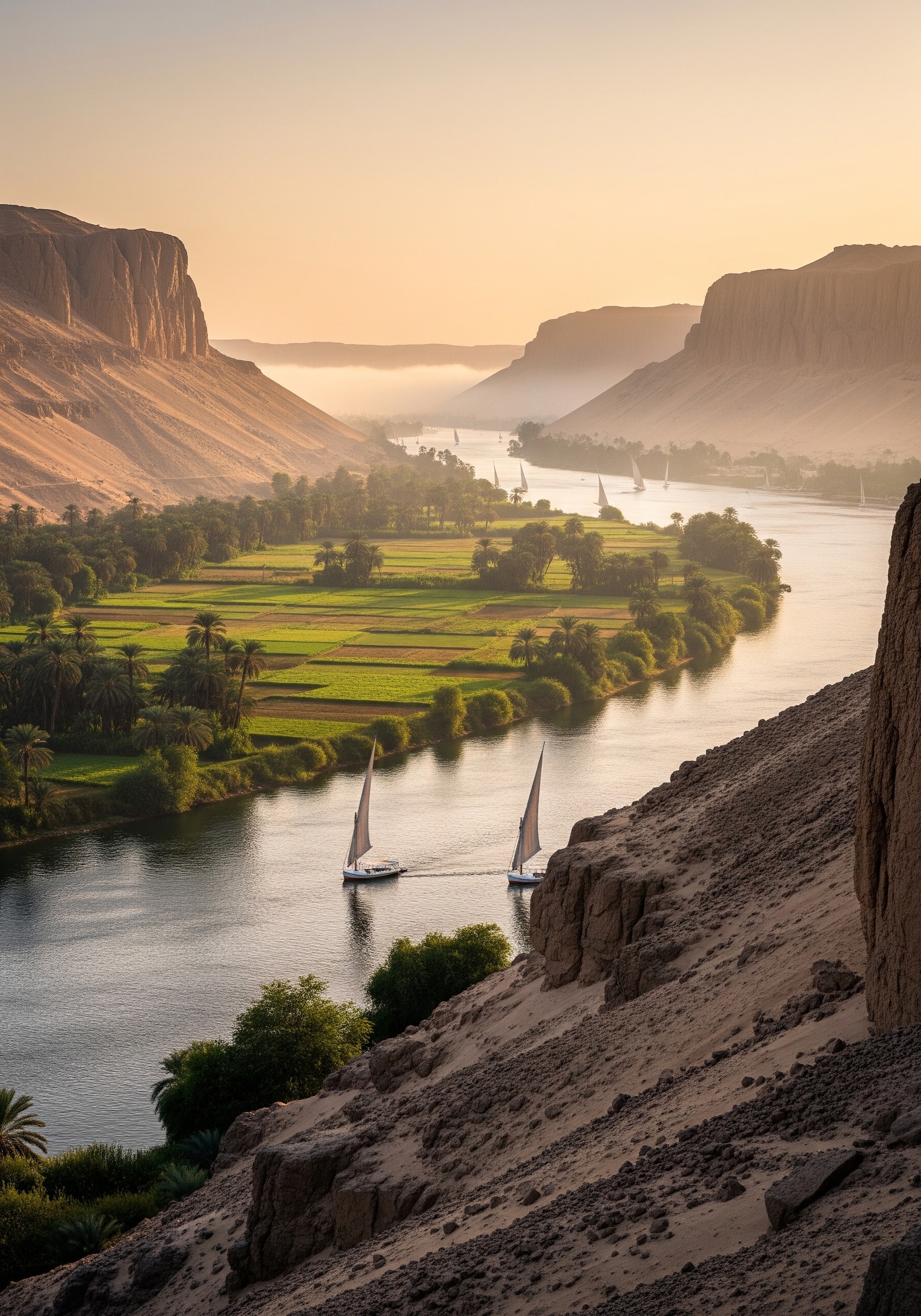
To answer how ancient Egypt started, you have to start somewhere unexpected: in the rain. Between roughly 9000 and 5500 BCE, during a climate phase scientists call the African Humid Period, the Sahara was not a desert. Lake beds glittered where today there is only sand. Giraffes, hippos, and cattle grazed across what is now Libya and the western Egyptian desert; rock art at Wadi Sura and Gilf Kebir still shows them — herds and human swimmers in places where no swimmer has lived for seven thousand years.
Then the monsoon belt slipped south. Lakes dried. Pasture turned to dune. The people who had ranged freely across green plains were funnelled, generation by generation, toward a single permanent water source: the Nile. By 5500 BCE the river valley — barely 15 kilometres wide in most places — was the only place left to live in a region the size of Western Europe. Egyptian civilization is, in this sense, a refugee story. The desert evicted a continent of herders, and the river took them in.
The Nile rewarded its tenants with the most reliable agriculture on Earth. Every July its waters, swollen by Ethiopian summer rains, rose over the floodplain, deposited a layer of nutrient-rich silt, and retreated by October — leaving the farmer a black, pre-fertilised seedbed to plant in. Mesopotamian farmers had to build canals to fight their rivers. Egyptian farmers just walked behind the receding water and scattered seed.
How Did Ancient Egypt Start in the Faiyum? The First Farmers, c. 5500 BCE
The earliest unmistakable agricultural community in Egypt sits on the shore of an ancient lake in the Faiyum oasis, about 100 kilometres southwest of modern Cairo. Excavations there have turned up emmer wheat and six-row barley grains dating to roughly 5500–5200 BCE, stored in basket-lined pits. These were not native African crops — they originated in the Levant. Egypt’s first farmers either learned the technique from migrants or were migrants themselves.
A few centuries later, at Merimde Beni Salama on the western edge of the Delta (c. 4750 BCE), we get something even more revealing: actual houses. Oval mud-and-reed huts arranged in rows, with hearths, granaries, and burials placed deliberately under the floors so the dead stayed close to the living. The Merimde villagers grew wheat, raised cattle, sheep, and pigs, and fished the Delta marshes. They were, by any reasonable definition, Egyptians — about 1,500 years before there was an “Egypt.”
{IMAGE_2}
The Two Lands: Why Upper and Lower Egypt Were Different Worlds
One of the most under-told facts about ancient Egypt’s beginning is that, for nearly two millennia, there was no “Egypt” at all — there were two of them. Upper Egypt was the long, narrow Nile valley running south from roughly modern Cairo to the first cataract at Aswan. Lower Egypt was the fan-shaped Delta where the river met the Mediterranean. Geographically, culturally, even religiously, they were as distinct as Scotland and Sicily.
By the time of Naqada II (c. 3500 BCE), the differences had crystallised. Below is what the two lands looked like in the centuries before unification:
| Feature | Upper Egypt (the Valley) | Lower Egypt (the Delta) |
|---|---|---|
| Royal crown | White conical crown (hedjet) | Red basket-shaped crown (deshret) |
| Patron deity | Nekhbet (vulture goddess) | Wadjet (cobra goddess) |
| Major centres | Hierakonpolis, Naqada, Abydos, Thinis | Buto, Sais, Merimde, Maadi |
| Burial style | Elaborate pit graves with painted pottery, ivory figurines | Simpler graves, fewer grave goods, more practical |
| Economy | Caravan trade with Nubia (gold, ivory, ebony) | Sea trade with the Levant (cedar, oils, copper) |
The pharaohs of historic Egypt never forgot this. For three thousand years, every king’s official titles included “Lord of the Two Lands,” and every coronation symbolically re-enacted the unification by stacking the red crown over the white one to form the iconic double crown, the pschent.
Naqada I, II, III: The Three Generations That Built a Civilization
Modern archaeology divides the Predynastic Period into three phases, named after the site of Naqada in Upper Egypt where each was first identified. The labels look bureaucratic, but they describe one of the most consequential transformations in human history: scattered farming villages turning into a centralised state.
Naqada I (c. 4000–3500 BCE) is the village world. Settlements are small, perhaps a few hundred people each. Pottery is hand-shaped, decorated with white crosshatched patterns. Burials show modest social stratification — some graves a little richer than others, but no kings yet.
Naqada II (c. 3500–3200 BCE) is when the wheel turns. Towns grow into cities. At Hierakonpolis — the “Falcon City” — archaeologists have found Egypt’s oldest known temple, a brewery capable of producing 300 gallons of beer at a time, and Tomb 100, the only painted tomb anywhere in Predynastic Egypt, decorated with scenes of boats and battle that prefigure pharaonic iconography by half a millennium. Long-distance trade explodes: lapis lazuli from Afghanistan, obsidian from Ethiopia, cedar from Lebanon.
Naqada III (c. 3200–3000 BCE), sometimes called Dynasty 0, is the dawn of the kings. Local chiefs at Abydos and Hierakonpolis style themselves with hawk symbols, build mud-brick mortuary enclosures, and begin scratching their names — Iry-Hor, Ka, Scorpion, Narmer — onto stone and clay. These are not yet pharaohs of a unified Egypt, but they are kings of something. The state is coming into focus.
How Ancient Egypt Started — A Calibrated Timeline
- c. 9000–5500 BCE — African Humid Period; the Sahara is green grassland.
- c. 5500–5200 BCE — First farmers settle the Faiyum; emmer wheat and barley arrive from the Levant.
- c. 4750 BCE — Merimde Beni Salama: organised village with houses, granaries, livestock.
- c. 4400–4000 BCE — Badarian culture in Upper Egypt; first copper tools, painted pottery.
- c. 4000–3500 BCE — Naqada I: villages, modest hierarchies, hand-made pottery.
- c. 3500–3200 BCE — Naqada II: cities, temples, long-distance trade, Tomb 100 at Hierakonpolis.
- c. 3320 BCE — Tomb U-J at Abydos: some of the world’s earliest writing.
- c. 3200–3050 BCE — Naqada III / “Dynasty 0”: named proto-kings (Scorpion, Ka, Iry-Hor).
- c. 3111–3045 BCE — Unification under Narmer/Menes (Oxford radiocarbon model, Dee et al., 2013).
- c. 3100 BCE onward — First Dynasty: dynastic Egypt begins; royal tombs at Abydos, capital at Memphis.
Writing Begins in a Royal Tomb at Abydos
Most popular histories skip over the moment Egyptian writing was born, but it is one of the most important answers to the question of how ancient Egypt started. In 1988, German archaeologist Günter Dreyer began excavating a tomb at Abydos catalogued as U-J, dated to roughly 3320 BCE — a century or more before Narmer. Inside, he found nearly 200 small bone and ivory tags pierced for stringing onto bags of goods, each tag carved with one or two pictographic signs: an elephant on a hill, a falcon on a perch, numbers.
These tags appear to record where things came from — proto-place names, written down. They are, by current consensus, the oldest writing in Egypt and among the oldest in the world, contemporary with the earliest cuneiform tablets of Mesopotamia. The implication is profound: even before Egypt was politically unified, an Upper Egyptian king at Abydos commanded a kingdom large enough and complex enough to need bureaucratic record-keeping. Writing did not appear after the state; writing helped build the state.
Narmer, the Palette, and the Unification of Egypt c. 3100 BCE
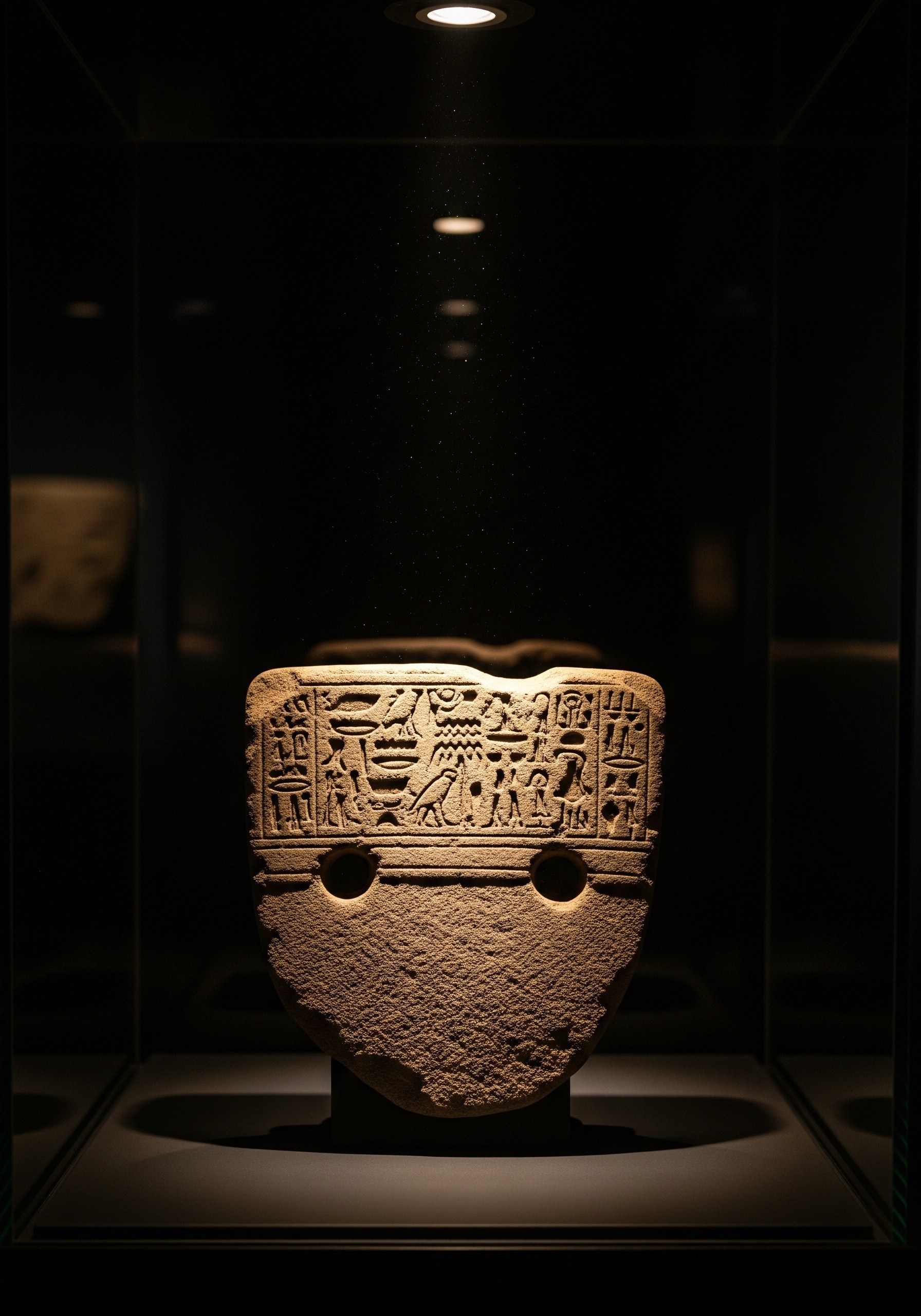
The single most famous artefact in the origin story of ancient Egypt is the Narmer Palette — a 64-centimetre slab of dark green siltstone, carved on both sides, discovered in 1898 by British archaeologists at Hierakonpolis and now in the Egyptian Museum in Cairo. It is, in effect, Egypt’s founding document.
The front shows King Narmer wearing the tall white crown of Upper Egypt, gripping a kneeling enemy by the hair and raising a mace to strike. Below him, two more fallen foes lie defeated. The reverse shows the same king — now wearing the red crown of Lower Egypt — striding in procession past rows of decapitated bodies. Two long-necked feline beasts have their necks intertwined at the centre, an image many scholars read as a symbol of the Two Lands being literally bound together.
Read carefully, the palette announces three things at once: Narmer has conquered Lower Egypt; he is therefore entitled to wear both crowns; and he is the first man in history to do so. Whether the conquest happened exactly as depicted or whether the palette is a piece of carefully constructed propaganda is still debated — but the result is not. From this moment, written sources, royal tombs, and a continuous list of kings appear. Pre-history ends. History begins.
Greek and Roman historians called this founding king “Menes.” The Egyptians wrote of him as Narmer. The modern scholarly consensus, supported by archaeology at Abydos, is that Menes and Narmer are two names for the same person.
Why the Unification Lasted: Geography, Religion, and the Pharaoh’s Genius
Mesopotamia, Egypt’s contemporary, invented cities, writing, and the wheel — but its city-states (Ur, Uruk, Lagash, Kish) never permanently merged. They fought, conquered, and broke apart again for two thousand years. Egypt, by contrast, was unified once and stayed unified for almost three millennia. Why?
The first answer is geography. Egypt is essentially one long valley, walled on both sides by deserts that travellers could not cross without state-organised support. There was nowhere to secede to. The second is the Nile itself: a single, predictable river meant a single, predictable calendar, which meant a single, predictable tax system. The third was theological genius. The pharaoh was not just a king. He was Horus on earth, the human incarnation of the falcon god whose two eyes were the sun and the moon. Rebelling against him was not politics; it was cosmic disorder. The British Museum’s timeline makes the durability of this system unmistakable: every kingdom that followed — Old, Middle, New — was a re-assertion of the same idea.
How We Know All This: Radiocarbon, Tombs, and the Modern Toolkit
For most of the twentieth century, Egyptian chronology rested on a 3rd-century-BCE list compiled by a priest named Manetho, plus a handful of astronomical references in pharaonic texts. The list was useful but imprecise. The breakthrough came in 2013, when Michael Dee and colleagues at the University of Oxford applied Bayesian statistical modelling to over 100 radiocarbon dates from short-lived plant material in well-dated archaeological contexts. Published in Proceedings of the Royal Society A, their model placed the start of Egypt’s First Dynasty between 3111 and 3045 BCE — about a century later than older estimates, and far tighter than anything before.
Combined with continuing excavations at Hierakonpolis, Abydos, and the Delta, that work has transformed our picture. The painted tomb walls, the brewery vats, the ivory tags from Tomb U-J — every season pushes the answer to “how did ancient Egypt start?” further back and into sharper focus. There is still much we do not know. We do not know what language the earliest farmers spoke. We do not know what most Predynastic women’s lives looked like. We do not know whether Narmer’s conquest was a single campaign or the climax of generations of warfare. The story is unfinished — but it is, increasingly, real.
Frequently Asked Questions
Q: When exactly did ancient Egypt start?
A: It depends what you mean by “Egypt.” The earliest farming settlements appear around 5500 BCE in the Faiyum oasis. The unified Egyptian state — the moment most historians call the beginning of “ancient Egypt” proper — began with King Narmer’s unification, dated by the 2013 Oxford radiocarbon study to between 3111 and 3045 BCE, conventionally rounded to 3100 BCE.
Q: Who founded ancient Egypt?
A: The unified kingdom was founded by King Narmer, who conquered Lower Egypt from his base in Upper Egypt around 3100 BCE. Later Egyptian tradition called him Menes; modern scholarship considers Narmer and Menes the same person. He founded the First Dynasty and probably established the early capital at Memphis, near the junction of the Nile valley and the Delta.
Q: Why did civilization develop along the Nile?
A: Because climate change made it the only option. As the African Humid Period ended around 5500 BCE, the Sahara turned from grassland into desert, pushing herders and hunters onto the Nile, which still offered water, predictable annual flooding, and rich silt for farming. The Nile flood was so reliable that Egyptian farming required almost no irrigation engineering — a huge head start.
Q: Were the ancient Egyptians one people from the beginning?
A: No — and this is one of the most overlooked facts about Egypt’s origins. For nearly two millennia before unification, Upper Egypt (the southern Nile valley) and Lower Egypt (the Delta) had different cultures, gods, crowns, pottery styles, and trading partners. Even after Narmer unified them around 3100 BCE, every pharaoh for the next 3,000 years held the title “Lord of the Two Lands” — a constant reminder that Egypt had been welded together, not born whole.
Five and a half thousand years ago, a slowly drying climate pushed scattered villages onto the most reliable river on Earth. Two thousand years after that, a king with a fish-and-chisel name carved their unity into stone. Out of that pressure — geological, agricultural, political, theological — emerged the civilization that would build the pyramids, write the Book of the Dead, and outlast every empire that came for it. How did ancient Egypt start? With a desert closing in, and a river that refused to fail.
Illustrations are AI-generated. Article fact-checked and human-edited.