How Did Ancient People Make Ice in the Desert?
How did ancient people make ice in places where summer afternoons routinely hit 40 °C? They did not freeze it with machines. They harvested cold the way a sailor harvests wind — patiently, geometrically, from the sky itself. From Persian deserts to the rooftops of the Nile and the shallow clay trays of Bengal, ancient engineers turned three quiet physical effects (radiative cooling, evaporation, and insulation) into industrial-scale refrigeration two thousand years before the first electric freezer hummed to life.
Key Facts
- By roughly 400 BCE, Persian engineers were operating purpose-built ice factories called yakhchāls; surviving examples still stand at Yazd, Kerman, Meybod, Abarkuh, and Sirjan in modern Iran.
- A classic yakhchāl dome rose 10–15 m tall, with walls at least 2 m thick at the base, sheltering underground storage chambers that could reach 5,000 m³ in volume.
- The Indian “Hooghly” method froze water in shallow porous clay pans set on straw, exploiting the night sky — whose effective radiative temperature can sit 5–16 °C below the surrounding air on a clear, dry, calm night.
- The water-resistant Persian mortar sarooj was a recipe of sand, clay, lime, ash, goat hair, and egg whites — an early composite material so durable that some yakhchāls have stood for over 1,500 years.
- On 10 February 1806, Boston merchant Frederic Tudor sailed the brig Favorite from Charlestown to Martinique with a cargo of New England pond ice — launching a global trade that would one day reach Calcutta, Bombay, Havana, and Hong Kong.
In short: Ancient people made ice without electricity by combining three tricks of physics — sky-facing radiative cooling on clear nights, evaporative loss through porous clay, and massive thermal insulation in shaded underground stores. The Persian yakhchāl is the most famous example, but Indians, Egyptians, Greeks, and Romans each engineered their own version of the same idea.
Key Facts
- By roughly 400 BCE, Persian engineers were operating purpose-built ice factories called yakhchāls; surviving examples still stand at Yazd, Kerman, Meybod, Abarkuh, and Sirjan.
- A classic yakhchāl dome rose 10–15 metres tall, with walls at least 2 metres thick at the base, sheltering underground storage chambers that could reach 5,000 cubic metres in volume.
- The Indian ‘Hooghly’ method froze water in shallow porous clay pans on straw, exploiting the night sky, whose effective radiative temperature can sit 5–16 °C below the surrounding air on a clear, dry, calm night.
- The Persian mortar sarooj combined sand, clay, lime, ash, goat hair and egg whites — a composite so durable that some yakhchāls have stood for over 1,500 years.
- On 10 February 1806, Boston merchant Frederic Tudor sailed the brig Favorite from Charlestown to Martinique with a cargo of New England pond ice, launching a global ice trade.
In short: Ancient people made ice without electricity by combining three tricks of physics: sky-facing radiative cooling on clear nights, evaporative loss through porous clay, and massive thermal insulation in shaded underground stores. The Persian yakhchāl is the most famous example, but India, Egypt, Greece and Rome each built versions.
The Lost Physics: How Cold Comes from a Cloudless Sky

To understand how did ancient people make ice in the desert, you first have to forget the modern mental image of a freezer. There is no compressor anywhere in this story. Instead there is a simple, beautiful fact: a clear night sky is, optically, a window into outer space, and outer space is roughly −270 °C. Any object pointed at it on a cloudless, dry, calm night radiates infrared heat upward and loses warmth faster than the surrounding air can replace it. Meteorologists call the resulting drop the night-sky depression; on the right night, the temperature of an exposed surface can fall 5 to 16 °C below the air temperature around it.
Add a second effect — evaporative cooling through porous clay — and the surface gets colder still. Each gram of water that evaporates carries away roughly 2,260 joules of latent heat. Stack these losses together in the right vessel, on the right night, and water that started the evening at 5 °C can reach 0 °C before sunrise. Ancient engineers did not write equations for any of this, but they read the sky as expertly as any modern thermodynamicist.
How Did Ancient People Make Ice in the Desert? The Persian Yakhchāl
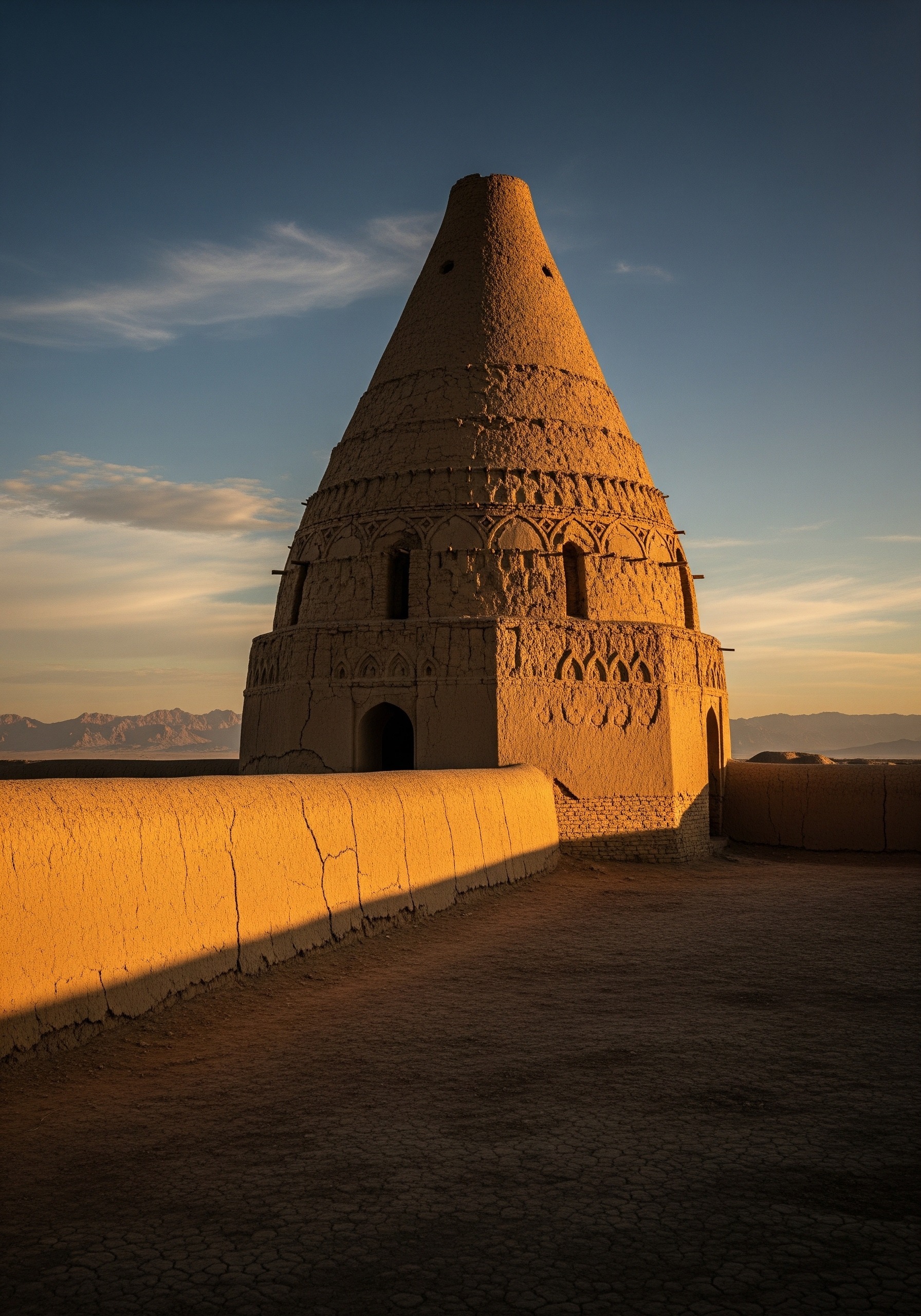
The grandest answer is also the oldest one we can still walk through. By around 400 BCE, on the high plateau of the Iranian central desert, Persian engineers were building yakhchāls — literally “ice pits.” From outside, a yakhchāl looks like a giant earthen beehive: a conical mud-brick dome, often 10 to 15 m tall, rising abruptly from flat ground. From inside, it is a different building entirely. Most of the structure lies underground, hollowed out as a cool, dry cellar large enough to swallow a small house.
The dome is the engine. Its conical shape is not decorative; it works as a solar chimney. Sunlight heats the upper air during the day, which rises and escapes through a small aperture at the apex. Cooler air is drawn up from the floor of the pit to replace it, creating a slow, steady internal draft that keeps the storage cellar shaded, dim, and chilled. A long east-running shade wall, sometimes reaching 10 m in height, casts the freezing pools on the north side into permanent shadow.
{IMAGE_2}
The water itself came in through qanāts — underground aqueducts that ran for kilometers beneath the desert, fed by mountain snowmelt and pre-chilled by their long subterranean journey. On winter nights, when the high desert easily dropped below freezing, this water was let into shallow trenches behind the shade wall. There it froze in thin slabs, was broken up at dawn, and was carried in baskets down into the dome’s pit, where it was stacked layer by layer, each layer separated by straw, mud, or branches so the blocks would not refreeze into one immovable mass. In the height of summer, with outside temperatures north of 40 °C, the bottom of a working yakhchāl could still be near 0 °C.
The Sarooj Secret: An Engineering Marvel in Mud
What kept it all together was a mortar called sārooj. Its recipe sounds more like a Persian cookbook than a building specification: roughly equal parts sand and clay, mixed with lime, wood ash, goat hair, and egg whites, then beaten and aged. The lime and ash produced a slow-curing pozzolanic binder; the egg whites improved water resistance; the goat hair acted as the fibrous reinforcement that modern engineers achieve with polypropylene. The walls it produced are extraordinarily good thermal insulators — thick, dense, dry, and impermeable to ground water.
That detail matters because ancient ice storage was a war against three enemies at once: warm air, warm ground, and humidity. Sarooj defeated all three. It is why yakhchāls built in the early Sasanian and Islamic periods are still standing in the open desert today, complete with their domes, after centuries of weathering. There is no Roman amphitheatre, no Egyptian temple, no medieval cathedral that has been engineered for a more brutal job: keeping ice solid through an Iranian summer.
The Hooghly Method: Bengali Ice Without a Single Freezer
Persia gets the headlines, but the most counter-intuitive ancient ice-making method appeared on the warm, humid plains of northern India — a place that, geographically, should be the worst possible candidate for a frozen-water industry. Yet by the early modern period, and almost certainly with roots reaching back to antiquity, villagers in the lower Ganges and Hooghly River basins were producing ice on demand using little more than clay, straw, and a clear night.
The process was disarmingly simple. At dusk, on cold dry winter nights, workers laid out long shallow trenches lined with straw and placed unglazed porous earthenware pans in them. Each pan was filled with a thin layer of pre-boiled water (boiling reduced dissolved gases and helped freezing). The straw insulated the pans from the relatively warmer ground; the porous clay sweated water out slowly, evaporating; the pans, lying face-up to a clear sky, radiated heat into space. Before sunrise, attendants rushed along the rows with wooden paddles, snapping the thin sheets of ice off the surface of each pan before the rising sun could undo the night’s work.
The British East India Company merchants who bought this ice in Calcutta in the 19th century called it “Hooghly ice,” after the river that ran past the city. They considered it a miracle of native engineering — until Frederic Tudor’s New England ice eventually undercut it on price.
Greek and Roman Ice Pits: Snow Hauled Down the Mountain
Around the Mediterranean, ancient ice making was less about freezing water and more about saving it. The Greeks and Romans understood, well before they could explain, that snow stored in deep enough holes and insulated heavily enough would last most of the summer. As early as the 5th century BCE, Athenians were drinking chionia — snow flavored with honey, fruit syrups, and wine — for which the snow was carried down from Mount Parnassus and stored in straw-lined pits.
The Romans industrialized the idea. Wealthy households kept snow pits on their estates; the city of Rome had a snow-and-ice market near the Forum, supplied by mule trains from the Apennines and Alps. Pliny the Elder wrote in the 1st century CE about boiling water before freezing it (because, he claimed, it froze faster and stayed cleaner), and the emperor Nero is said to have hosted lavish summer banquets at which iced wine was a centerpiece. None of this was “made” ice in the Persian sense; it was harvested winter held captive into the heat.
Egyptian Rooftops and the Earliest Frozen Water
The oldest credible record of human-made ice appears in dynastic Egypt. Long before the Persian yakhchāl, Egyptian peasants and townspeople were placing shallow earthenware bowls of water on flat rooftops during the dry desert nights of late winter. With clear skies, low humidity, and almost no wind shelter, the rooftops radiated heat away from the bowls so effectively that, by dawn, a thin skin of ice could appear on the surface — even with the air temperature still several degrees above freezing.
The same principle, scaled up, would later be perfected on the Bengal plains. What the Egyptians lacked was the engineering apparatus to store it; what the Persians and Indians later added was the realization that, with the right architecture, you could not only make ice but keep it through July.
The Chinese Snow Trade and the Saltwater Trick
Ancient Chinese sources, including the Shijing (Book of Songs, compiled roughly 1000–600 BCE), reference imperial winter ice harvests stored in underground cellars called ling yin. Court officials oversaw the cutting of ice from frozen rivers in January and February, the lining of pits with straw, and the rationing of stored ice through the summer for use in the imperial kitchens and for cooling silk garments worn at banquets.
Later Chinese alchemists also explored a chemical trick that medieval Arab scholars would refine: adding salt or saltpeter to water dramatically lowers its freezing point, so a container of saltwater could be used as a freezing bath to chill a smaller container of pure water or wine inside it down past 0 °C. This was the seed of what would, centuries later, become the hand-cranked ice cream churn.
From Saved Snow to the Boston Ice King
The bridge between ancient methods and modern refrigeration is a young Bostonian named Frederic Tudor. On 10 February 1806, at age 23, Tudor loaded a cargo of New England pond ice onto the brig Favorite and sent it 1,500 miles south to the Caribbean island of Martinique. The Boston Gazette mocked the venture as a “slippery speculation”; much of the ice did, in fact, melt during the three-week voyage, and Tudor lost a small fortune. He spent parts of 1812 and 1813 in debtor’s prison.
But the model worked. Within thirty years, Tudor’s ships were carrying New England ice to Havana, Charleston, New Orleans, Calcutta, Madras, Bombay, and even Hong Kong, insulating it with the same humble straw and sawdust the ancients had used. By the mid-19th century, ice was, by tonnage, second only to cotton among American exports. Tudor died in 1864 with a fortune that would today equal more than 200 million U.S. dollars — built, in essence, on the same physical insight that had powered the Persian yakhchāl two millennia earlier.
Why Ancient Ice-Making Still Matters
The world is rediscovering these techniques. The yakhchāl is now studied by passive-cooling architects as a model for buildings that need almost no electricity to stay habitable in extreme heat. Researchers at universities in the United States, Iran, and Australia are publishing on “radiative sky cooling” — the exact same effect Egyptian and Bengali ice makers used — as a way to refrigerate buildings without any energy input at all. Engineers at Stanford have built rooftop panels that, on clear nights, drop below ambient temperature using only the night sky.
This is the genuinely useful lesson of the yakhchāl, the Hooghly pan, and the Egyptian rooftop pot: long before electricity, our ancestors built whole industries on three free physical effects. The next century, in a world worried about cooling demand and grid loads, may well bring them back. To learn more about parallel ancient engineering feats, see our deep dives on Roman aqueduct engineering, the qanāt underground water system, and ancient wind-catcher air conditioning.
How Ancient Ice-Making Worked: The Numbers
- ~400 BCE — first dated Persian yakhchāls operating in the Iranian central plateau
- 2 m — minimum base wall thickness of a classic yakhchāl
- 10–15 m — height of a typical yakhchāl dome
- 5,000 m³ — maximum underground storage volume
- 5–16 °C — how far below air temperature a clear night sky can pull an exposed surface
- 2,260 J/g — latent heat carried away by each gram of water that evaporates
- 1806 CE — Frederic Tudor’s first ice shipment, Boston to Martinique
| Method | Where & When | Physical Trick | What It Produced |
|---|---|---|---|
| Yakhchāl | Persia, ~400 BCE–1900s | Night freezing + shaded mass insulation | Year-round ice in 40 °C desert |
| Hooghly pans | Bengal, India | Radiative + evaporative cooling | Thin sheet ice on warm-climate nights |
| Snow pits | Greece & Rome, 5th c. BCE– | Insulated mountain-snow storage | Iced wine, flavored snow desserts |
| Rooftop pots | Egypt, dynastic period | Radiative cooling on shallow water | Thin morning ice skin |
| Ling yin cellars | China, ~1000 BCE– | Harvested river ice + cellar insulation | Court-rationed summer ice |
Frequently Asked Questions
Q: Did ancient Persians really make ice in a desert with no machines?
A: Yes. They did not magic ice out of summer heat — they made it on cold winter nights in shallow shaded pools, then stored it through summer in massive, well-insulated underground chambers called yakhchāls. The Iranian central plateau gets bitterly cold winters, with frequent sub-zero nights, which made the freezing step easy; the genuine engineering breakthrough was the year-round storage, not the freezing.
Q: How could Indians produce ice in a tropical climate?
A: Through a method now called “Hooghly ice.” Workers placed shallow porous clay pans of pre-boiled water on straw beds on clear, dry, calm winter nights. Two effects combined: water slowly evaporated through the unglazed pottery (carrying away heat), and the pans radiated infrared energy into the cold open sky. Together these effects could drop the water from a few degrees above freezing down past 0 °C by dawn.
Q: Who actually invented ice making first?
A: The oldest documentary references point to dynastic Egypt and ancient China for stored or rooftop ice, around the 2nd millennium BCE. The first true industrial-scale “ice factory,” in the sense of a purpose-built structure where ice was produced and stored year-round, is the Persian yakhchāl, dated to roughly 400 BCE.
Q: What were the yakhchāl walls made of?
A: A traditional Persian mortar called sarooj — a mixture of sand, clay, lime, wood ash, goat hair, and egg whites, beaten and aged. It cured slowly into a dense, waterproof, fibre-reinforced wall that doubled as a powerful thermal insulator. Some sarooj walls have stood, exposed to the open desert, for well over a thousand years.
The next time you crack a tray of ice out of a freezer, picture instead a Persian engineer in a goat-hair cloak, standing at sunrise in a frozen courtyard in Yazd, lifting a slab of clear winter ice into a sarooj-walled pit large enough to swallow a house. The technology was different, but the trick was the same one we still use: convince warm water to give up its heat to something colder — in their case, the night sky itself. Two and a half thousand years on, that is still one of the most elegant pieces of practical physics any civilization has ever built.
Illustrations are AI-generated. Article fact-checked and human-edited.