Velvet Worm Slime: Earth’s 500-Million-Year-Old Trap
Velvet worm slime is one of the most efficient weapons in the animal kingdom — a sticky protein jet that fires in roughly 1/40th of a second, hardens into a glue-and-fiber net before the prey can shake free, and has been doing this since trilobites still ruled the seas. The animal behind it looks like nothing in particular. A soft tube, a velvet skin, a row of stubby legs. Easy to step over. That, of course, is the point.
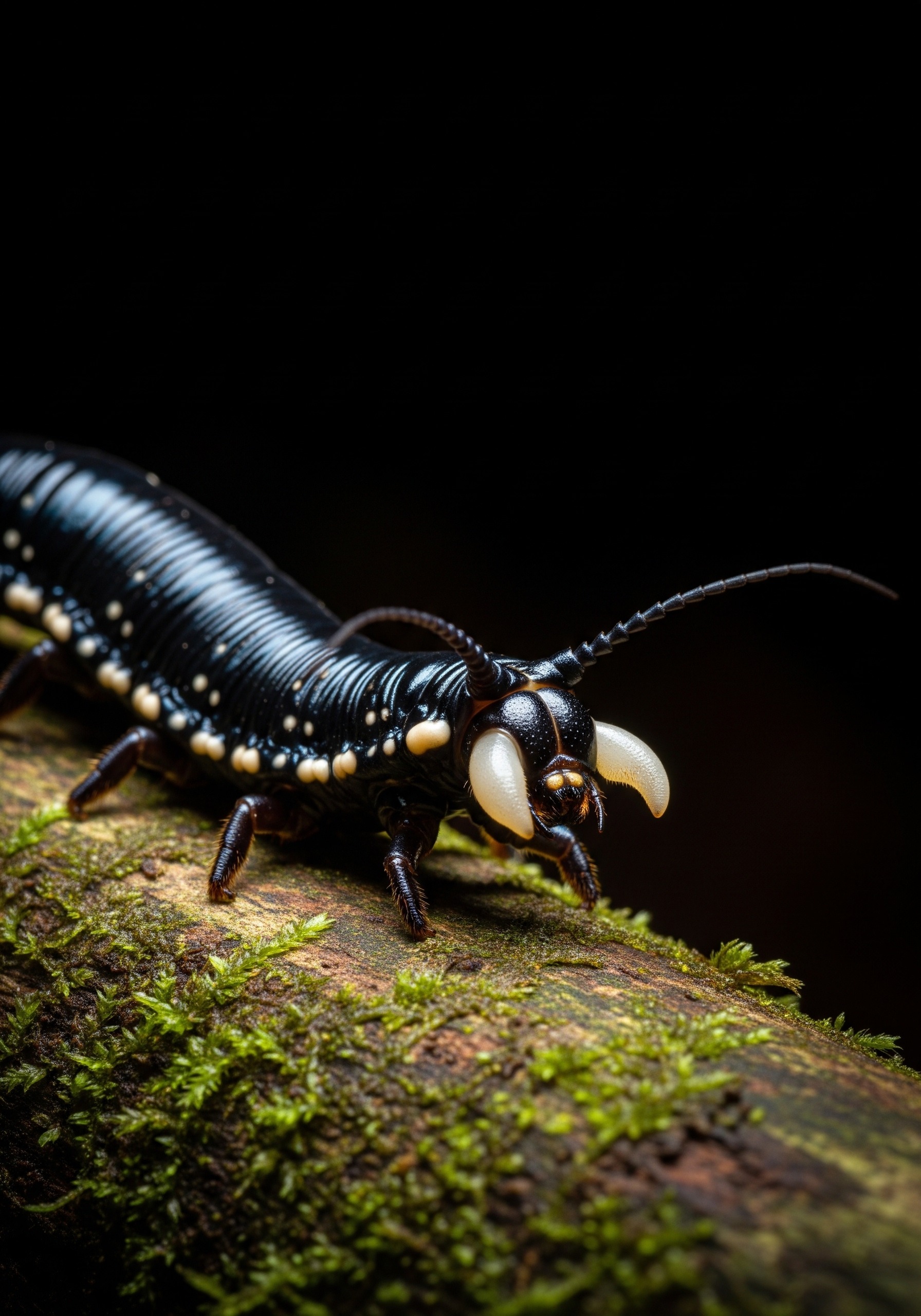
Key Facts
- Roughly 200 described species of velvet worms (phylum Onychophora) — true total almost certainly higher.
- Body length ranges from about 0.5 cm to 22 cm; between 13 and 43 pairs of stubby, clawed legs depending on species.
- The slime is roughly 90% water; the dry residue is mainly a collagen-type protein, and it forms fibers as stiff as some thermoplastics on contact with air.
- The jet is aimed by elastic recoil and a fluid instability, not by muscle (Concha et al., 2015, Nature Communications) — effective range is typically 1–4 cm, with a reported maximum near 10 cm.
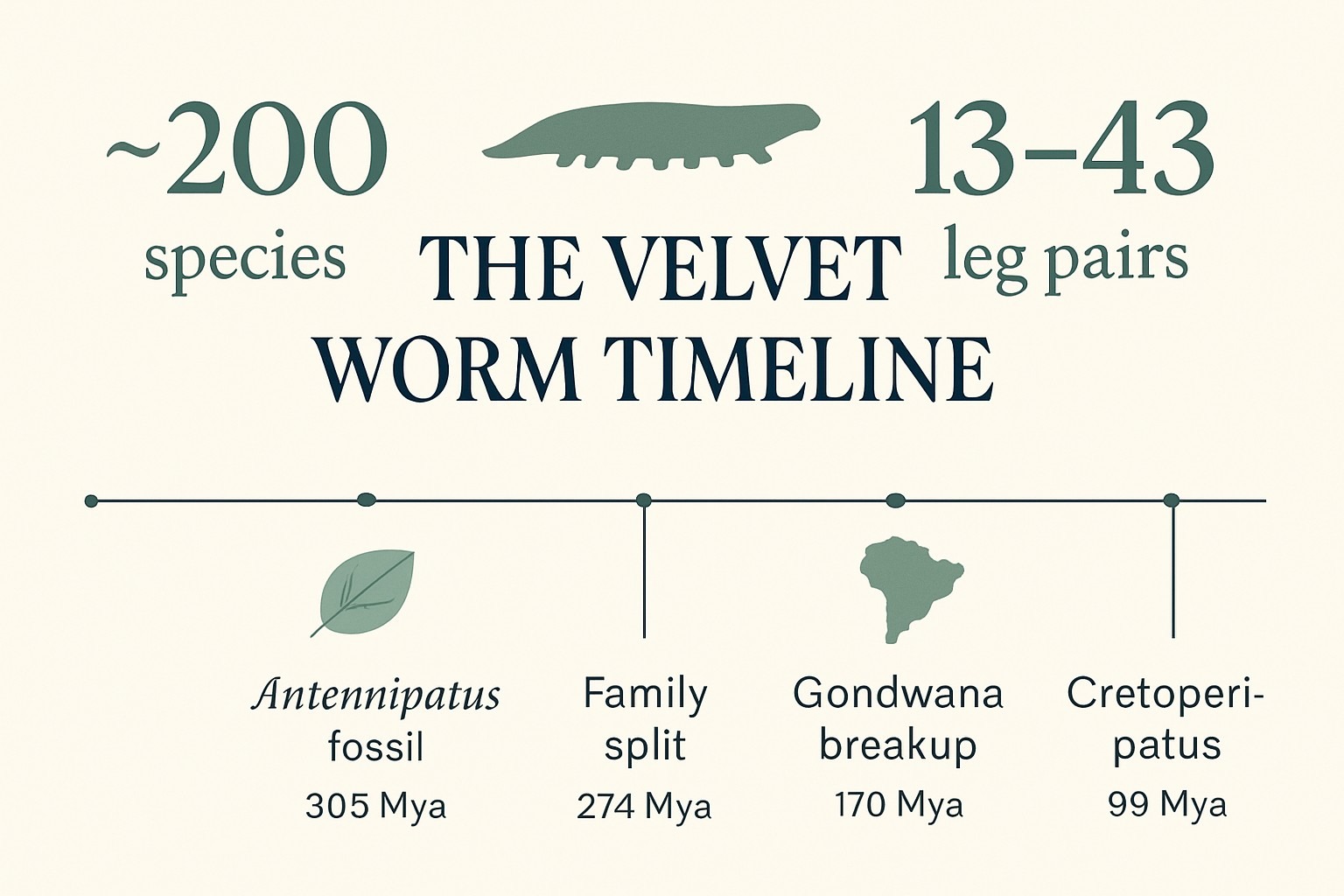
- The two living families (Peripatidae, Peripatopsidae) split around 274 million years ago; their distribution still traces the breakup of Gondwana.
In short: Velvet worms are soft-bodied, leggy forest invertebrates that ambush prey by spraying a quick-hardening protein slime from two nozzles on their heads. A 2025 PNAS paper finally explained the molecular trick behind it — and the answer turns out to point at recyclable bioplastics.
Key Facts
- Roughly 200 species of velvet worms (phylum Onychophora) have been described, with bodies from about 0.5 cm to 22 cm and 13 to 43 pairs of clawed legs.
- Velvet worm slime is about 90% water; its dry residue is mainly a collagen-type protein that hardens into fibres as stiff as some thermoplastics on contact with air.
- The slime jet fires in roughly 1/40th of a second, with an effective range of 1–4 cm and a reported maximum near 10 cm.
- A 2015 study by Andrés Concha and colleagues (Nature Communications) showed the jet is aimed by an elastohydrodynamic instability, not by muscle.
- A March 2025 PNAS paper led by Matthew Harrington (McGill University) identified leucine-rich repeat (LRR) proteins behind the slime’s reversible behaviour.
In short: Velvet worms (Onychophora) are soft-bodied forest invertebrates that ambush prey by spraying a quick-hardening protein slime from two head nozzles in about 1/40th of a second. The jet is aimed by a fluid instability, not muscle. A 2025 PNAS study identified the proteins behind its reversible slime — a possible model for recyclable bioplastics.
What a velvet worm actually is
Onychophora — the velvet worms — are their own phylum. Not insects. Not worms. Their closest known relatives are arthropods and tardigrades, the same evolutionary neighborhood as spiders and water bears. The “velvet” name comes from microscopic skin papillae that give the body a soft, matte sheen under a torch; the “worm” part comes from a body plan that looks vaguely caterpillar-shaped to anyone who isn’t a taxonomist.
Roughly 200 species have been described, with body lengths anywhere from about half a centimeter to 22 cm and between 13 and 43 pairs of short, clawed legs. They are obligate inhabitants of moist, dark microhabitats: rotting logs, leaf litter, the underside of stones, the occasional cave. Their skin pores are permanently open, which means their main daily problem is staying damp.
A dry afternoon kills them.
Two families divide the group geographically. Peripatidae circles the tropics. Peripatopsidae owns the southern temperate zone. We will come back to that map — it tells a story.
Velvet worm by the numbers
- ~200 described species (Onychophora)
- 13 to 43 pairs of legs
- 0.5–22 cm body length
- Slime: ~90% water, ~10% mostly protein
- Slime jet: 1–4 cm typical, ~10 cm maximum
- Two living families diverged ~274 Mya
How velvet worm slime works
Each side of the mouth sits a small turret called an oral papilla. Inside the body, a pair of large reservoirs runs nearly the worm’s full length, packed with the slime in liquid form. When prey wanders close, the worm contracts the reservoir and a thin duct shoots the fluid out through the papilla.
For decades the puzzle was: how does an animal with no real muscles in those nozzles aim a fast, oscillating fan of slime? In 2015, Andrés Concha and colleagues — then at Harvard’s School of Engineering and Applied Sciences — answered it in Nature Communications. The worm doesn’t aim. The papillae flail because of an elastohydrodynamic instability — the same physics that makes a garden hose dance when you crank the pressure too high. A slow squeeze on the reservoir generates a fast, chaotic oscillation at the nozzle. Two fine jets spray out, cross, and cover a much larger area than any aimed shot could.
That instability is the entire targeting system. No nervous control, no muscular flick, no aim. Just clever plumbing.
The slime itself is roughly 90% water, with the remaining 10% mostly a collagen-type protein. The moment the fluid leaves the papilla and meets air, the protein chains shear and dehydrate, and within seconds the liquid sets into fibers as stiff as some thermoplastics.
A hunt, stage by stage
{IMAGE_2}
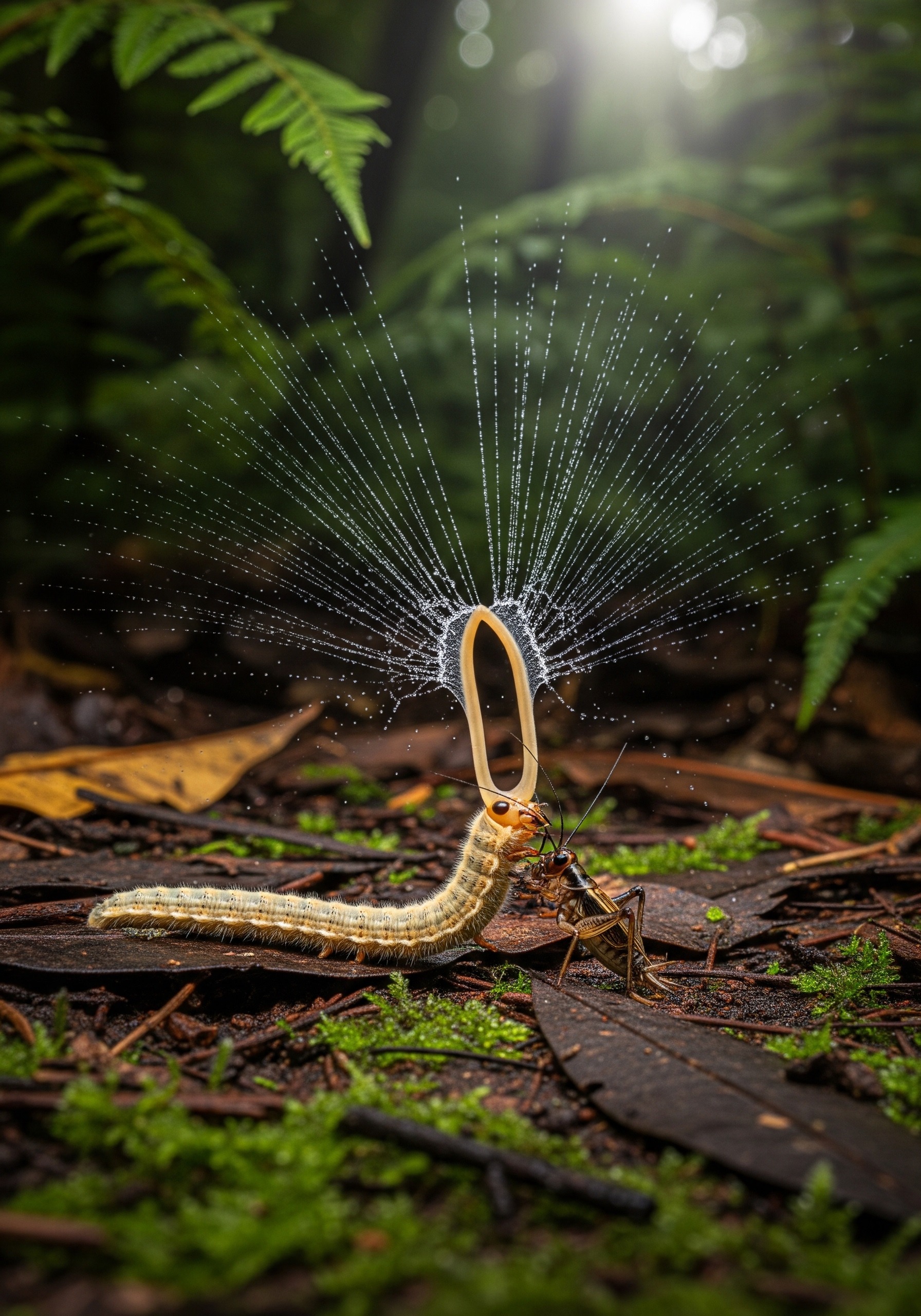
Velvet worms hunt at night. Their eyes are simple — useful for telling light from dark, not much else — so they navigate by their long antennae, picking up air currents and the trails of crickets, termites, spiders, and woodlice. Approaching prey, the worm brushes it with the antennae first. A short, careful tap. If the prey is wrong (too large, too defensive, the worm is full) it walks away. If it is right, the slime fires.
That spray is over in roughly 1/40th of a second. By the time the prey registers what hit it, it is already glued to the leaf litter under a fast-curing net of protein fiber. The worm then walks up at a leisurely pace, opens the prey with a pair of sharp paired jaws, injects digestive saliva, waits for the inside to liquefy, and drinks it out like fruit pulp through a straw.
Then — the part nobody mentions — it eats the dried slime. Almost the entire protein investment is recovered. For an animal that drips moisture and lives on whatever staggers past in the dark, that level of recycling is not a curiosity. It is the business model.
The 2025 discovery that could rewrite bioplastics
The harder puzzle isn’t how the slime sets. It is how the same slime can dissolve back into water hours later and be re-used. That kind of reversible liquid-to-fiber-to-liquid loop is exactly what materials scientists have been trying to engineer into plastics for decades — and failing.
In March 2025, a team led by Matthew Harrington, a chemistry professor and Canada Research Chair at McGill University, with Alexander Baer (McGill) and Ali Miserez (Nanyang Technological University, Singapore), published in Proceedings of the National Academy of Sciences. Using protein sequencing and AlphaFold structure prediction, they identified the missing ingredient: a family of leucine-rich repeat (LRR) proteins, conserved across velvet worm species from Australia, Singapore and Barbados over roughly 380 million years of evolution.
LRR proteins behave a little like immune receptors. They latch onto each other reversibly. Pull the slime through a shear gradient and the LRRs snap together into long fibers. Drop the fiber back into water and the same LRRs let go. The transition runs without enzymes, without curing chemistry, and without any of the harsh inputs modern recyclable plastics need.
That a soft, slow-moving forest animal accidentally solved the bioplastic-reversibility problem 380 million years before we noticed it should be slightly humbling for anyone who assumes evolution always converges on the obvious answer.
500 million years? What the fossil record actually says
Pick up almost any popular article on velvet worms and you will see them called 500-million-year-old living fossils, unchanged since the Cambrian. The truth is more interesting and more honest.
Yes, the lineage really is old. Modern onychophorans descend from a grade of Cambrian animals called lobopodians — soft, tubular, leg-fringed creatures including the famously bizarre Hallucigenia and the seafloor-prowling Aysheaia, both preserved in the Burgess Shale at around 508 million years ago. Velvet worms sit firmly on that branch of the family tree, alongside trilobites and other Cambrian-era survivors.
But confirmed fossil velvet worms — animals you can safely call crown-group Onychophora — are surprisingly thin on the ground. Only two species are reliably inside the modern group: Antennipatus from the Late Carboniferous, around 305 million years ago, and Cretoperipatus from the Late Cretaceous, around 99 million years ago. The two living families themselves diverged about 274 million years ago.
So “500-million-year-old body plan” is a fair description. “The modern velvet worm has not changed in 500 million years” is overstated. Soft-bodied animals do not fossilize cleanly, and the gaps are an artifact of preservation, not a sign that nothing happened in between. The body plan looks unchanged because the niche — moist leaf-litter ambush predator — has barely changed either. The same trick keeps moss winning at 450 million years and counting: be small, be wet, be uninteresting to most things.
Where to find them — a Gondwanan map
Velvet worm distribution is one of the cleanest pieces of biogeographic evidence for continental drift you can point at. The two families slice the world map almost surgically. Peripatidae lives in a belt across the tropics: Central and South America, the Caribbean, West Africa (Gabon), Northeast India, parts of Southeast Asia. Peripatopsidae owns the southern temperate world: South Africa, Chile, Australia, Tasmania, New Zealand, New Guinea.
Within Peripatopsidae, the split between a western clade (South Africa, Chile) and an eastern clade (Australia, New Zealand) mirrors the breakup of Gondwana into western and eastern halves roughly 170 million years ago. The Chile–South Africa branch separated around 154 million years ago. You are looking at an animal whose family map froze when the continents were still drifting apart.
In May 2025, researchers described a new species from South Africa’s arid Karoo — surprising, because velvet worms famously cannot stand dry country. The trick, predictably, is that the Karoo isn’t uniformly arid. The species clings to small, stable, humid pockets inside an otherwise hostile landscape. If you live in New Zealand, parts of Australia, or wet patches of southern Africa, the practical takeaway is unromantic: walk into a damp forest at night, turn over a rotting log, and aim a torch. There may be a 500-million-year-old hunter on the other side.
Frequently Asked Questions
Q: Is velvet worm slime dangerous to humans?
A: No. It is harmless to skin — sticky, mildly annoying to peel off, but neither venomous nor toxic. Velvet worms have no defensive bite or sting worth worrying about.
Q: How far can a velvet worm shoot its slime?
A: Most strikes travel 1–4 cm. Reported maximum range is around 10 cm — roughly four inches, impressive for an animal that fits in your hand.
Q: Are velvet worms insects or worms?
A: Neither. They are their own phylum, Onychophora. Their nearest living relatives are arthropods (insects, spiders, crustaceans) and tardigrades. The English name is misleading on both counts.
Q: Are velvet worms endangered?
A: Many species are extremely local — sometimes confined to a single forest patch — and are vulnerable to habitat loss and drying climates. Some are formally listed as Endangered or Critically Endangered, but most of the roughly 200 described species have never been assessed.
Sources
- Concha, A. et al. (2015). “Oscillation of the velvet worm slime jet by passive hydrodynamic instability.” Nature Communications.
- Baer, A., Hering, L., Hu, Z. et al. (2025). “Conserved leucine-rich repeat proteins in the adhesive projectile slime of velvet worms.” Proceedings of the National Academy of Sciences (PNAS).
- The Australian Museum — velvet worm species profile.
- Encyclopædia Britannica — Onychophora.
- Natural History Museum, London — overview of the Cambrian period and the Burgess Shale lobopodians.
Pinch a thumb-sized animal with no skeleton, no obvious weapon, and a permanent water problem, and you would expect the predators of the forest floor to eat it for dinner. Instead, the velvet worm fires a perfectly tuned protein trap from its face — a trick worked out before there were trees, and one our best chemists are only just starting to copy. The world is older and weirder than most textbooks let on, and most of it is still under the next damp log.
Illustrations are AI-generated. Article fact-checked and human-edited. Our editorial standards.