This 500-Million-Year-Old Fossil Shows a Bite That Didn’t Kill
A trilobite got bitten hard enough to lose a chunk of its body. Then it lived. The wound healed so cleanly that a paleontologist 500 million years later could see exactly what attacked it — and that’s the wild part.
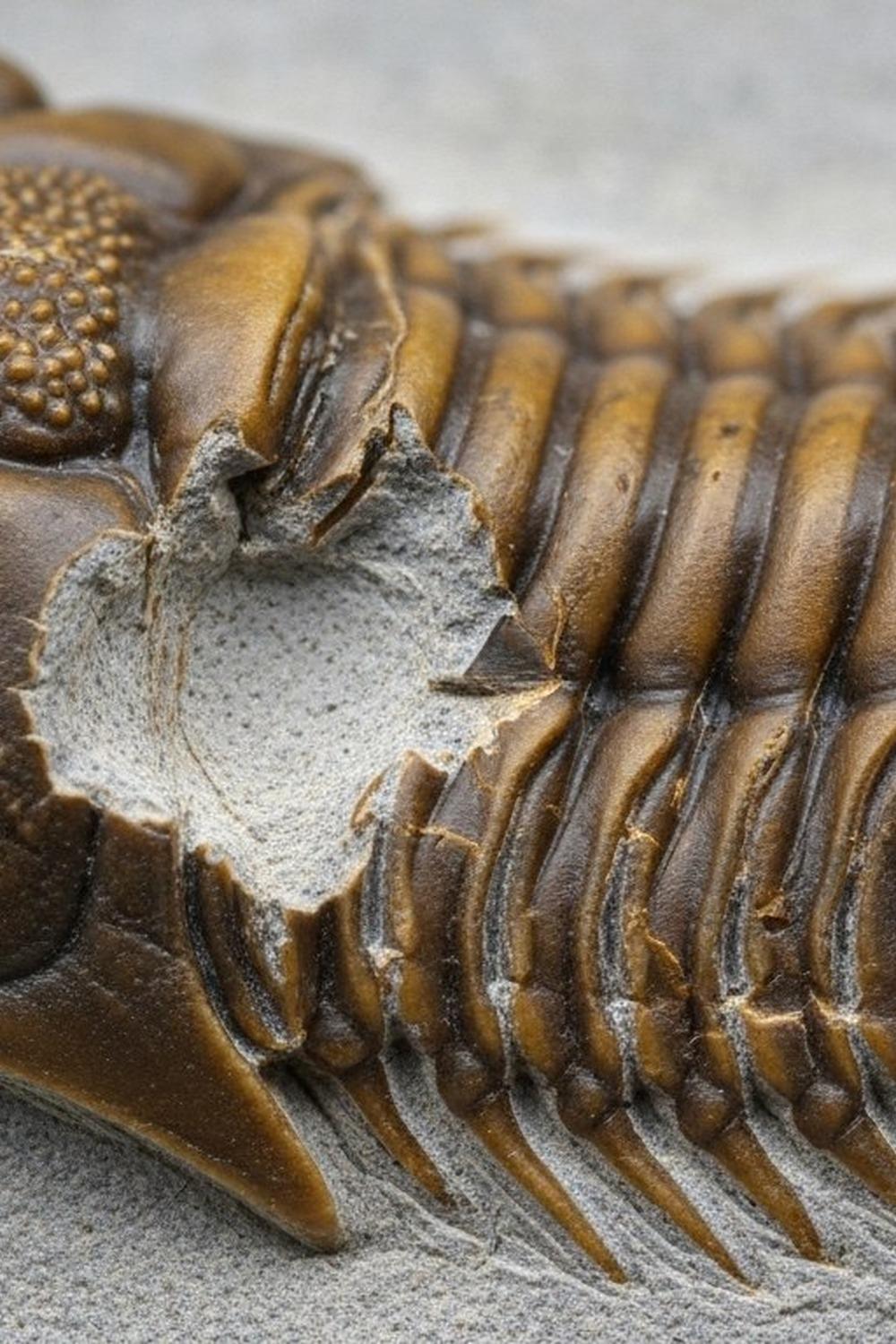
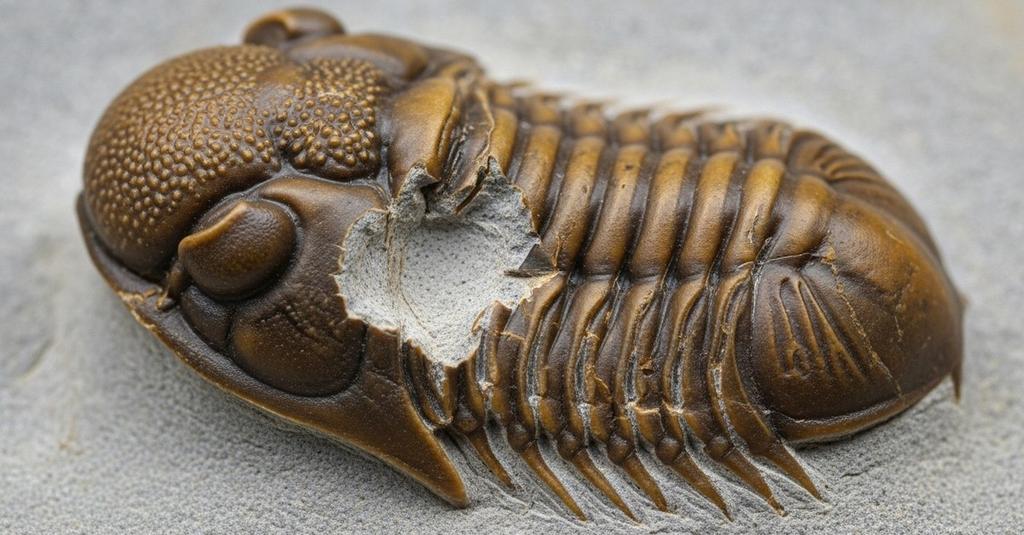
There’s this Lower Cambrian Elliptocephala specimen sitting in a collection somewhere, and embedded in its thorax is evidence of something that almost killed it but didn’t. The bite took tissue. Real tissue. Gone. And the animal’s body sealed the wound back up, smooth edges, no infection, no festering — just biological closure. Then it kept existing in those ancient seas. For half a billion years, that secret stayed locked in stone.
Key Facts
- A Lower Cambrian Elliptocephala trilobite specimen preserves a healed predator bite wound on its thorax, dating back roughly 500 million years.
- Trilobites lasted about 270 million years as a lineage, from roughly 521 to 252 million years ago, one of the longest-surviving animal groups in Earth’s history.
- Over 20,000 trilobite species have been formally described by paleontologists.
- The prime suspect predator, Anomalocaris, reached up to 1 meter in length and dominated the Cambrian seas.
- Fewer than 3% of trilobite specimens showing predation damage have signs of healing, making this Elliptocephala a rare survival case.
In short: A Lower Cambrian Elliptocephala trilobite shows trilobite predator survival frozen in stone: a healed bite wound, likely from the meter-long Anomalocaris, that closed cleanly 500 million years ago. With fewer than 3% of damaged specimens showing healing, this fossil is a rare window into Cambrian predator-prey arms races.
The Proof Is Written Into the Shell Itself
Paleontologists don’t guess at this stuff. When they looked at the damaged section on this Elliptocephala, the wound margins showed actual healing tissue — the kind of smooth, reinforced edges that only appear when a living organism repairs itself. Dead animals don’t do that. Researcher Gábor Botfalvai and his team have documented similar healed injuries across multiple trilobite specimens, and the damage pattern on each one points to a single, deliberate predatory strike. So.
What was actually hunting these things?
That question is the unsettling part. The Cambrian wasn’t some empty sandbox where life was just starting. It was packed. Something in those waters had already learned precision hunting.
Meet the Apex Predator
The main suspect is Anomalocaris — and if you haven’t looked this thing up, do it right now. It’s a meter-long shrimp-shaped nightmare with grasping appendages and a circular mouth ringed with teeth. By the time this trilobite took that bite, Anomalocaris was already an established predator, already sophisticated, already doing this on purpose. The evolutionary arms race was already spinning at full velocity. Trilobites were everywhere. Easy targets.
Think about what that means. The animal that bit this trilobite had already been hunting for generations. It knew what it was doing. This trilobite just happened to be the one that got away.
By the time predation became the dominant survival pressure in the Cambrian seas, the evolutionary arms race between predators and prey had already locked both sides into an endless cycle of adaptation.
How a Molt Saved a Life
Here’s where it gets good. Trilobites molted — they did what crabs and lobsters still do, shedding their entire exoskeleton to grow. Most people think molting is just about size. It wasn’t. It was a biological restart button.
After the Anomalocaris bite, that trilobite almost certainly went into a molt. The damaged exoskeleton fell away. New tissue regenerated underneath. The new shell grew back complete. The animal didn’t just survive the attack — it erased the evidence from its own body. That’s not luck. That’s adaptation.
We see this in modern crustaceans all the time and nobody thinks twice about it.
In a 500-million-year-old fossil? That’s remarkable.
The Cambrian Was Already Brutal
Most predation evidence from this period ends one way. Crushed shells. Scattered fragments. Bite marks on bone. The fossil record of the Cambrian is basically a record of successful hunts — which means a healed wound is statistically rare. Paleontologists have found that the majority of preserved injury evidence represents fatal encounters. Every healed trilobite specimen they find is a statistical outlier, which is exactly why it matters.
The Cambrian wasn’t just an explosion of new life forms. It was an explosion of new ways those life forms could kill each other. Predation as a strategy was young then. And it was already brutally efficient.
Survivors stood out.
What a Healed Wound Actually Tells You
A fatal attack tells you something died. That’s useful. A healed wound tells you almost everything else — the predator’s size, the angle of attack, how much force it applied, the fact that prey survived long enough to repair itself afterward. Each healed trilobite is a data point about predator behavior, prey resilience, and what animals 500 million years before fish, before land plants, before almost anything modern, were actually capable of doing.
It completely reframes Cambrian ecosystems. These weren’t simple or passive. They were complex, dangerous, and already locked in feedback loops that would shape life on Earth for the next 500 million years. That last fact kept me reading for another hour.
The Numbers
- Trilobites lasted ~270 million years as a lineage (from roughly 521 to 252 million years ago), making them one of the longest-surviving animal groups in Earth’s entire history.
- Over 20,000 species have been formally described by paleontologists — which is just wild when you think about it.
- Anomalocaris reached up to 1 meter in length, dominating the Cambrian like nothing else came close to its size.
- Fewer than 3% of trilobite specimens showing predation damage have signs of healing. Most died from their injuries. This Elliptocephala fossil is in the rare survival category.
Stranger Details from the Stone
- Some trilobites could roll into a ball — enrollment, like a pill bug — and paleontologists have found them fossilized mid-curl, suggesting the behavior may have been triggered by a predator threat right before death.
- Trilobite eyes were made of calcite crystals. Some species had up to 15,000 individual lenses. That level of optical complexity still surprises researchers who study them.
- Not every wound came from predators. Some trilobite specimens show damage consistent with cannibalism — trilobites eating other trilobites — which tells you competition for resources was already extreme.
Why This One Survivor Matters Half a Billion Years Later
The bigger story: every trilobite that survived a predatory attack and healed went on to molt again, move again, and probably reproduce. That meant the individuals best at surviving — whether through speed or armor or the biological ability to regenerate — passed those traits forward. This single specimen is natural selection caught in the act, frozen in limestone, waiting 500 million years for someone to examine the smooth edges of that healed wound.
That’s a window into how life learned to persist. The Cambrian was brutal and strange and full of creatures trying to eat each other. And somehow, some of them made it anyway.
A chunk of its body was gone. The animal healed. It molted and kept moving through seas that don’t exist anymore, under a sun that still looked the same but lit a world we wouldn’t recognize. That moment — attack, survival, molt, recovery — is still there in the rock. There are probably more survivors in museum drawers, their healed wounds never examined, waiting in Cambrian stone for someone to look closely. If this keeps you wondering, there’s more at this-amazing-world.com.
“
Frequently Asked Questions
Q: How can scientists tell a 500-million-year-old trilobite survived an attack?
When paleontologists examined the damaged thorax of this Lower Cambrian Elliptocephala, the wound margins showed actual healing tissue, smooth and reinforced edges that only form when a living organism repairs itself. Dead animals do not heal. Researcher Gabor Botfalvai and his team have documented similar healed injuries across multiple trilobite specimens, with damage patterns pointing to single, deliberate predatory strikes rather than random scavenging or post-mortem damage.
Q: What predator attacked the trilobite?
The main suspect is Anomalocaris, a roughly meter-long shrimp-shaped predator with grasping appendages and a circular tooth-ringed mouth. By the time this trilobite was bitten, Anomalocaris was already an established, sophisticated hunter, showing the Cambrian evolutionary arms race was running at full velocity. Trilobites were abundant and easy targets, so the animal that bit this one had likely been hunting for generations and knew exactly what it was doing.
Q: How did the trilobite erase the evidence of its wound?
Trilobites molted, shedding their entire exoskeleton to grow, much like modern crabs and lobsters. After the Anomalocaris bite, the trilobite almost certainly molted: the damaged exoskeleton fell away, new tissue regenerated underneath, and a complete new shell grew back. The animal did not just survive the attack, it erased the evidence from its own body. That ability to regenerate is exactly the kind of trait natural selection passes forward.
Q: Why is a healed wound rarer than a fatal one in the fossil record?
Most Cambrian predation evidence ends in crushed shells, scattered fragments, and bite marks, meaning the majority of preserved injuries represent successful, fatal hunts. Fewer than 3% of trilobite specimens showing predation damage have signs of healing. A healed wound tells researchers far more than a fatal one: the predator’s size, the angle and force of attack, and proof the prey survived long enough to repair itself, making each survivor a statistical outlier worth studying.
Illustrations are AI-generated. Article fact-checked and human-edited. Our editorial standards.