Why Every Child Who Gardens Grows an Ecologist
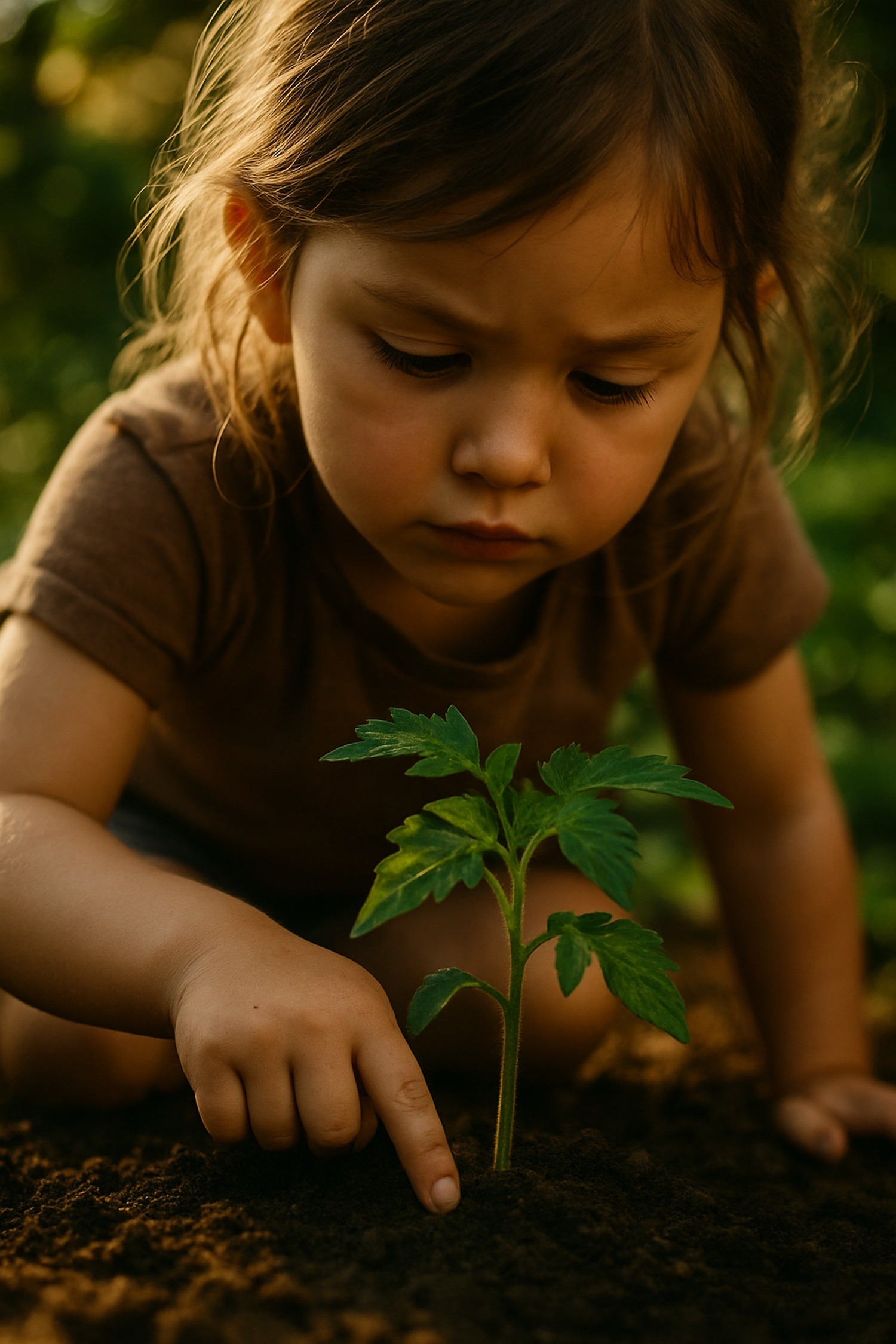
What happens when a five-year-old’s finger breaks the surface of soil and she realizes, without anyone telling her, that something she planted might actually live? Children gardening environmental awareness isn’t built in classrooms or absorbed from screens. It’s earned in the specific, irreplaceable moment when a child discovers she has the power to make something grow.
The plant becomes hers. A tomato seedling starts as curiosity and becomes, quietly, a complete rewiring of how that human being will understand water, soil, insects, and everything connected between them. For decades, researchers have been asking the hard question: can we scale this rewiring? What do we lose if we don’t even try?
Key Facts
- In 2013, the University of Illinois’s Landscape and Human Health Laboratory published findings showing children who garden score measurably higher in ‘nature connectedness,’ a metric that predicts long-term pro-environmental behavior
- The Royal Horticultural Society launched its Campaign for School Gardening in 2007 and tracked thousands of primary school children, finding consistent links between gardening and gains in science literacy, emotional regulation, and dietary habits
- A 2018 long-term study by the Royal Botanic Gardens, Kew, documented that early exposure to plant and insect ecosystems correlates with adult conservation volunteering and environmental advocacy
- The UK’s 2019 State of Nature report estimated that 41% of species monitored in Britain had declined in abundance since 1970, with insect populations hit particularly hard
- A single teaspoon of healthy garden soil contains roughly one billion bacteria, several yards of fungal filaments, and thousands of microorganisms from dozens of species
In short: Children who garden develop measurably stronger environmental awareness than those who learn ecology only in classrooms. A 2013 University of Illinois study confirmed higher ‘nature connectedness’ scores. Royal Horticultural Society research since 2007 linked gardening to better science literacy and dietary habits. A 2018 Kew study tied early plant exposure to lifelong conservation advocacy.
How Children Gardening Builds Environmental Awareness Early
The science isn’t soft. In 2013, the University of Illinois’s Landscape and Human Health Laboratory published findings showing that children engaged in regular gardening demonstrated measurably higher scores in what psychologists call “nature connectedness” — a metric that predicts long-term pro-environmental behavior better than classroom instruction alone. When a child tends a plant across weeks or months, they’re developing systems thinking: the intuitive grasp that actions have downstream consequences. A missed watering affects a root. A root affects a fruit. A fruit affects the bird that would have eaten it. That chain of causation is the foundation of every environmental science course ever written.
The difference is fundamental: the garden teaches it through failure, not lecture.
Children learn accountability differently when the stakes are biological. A worksheet can be redone. A plant that dies from neglect cannot. That’s not cruelty — it’s consequence, and consequence is one of the most efficient teachers evolution ever produced. Studies from the Royal Horticultural Society in the UK, published as part of their Campaign for School Gardening launched in 2007, tracked thousands of children across primary schools and found consistent links between gardening participation and improvements in science literacy, emotional regulation, and — perhaps most surprisingly — dietary habits.
Kids who grew vegetables ate them. Not because they were told to. Because they’d earned them.
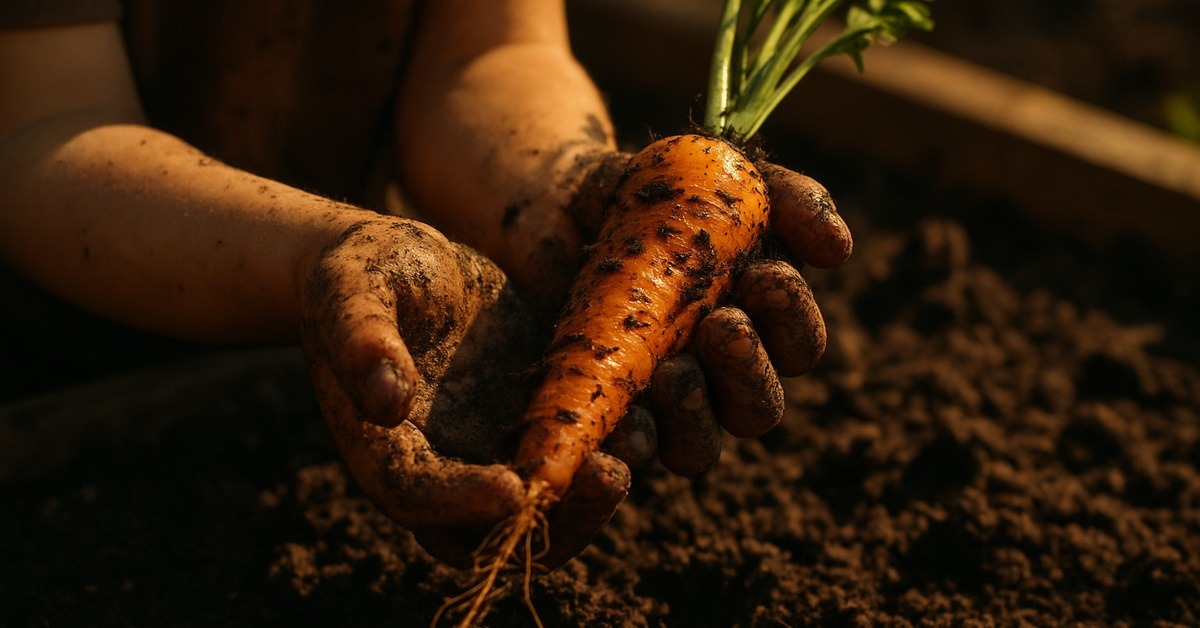
Think about what that carrot represents to a seven-year-old who pulled it from the ground herself. It’s not food. It’s proof — proof that patience produces something real, that the soil rewards attention, that she is capable of participating in the living world rather than just consuming it. That shift in identity, from passive recipient to active steward, is one of the most durable lessons a childhood can carry forward.
The Garden as Classroom: What Insects Teach Without Trying
Why does watching a bee land on a flower you planted change everything? Because in that moment, the garden stops being a hobby and becomes an ecosystem. For children, this encounter is formative in ways that go far beyond the lesson plan. It’s the entry point into understanding pollination, habitat dependency, and the fragility of food systems — concepts that ecology textbooks spend whole chapters trying to convey.
A child who starts noticing bumblebees in the bean flowers starts asking why they’re there. What do they need? Where do they go in winter? That curiosity doesn’t disappear when the growing season ends. It compounds. A 2018 long-term study by the Royal Botanic Gardens, Kew, documented that early exposure to living plant and insect ecosystems in childhood correlates strongly with adult conservation volunteering and environmental advocacy — a feedback loop between wonder and action. And here’s the thing: this mirrors what happens in the wild when other species investigate their world. Consider the methodical way a crow drops to the forest floor to perform anting, using formic acid from ants to maintain its feathers — a behavior discovered through decades of careful field observation, exactly the kind of noticing that gardening teaches children to do.
In 2019, the UK’s State of Nature report estimated that 41% of species monitored in Britain had declined in abundance since 1970, with insect populations hit particularly hard. Children who garden don’t hear this statistic as abstract. They’ve seen a bee. They’ve watched it work. They understand, viscerally, that something irreplaceable is at stake. That translation — from number to meaning — is what environmental education has been struggling to achieve for fifty years. The garden does it in an afternoon.
But the insects teach something deeper, and it’s subtle. They teach children that they are not the center of the garden’s story. The bee isn’t visiting for you. The earthworm isn’t there for your benefit. Watching a species flourish on its own agenda, indifferent to your presence, you stop thinking of nature as backdrop and start thinking of it as a world you inhabit rather than manage. The garden is full of agendas that have nothing to do with the child tending it — and learning to exist alongside those agendas, rather than over them, is the beginning of genuine ecological thinking.
Soil, Science, and the Oldest Classroom on Earth
A single teaspoon of healthy garden soil contains roughly one billion bacteria, several yards of fungal filaments, and thousands of individual microorganisms from dozens of different species. Most children who garden have no idea they’re holding an entire civilization in their hands. But they know the soil smells different from the bag of sand in the playground. They know it darkens when wet and crumbles when dry. They know their seeds germinate faster in the crumbly dark stuff.
This is empirical observation. This is science, conducted without a lab, without equipment, without a teacher standing at the front of a room.
Research published in 2020 by the National Geographic Society’s environmental reporting team highlighted that soil biodiversity is one of the most overlooked dimensions of the global ecological crisis — and that children who interact with living soil in early childhood show significantly stronger comprehension of biological interdependence in later schooling. The oldest classroom on earth is still outperforming the newest ones. A 2021 meta-analysis conducted by researchers at Wageningen University in the Netherlands, reviewing over 100 international studies on school gardening programs, found that garden-based learning consistently improved environmental knowledge scores, reduced nature deficit disorder symptoms, and increased what the researchers termed “biophilic behavior” — the tendency to seek out, protect, and engage with living systems. These outcomes held across cultures, income levels, and urban or rural settings.
The garden doesn’t care about your postcode.
What changes when a child understands that soil is alive? Her relationship to the ground changes. She stops seeing dirt as something to wash off and starts seeing it as something to protect. That’s not a metaphor for environmental consciousness. It is environmental consciousness — small, personal, undeniable, and exactly where it needs to begin.
Children Gardening Environmental Awareness: The Long-Term Stakes
In 2022, a longitudinal study from the University of Exeter’s European Centre for Environment and Human Health tracked children who had participated in school gardening programs over a ten-year period. The findings were striking: adults who had gardened as children were 2.3 times more likely to report regular contact with nature, significantly more likely to hold pro-environmental political views, and notably more likely to teach their own children to garden. The loop closes. The garden replicates itself across generations, not through genetics but through the transmission of a certain kind of attention — the kind that notices whether something is thriving or struggling, and cares about the difference. It’s a form of ecological literacy that no app has come close to replicating, because it requires time, weather, failure, and the presence of actual living things.
Here’s what nobody predicted: the strongest environmental outcomes weren’t correlated with the size or sophistication of the garden. A single raised bed in an inner-city schoolyard produced outcomes comparable to a full-scale school farm. What mattered wasn’t acreage. It was ownership. Children who had a specific plant, a specific bed, a specific responsibility showed the deepest and most durable environmental learning.
The mechanism appears to be emotional investment — when something is yours, you pay a different quality of attention to it. That quality of attention is precisely what environmental stewardship requires at every scale, from backyard composting to international climate policy. Schools that have implemented mandatory gardening programs — including primary schools in Denmark, Japan’s school lunch farming curriculum, and the UK’s RHS Campaign for School Gardening, which had reached over 30,000 schools by 2023 — report a consistent secondary benefit that no one quite predicted: improved social cohesion. The garden forces collaboration. You can’t grow a pumpkin alone. You need someone to water while you’re absent, someone to notice the aphids you missed, someone to share the harvest with. Tending living things together turns out to be one of the oldest forms of community-building our species knows.
What Schools Get Right When They Dig In
Denmark introduced mandatory outdoor learning in primary schools in 2014, with garden-based activities forming a core pillar of science and environmental curricula. By 2020, national assessment data showed that Danish students consistently outperformed EU averages in both environmental knowledge and what educators call “agency beliefs” — the conviction that one’s actions can have positive environmental consequences. That’s not a minor outcome. Agency beliefs are the single strongest psychological predictor of adult environmental behavior. A child who believes her actions matter grows into an adult who acts. A child who learns environmental facts in a passive classroom — but never feels the weight of a living thing depending on her — grows into an adult who knows but doesn’t do. The difference between those two outcomes might be a patch of soil six feet square.
In Japan, the school lunch program, known as Kyushoku, has incorporated student-grown produce since the 1950s. Children grow rice, vegetables, and herbs as part of their school day and help prepare the meals served to their classmates. Studies conducted by the National Institute for Educational Policy Research in Japan in 2017 found that schools participating in active growing programs reported not only better nutritional outcomes but measurably stronger environmental ethics scores compared to schools without gardening components. These children aren’t just eating better. They’re thinking differently about where food comes from, what it costs the land to produce, and what their responsibility to that land might be.
Children gardening environmental awareness, it turns out, is also food literacy, climate literacy, and community literacy — all at once.
Walk into one of these classrooms on harvest day. The noise is different. There’s argument about whose courgette grew biggest, debate about why the tomatoes in the sunny corner outperformed the ones near the fence, genuine negotiation over who gets to take the first beans home. These children aren’t performing engagement. They’re engaged — by something that was alive, that needed them, that rewarded their attention with something edible and real. Every educator who witnesses it says the same thing: you can’t manufacture that in a smartboard lesson. You have to grow it.
How It Unfolded
- 1950s — Japan launches the Kyushoku school lunch program, embedding student-grown produce into primary education for the first time at national scale.
- 2007 — The Royal Horticultural Society launches its Campaign for School Gardening in the UK, providing resources, training, and funding to primary schools to establish working garden programs.
- 2013 — University of Illinois researchers publish landmark findings linking regular childhood gardening to measurable increases in nature connectedness and pro-environmental behavior scores.
- 2022 — University of Exeter’s decade-long longitudinal study confirms that children who garden are 2.3 times more likely to maintain regular contact with nature as adults, establishing the strongest long-term behavioral evidence yet for garden-based environmental education.
By the Numbers
- 1 billion — bacterial organisms in a single teaspoon of healthy garden soil (USDA Natural Resources Conservation Service, 2019)
- 30,000+ — UK primary schools enrolled in the RHS Campaign for School Gardening by 2023
- 2.3× — how much more likely adults who gardened as children are to maintain regular contact with nature (University of Exeter, 2022)
- 41% — proportion of monitored UK species that declined in abundance between 1970 and 2019 (State of Nature Report, 2019)
- 100+ — number of international school gardening studies reviewed in the 2021 Wageningen University meta-analysis confirming consistent environmental learning outcomes across all contexts
Field Notes
- In a 2016 trial by the University of Minnesota Extension program, children aged 6–10 who tended school gardens for a single growing season showed a 50% increase in willingness to try new vegetables — and the effect held six months after the program ended, suggesting that garden exposure creates lasting changes in food-related behavior rather than just novelty responses.
- The specific act of digging — not planting, not watering, but digging bare-handed in soil — exposes children to Mycobacterium vaccae, a naturally occurring soil bacterium that research published in 2016 in the journal Psychopharmacology found stimulates serotonin production in the brain. Children who garden may literally feel better in the literal, neurochemical sense.
- Japan’s Kyushoku program predates most Western garden-based education by half a century, yet it’s rarely cited in English-language educational research — a gap that may explain why Western policymakers keep rediscovering what Japan systematized in the 1950s.
- Researchers still can’t fully explain why emotional ownership of a specific plant produces stronger environmental outcomes than general exposure to gardens. Is it the responsibility? The narrative of watching something grow? The grief when it fails? The mechanism behind what educators call “plant attachment” in children remains genuinely unresolved.
Frequently Asked Questions
Q: How does children gardening improve environmental awareness specifically?
Children gardening environmental awareness develops through direct, consequential experience rather than abstract instruction. When a child tends a plant across weeks, they observe water cycles, soil biology, insect behavior, and the effects of weather firsthand. A 2013 University of Illinois study found that this hands-on exposure measurably increases nature connectedness — the psychological metric most predictive of lifelong pro-environmental behavior. The learning sticks because it’s earned, not delivered.
Q: What age is best to start a child gardening?
Most developmental psychologists and garden educators recommend starting as young as three or four, when children are naturally drawn to digging and tactile exploration. At this age, simple tasks — pressing seeds into soil, watering with a small can, checking for growth — build motor skills and observation habits simultaneously. Royal Horticultural Society research found that children who begin gardening before age seven show stronger long-term nature connection than those who start in later primary years, suggesting early exposure has compounding benefits that later introduction can’t fully replicate.
Q: Can urban children get the same benefits without a yard or outdoor space?
Yes — and this is where assumptions about children gardening environmental awareness need correcting. The Wageningen University meta-analysis of 2021 found that outcomes were consistent whether children gardened in large school farms or in single raised beds in urban courtyards. Window boxes, balcony containers, and community garden plots produce equivalent environmental learning outcomes to suburban gardens, as long as the child has ownership of a specific plant or bed. Scale doesn’t matter. Responsibility does.
Editor’s Take — Alex Morgan
The most striking data point in all of this isn’t the bacterial count in a teaspoon of soil or the RHS enrollment numbers. It’s the Exeter longitudinal finding that children who gardened were 2.3 times more likely to maintain contact with nature as adults — and more likely to teach their own children to do the same. We keep designing environmental education as if it needs to be new. It doesn’t. It needs to be rooted. There is no smarter infrastructure investment in the future of this planet than a patch of dirt and a child who feels responsible for it.
Every generation inherits an ecological crisis it didn’t create and a body of knowledge it didn’t ask for. What it also inherits, if we’re thoughtful enough to give it, is a set of hands that have been in the soil — that know what living systems feel like from the inside. Children gardening environmental awareness isn’t a program or a policy. It’s a relationship, built one missed watering and one harvested carrot at a time. The question isn’t whether gardens can teach. The question is whether we trust children enough to let the garden be the teacher — and whether we’re willing to clear a little ground to make that possible.
Illustrations are AI-generated. Article fact-checked and human-edited. Our editorial standards.