The Wild Cat That Dunks Its Head Underwater to Fish
So there’s this cat that just… dunks its entire head underwater. No hesitation. No internal debate about whether wet fur is acceptable. Just commits fully to drowning itself for five seconds to catch a fish.
Most cats would stage a protest over a damp paw. This one is built entirely different.
The fishing cat — Prionailurus viverrinus if you want the scientific version — is a stocky, spotted wild cat that haunts the wetlands of South and Southeast Asia and apparently never received the standard feline memo about water being the enemy. You can find them threading through mangroves, marshes, and river deltas across India, Nepal, Bangladesh, Sri Lanka, Thailand, and Indonesia. And the wild part? Most people have never heard of it. Most scientists barely studied it until recently.
Key Facts
- The fishing cat (Prionailurus viverrinus) inhabits wetlands across India, Nepal, Bangladesh, Sri Lanka, Thailand, and Indonesia.
- A 2016 camera trap study in Nepal’s Terai Arc Landscape documented a single male’s territory reaching 22 square kilometers.
- Adult male fishing cats weigh up to 12 kilograms and measure over 85 centimeters in body length.
- The species is listed as Vulnerable on the IUCN Red List, with partially webbed toes on all four paws.
- Over 50% of Asian wetlands have been degraded or lost since 1900, per the Ramsar Convention’s 2018 Global Wetland Outlook.
In short: The fishing cat is a stocky wild cat of South and Southeast Asian wetlands that dunks its head underwater to catch fish. Built with partially webbed paws and a dual-layer wetsuit-like coat, this fishing cat wetlands specialist is listed as Vulnerable as over half of Asia’s wetlands have vanished since 1900.
How One Cat Decided Wetlands Were Home
The fishing cat’s range covers some genuinely intense terrain. We’re talking about the Ganges delta, Sri Lankan swamps, Sumatran marshes — the kind of places where water doesn’t stay politely contained. A 2016 camera trap study in Nepal’s Terai Arc Landscape (funded by the Fishing Cat Conservation Alliance) documented individual males patrolling territories up to 22 square kilometers. For a mid-sized cat, that’s absurdly vast.
Researcher Tiasa Adhya has spent years tracking these animals through West Bengal’s wetlands, and she describes them as creatures “completely defined by water.” Which raises the obvious question — what exactly got shaped differently?
It wasn’t just behavior.
Their paws are partially webbed. The legs are shorter and stockier than most felines, which lowers their center of gravity right toward the water’s edge. And then there’s what happens with the fur, which is where things get genuinely weird.
The Fur Engineering That Changed Everything
Here’s the part that kept me reading for another hour: the fishing cat has two completely distinct layers of fur working in tandem. A dense, water-repelling undercoat locks heat in and keeps the skin dry. The longer outer guard hairs absorb the actual soaking. It functions identically to a wetsuit — trap a thin layer of warmth, manage heat loss, protect the core. The cat can submerge repeatedly without becoming waterlogged or hypothermic.
Nature engineered performance outerwear before humans even invented the concept.
And the hunting? It’s not chaotic. The fishing cat crouches at the water’s edge and uses one hooked paw to swipe fish toward the surface. When the moment arrives, it plunges its head fully below and snatches prey directly with its teeth. That’s strategy. That’s deliberate. That’s a cat that has spent millennia refining an approach.
For more on animals with extraordinary physical adaptations built for extreme environments, this-amazing-world.com has research worth an entire sleepless night.
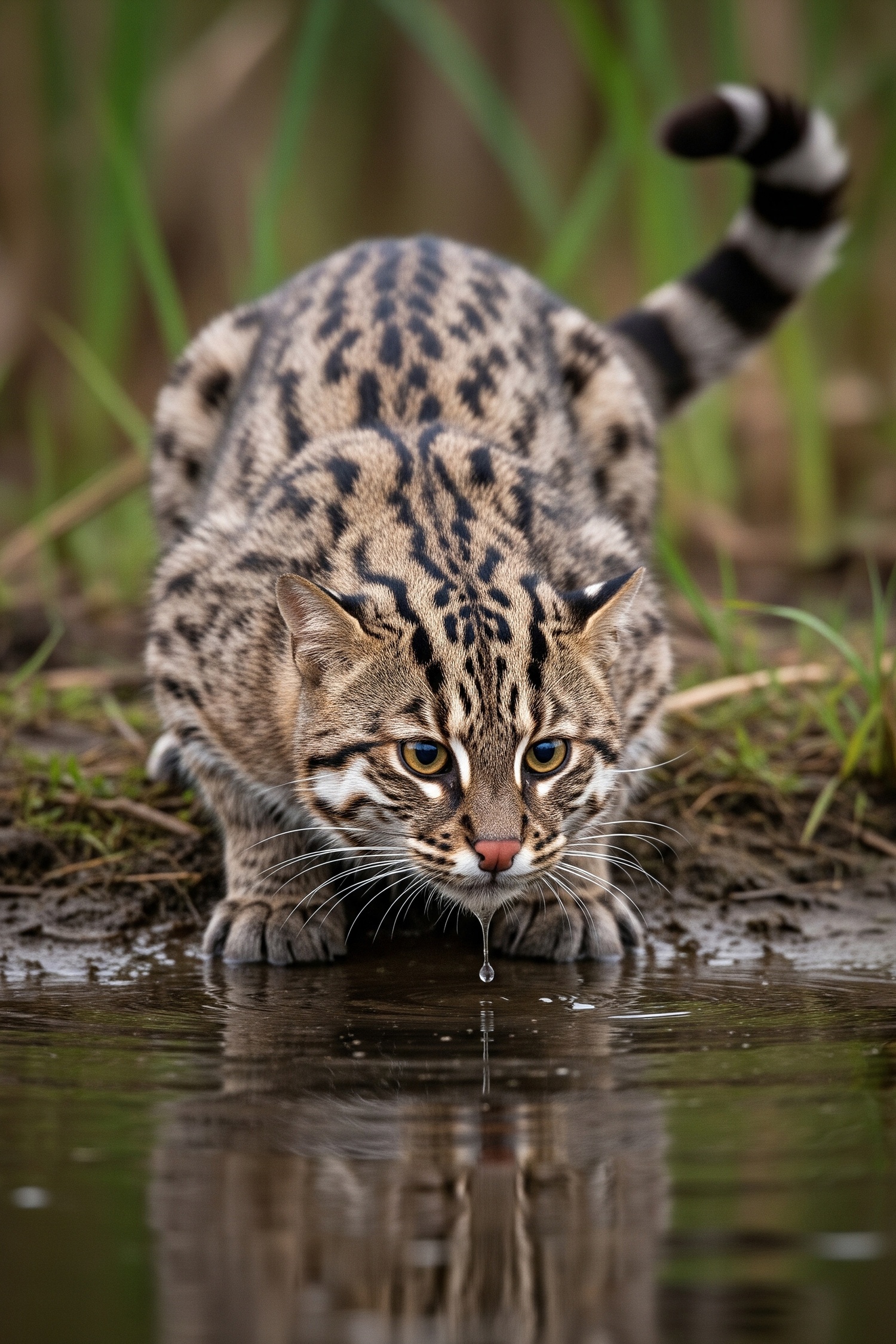
A Wrestler That Hunts in Water
Don’t mistake the word “cat” for dainty. Adult fishing cats reach 12 kilograms and measure over 85 centimeters in body length. That’s roughly the size of a bulldog — thick neck, broad skull, powerful forelimbs built around raw force rather than grace. A cheetah is graceful. This animal is powerful the way a wrestler is powerful. Compact. Low. Immovable once it decides to act.
The fishing cat also hunts birds, snakes, rodents, and small deer.
“Fishing” undersells what this animal actually does. It’s an apex predator of the wetland floor, and almost nobody could pick one out of a lineup.
The Conservation Numbers Nobody Wants to Read
The fishing cat is listed as Vulnerable on the IUCN Red List. The status sounds neutral. The data behind it isn’t.
Wetland destruction across South and Southeast Asia has accelerated dramatically over the past three decades. The fishing cat has vanished from large portions of its former range — most of mainland Southeast Asia, where it was once relatively common. Aquaculture expansion, agricultural drainage, and urban encroachment on riverine habitats have consumed the exact zones this cat needs to survive. And here’s the thing: protecting an animal that lives in murky wetlands doesn’t generate the same public energy as saving a tiger or a panda.
Wetlands are messy. They flood. They smell. They don’t photograph cleanly for social media. So they get converted first and mourned last.
The fishing cat is caught directly in that gap — ecologically essential, publicly invisible.
By the Numbers
- 22 square kilometers: the recorded territory size of a single male fishing cat in Nepal’s Terai Arc Landscape, documented in a 2016 camera trap study.
- Over 50% of Asian wetlands have been degraded or lost since 1900, according to the Ramsar Convention on Wetlands (2018 Global Wetland Outlook) — directly eroding the habitat the fishing cat depends on for survival.
- Adult males weigh up to 12 kilograms — roughly twice a domestic cat, significantly heavier than most people expect from something called a “water cat.”
- Partially webbed toes on all four paws. This trait is shared with only a handful of wild feline species worldwide, including the flat-headed cat and the Borneo bay cat.
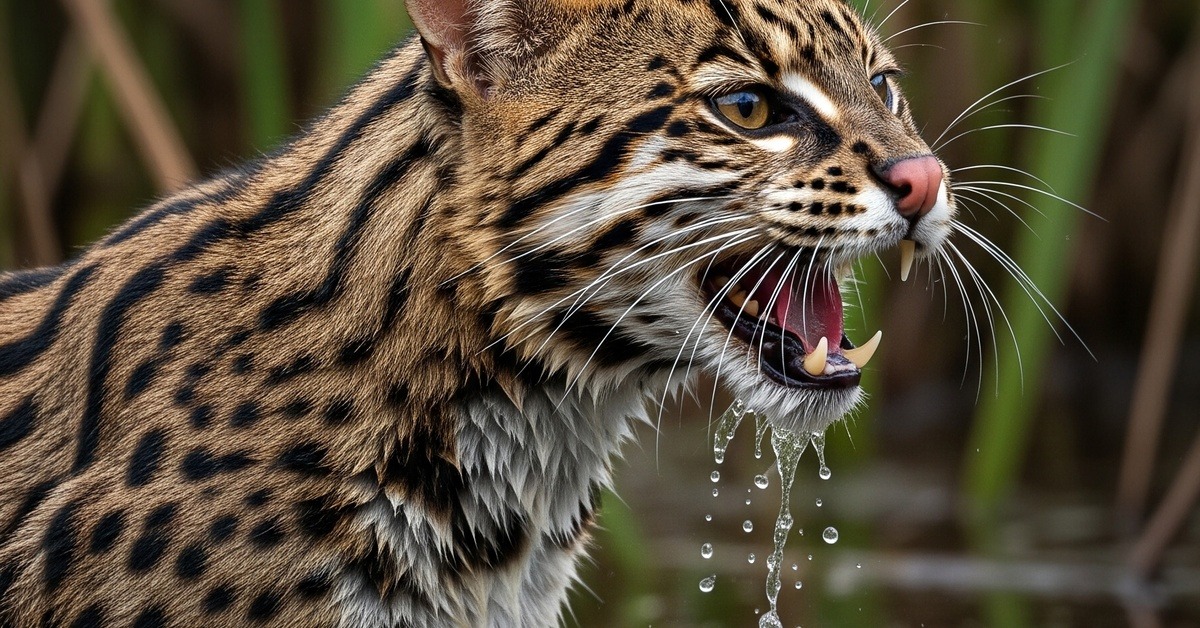
What Researchers Actually Observed
- Fishing cats tap the water’s surface with their paws before striking. Researchers believe this mimics insect movement to lure fish toward the edge — suggesting active deception in their hunting strategy.
- Unlike most wild cats, fishing cats swim across rivers at night.
- The fishing cat has a shortened, thickened tail compared to similar-sized cats — a physical adaptation for balance and steering in water, functioning almost like a rudder during swimming.
Why This Actually Matters Beyond the Weird Factor
The fishing cat is an indicator species. Its presence or absence tells ecologists something concrete about whether an entire wetland system is actually functional. Where fishing cats thrive, the broader wetland food web is typically intact. Where they disappear, the system has usually been pushed past some kind of threshold.
Protecting the fishing cat means protecting the rivers, marshes, and mangroves that regulate water quality, prevent flooding, and support biodiversity across some of the most densely populated regions on earth.
The cat becomes a proxy for the whole ecosystem.
When conservation gets framed in abstract terms — carbon sequestration, hydrological regulation, biodiversity corridors — most people zone out. But a cat that dunks its head underwater to catch fish? That lands differently. That’s the entry point. That’s the moment people actually care.
The fishing cat has spent thousands of years engineering its own survival in wetland margins, quietly refining techniques that most predators never attempt. It doesn’t need our admiration to keep functioning. But it does need its habitat to exist. And that part is entirely up to us. The natural world keeps producing animals like this — strange, specific, built for one particular corner of existence — and most of them slip away before we ever properly notice. If this kind of story lands for you, there’s more at this-amazing-world.com. The next one gets even weirder.
Frequently Asked Questions
Q: Where do fishing cats live and what is their range?
Fishing cats inhabit wetlands, mangroves, marshes, and river deltas across South and Southeast Asia, including India, Nepal, Bangladesh, Sri Lanka, Thailand, and Indonesia. A 2016 camera trap study in Nepal’s Terai Arc Landscape recorded a single male patrolling a territory of up to 22 square kilometers. The species has vanished from large portions of mainland Southeast Asia, where it was once relatively common, due to wetland destruction.
Q: How is a fishing cat adapted to catch fish underwater?
The fishing cat has partially webbed paws on all four feet, shorter stockier legs, and a shortened thickened tail that works like a rudder when swimming. It has two distinct fur layers: a dense water-repelling undercoat and longer guard hairs, functioning like a wetsuit. Adults reach 12 kilograms. The cat crouches at the water’s edge, swipes fish with a hooked paw, then plunges its head fully underwater to grab prey with its teeth.
Q: Why is the fishing cat endangered?
The fishing cat is listed as Vulnerable on the IUCN Red List. Over 50% of Asian wetlands have been degraded or lost since 1900, according to the Ramsar Convention’s 2018 Global Wetland Outlook. Aquaculture expansion, agricultural drainage, and urban encroachment on riverine habitats have consumed the exact zones the cat needs. As an indicator species, its disappearance signals that an entire wetland food web has been pushed past a critical threshold.
Illustrations are AI-generated. Article fact-checked and human-edited. Our editorial standards.