The Man Who Bought a Cave for $6,000 and Never Looked Back
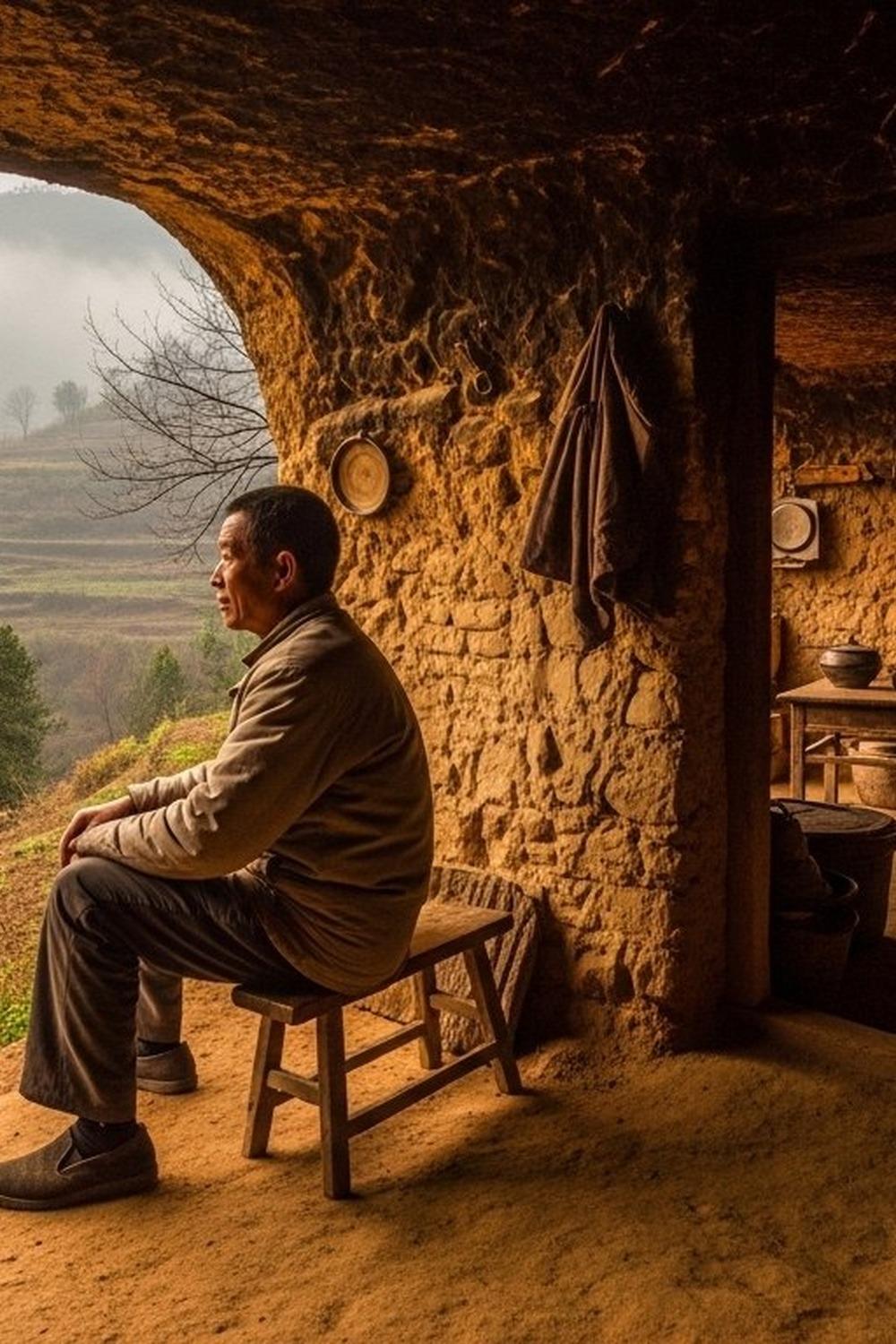
Forty thousand people are watching a man live in a cave. Min Hengcai isn’t a tech billionaire or a meditation influencer — he’s a former ride-hailing driver who crawled out from under $42,000 in debt by buying a hollowed-out hillside for $6,000 and learning to want almost nothing. Modern Chinese hermit cave life, it turns out, isn’t mystical. It’s arithmetic.
The story cuts through something important. He’s not performing simplicity. He wakes at eight because nothing wakes him earlier. He tends vegetables because they feed him. He hasn’t looked at a performance review in years because there’s no one left to perform for — except, paradoxically, the 40,000 strangers watching him not perform.
Key Facts
- Min Hengcai, a former ride-hailing driver, bought a hollowed-out hillside cave for $6,000 after accumulating $42,000 in debt.
- Min’s cave-dwelling livestream attracted 40,000 followers, generating enough ad revenue and donations to cover basic living costs.
- The Zhongnan Mountains south of Xi’an still shelter an estimated 600 to 1,000 hermits as of 2016 research.
- A 2023 Tsinghua University report found rural and slow-living content in China saw a 280% increase in engagement between 2019 and 2023.
- The average urban Chinese worker logged 2,174 hours annually in 2022 (International Labour Organization), versus 1,794 hours for German workers.
In short: Modern Chinese hermit cave life found its viral face in Min Hengcai, a former ride-hailing driver who crawled out from $42,000 in debt by buying a $6,000 cave in Sichuan. His livestream draws 40,000 followers, framing a 2,000-year-old withdrawal tradition as arithmetic against burnout and the gig economy.
Where This Came From — Two Thousand Years of Walking Away
At least 2,000 years ago, something in Chinese culture learned how to say no. Scholars and court officials began retreating from dynastic chaos into mountain solitude, and the tradition stuck — so thoroughly that historians at Peking University classified it in 2019 as its own philosophical genre, separate from religious monasticism, closer to what the West might call Stoic escape. Tao Yuanming, the 4th-century poet, abandoned a government post, returned to farming, and wrote lines about the suffocation of obligation that still read like a diagnosis.
Here’s what matters: Min Hengcai didn’t study the tradition and decide to emulate it. He collapsed under debt, lost everything moveable, and arrived at the same conclusion ancient court scholars had reached in the Han dynasty. When you strip away the noise, the cave is what’s left. There’s something almost genetic about that impulse in Chinese culture — it resurfaces every few generations, usually when the gap between official ambition and what a body can actually endure becomes too wide to ignore.
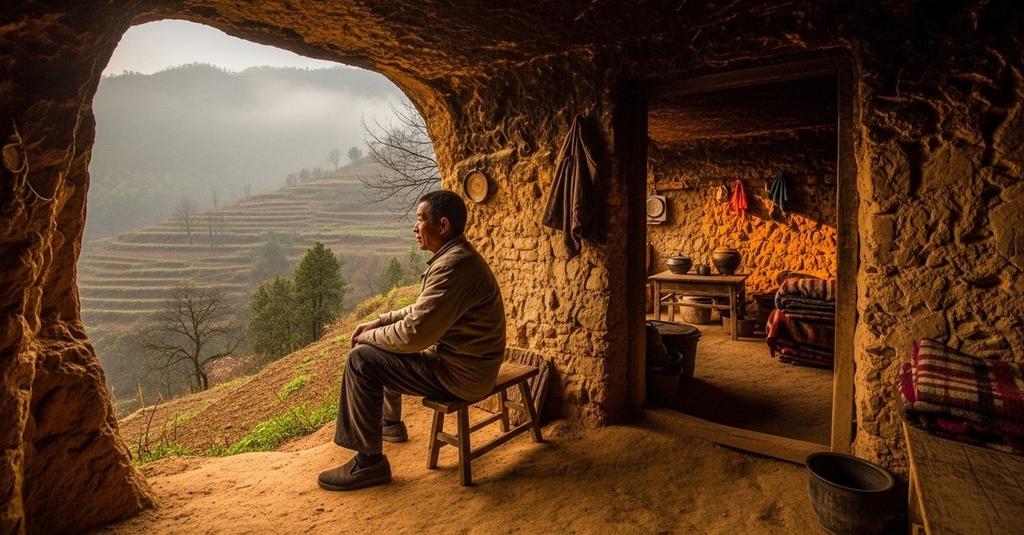
The Zhongnan Mountains south of Xi’an still shelter an estimated 600 to 1,000 hermits today, according to 2016 research documenting the tradition. Most are Taoist or Buddhist practitioners.
Min Hengcai is neither. He’s just tired. That distinction matters more than it seems.
The Economics of Opting Out — and Who Actually Gets to Do It
Here’s what the romanticized version leaves out: Min didn’t choose simplicity from comfort. He chose it from rubble. In rural Sichuan, $42,000 represented years of earnings for a working driver — an amount that compounds faster than hourly labor can repay. His relatives sold his properties to cover part of it. What remained was a smaller plot and a cave. The $6,000 renovation wasn’t design. It was survival engineering: insulation, plumbing, electricity, a bed.
Compare this to the Western “off-grid” movement. A 2021 analysis by University of Vermont researchers found that the median participant has savings or inheritance to fall back on. There’s a sealed ecosystem that sustains itself without external input — but for most humans, the hermit life requires a financial floor. Min’s floor was thinner than most.
And yet something shifted once he was inside. The cave gave him what debt never could: a fixed cost of living so low it became irrelevant.
He grows vegetables. He reads. He walks. The livestream generates enough ad revenue and small donations to cover what the garden doesn’t. Why does this matter? Because he isn’t escaping the economy — he found its lowest-friction corner and sat down in it. The cave isn’t a rejection of capitalism. It’s a negotiation with it that, for once, came out in his favor.
What Burnout Research Actually Says
Min’s choice looks eccentric until you place it against the data. The World Health Organization formally classified burnout as an occupational phenomenon in 2019. That same year, Fudan University in Shanghai published research showing that gig economy workers in China’s tier-one and tier-two cities reported burnout rates 34% higher than salaried counterparts — driven specifically by unpredictable income, relentless hours, and zero social protection. Min Hengcai was the textbook case before the textbook existed.
Ride-hailing drivers in China operate inside one of the most psychologically demanding labor structures ever devised: constant performance scoring, customer ratings that determine daily earnings, zero paid sick leave. But here’s the uncomfortable part: recovery isn’t primarily about rest. It’s about control.
A 2022 meta-analysis by Leiden University researchers covering 38 separate burnout recovery studies found that agency over one’s own time is more restorative than sleep duration, vacation length, or even social connection. Min wakes at 8 a.m. because he decided to. He sleeps at 10 p.m. because nothing is pulling him past that threshold. The cave isn’t therapy — but structurally, it delivers what therapy is trying to restore. Watching a structure work that elegantly, you stop dismissing it as escape.
Philosophy or Flight — The Question That Won’t Settle
The critics have a point. Withdrawal has always attracted two populations: those who worked through the world’s demands and stepped back with clear eyes, and those defeated by those demands who reframed defeat as philosophy. The Chinese intellectual tradition knows this distinction intimately. Song dynasty philosopher Cheng Yi, writing in the 11th century, warned explicitly against what he called “false retirement” — the performance of withdrawal without the genuine interior work to justify it. A man in a cave livestreaming to 40,000 followers would require some explaining in Cheng Yi’s framework.
And yet the audience exists, which is its own evidence. Those 40,000 followers aren’t watching because cave living is aspirational. Most live in apartments in Chengdu, Chongqing, or Shenzhen, commuting to jobs they tolerate. They watch because something in the image of a man tending vegetables at his own pace reaches them at frequencies standard content doesn’t. A 2023 Tsinghua University report found that rural and slow-living content in China saw a 280% increase in engagement between 2019 and 2023, with the largest growth among urban workers aged 25 to 40.
Min Hengcai isn’t selling a lifestyle. He’s holding up a mirror.
The actual question isn’t whether his choice is philosophically pure. It’s whether it’s working — and by every measure he controls, it appears to be. Health improved. Debt halted. Sleep restored. Peace achieved. For a man who once felt trapped under a $42,000 ceiling, that might be everything.
The Livestream Hermit and What He Reveals About Hunger
There’s a genuine paradox. The most watched hermit in China isn’t hidden. He has WiFi. He has a ring light, presumably. He has a content schedule.
Ancient Chinese hermit poets like Han Shan — the 9th-century monk whose Cold Mountain poems weren’t discovered until after his death — achieved influence through disappearance. Min achieves his through visibility. He calls the cave his “black hole,” a reminder of his smallness in the universe. But black holes, as it turns out, emit radiation. They’re not entirely invisible. Neither is he.
What this reveals about the contemporary moment is more interesting than Min himself. A global audience is hungry for images of slowed-down, low-stakes existence — not because everyone wants to live that way, but because the contrast is so violent. According to the International Labour Organization, the average urban Chinese worker logged 2,174 hours annually in 2022 — nearly 400 hours more than German workers and 200 more than American ones. Against that backdrop, a man reading a book in a cave at noon isn’t an oddity. He’s a provocation.
Every view is a private confession that the viewer, too, sometimes imagines stopping. Stand at the mouth of Min’s cave on a clear Sichuan morning, and you’d smell woodsmoke and wet earth. You’d hear very little. Birds. Wind moving across the hillside. That specific quiet that exists only where traffic can’t reach — it isn’t absence. It’s something his 40,000 followers can feel through a phone screen, which is exactly why they keep returning.
How It Unfolded
- 4th century CE — Tao Yuanming resigns his government post, returns to farming, and writes “Return to the Farm,” establishing the literary template for voluntary withdrawal that Chinese culture would revisit for 1,600 years.
- 11th century — Song dynasty philosopher Cheng Yi distinguishes between genuine and performative hermit withdrawal, creating a moral framework still cited in Chinese philosophical discourse today.
- 2016 — Researchers documenting the Zhongnan Mountain hermit communities estimate 600 to 1,000 active hermits still living in the range south of Xi’an, bringing international attention to the tradition’s survival.
- 2023 — Min Hengcai’s cave-dwelling content goes viral across Chinese social media platforms, accumulating 40,000 followers and sparking a national conversation about burnout, debt, and the limits of the gig economy.
By the Numbers
- $42,000 — the debt Min Hengcai accumulated during his years as a ride-hailing driver in Sichuan, which ultimately triggered his decision to sell his remaining land.
- $6,000 — the total renovation cost to convert a raw 50-square-meter cave into a livable dwelling with electricity, basic plumbing, and insulation.
- 40,000 — the number of social media followers Min’s cave-dwelling livestream attracted, generating enough revenue to cover basic living costs.
- 280% — the increase in rural and slow-living content engagement in China between 2019 and 2023, documented by Tsinghua University researchers in 2023.
- 2,174 hours — average annual work hours logged by Chinese workers in 2022, according to the International Labour Organization, versus 1,794 hours for German workers.
Field Notes
- Min Hengcai named his cave a “black hole” — not as a joke, but as a deliberate cosmological metaphor for self-erasure. The name has since been adopted by followers who describe their own fantasies of disappearing from the performance economy, creating an informal online community around the phrase.
- Cave dwellings in China’s loess plateau region — particularly in Shaanxi and Gansu provinces — maintain a near-constant interior temperature of 12 to 14 degrees Celsius year-round without mechanical climate control, making them naturally energy-efficient in ways modern architecture rarely achieves.
- The Zhongnan Mountain hermit community south of Xi’an includes former engineers, university professors, and at least one retired army officer — suggesting that voluntary withdrawal from high-status careers is as much a pattern as withdrawal from grinding low-wage work.
- Researchers still can’t determine whether the mental health benefits Min and others describe from cave living stem from the environment itself, the removal of social performance pressure, or simply the reduced cost of living — and whether those benefits persist beyond the first two years of transition.
Frequently Asked Questions
Q: What exactly is modern Chinese hermit cave life, and is it a new phenomenon?
Modern Chinese hermit cave life refers to contemporary voluntary withdrawal into cave or rural dwellings, often driven by burnout, debt, or rejection of urban productivity culture. The tradition stretches back over 2,000 years to the Han dynasty — what’s new is the visibility. Social media has allowed figures like Min Hengcai to build audiences of tens of thousands while living off-grid, creating a paradox that older traditions couldn’t have anticipated.
Q: How does Min Hengcai actually support himself financially in the cave?
Min relies on a combination of subsistence farming and social media income. His vegetable garden covers a significant portion of food costs, while his livestream following of 40,000 generates ad revenue and viewer donations through Chinese platforms. The cave’s fixed costs are extremely low — he spent $6,000 on initial renovation, and ongoing expenses are minimal. The WiFi costs roughly what a single tank of petrol would, making digital income a sustainable match for his stripped-back expenses.
Q: Isn’t this just avoidance — and does modern Chinese hermit cave life actually solve anything?
The avoidance critique misreads what burnout research actually shows. Recovery from occupational burnout is primarily driven by restored agency — the sense of control over one’s own time — not by rest alone. Min’s cave structure delivers exactly that. He didn’t solve his debt through the cave (relatives had already partially resolved it), but he solved the psychological framework that made more debt inevitable. Whether that’s philosophy or pragmatism, the outcome is difficult to argue with: improved health, zero new debt, stable routine.
Editor’s Take — Sarah Blake
What nobody in the “enlightened or running?” debate wants to admit is that the distinction might not matter. Min Hengcai reduced his cost of living below his income for the first time in years. The cave isn’t a philosophy — it’s a balance sheet that finally works. Sometimes the most radical act isn’t a manifesto. It’s just stopping the bleed.
Min Hengcai’s cave is 50 square meters. It cost $6,000. It has WiFi. It also has something most apartments in Chengdu, London, and New York don’t: a cost of living low enough that a single person can meet it without performing at a level that breaks them. That’s not a philosophy. That’s engineering. The real question his story forces isn’t whether he’s brave or broken — it’s why the alternative he found feels so impossible to most people watching him from their phone, in the dark, at midnight, still scrolling.
Illustrations are AI-generated. Article fact-checked and human-edited. Our editorial standards.