The Māori Tattoo That Changed New Zealand TV Forever
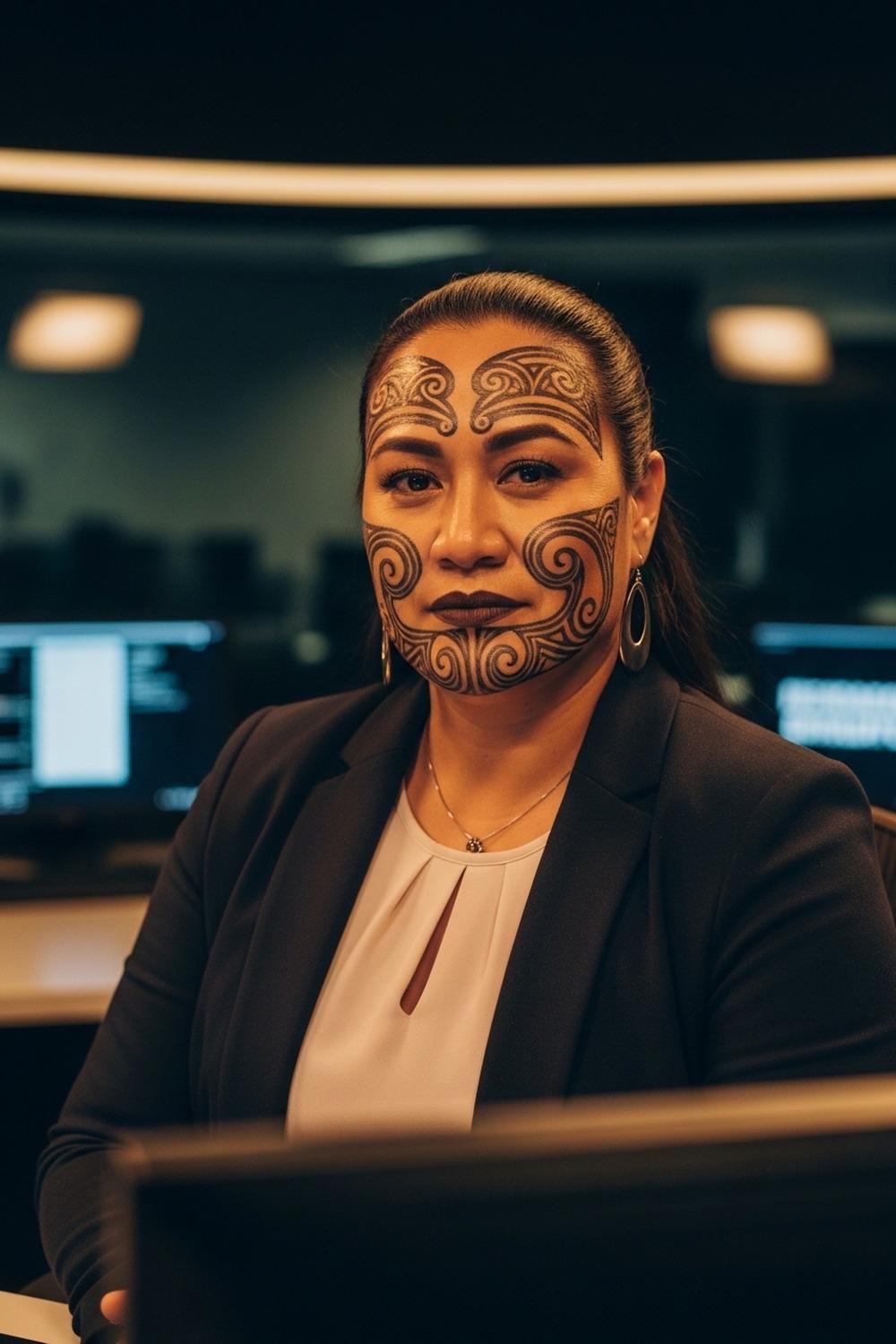
On Christmas night 2021, a moko kauae Māori tattoo appeared on primetime New Zealand television for the first time in nearly a century — and the person wearing it wasn’t asking for permission to do so. Oriini Kaipara sat at the Newshub desk, her chin marked with the genealogical lines of her ancestors, and read the 6 p.m. news as if this were the most ordinary thing in the world. The nation watched. Then it couldn’t stop watching.
What made that moment seismic wasn’t the tattoo itself. It was the collision between a woman living fully as herself and a broadcast system that had never encountered such a thing on camera before. The moko kauae isn’t decoration. It isn’t a choice about aesthetics. It is identity made permanent in skin, a genealogical record that carries whakapapa — the living lineage connecting her to every ancestor who wore those same patterns across centuries.
Key Facts
- On December 25, 2021, Oriini Kaipara became the first primetime news anchor in New Zealand broadcast history to deliver the 6 p.m. news on Newshub with a visible moko kauae.
- Oriini Kaipara received her moko kauae in 2019, two years before the broadcast that brought it global attention.
- Maori make up approximately 17% of New Zealand’s population according to the Stats NZ 2023 census.
- Traditional moko application used a chisel called an uhi, historically made from albatross bone, that cut grooves into the skin.
- The 1975 Maori land march led by Dame Whina Cooper is widely cited as a catalyst for the cultural renaissance that restored moko practices.
In short: The moko kauae Maori tattoo is a women’s chin marking encoding whakapapa, tribal affiliation, and standing. When Oriini Kaipara read New Zealand’s 6 p.m. news on December 25, 2021 wearing hers, it became the first primetime appearance in nearly a century and traveled globally within hours.
What a Moko Kauae Actually Carries
According to tāonga — the Māori concept of a culturally treasured possession — the moko kauae belongs to a woman’s whakapapa, her genealogical record, connecting her to every ancestor who wore those same patterns before colonisation attempted to erase them. It isn’t a tattoo in the way most of the world uses that word. It isn’t decoration. It isn’t fashion. It is, in the most literal sense possible, identity made permanent in skin. Each curve is a sentence. The whole face is a text that trained eyes can read in seconds.
The University of Auckland’s Te Wānanga o Aotearoa has documented that specific line patterns within a moko kauae indicate iwi (tribal) affiliation, hapū (sub-tribal) identity, and the wearer’s position within that lineage.
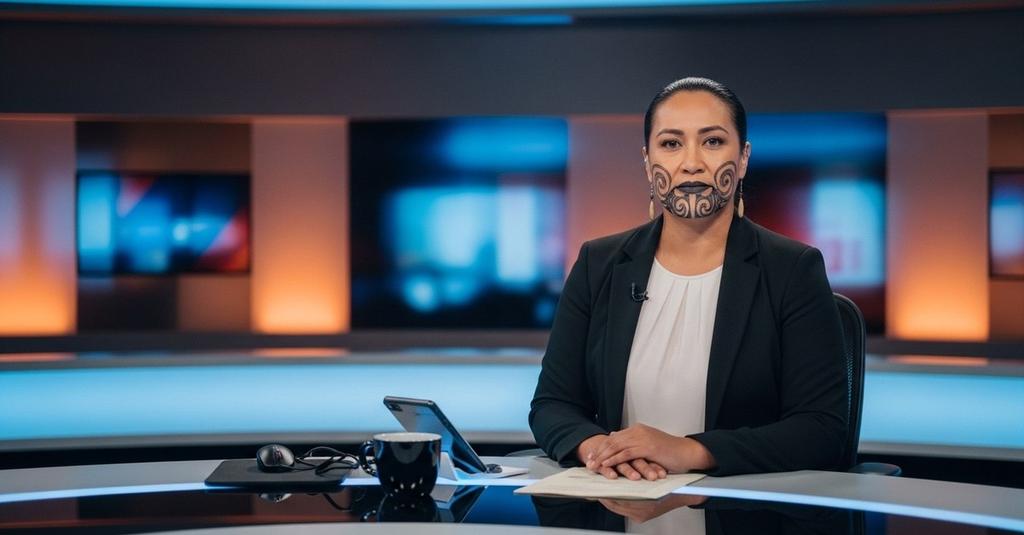
Oriini Kaipara received her moko kauae in 2019, after nearly two decades building her journalism career. She didn’t receive it once she’d arrived somewhere safe — she received it while still climbing, still proving herself inside an industry that had never looked like her. The timing matters because that’s a specific kind of courage, wearing your fullest self in a room that hasn’t decided whether it wants you yet. The moko kauae didn’t soften her professional image. It deepened it.
Traditional application used chisels made from albatross bone, cutting grooves rather than puncturing skin. Today, most practitioners use modern tattooing equipment while maintaining the ceremonial protocols that surround the process. The physical method has adapted. The meaning hasn’t moved an inch.
The Night New Zealand Saw Itself Differently
What happened next crossed oceans. Māori viewers described watching through tears. Indigenous communities across the Pacific and into North America shared her image with the kind of urgency that signals recognition — not admiration, recognition. There’s a difference between finding something beautiful and finding proof that you exist. And here’s the thing: the responses poured in immediately, which told you everything about what had actually been missing from that chair for a hundred years.
There’s a particular quality to representation that lands at the right moment — it doesn’t just include people, it restructures what they believe is possible. Oriini’s appearance behind the Newshub desk on December 25, 2021, did something that decades of diversity policy had failed to do: it made visible an identity that New Zealand television had treated, through a century of near-total absence, as incompatible with authority.
The response wasn’t universally celebratory. Some viewers complained about whether visible cultural identity was “appropriate” for a news presenter — an argument that reveals more about the complaint than the complained-about. What it exposed is that a century of unadorned, Pākehā-presenting news anchors had not been culturally neutral. It had been a specific cultural choice, rendered invisible by dominance. Oriini’s moko kauae didn’t introduce culture into the newsroom. It made the existing cultural assumptions legible.
Newshub’s decision to put her in that chair on Christmas night — watched by one of the year’s largest audiences — was not accidental.
It was a deliberate act of editorial courage by a broadcaster that knew exactly what it was doing. Some calls take institutional nerve, not just individual bravery.
Colonisation and the Long Silencing of Moko
To understand why Christmas night 2021 felt so seismic, you need to understand what the preceding century actually erased. When British colonisation accelerated through the mid-1800s, moko — across all its forms — became stigmatised by missionaries and colonial administrators who consistently portrayed facial tattooing as evidence of savagery, something to be shed on the path to “civilisation.” By the early twentieth century, the practice had contracted dramatically. Children were punished in schools for speaking te reo Māori, the Māori language. Cultural practices tied to identity and whakapapa were pushed underground or abandoned under sustained social pressure.
As documented by the Smithsonian’s extensive coverage of Māori tattooing history, the suppression of moko was not incidental to colonisation — it was part of its architecture, a targeted dismantling of the visual language through which Māori people communicated identity, belonging, and sovereignty.
The revival began gaining momentum in the 1970s, inseparable from the broader Māori cultural renaissance. But the political energy of the 1975 land march — led by Dame Whina Cooper — and the radical cultural reclamation that followed created new space for practices like moko to return. (Te Ao Hou, the Māori magazine, had been documenting traditional arts since 1952, but this was different — this was institutional power shifting.) By the 1990s, tohunga tā moko (master tattoo practitioners) were actively training again. The revival wasn’t nostalgia. It was resistance with a long memory.
What Oriini stepped into in 2021 was not a sudden cultural moment. It was the visible tip of fifty years of slow, deliberate reclamation.
How the Moko Kauae Māori Tattoo Travels the World Now
After December 25, 2021, Oriini Kaipara’s image didn’t stay in New Zealand. Indigenous news outlets in Australia picked it up immediately. Pasifika communities in the United States and Canada shared it widely. Journalists in Taiwan, where Indigenous tattooing traditions among the Atayal and Seediq peoples had faced their own colonial suppression, wrote about what her appearance meant to their own ongoing cultural recovery. The University of Hawai’i’s Hamilton Library, which archives Pacific cultural documentation, began fielding researcher inquiries specifically about Māori tattooing’s visibility in media contexts within weeks of the broadcast.
It moved the way things move when they answer a question people didn’t know they were asking.
Why does visibility in one newsroom create permission elsewhere? Because suppressed cultural practices don’t just become visible to outside audiences when they appear in dominant media contexts — they become more viable to community members who’ve been weighing the professional cost of cultural expression. Young Māori women reported, in the weeks after Oriini’s broadcast, reconsidering decisions they’d put on hold. Some had delayed receiving their moko kauae specifically because they feared professional consequences. Seeing someone in the most public media seat in the country changed their calculation. Representation doesn’t just reflect reality. It reshapes what people believe they’re allowed to attempt.
There’s a mechanism at work here that goes beyond inspiration. But Oriini herself has spoken directly about this responsibility, and what she said matters more than what was said about her. “I didn’t do this for myself,” she said in interviews following the broadcast. She wore her whakapapa for every woman who came before her, and for those still deciding whether the world has room for them as they are. The pressure of carrying that forward to a news desk — it’s not small.
How It Unfolded
- Pre-1800s: Moko kauae worn widely among Māori women as a core expression of whakapapa, social standing, and tribal identity across Aotearoa New Zealand.
- Mid-1800s–early 1900s: British colonisation and missionary influence actively suppressed moko practice; by the early twentieth century the tradition had contracted to near-disappearance in many regions.
- 1970s–1990s: The Māori cultural renaissance, galvanised by political movements including the 1975 land march, began reversing the suppression; tohunga tā moko trained new practitioners and the practice gradually re-emerged.
- 2019: Oriini Kaipara receives her moko kauae, a personal act embedded in twenty years of journalism career, two decades spent in a profession that had never made space for this identity.
- December 25, 2021: Oriini delivers New Zealand’s 6 p.m. news on Newshub with her moko kauae visible — the first primetime news anchor to do so in the country’s broadcast history. The image travels globally within hours.
By the Numbers
- Nearly 100 years: the approximate span of broadcast television history in New Zealand during which no primetime news anchor appeared on screen with a moko kauae — until December 2021.
- ~17%: Māori make up approximately 17% of New Zealand’s population (Stats NZ, 2023 census), yet their representation in senior media roles has historically remained far below this proportion.
- 1975: the year of the landmark Māori land march led by Dame Whina Cooper, widely cited as a catalyst for the broader Māori cultural renaissance that eventually restored practices including moko kauae.
- 2019: the year Oriini received her moko kauae — two years before the broadcast that brought it to global attention, demonstrating that the decision was personal first, and public second.
- Dozens of Indigenous media outlets across at least 5 countries shared Oriini’s image within 48 hours of the Christmas 2021 broadcast, according to subsequent media tracking reported by New Zealand journalism researchers.
Field Notes
- The traditional application of moko used a chisel called an uhi — historically made from albatross bone — that cut grooves into the skin rather than puncturing it, producing a textured, ridged surface that was distinctly different from a flat tattoo. Some contemporary tohunga tā moko use modern equipment while maintaining this understanding of depth and dimension.
- Moko kauae is specifically a women’s mark — worn on the chin and lower lip. Men’s traditional facial tattooing is called tā moko and covers different facial regions. The two are related but distinct, with their own protocols and meanings.
- In some iwi traditions, the right to wear certain moko patterns must be granted — it’s not purely an individual decision. The patterns are, in a sense, held collectively by the lineage, and the wearer is custodian rather than owner.
- Researchers and cultural practitioners still debate the boundaries of who may appropriately receive moko kauae, particularly regarding Māori people with complex or interrupted genealogical connections. The protocols surrounding consent, lineage verification, and tohunga authority in these cases remain a live and sometimes contested conversation within Māori communities themselves.
Frequently Asked Questions
Q: What does a moko kauae Māori tattoo actually mean, and who can wear one?
A moko kauae is a traditional Māori women’s facial tattoo worn on the chin and lower lip. It isn’t decorative — each pattern encodes the wearer’s whakapapa (genealogy), tribal affiliation, and social standing. Traditionally, and in most contemporary practice, it’s worn by women of Māori descent. The specific right to wear certain patterns is often a matter of consultation with iwi elders and tohunga tā moko, the master practitioners who hold the knowledge to design and apply them appropriately.
Q: Why had no New Zealand news anchor worn a moko kauae on primetime television before Oriini Kaipara in 2021?
The absence reflects colonisation’s long cultural shadow. Through the nineteenth and twentieth centuries, moko was actively suppressed — stigmatised as incompatible with Western professional norms. Even as the Māori cultural renaissance recovered the practice from the 1970s onward, media industries maintained unspoken standards that effectively excluded visible Māori cultural identity from positions of broadcast authority. No explicit rule said “no moko.” The pressure was structural — a century of one kind of face in that chair, normalised into invisible expectation.
Q: Is a moko kauae the same as tā moko, and are non-Māori people allowed to get one?
They’re related but distinct. Tā moko is the broader practice of Māori tattooing, which includes facial and body patterns worn historically by both men and women. Moko kauae refers specifically to women’s chin and lower-lip markings. Non-Māori people are generally not considered appropriate recipients of moko kauae — this is a broadly held view within Māori communities, grounded in the understanding that these marks carry whakapapa that belongs to Māori lineages. Wearing them without that connection is widely regarded as cultural appropriation, not cultural appreciation.
Editor’s Take — Sarah Blake
What strikes me hardest about Oriini’s story isn’t the broadcast itself — it’s the two-year gap between receiving her moko kauae in 2019 and appearing on screen with it in 2021. She wasn’t waiting for permission. She was already living as herself, and the television eventually had to catch up. The courage happened privately first, while cameras were still looking elsewhere. Watching a woman carry her ancestors into a room built to exclude them, you stop calling it representation. It’s something older than that, and more necessary.
A single broadcast on Christmas night, watched by a country in the middle of summer holidays, did something that decades of diversity rhetoric hadn’t managed: it made a century of absence suddenly legible. When a face carries the lines of its ancestors into a room that was built to exclude them, it doesn’t just represent change. It is the change, happening in real time, in front of a nation that had to sit with what it was seeing and decide what it believed. What does it mean for a country to look at itself and finally recognise a face it had kept off-screen for a hundred years?
Illustrations are AI-generated. Article fact-checked and human-edited. Our editorial standards.