The Fox Who Became a Farmer’s Unlikely Ally
A farmer in rural England stopped losing vegetables the night he stopped trying to kill the thief. The vixen at his field margin wasn’t interested in his crops — she was interested in the voles and rabbits destroying them. This red fox commensal relationship began as accident and ended as something neither of them expected: partnership. The standoff that started with tracks in the soil became the most effective pest control he’d ever deployed, and he never bought a single pesticide to make it work.
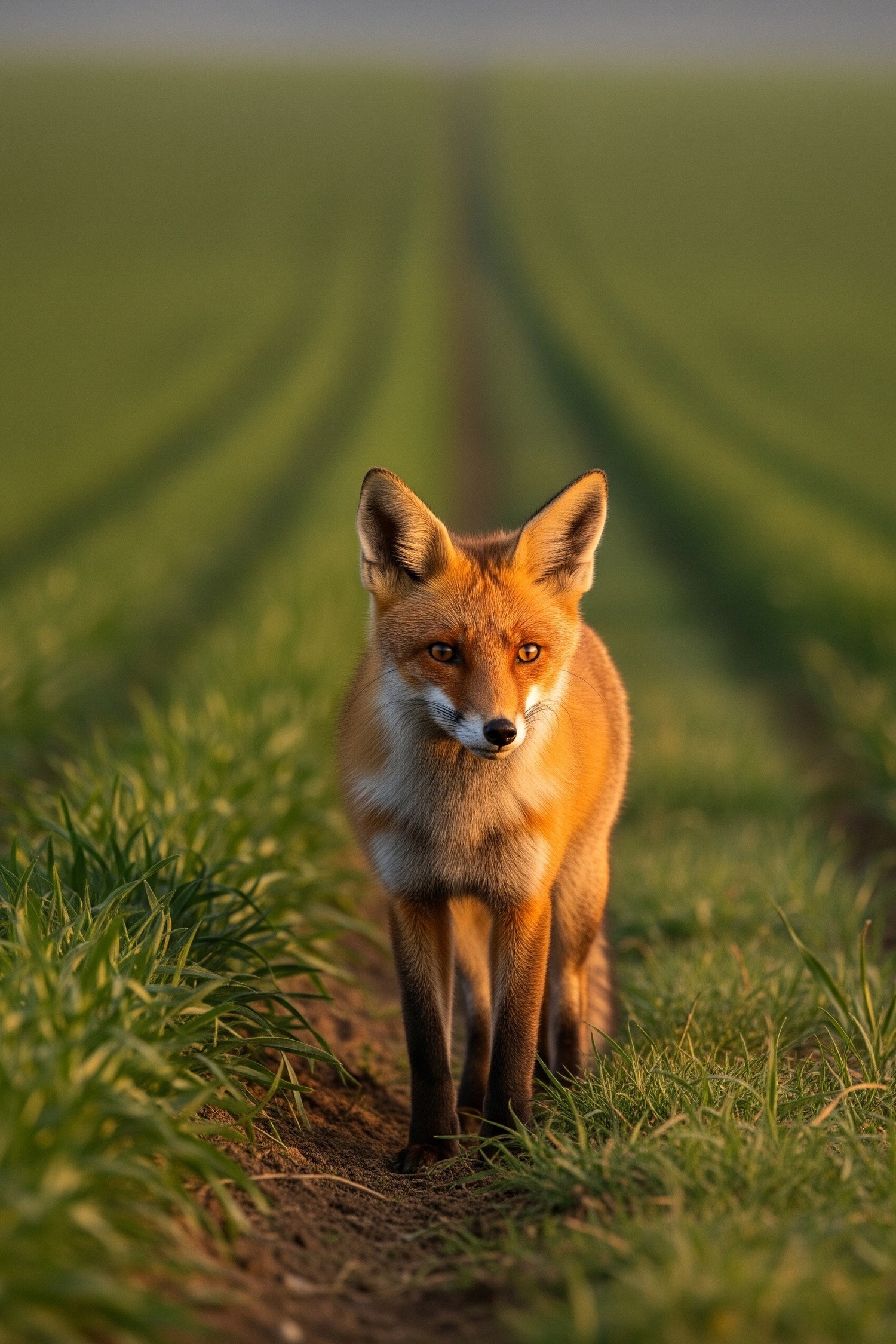
Night after night, a russet shape slipped along the hedgerow. The patterns were deliberate, too consistent to be random foraging. When he finally stopped trying to scare it off, what happened next confounded everything he thought he knew about foxes.
Key Facts
- The British red fox population is estimated at roughly 357,000 individuals (Mammal Society, 2018 national survey).
- A single adult red fox consumes between 1,000 and 1,500 small rodents per growing season (Game & Wildlife Conservation Trust).
- Farmland with established resident fox territories showed 23% lower field vole density than adjacent unoccupied land (UK Centre for Ecology and Hydrology, 2021).
- A 2022 Wageningen University study found each resident fox removed an average of 847 voles and 412 rabbits per season on Gelderland organic farms.
- Fields with multi-year fox residency showed root crop damage rates 31% lower than fox-excluded fields in the Wageningen study.
In short: A red fox commensal relationship lets a farm benefit from a fox preying on crop-destroying voles, mice and rabbits while the fox gains shelter and food proximity. Research shows resident foxes cut vole density 23% and root crop damage up to 31%, providing chemical-free, season-on-season pest control.
How a Red Fox Becomes a Farming Partner
Vulpes vulpes — the red fox — occupies every continent except Antarctica. The British population alone is estimated at roughly 357,000 individuals, according to the Mammal Society’s 2018 population survey. That number rises sharply each spring when litters are born. What most people don’t know is that foxes are opportunistic generalists in the truest ecological sense. They don’t simply take what’s easy. They take what’s available, and in farmland Britain, that’s a buffet of exactly the animals that destroy crops.
A single adult red fox will consume between 1,000 and 1,500 small rodents per season, according to research published by the Game & Wildlife Conservation Trust. Voles, mice, rabbits, ground beetles — the same organisms that tunnel through root systems and strip seedlings overnight. The vixen in this story wasn’t unusual in her behavior. She was doing exactly what red foxes do.
What was unusual was the farmer’s response. Instead of a trap or a rifle or a call to pest control, he left food out near the field margin. A small gesture. A pile of kitchen scraps beside a fence post. She came back. And when she came back regularly, fed and unafraid, she began to hunt the field with the kind of sustained focus she’d previously only brought to her kits’ survival. The pest pressure on his brassicas dropped noticeably within two growing seasons. It’s a quiet story. No cameras, no press releases. But it’s the kind of quiet story ecologists have been trying to tell farmers for decades, and mostly failing.
The Science Behind This Accidental Alliance
Wildlife ecologists use the term commensal to describe a relationship where one species benefits and the other is unaffected. But what happens on working farms is often something closer to mutualism — both parties gain. It’s the same dynamic at play in other unexpected animal partnerships. Consider how crows engage in elaborate behaviors to maintain their own health, as detailed in the story of crows lying motionless on the forest floor, letting foraging ants flood their feathers with formic acid to kill parasites.
The animal world is full of relationships that look purposeless until you understand the mechanism. The University of Bristol’s Mammal Research Unit published findings in 2019 showing that red fox territories on mixed farmland in the West Country overlap almost entirely with the highest concentrations of small mammal pests. The foxes weren’t there by accident. They were drawn by the same gradient of food that makes those fields vulnerable in the first place. Here’s the thing: the mechanism is elegantly simple.
A vixen with dependent kits needs to provision them around the clock. A litter of four to six cubs requires roughly two to four prey items per hour during peak demand in May and June. That hunting pressure — sustained, nocturnal, territorially concentrated — functions as a biological control agent with a level of precision that chemical pesticides can’t replicate. Pesticides kill broadly. A fox kills selectively, targeting the animals actively moving through the crop zone.
In a 2021 analysis by the UK Centre for Ecology and Hydrology, farmland with established fox territories showed a 23% lower density of field voles compared to adjacent land without resident foxes. The farmer hadn’t engineered any of this. He’d simply made the fox feel safe enough to stay, and that turns out to be most of the work.
Why Farmers Have Ignored This for So Long
Fox persecution in British agriculture has a long and entrenched history. For centuries, the dominant narrative was damage — poultry raids, lamb predation, crop disturbance. That narrative isn’t wrong exactly. It’s incomplete. A 2020 report from the Smithsonian’s National Zoo and Conservation Biology Institute examining predator-human conflict across Europe noted that tolerance thresholds for foxes are shaped far more by cultural inheritance than by measured economic loss. Farmers who had experienced direct livestock loss were no more likely to persecute foxes than those who hadn’t — but farmers whose neighbors or parents had lost livestock were significantly more likely to. The bias is transmitted socially, not experientially.
That’s a crucial distinction. It means the barrier to accepting a red fox commensal relationship isn’t really evidence. It’s story. The red fox commensal relationship also challenges a deeply held idea about control. Farmers are managers. They manage soil chemistry, seed timing, moisture levels, pest populations.
But a fox operates outside that management framework entirely — autonomous, unpredictable, impossible to schedule. Accepting a fox into the farm system means accepting a degree of wildness that most agricultural culture has spent generations eliminating. (Researchers actually call this the “domestication paradox” — the more we control a system, the more vulnerable it becomes to the variables we can’t control.) That psychological shift is harder than any practical adjustment. It requires a farmer to stop thinking of the hedgerow as the boundary between order and chaos, and start thinking of it as part of the farm itself. The English farmer who started this story made that shift intuitively. He didn’t read the literature. He just watched, and waited long enough to see what the fox was actually doing.
Red Fox Commensal Relationships Across Farmland Europe
Documented red fox commensal relationships have been recorded in farmland systems from the Loire Valley in France to the Po Valley in northern Italy, where mixed arable and livestock farming creates precisely the habitat mosaic that foxes exploit most effectively. The English case isn’t isolated.
Research published in the journal Agriculture, Ecosystems and Environment in 2022 by a team at Wageningen University in the Netherlands tracked seventeen individual foxes across organic farms in Gelderland province over three growing seasons. GPS collar data showed that eleven of the seventeen individuals spent more than 60% of their nocturnal foraging time within active crop margins — exactly where pest density is highest. The study calculated that each resident fox removed an average of 847 voles and 412 rabbits per season from the monitored fields. Why does this matter? Because those numbers compound in ways that pesticides never do. A female with a territory will hold that ground for three to five years. If she raises two litters successfully — typically four to six kits each — and those kits establish adjacent territories before dispersal, the biological pressure on local pest populations builds year on year.
The Wageningen team found that fields with multi-year fox residency showed root crop damage rates 31% lower than fields where foxes had been actively deterred or removed. No chemical intervention matched that figure consistently across the study period. The red fox commensal relationship, when allowed to establish, acts like a slow-growing perennial — it gets stronger with time rather than requiring repeated application. Watching a population of crop damage drop by nearly a third without a single spray bottle touched, you realize how much of modern farming has been solving yesterday’s problem with tomorrow’s chemicals.
Farmers in the study reported mixed feelings. Most acknowledged the data. Fewer were willing to stop shooting foxes on sight. One Dutch farmer, Pieter van den Berg of Lingewaard, changed his mind after the second season of collar data. He’d been skeptical. The GPS tracks converted him — because the fox on his farm was doing something he genuinely couldn’t do himself.
Where to See This
- The Cotswolds and Somerset Levels in England offer some of the best opportunities to observe foxes working farmland margins at dawn and dusk, particularly between March and June when vixens are actively provisioning litters — public footpaths through mixed arable land are ideal vantage points.
- The Game & Wildlife Conservation Trust (gwct.org.uk) runs ongoing farmland predator research in the UK and publishes accessible summaries of fox-prey interaction data for landowners and naturalists.
- For practical engagement, the People’s Trust for Endangered Species (ptes.org) offers guidance on creating wildlife-friendly farm margins that encourage predator residency as part of integrated pest management — a good first read for any farmer skeptical of chemical-free approaches.
By the Numbers
- 357,000 — estimated population of wild red foxes across the British Isles (Mammal Society, 2018 national survey)
- 1,000–1,500 small rodents consumed by a single adult red fox per growing season, according to the Game & Wildlife Conservation Trust
- 23% — reduction in field vole density recorded on farmland with established resident fox territories compared to adjacent unoccupied land (UK Centre for Ecology and Hydrology, 2021)
- 847 voles and 412 rabbits — average seasonal removal per resident fox across monitored organic farms in Gelderland, Netherlands (Wageningen University, 2022)
- 31% — reduction in root crop damage rates on fields with multi-year fox residency compared to fox-excluded fields, across the same three-season Wageningen study
Field Notes
- Red foxes use a distinctive high-arc pounce — launching vertically before driving the snout into the ground — to pinpoint voles beneath snow or dense grass cover. The technique relies on magnetic field sensing, confirmed by a 2011 study from Charles University in Prague showing that foxes orient their pounces preferentially toward the north-northeast, likely using Earth’s geomagnetic field as a targeting aid.
- A vixen doesn’t share her territory with other adult females — but she will sometimes tolerate her own daughters remaining as non-breeding helpers through a second season, effectively creating a hunting team that increases prey removal pressure without expanding the territorial footprint.
- The beetles that damage root crops — particularly click beetles whose larvae attack potato and carrot systems — are a significant but underreported component of fox diet. Foxes will forage soil surfaces for beetle larvae on warm nights, functioning as an insectivorous predator as well as a rodent controller.
- Researchers still can’t reliably predict which individual foxes will establish stable farm territories versus those that remain transient. What triggers residency appears to involve both food security and disturbance levels, but the weighting between those factors — and whether personality differences between individual foxes play a role — remains unresolved.
Frequently Asked Questions
Q: What exactly is a red fox commensal relationship and how does it benefit farmers?
A red fox commensal relationship describes the ecological dynamic in which a fox living near or within a farm benefits from the shelter and food proximity the farm provides, while the farm gains from the fox’s predation on pest species. In practice, researchers at the UK Centre for Ecology and Hydrology found in 2021 that farmland with resident foxes had 23% lower vole densities than fox-free land. Over a full growing season, that translates into measurable reductions in root crop damage — without any chemical input.
Q: Will a resident fox attack poultry or lambs if encouraged to stay near a farm?
It’s a real risk, and it shouldn’t be dismissed. Foxes are opportunists, and a poorly secured henhouse is a genuine vulnerability. The key distinction ecologists make is between a fox that’s provisioned regularly and habituated to human activity — which tends to show more predictable, range-stable behavior — and a transient fox acting under desperation, which is more likely to raid. Research from the Mammal Research Unit at Bristol University suggests that foxes with established territories near farms rarely target secured poultry because the energetic cost-benefit doesn’t favor it when small mammals are abundant. Basic biosecurity — locked coops, reinforced runs — resolves most conflict.
Q: Is it legal to feed or deliberately encourage foxes near farmland in the UK?
Yes, entirely legal. The Wildlife and Countryside Act 1981 protects foxes from certain methods of killing but doesn’t restrict supplementary feeding or deliberate habituation. What’s sometimes misunderstood is that encouraging foxes doesn’t mean losing control of your land. It means trading one form of pest management — trapping, poisoning, shooting — for a biological one. The tradeoff requires patience. A fox needs one to two seasons to establish reliable territorial behavior, and the pest reduction benefits typically don’t become statistically significant until the second full growing season.
Editor’s Take — Alex Morgan
What strikes me about this story isn’t the fox. It’s the waiting. The farmer who watched for weeks without reaching for a trap made a choice that most agricultural culture trains people out of making. We’ve built entire industries around the idea that wildness on a farm is a problem to be solved quickly. What the data from Wageningen and Bristol actually suggests is that the fastest solution — remove the predator — is also the one that keeps the pest problem permanent. The fox isn’t the interruption. She’s the correction.
There are roughly 357,000 red foxes moving through the British countryside right now, most of them regarded as nuisances to be managed down. But at the edge of every field where one has been allowed to stay — really stay, season after season, raising kits in the hedgerow — the soil biology is different, the vole tunnels shallower, the crop loss quieter. We’ve spent centuries engineering wildness out of farmland. The foxes have been offering a different arrangement the whole time. The question isn’t whether it works. The question is whether we’re finally ready to watch long enough to see it.
Illustrations are AI-generated. Article fact-checked and human-edited. Our editorial standards.