Sea Wolves: The Ocean-Swimming Wolves of British Columbia
Most animals recognize a boundary between forest and ocean. Wolves patrolling the coasts of British Columbia never got that memo. For thousands of years, sea wolves British Columbia have been swimming open straits, hunting seals on rocky islands, and feeding their bodies on salmon — all while the rest of the world assumed wolves were mountain animals, period. The genetic evidence arrived late: these animals carry mitochondrial DNA markers found nowhere else on Earth.
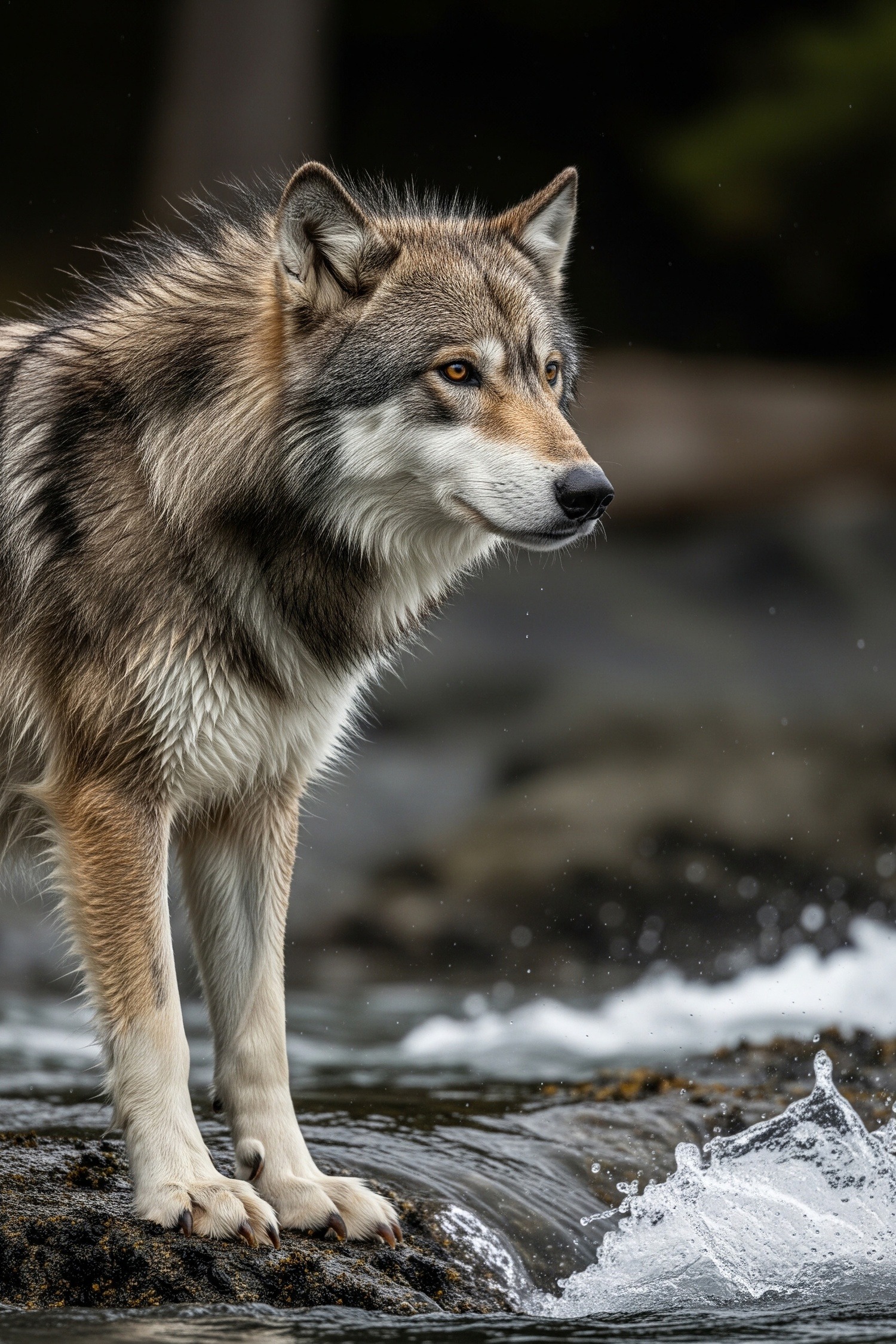
Their inland cousins chase elk through snow-thick valleys. Coastal wolves do something stranger. They work the beach at low tide, cracking barnacles open with their teeth, stalking seals in the surge, gorging on salmon that run upstream through ancient forest. In some territories, seafood accounts for more than 90% of their annual diet.
And for most of recorded human history, the outside world had no idea any of this was happening.
Key Facts
- For some coastal wolf packs in British Columbia, 90% or higher of the annual diet consists of marine-derived food sources (University of Victoria, Darimont et al., 2008).
- Coastal wolves carry unique mitochondrial DNA markers not found in any other wolf population on Earth.
- A coastal wolf was documented swimming more than 7.5 kilometres of open ocean between islands in 2014, with visits to over 700 individual islands recorded.
- The estimated global population of genetically distinct sea wolves is 150 to 250 individuals in the Great Bear Rainforest (Raincoast Conservation Foundation, 2020).
- The Great Bear Rainforest spans 6.4 million hectares, larger than Ireland, and trophy hunting bans covering core habitat took effect in 2016.
In short: Sea wolves British Columbia are a genetically distinct coastal wolf lineage in the Great Bear Rainforest that swim open straits, hunt seals, and feed on salmon, with marine sources exceeding 90% of some packs’ diets. Only 150 to 250 individuals remain, carrying unique mitochondrial DNA found nowhere else on Earth.
Wolves of the Tide: A Species Reexamined
The Great Bear Rainforest stretches along the central and north coast of British Columbia — 6.4 million hectares of temperate rainforest, longer than Ireland and wilder than almost anywhere left in North America. In the early 2000s, researchers from the University of Victoria began genetic sampling of the coastal wolf populations living there. What they found stopped them short. These wolves weren’t just behaving differently from their inland relatives. Genetically, they were distinct.
Chris Darimont, a conservation scientist who has spent decades studying predator ecology in the region, led research that revealed the full picture. The coastal wolf carries unique mitochondrial DNA markers not found in any other wolf population on Earth. His team estimated that this divergence likely began thousands of years ago — a moment when certain wolves started exploiting the extraordinary abundance of the Pacific coastline and never looked back.
Why does this matter? Because it wasn’t just behaviour that changed. Here’s the thing: these animals underwent physical transformation.
Skull morphology shifted slightly. Body size became leaner. Behaviour calibrated itself to tidal rhythms instead of ungulate migrations. In 2018, a study published in Ecology and Evolution confirmed what the bones were already telling researchers: coastal wolves showed isotopic signatures that matched marine mammal predators far more closely than terrestrial carnivores. Chemically, their skeletons looked more like orca than wolf.
That’s not poetic language. That’s bone chemistry speaking.
These animals have been eating the ocean long enough for it to show up in their skeletons. The sea didn’t just change their habits.
What They Actually Eat — And How They Hunt It
Low tide on a rocky point. Watch a sea wolf work, and you start to understand the full range of what this animal has become. They move with a patience that looks almost feline — flipping rocks with their snouts, crunching through mussel shells and barnacles, occasionally wading shallow to pin a fish. Patience collapses entirely during salmon season. The pace becomes urgent then. Coastal wolves follow the runs upstream into old-growth forest, feasting on pink, coho, and chum salmon the way bears do — selectively eating the brain and eggs, leaving the carcasses to rot into the forest floor.
This matters enormously to the forest itself. Marine-derived nutrients that cycle through salmon bodies end up in old spruce and cedar trees. A chain of connection as intricate as anything in the ocean. The same nutrient flow that happens when sockeye salmon carry ocean minerals deep into river systems — a pattern explored in detail in this piece on how salmon runs feed entire forest ecosystems.
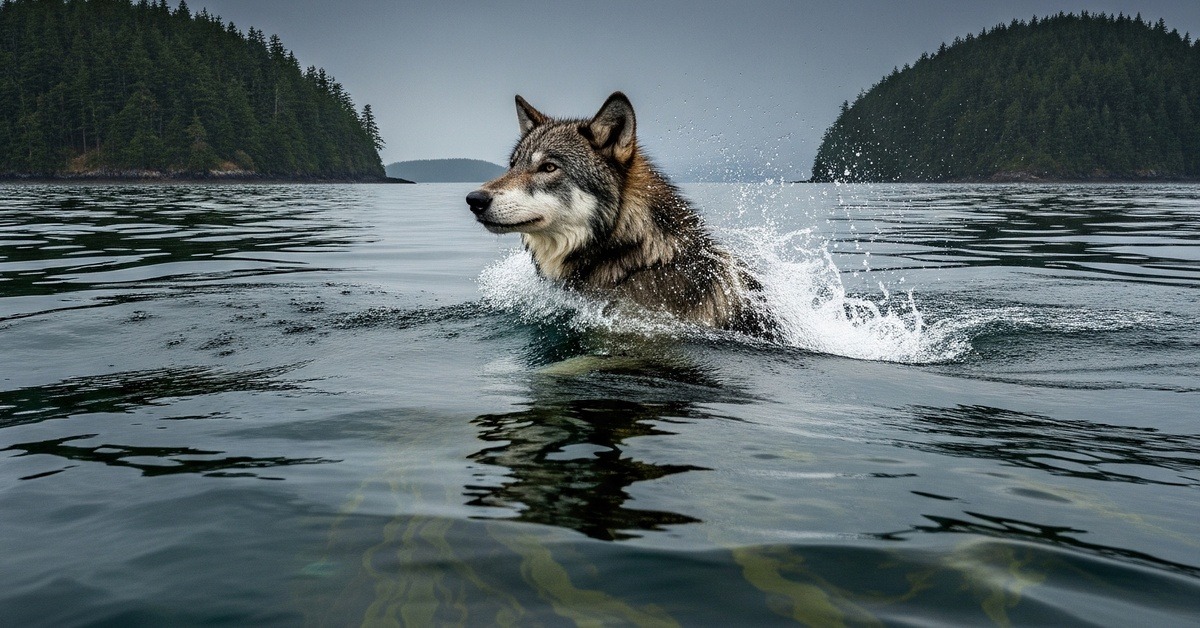
Seal hunting requires a different skill set entirely. Researchers with the Raincoast Conservation Foundation documented wolves in the Broughton Archipelago using a tactic that looks calculated: ambushing harbour seals on haul-out rocks, waiting at the waterline for the tide to pin the seals between surf and stone. In 2014, camera trap footage captured a coastal wolf swimming more than 7.5 kilometres between islands, crossing open strait in rough water without hesitation. Over 700 individual islands have been visited by these wolves across the region. They move through this seascape systematically, seasonally, with evident knowledge of the terrain — the way wolves elsewhere move through a forest.
The swimming itself deserves a full pause. Grey wolves can swim, sure. But coastal wolves do it constantly, routinely, as part of their daily range. Slightly wider paws than inland wolves carry — (researchers actually call this a potential paddle adaptation, though confirmation is still pending) — might assist in the water, though it remains unconfirmed. Either way, the Pacific doesn’t stop them.
The Forest That Feeds the Wolf That Feeds the Forest
What happens when a wolf drags a salmon carcass into the forest? Nitrogen enters the soil. Marine nitrogen — the dense, isotopically distinct kind that comes from the open ocean, thousands of kilometres away. Deposits it directly into old-growth earth. Trees near salmon streams in the region show measurably higher growth rates.
The wolves are, in a very real sense, gardeners of the rainforest.
Remove them, and the flow of marine nutrients from sea to forest slows. The trees grow differently. The whole system drifts. A National Geographic investigation into coastal wolf ecology documented how the loss of large predators from coastal rainforest systems triggers cascading effects that take generations of forest growth to become visible. Which is exactly why they went unnoticed for so long.
Sea wolves British Columbia also shape intertidal ecology directly. Hunting on beaches regulates how often marine mammals use certain haul-out sites, which affects how much kelp and seagrass gets grazed, which in turn affects nearshore fish habitat. Scientists at the Hakai Institute, a research station on Calvert Island conducting continuous ecological monitoring since 2011, have been piecing this web together strand by strand. What they’re finding is something that rewrites the textbooks: wolves aren’t peripheral to marine ecosystems. They’re structurally embedded in them, part of the foundation.
But we think of ocean ecosystems as separate from terrestrial ones. A line at the waterline, clean and absolute. Sea wolves never signed up for that boundary.
Sea Wolves British Columbia: Threatened by the Invisible
Despite their ecological weight, sea wolves British Columbia face pressures that are easy to underestimate precisely because they’re so hard to see. Sport trophy hunting of wolves has been legal in British Columbia for decades. Between 2012 and 2015, provincial wolf culls killed hundreds of wolves across the province. Official justification: protecting caribou herds. Reality: conservation scientists including Darimont publicly challenged both the evidence base and the geographic scope of those culls. Coastal wolves, with their restricted island ranges and small pack sizes, face disproportionate vulnerability. A single hunt that removes a breeding pair from an island territory can collapse an entire pack, leaving the land empty for years.
Population estimates are difficult to pin down precisely. Dense rainforest. Thousands of islands. Limited road access. The Raincoast Conservation Foundation, conducting non-lethal wolf research in the region since 1999, estimates the total coastal wolf population across the Great Bear Rainforest at somewhere between 150 and 250 individuals. That’s the entire global population of a genetically unique lineage. Watching a species this distinct, this few in number, persist on an island-by-island basis, you stop calling it conservation and start calling it a lottery. For comparison: Yellowstone National Park holds more wolves than exist in all of British Columbia’s coastal rainforest.
In 2016, after sustained pressure from Indigenous nations — Heiltsuk, Gitga’at, and Kitasoo/Xai’xais, whose territories encompass the core of the coastal wolf range — British Columbia expanded protections within the Great Bear Rainforest agreement. Trophy hunting was banned in significant portions of the region. It was meaningful.
Whether it was enough remains an open question.
The Indigenous Memory That Science Is Still Catching Up To
Here’s what stops you: the coastal First Nations of British Columbia have known about these wolves for thousands of years. The sea wolf appears in Nuu-chah-nulth oral tradition sometimes called “Rou-Garu,” woven into totem poles, crest art, ceremonial objects across dozens of distinct nations along the coast. To the people who lived alongside it, this animal was never mysterious. The wolf that swims between islands. The wolf that hunts the shore. The wolf that moves between forest and sea — common knowledge, embedded in cultural identity since time immemorial.
Western science classified it as a curiosity in the early 2000s.
Oral histories from Heiltsuk and Gitxaała elders document changes in coastal wolf territory use that predate written records by centuries — movements tied to salmon run timing, to sea level fluctuations, to the arrival and disappearance of certain prey species. When Darimont and colleagues at the University of Victoria began integrating traditional ecological knowledge into their research frameworks around 2010, the alignment was striking. Pack territories that elders described from family stories matched GPS collar data exactly. Seasonal patterns passed down through oral tradition reflected isotopic data from bones. The knowledge was there all along, waiting to be confirmed by the methods Western science would finally accept.
Stand on a rocky point on Calvert Island on a grey October morning. Rain comes sideways off the strait. Kelp mats shift in the surge below. And then a wolf steps out of the treeline, fifty metres away, picks its way down the barnacled rock, and slides into the water without hesitation. It doesn’t look back at the forest. It’s heading somewhere specific, across grey water, and it knows exactly where.
Where to See This
- The Great Bear Rainforest is accessible by boat or floatplane from Campbell River or Bella Bella, British Columbia — best visited during the autumn salmon run (September–November) when coastal wolves are most active along forest streams and river mouths.
- Raincoast Conservation Foundation (raincoast.org) operates ongoing research and publishes educational resources on sea wolves British Columbia ecology, including non-lethal study methodology and population monitoring data updated annually.
- Ian McAllister’s The Sea Wolves: Living Wild in the Great Bear Rainforest (2010) remains the most accessible visual and scientific introduction to coastal wolf life. Pair it with the documentary series of the same name for the most comprehensive starting point.
By the Numbers
- 90% or higher — the proportion of annual diet consisting of marine-derived food sources (salmon, seals, intertidal invertebrates) for some coastal wolf packs in British Columbia (University of Victoria / Darimont et al., 2008).
- 7.5+ kilometres — the documented distance of open-ocean swimming between islands, with visits to more than 700 individual islands recorded across the coastal wolf range.
- 150–250 individuals — estimated global population of genetically distinct sea wolves British Columbia in the Great Bear Rainforest (Raincoast Conservation Foundation, 2020).
- 6.4 million hectares — total area of the Great Bear Rainforest, larger than the entire country of Ireland.
- 2016 — year trophy hunting bans covering core coastal wolf habitat came into effect within the Great Bear Rainforest Agreement, though full provincial protections remain incomplete as of 2024.
Field Notes
- A single coastal wolf completed a 7.5-kilometre open-ocean crossing in the Broughton Archipelago in 2014, captured on camera trap footage by Raincoast Conservation Foundation researchers — the longest documented single swim for a wild wolf, achieved in rough Pacific water with no apparent distress.
- Coastal wolves don’t eat salmon indiscriminately. They selectively consume brains and egg sacs first, leaving the protein-rich flesh behind. This selective feeding is actually optimal: it maximises caloric density per bite during a brief, high-abundance seasonal window.
- Marine nitrogen isotopic signatures found in coastal wolf bones are identical to markers used in archaeological studies to identify ancient ocean-going peoples — essentially the same chemical fingerprint that reveals a lifetime spent eating the sea.
- Navigation between islands at night, in fog, across currents remains scientifically unresolved for coastal wolf packs. Whether they use smell, memory of tidal patterns, or something else entirely is still unknown — one of the most quietly compelling open questions in Pacific Northwest ecology.
Frequently Asked Questions
Q: What makes sea wolves British Columbia different from regular grey wolves?
Sea wolves British Columbia carry unique mitochondrial DNA markers identified by University of Victoria researchers — genetic distinctness not found in inland grey wolf populations. Physical differences include leaner body composition and slightly wider paws. Behaviour is tuned to tidal and seasonal ocean rhythms rather than terrestrial prey cycles. The dietary shift is the most dramatic: in some packs, more than 90% of annual food intake comes from marine sources — salmon, seals, and intertidal invertebrates. Sustained over thousands of years, this diet has left measurable traces in bone chemistry.
Q: How far can coastal wolves actually swim?
Documented open-ocean swims exceed 7.5 kilometres in a single crossing. Longer swims likely occur and simply haven’t been captured on film. Grey wolves are naturally strong swimmers, but coastal wolves do it routinely and deliberately — not in response to flooding or emergencies, but as standard range behaviour. More than 700 islands have been visited by these wolves across British Columbia’s coast, which means regular open-water crossings are built into their daily and seasonal movements.
Q: Are sea wolves endangered, and are they protected?
Sea wolves British Columbia aren’t listed as a distinct species under Canadian federal law — itself part of the conservation problem, since genetic uniqueness isn’t yet reflected in formal protection status. Provincial trophy hunting bans within parts of the Great Bear Rainforest Agreement (2016) offer partial protection, but wolves outside those boundaries remain huntable. With an estimated global population of only 150–250 individuals representing a genetically unique lineage, many conservation scientists argue that current protections are insufficient. The Raincoast Conservation Foundation continues to advocate for full non-lethal research protocols and expanded hunting restrictions.
Editor’s Take — Alex Morgan
What stops me cold about this story isn’t the swimming — it’s the bone chemistry. When you find marine nitrogen in a wolf’s skeleton, you’re reading thousands of years of choice baked into biology. These animals didn’t accidentally wander to the coast. They chose it, generation after generation, until the choice became anatomy. And we almost hunted them into silence before we understood what they were. History has a way of treating the people who ignored this kind of evidence with considerable unkindness.
The boundary between forest and ocean has always been a fiction — convenient for maps, meaningless to the animals that live across it. Sea wolves British Columbia have been crossing that line for millennia, carrying ocean nutrients into old-growth soil, shaping intertidal ecosystems from the land side, swimming through straits that humans cross only by boat. What else are we drawing lines around that doesn’t recognise them? What other animal is out there, right now, doing something we told ourselves was impossible — because we never thought to look at the tide?
Illustrations are AI-generated. Article fact-checked and human-edited. Our editorial standards.