This Tiny Primate Pees on Its Hands — On Purpose
So there’s this tiny primate in Africa that deliberately pees on its own hands before climbing through trees at night. It weighs less than a can of soup and somehow nobody talks about it.
I went down a research hole about this for like three hours at midnight, and honestly, I’m still not over it. The Senegal bush baby — which is also called the Northern lesser galago, though honestly that’s a terrible name for something this weird — is basically a lemon-sized hunting machine that’s engineered itself into becoming nearly invisible.
Key Facts
- The Senegal bush baby (Galago senegalensis) deliberately urinates on its own hands and feet before climbing through trees at night — a behavior called urine-washing — to leave scent messages on branches
- Adult weight ranges between 95 and 300 grams, comparable to a large orange
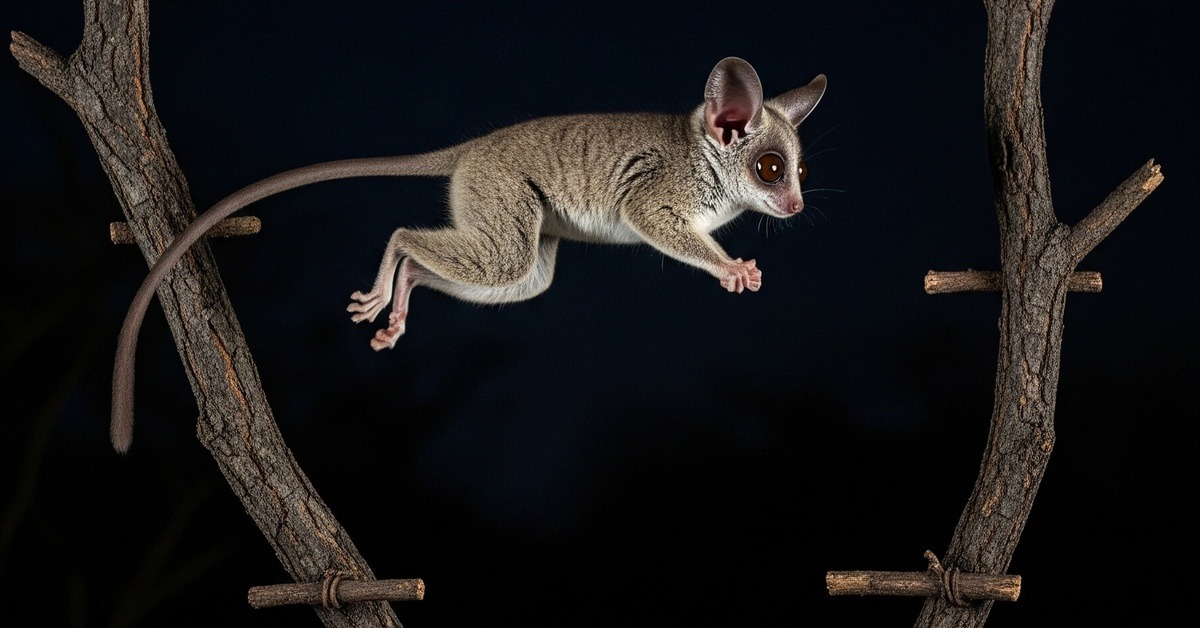
- A single bush baby leap can cover up to 2.5 meters — roughly 10 times its body length — in complete darkness while tracking moving prey
- The species was formally described in 1796, making it one of the earliest African primates documented by European science
- The family Galagidae contains at least 20 recognized species, distributed across more than 20 African countries from Senegal to Ethiopia
In short: The Senegal bush baby (Galago senegalensis) deliberately pees on its hands and feet before climbing — a communication strategy called urine-washing that marks every branch with identity and territory data. Weighing 95–300 grams, it leaps up to 2.5 meters (10× its body length) in total darkness and hunts insects with independently moving ears and oversized, immobile eyes.
The Hand-Pissing Thing Is Actually Genius
Before the sun sets, the Senegal bush baby crouches down, urinates on its own hands and feet, and then launches itself into the canopy. Every branch it touches. Every surface it lands on. All of it gets marked with scent. Primatologist Simon Bearder spent decades watching these animals in East Africa, and he described this behavior as basically a personalized message system written in pee.
It’s deliberate. Strategic. Not a reflex at all.
Each footprint tells a story — identity, reproductive status, territory boundaries. Every branch becomes a bulletin board that other bush babies can read long after the original animal has moved on. The thing is, we’re still not entirely sure who’s reading all these scent messages and what they’re deciding based on them. That last fact kept me reading for another hour straight.
It’s called urine-washing, and it sounds gross until you realize it’s actually a communication network more sophisticated than most humans give it credit for.
Those Eyes Aren’t Just Big — They’re Physically Weird
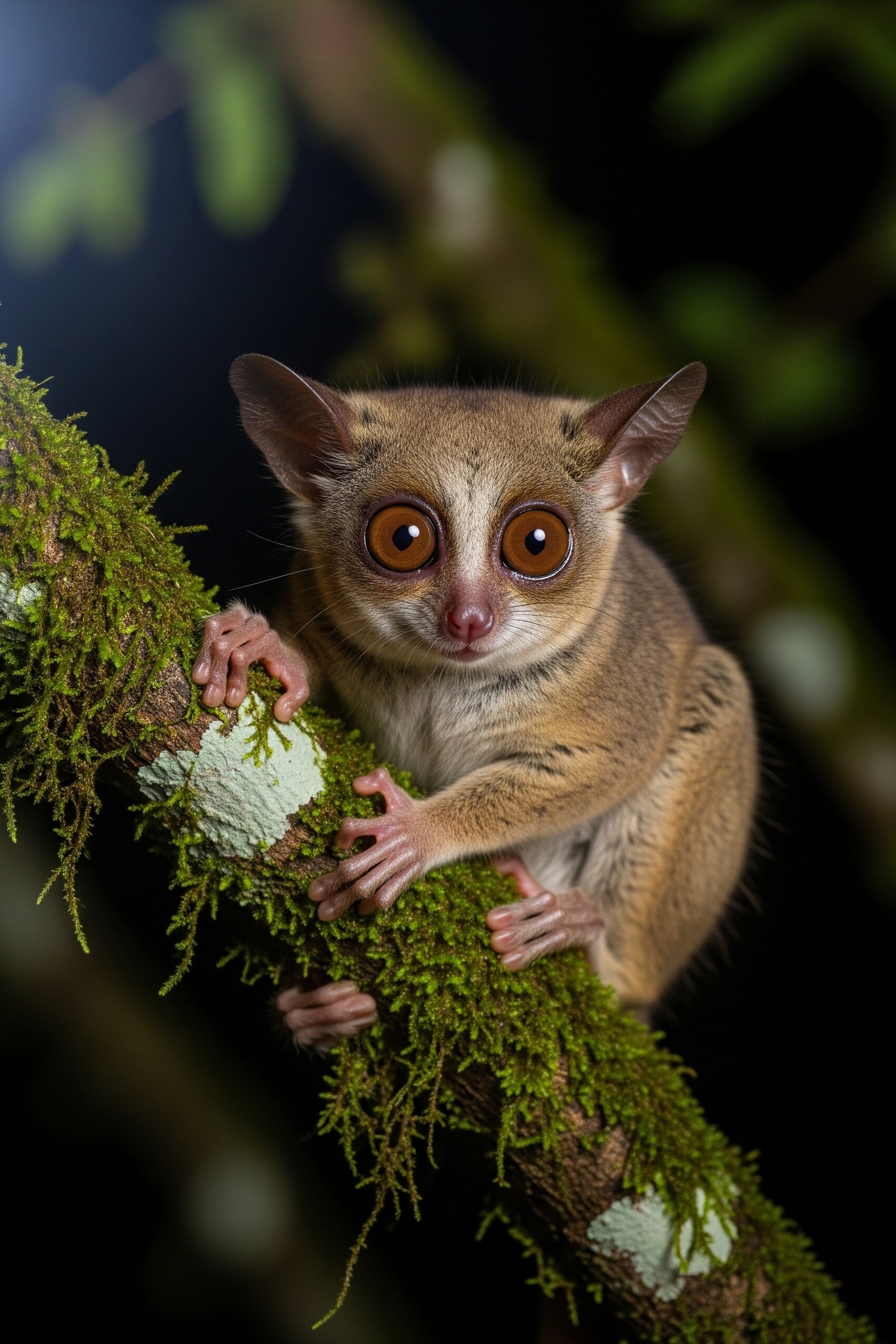
Bush baby eyes are enormous. Disproportionately, absurdly enormous. They’re so large that they literally cannot rotate in their sockets at all. To look sideways, the animal has to rotate its entire head nearly 180 degrees — think of that creepy owl-head-spin thing, except in a tiny primate form.
The weird part? It actually works.
Those eyes are packed with rod cells that gather light with such efficiency that the bush baby can see in conditions where most mammals would be completely blind. But the eyes are only half the hunting system. The ears are the other half, and they move independently of each other. Like separate radar dishes. A single moth fluttering three meters away doesn’t have a chance — the bush baby hears it from different angles simultaneously, calculates the trajectory, and launches itself into the darkness to catch it mid-flight.
You can read more about galago sensory evolution on the Galago Wikipedia page, but honestly, the mechanics are almost beside the point. The fact is: this animal hunts in total darkness with precision that would make a sniper jealous.
What This Thing Actually Eats
Most people assume small primates just munch fruit peacefully. Wrong. The Senegal bush baby is an opportunistic predator, and it doesn’t care if its prey is flying, crawling, or running. During wet season, insects make up the bulk of its diet. Dry season? It switches gears and scrapes tree gum off acacia bark using specialized teeth — a “tooth comb” of forward-pointing lower incisors built specifically for gouging. It’s like having a built-in multitool.
The jumping ability is where things get genuinely absurd. A creature under 300 grams can cover 2.5 meters in a single bound. That’s roughly ten times its own body length. For a human, that would be equivalent to a standing broad jump of about 17 meters. From a standstill. In complete darkness. While tracking moving prey.
Repeatedly.
The Daytime Disappearing Act
During the day, the Senegal bush baby essentially ceases to exist. It folds itself into a hollow tree, a dense clump of leaves, sometimes a abandoned bird nest — and sleeps deeply, body temperature dropping slightly to save energy. Predators walk right past without ever knowing it’s there.
Then sunset happens.
The transformation is startling. The invisible animal becomes a precision hunting machine moving through the canopy at speed. It’s documented across more than 20 African countries — from Senegal to Ethiopia, from dry savanna to dense riverine forest. But because they’re nocturnal, small, and quiet, most people who live alongside them have never actually seen one in action.
The Social Life Hidden in the Pee Marks
Here’s what most articles get wrong about urine-washing: it’s not just territorial marking. Research suggests the Senegal bush baby uses scent as a social coordination system — a way of keeping track of other individuals in a network of overlapping home ranges. A male’s territory might overlap with several females. A female knows which males have passed through. By the time two animals actually encounter each other face-to-face, they already know enormous amounts about each other through scent alone.
It’s a conversation conducted entirely through footprints.
Turns out the social structure is far more complex than their solitary appearance suggests. Females sometimes sleep in small groups — mothers with offspring from multiple seasons. Males roost alone but navigate through a landscape absolutely saturated with chemical information left by everyone in their network. The forest at night is an information system. The bush baby is both writer and reader.
The Numbers
- The Senegal bush baby (Galago senegalensis) was formally described in 1796 — one of the earliest African primates documented by European science.
- Its jump covers up to 2.5 meters in a single leap — roughly 10 times its body length — and it can execute multiple consecutive jumps without losing accuracy or momentum in complete darkness.
- Adult weight: between 95 and 300 grams. Comparable to a large orange.
- The family Galagidae contains at least 20 recognized species, with new species still being formally described as recently as the early 2000s — suggesting we’ve barely scratched the surface of what’s actually out there.
Field Details
- That tooth comb does double duty: it scrapes tree gum for food, but also grooms both the animal itself and its social partners, making it a tool for both feeding and bonding.
- Bush babies can lower their body temperature and enter daily torpor during cold or dry periods, dramatically reducing caloric needs — a metabolic trick usually associated with hibernating animals.
- Their calls sound unsettlingly similar to a human infant crying. Early East African communities interpreted these sounds as spirits moving through the forest at night.
Why This Still Matters
The Senegal bush baby isn’t endangered — it’s adaptable enough to survive across different habitats. But that doesn’t mean it’s safe. Habitat fragmentation, the bushmeat trade, the exotic pet market — they all take a toll. Because bush babies are small, nocturnal, and not considered “charismatic” the way lions and elephants are, they don’t attract conservation attention.
They’re easy to overlook. That’s always been their strength. It might also be their greatest vulnerability.
What we actually know about the Senegal bush baby’s behavior and social life is still surprisingly incomplete. There are entire chapters of its story that haven’t been written yet. That gap matters. You can’t protect what you don’t understand.
A creature the size of your fist, navigating the African night with urine-painted hands and ears that move like independent radar dishes. It sleeps through the day like it doesn’t exist, then sprints through darkness to snatch moths mid-flight. The Senegal bush baby has been doing this for millions of years without anyone really paying attention. That’s a gap worth closing. There’s more wildlife stories at this-amazing-world.com — and honestly, the next one gets even weirder.
Frequently Asked Questions
Q: Why does the Senegal bush baby pee on its own hands?
The behavior, called urine-washing, is a deliberate communication strategy. Before climbing through the canopy at night, the bush baby crouches and urinates on its own hands and feet. Every branch it then touches gets marked with scent. Primatologist Simon Bearder, who spent decades observing them in East Africa, described this as a personalized message system written in pee. Each footprint encodes identity, reproductive status, and territory boundaries, turning every branch into a bulletin board other bush babies can read long after the original animal has passed.
Q: Why are the bush baby’s eyes so unusual?
Bush baby eyes are disproportionately enormous, so large that they cannot rotate in their sockets at all. To look sideways, the animal must rotate its entire head nearly 180 degrees, like an owl. The eyes are packed with rod cells that gather light with extraordinary efficiency, allowing the bush baby to see in conditions where most mammals would be blind. The ears compensate where the eyes can’t — they move independently of each other, functioning like separate radar dishes to triangulate the position of insects in flight.
Q: What does the bush baby eat?
It is an opportunistic predator, not a peaceful fruit-eater. During wet season, insects make up the bulk of its diet, caught mid-flight with the help of acoustic triangulation from independently movable ears. In dry season, the bush baby switches to scraping tree gum off acacia bark using specialized teeth — a ‘tooth comb’ of forward-pointing lower incisors built for gouging. A creature under 300 grams can leap up to 2.5 meters in a single bound, roughly 10 times its body length, while tracking moving prey in complete darkness.
Q: Where does the Senegal bush baby live?
Across more than 20 African countries — from Senegal to Ethiopia, from dry savanna to dense riverine forest. The species was formally described in 1796, making it one of the earliest African primates documented by European science. Because they are nocturnal, small, and quiet, most people who live alongside them have never seen one in action. During the day, the bush baby folds itself into a hollow tree, dense clump of leaves, or abandoned bird nest, with body temperature dropping slightly to save energy.
Illustrations are AI-generated. Article fact-checked and human-edited. Our editorial standards.