The Sheep Buried Alive in His Own Wool for Years
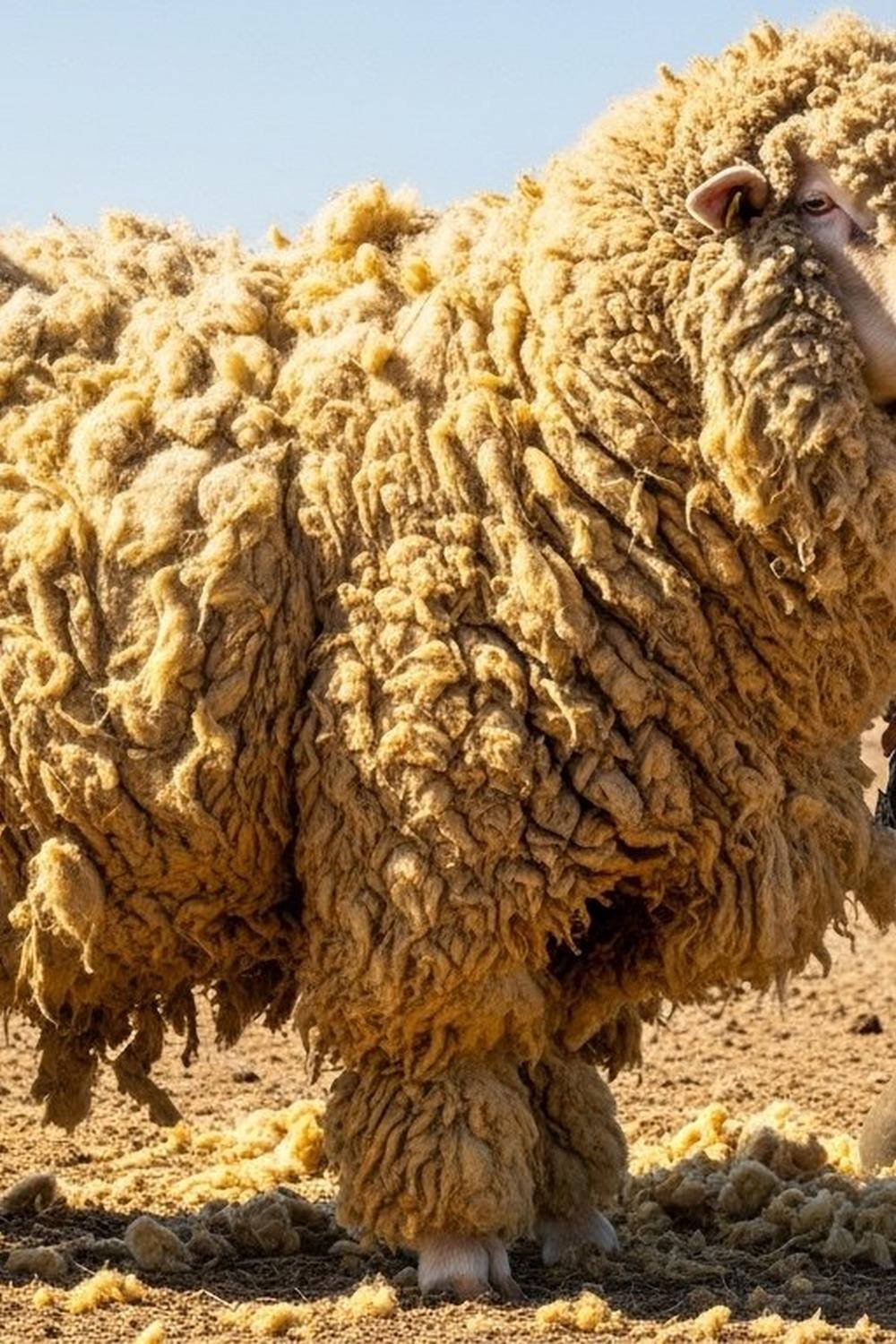
In 2015, someone found a sheep near Canberra that was barely moving under what looked like a walking haystack. Turns out he’d been carrying 41 kilograms of wool — heavier than most ten-year-olds — and nobody had noticed for years.
The sheep’s name was Chris. And what happened to him wasn’t a fluke. It was the inevitable outcome of breeding an animal that literally can’t shed its own skin without human hands.
Key Facts
- A merino sheep named Chris was found near Canberra in 2015 carrying a 41 kg (90 lb) fleece, a Guinness World Record for the heaviest fleece ever recorded on a single sheep.
- Chris was carrying roughly 8 to 10 years of unsheared growth, compared to a healthy merino’s annual 4-5 kg yield.
- Shrek, the previous record holder from New Zealand, went unsheared for six years and produced a 27 kg fleece in 2004.
- Fly strike affects an estimated 3 million sheep per year in Australia, directly caused by wool overgrowth and matting (Australian Wool Innovation, 2020).
- Merino fleece grows at roughly 2-3 cm per month, and Australia has 65 to 70 million sheep across its territory.
In short: Sheep wool overgrowth turned deadly for Chris, a merino found near Canberra in 2015 under a record 41 kg fleece, roughly 8 to 10 years of unsheared growth. Because selective breeding eliminated merinos’ natural molting cycle, escaped or abandoned sheep keep growing wool until the weight, trapped heat, and fly strike threaten their lives.
How Sheep Wool Overgrowth Becomes a Silent Emergency
Here’s the thing about merino sheep: they were engineered to never stop growing wool. Over centuries of selective breeding, humans bred out the natural molting cycle that wild sheep rely on. That made them commercially incredible — dense, fine fleece that just keeps coming. It also made them biologically incomplete without constant intervention.
Wild sheep shed. Merinos don’t.
Chris was carrying the equivalent of 8 to 10 years of unsheared growth when rescuers finally found him. According to the Merino breed’s documented history, this isn’t abnormal behavior for the animal — it’s exactly what the breed does when left alone. The fleece just keeps growing. And growing. Until the sheep can barely move.
What Happens Inside an Overgrown Fleece
It’s not just uncomfortable.
The weight alone makes every step a grinding, exhausting effort. The dense insulation traps heat with nowhere to escape — body temperature climbs into dangerous territory on even mild days. The fleece compresses until walking becomes something between wading and crawling. In extreme cases, sheep just collapse from the effort of standing upright. Not from injury. Just from the accumulated weight pressing down on bones that evolved to carry, maybe, a quarter of that load.
Then there’s what happens underneath.
The matted wool traps moisture, urine, and waste directly against the skin. Over months, that becomes a toxic, rotting layer that attracts parasites, causes infections, and invites fly strike — a condition where blowflies lay eggs in the decomposing material. That last fact kept me reading about this for another hour. The eggs hatch into larvae that eat the animal alive from the inside of its own coat. It’s not just weight. It’s a slow biological catastrophe nobody can see from the outside.
The Shearing That Made the Whole World Watch
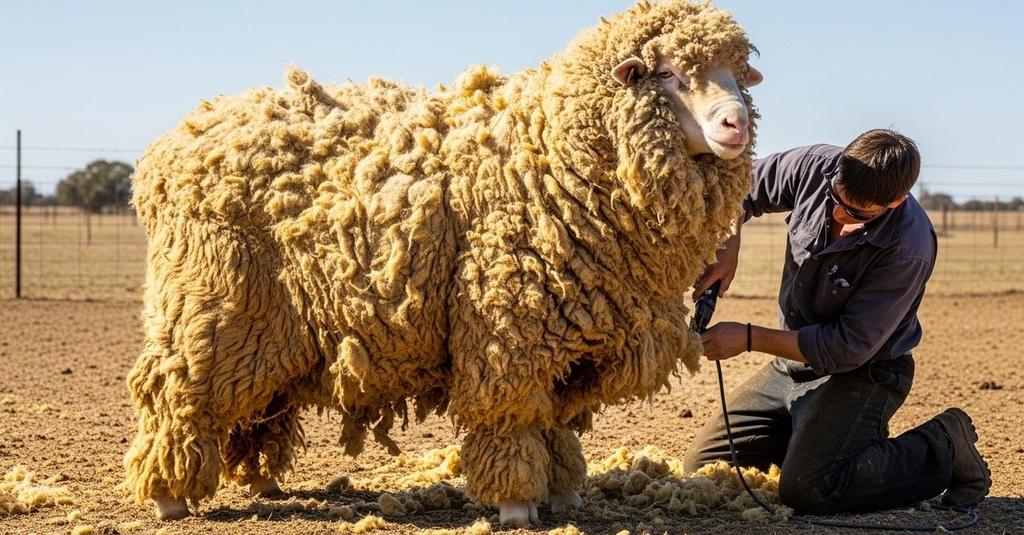
When the RSPCA finally got to Chris, it took over 40 minutes just to reach him. Not to shear him cleanly. Just to peel back enough matted wool to find the animal underneath. The fleece had compressed into something closer to armor than a coat. Ian Elkins, one of Australia’s most experienced shearers, had to be called in — one wrong cut and they’d cut the sheep himself.
And then something happened that the news coverage barely mentioned.
The moment the fleece came off, Chris changed. His breathing slowed within minutes. His legs found their full range of motion. His entire posture shifted from hunched and compressed to just — upright. Like a creature suddenly remembering what existence felt like without carrying a second body on its back.
The footage went viral.
But what actually hit people wasn’t the drama of rescue. It was how quiet the relief was.
The Breeding Decision That Created This Problem
Chris wasn’t an accident. He was a predictable outcome of a deliberate choice made by people centuries ago.
Merino sheep were selectively bred to eliminate molting — the natural shedding cycle every wild sheep uses. That pressure, applied generation after generation, created wool of extraordinary softness and density. It also created an animal that is, without constant human intervention, biologically incomplete. The sheep wool overgrowth problem isn’t a rare malfunction. It’s the system working exactly as designed.
Which raises the obvious question: what’s the ethical weight of breeding a creature that can’t survive without you? Chris didn’t wander off and accidentally get overgrown. He likely escaped or was abandoned. And then the biology just kept running. Kept growing. Kept compressing. Nobody told his fleece to stop because nobody was there to tell it.
By the Numbers
- Chris’s fleece: 41 kg (90 lbs) when removed in 2015 — a Guinness World Record for the heaviest fleece ever recorded on a single sheep.
- A healthy merino gets shorn once yearly and produces 4–5 kg of wool. Chris was carrying roughly 8–10 years of unsheared growth compressed into one coat.
- Shrek, the previous record holder from New Zealand, went unsheared for six years and produced a 27 kg fleece in 2004. Chris nearly doubled that.
- Fly strike affects an estimated 3 million sheep per year in Australia alone — it’s directly caused by wool overgrowth and matting, and it kills animals if untreated (Australian Wool Innovation, 2020).
- Merino fleece grows at roughly 2–3 cm per month, meaning a single missed year of shearing can already begin creating serious mobility problems.
What Happened Next
After shearing, Chris recovered at a local farm near Canberra. He’d been estimated at around ten years old — already elderly for a sheep — and he lived out the rest of his life in a paddock where nobody demanded anything of his body anymore.
His fleece went to charity auctions and raised thousands of dollars for animal welfare work. The same coat that nearly killed him became the thing that funded rescue operations.
The shearing team that freed him became minor celebrities for about a week. Then everyone moved on to the next viral story.
Why This Story Is Bigger Than One Sheep
The hard part? Chris got found. He stumbled close enough to populated land that someone saw a walking wool pile and thought: that’s wrong. They called it in. The machinery started moving.
But Australia has 65 to 70 million sheep. Feral and escaped merinos are scattered across hundreds of thousands of square kilometers of rural outback where properties span areas bigger than some countries. Sheep wool overgrowth in those populations almost certainly goes undetected for years. There are animals wandering right now — in paddocks, scrubland, remote valleys — carrying coats that are slowly crushing them.
No camera crew coming.
No rescue scheduled.
The selective breeding that made merinos so valuable commercially created an animal with a dependency so complete that survival without human hands isn’t actually possible. And when those hands aren’t there — when a sheep escapes or gets abandoned — the biology just quietly keeps running until it can’t run anymore.
Chris survived something that should have killed him. Not through toughness or luck. Just because someone happened to notice. That’s the actual story. A creature built by human decisions, saved by human attention, now retired in a paddock in New South Wales. The rest are still out there. If you want more stories like this — the ones that don’t make the news cycle but should — there’s more at this-amazing-world.com.
“
Frequently Asked Questions
Q: What is sheep wool overgrowth and why does it happen?
Sheep wool overgrowth occurs because merino sheep were selectively bred over centuries to eliminate the natural molting cycle that wild sheep use to shed. Wild sheep shed; merinos do not. This made their fleece commercially dense and fine, but biologically incomplete without constant human shearing. When a merino escapes or is abandoned, the fleece keeps growing at roughly 2 to 3 centimeters per month until the animal can barely move, with no biological mechanism to stop it.
Q: How heavy was Chris the sheep’s fleece?
When rescuers found Chris near Canberra in 2015, his fleece weighed 41 kilograms (90 pounds) once removed, a Guinness World Record for the heaviest fleece ever recorded on a single sheep. That represented roughly 8 to 10 years of unsheared growth, since a healthy merino is shorn yearly and produces only 4 to 5 kg. The previous record holder, Shrek from New Zealand, produced a 27 kg fleece in 2004 after going unsheared for six years.
Q: What harm does an overgrown fleece cause a sheep?
The weight makes every step exhausting and can cause sheep to collapse from the effort of standing. Dense insulation traps heat, pushing body temperature into dangerous territory on mild days. Underneath, matted wool traps moisture, urine, and waste against the skin, attracting parasites and inviting fly strike, where blowflies lay eggs that hatch into larvae eating the animal alive. Fly strike affects an estimated 3 million sheep yearly in Australia and kills untreated animals.
Q: Why is Chris’s story bigger than one sheep?
Australia has 65 to 70 million sheep scattered across hundreds of thousands of square kilometers of rural outback. Chris was found only because he wandered close to populated land and someone noticed a walking wool pile. Feral and escaped merinos in remote areas almost certainly suffer wool overgrowth undetected for years. The selective breeding that made merinos commercially valuable created an animal whose survival is impossible without human hands.
Illustrations are AI-generated. Article fact-checked and human-edited. Our editorial standards.