Moss: The 450-Million-Year-Old Plant That Needs Nothing
For 450 million years, moss prehistoric survival has asked almost nothing of the world — no roots, no soil, no elaborate systems — and received almost everything in return. It predates trees. It predates insects with wings. And it still grows on your garden wall right now, drinking rain through its skin, asking nothing, giving everything.
While ancient forests rose and collapsed, while dinosaurs came and went, while continents drifted apart like slow arguments, moss just kept going. No flowers. No seeds. No vascular plumbing to maintain. Just a soft green layer of cells so brilliantly engineered by evolution that 450 million years of extinction events, ice ages, and mass die-offs have barely touched it.
So what does moss know that everything else doesn’t?

Key Facts
- Bryophytes, the plant group moss belongs to, have existed for approximately 470 million years according to a 2018 University of Edinburgh molecular clock analysis
- Around 12,000 known species of moss exist, distributed across virtually every terrestrial habitat on Earth
- Sphagnum moss alone covers roughly 3% of Earth’s land surface — about 4 million square kilometers, larger than the European Union
- A 2021 Nature paper estimated the world’s peatlands contain approximately 500–600 gigatonnes of carbon, equivalent to 50–70 years of current global CO₂ emissions
- In 2023, University of Exeter researchers monitoring subarctic peatlands in northern Canada observed sites shifting from net carbon sinks to net carbon sources
In short: Moss has survived approximately 470 million years by needing almost nothing — no roots, no soil, just rhizoids and skin-level water absorption (poikilohydry). About 12,000 species exist worldwide, and Sphagnum moss alone covers 3% of Earth’s land surface. Peatlands it built store 500–600 gigatonnes of carbon, equal to decades of human emissions, now at risk from warming and drying.
Ancient Survival Strategy: How Moss Outlasted Everything
A lineage so ancient it predates the evolution of vascular tissue — that’s what bryophytes are. Bryophytes are the plant group moss belongs to, and they’ve been around since approximately 470 million years ago, according to a landmark 2018 study by researchers at the University of Edinburgh using molecular clock analysis. That places their divergence from other land plants squarely in the Ordovician period, a time when the oceans were full of strange armoured fish and the land was essentially bare rock. Moss didn’t colonise a world built for it.
It helped build the world for everything else.
Instead of roots, moss uses rhizoids — tiny, thread-like structures that anchor it to surfaces without ever truly burrowing in. It drinks through its skin. Every millimetre of its surface can absorb moisture directly from rainfall, dew, or humid air. This process is called poikilohydry, and (researchers actually call this a superpower disguised as a limitation) it’s exactly what separates moss from everything else trying to survive in extreme conditions. When conditions dry out, moss doesn’t die. It desiccates, suspending its metabolism almost completely, and then rehydrates when moisture returns.
Some species have been fully revived after more than a century of dryness in museum collections.
Think about what that means in practice. While every tree around it is gambling everything on reaching water underground, moss is sitting on bare granite in the rain, drinking directly from the sky. It has no infrastructure to protect, no system to maintain. It costs almost nothing to be moss.
Twelve Thousand Species, One Ruthless Simplicity
Around 12,000 known species of moss exist, distributed across virtually every terrestrial habitat on Earth. From Arctic tundra to tropical cloud forests, from Tokyo pavements to Antarctic cliffs, moss finds a way. This kind of ecological range is rare among plants of any kind, and it points to something important about moss prehistoric survival. Simplicity, it turns out, is a form of flexibility.
When you don’t depend on specific soil chemistry, specific pollinators, or specific temperature ranges, the world gets a lot bigger. Much like the velvet worm — another prehistoric survivor that has kept its body plan almost unchanged for half a billion years — moss proves that evolution doesn’t always reward complexity. Sometimes the oldest design is the best one.
Sphagnum moss alone accounts for roughly 3% of Earth’s entire land surface. That’s around 4 million square kilometres — an area larger than the European Union. And here’s the thing: Sphagnum-dominated peatlands store an estimated one-third of all the carbon locked in soil worldwide, according to the International Peatland Society’s 2022 figures. One genus of moss. No flowers. Carrying a third of the planet’s buried carbon on its soft green back.
The climate conversation focuses endlessly on forests and oceans, but the quiet, waterlogged carpets of sphagnum underfoot may matter just as much.
Field bryologists — the botanists who specialise in mosses — often describe looking at a single moss cushion under magnification as looking at a miniature forest. Each stem a tree. Each leaf a canopy. An entire ecosystem compressed into something you’d step over without noticing.
The Carbon Vault Nobody Talks About
For thousands of years, peatlands dominated by sphagnum moss have been accumulating carbon, and the scale of what they hold is genuinely difficult to process. A 2021 paper published in Nature estimated that the world’s peatlands contain approximately 500–600 gigatonnes of carbon — roughly equivalent to 50 to 70 years of current global CO₂ emissions, all stored in slowly decomposing organic matter that sphagnum moss helped create and continues to maintain.
The mechanism is elegant and brutal. Sphagnum grows on top of itself. Old layers die but don’t fully decompose because the moss keeps the environment so waterlogged and acidic that microbial decomposition slows almost to a halt. Dead moss just accumulates, layer by layer, compressing into peat over millennia.
But what happens when conditions change faster than evolution can respond?
This is where moss prehistoric survival takes on a modern urgency. Climate change is warming and drying peatlands at rates that leave researchers alarmed. When peat dries, it aerates. When it aerates, decomposition accelerates. Carbon that took ten thousand years to accumulate can begin releasing within decades. In 2023, scientists at the University of Exeter monitoring subarctic peatlands in northern Canada observed that some sites had already shifted from net carbon sinks to net carbon sources — meaning they were now releasing more CO₂ than they were capturing.
Moss didn’t fail.
The conditions around it changed too fast. There’s a grim irony in watching a species survive five mass extinction events only to be compromised not by an asteroid or a glaciation but by the slow burn of human industrial activity. Moss outlasted the dinosaurs. Whether it outlasts us remains to be seen.
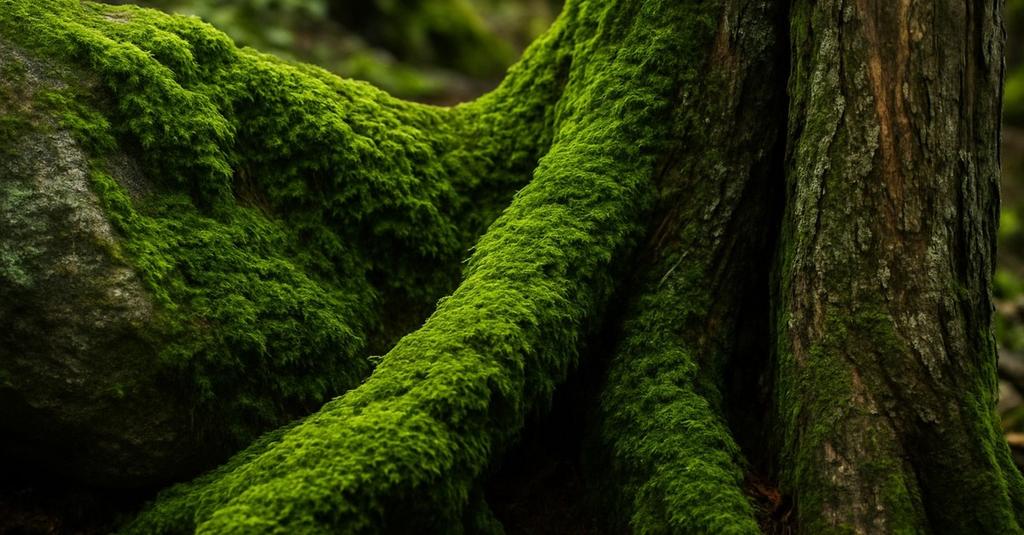
How Moss Prehistoric Survival Shapes Modern Science
In 2020, a team at the Boyce Thompson Institute in New York sequenced the complete genome of Physcomitrium patens, a common moss species used in laboratories worldwide. Researchers have increasingly turned to moss not just as an ecological curiosity but as a model organism for understanding the deep history of plant life. What they found confirmed something evolutionary biologists had long suspected: moss retains genetic machinery that was present in the very first land plants, equipment that all subsequent plant lineages either modified or discarded.
Studying moss, in other words, is like finding a living blueprint for how plants conquered land in the first place. It’s the original code, still running.
That genomic work has practical applications beyond historical curiosity. Because moss has such simplified cellular architecture, it’s become a surprisingly useful platform for pharmaceutical research. The biotech company Greenovation, based in Germany, has used Physcomitrium patens to produce complex human proteins in moss cells — leveraging the plant’s genetic simplicity to manufacture compounds that are difficult to synthesise elsewhere. By 2019, moss-derived pharmaceuticals were in clinical trials for conditions including haemophilia and kidney disease.
A 450-million-year-old survivor was doing drug development.
Conservationists are paying attention too. Restoration ecologists working on degraded peatlands in Scotland, Indonesia, and Canada have started treating sphagnum reintroduction as a foundational step — not an afterthought. Bring the moss back first. Everything else follows.
The Quiet Coloniser That Built the Biosphere
Before moss, the land was rock. Bare, exposed, chemically inhospitable. The first plants to leave the ocean needed to survive on surfaces that offered no soil, no shelter, and enormous fluctuations in temperature and moisture. Bryophytes — mosses and their close relatives — were almost certainly among the very first organisms to make that crossing, and in doing so, they didn’t just survive.
They terraformed.
As moss died and accumulated over millions of years, it began building the thin layer of organic material we call soil. It held water that would otherwise have run off bare rock. It created microhabitats where other organisms could gain a foothold. The entire subsequent explosion of terrestrial life — insects, amphibians, reptiles, mammals, forests — was built on a foundation that moss spent millions of years constructing. A 2019 modelling study by researchers at the University of Bristol calculated that early land plants, primarily bryophytes, dramatically increased global weathering rates during the late Ordovician and Silurian periods, drawing down significant amounts of CO₂ from the atmosphere and contributing to a cooling event that ended a major warm period.
Moss didn’t just survive the climate. It changed it. The thought reframes the entire story of moss prehistoric survival — from passive endurance to active planetary influence.
Stand on any patch of Scottish moorland or Canadian boreal forest and look down. The spongy green surface under your boots is both a relic and an engine. Ancient in its form. Utterly alive in its function. Doing, right now, exactly what it was doing before the first fish ever considered leaving the sea.
How It Unfolded
- ~470 million years ago — Molecular clock analysis places the origin of bryophytes in the Ordovician period, making them among the first plants to colonise land (University of Edinburgh, 2018).
- 1935 — Finnish botanist Auer V.K. publishes foundational work on sphagnum peat accumulation in South America, establishing the first long-term carbon accounting framework for moss-dominated ecosystems.
- 2000 — The complete genome sequencing of Physcomitrium patens is initiated at the University of Leeds, opening moss to modern genomic analysis and pharmaceutical applications.
- 2023 — Subarctic peatland monitoring sites in northern Canada, tracked by the University of Exeter, record a historic shift: several moss-dominated bogs officially become net carbon emitters for the first time.
By the Numbers
- ~12,000 known moss species worldwide, with new species still being described annually (International Association of Bryologists, 2022).
- 4 million km² — the approximate global coverage of sphagnum-dominated peatlands, larger than the entire European Union.
- 500–600 gigatonnes of carbon stored in peatlands globally — equivalent to 50–70 years of current human CO₂ emissions (Nature, 2021).
- Some dried moss specimens have been successfully rehydrated and revived after more than 100 years in herbarium collections.
- 3% of Earth’s total land surface is covered by sphagnum moss — a single genus of one of the planet’s oldest plant lineages.
Field Notes
- In 2012, researchers at the British Antarctic Survey revived moss cores extracted from beneath Antarctic permafrost that had been frozen for approximately 1,530 years — the longest recorded revival of any plant from frozen storage. The moss grew normally once thawed.
- Sphagnum moss has natural antiseptic properties due to its high acidity and phenolic compounds; it was used as wound dressing during both World War I and World War II when medical supplies ran short, absorbing up to 20 times its own weight in fluid.
- Mosses don’t just live on surfaces — they engineer them. A single gram of sphagnum moss can hold between 16 and 26 times its dry weight in water, giving peatlands a flood-buffering capacity that engineered drainage systems struggle to match.
- Scientists still can’t fully explain how some moss species survive complete cellular desiccation and then recover without apparent damage — the exact molecular repair mechanism remains poorly understood, and replicating it synthetically has so far proved impossible.
Frequently Asked Questions
Q: What makes moss prehistoric survival so remarkable compared to other ancient plants?
Moss prehistoric survival is remarkable primarily because moss achieved it through radical simplicity rather than complexity. While other ancient plant lineages developed elaborate root systems, vascular tissue, flowers, and seeds, moss kept its body plan almost identical to its Ordovician ancestors. It can photosynthesize, reproduce, and survive desiccation without any of those innovations. Over 450 million years, that stripped-down design has proven more resilient than almost anything evolution has produced since.
Q: Does moss actually absorb water through its leaves?
Yes — and it’s one of the most important things to understand about how moss works. Because moss lacks the vascular tissue found in most plants, it can’t draw water up from soil through roots. Instead, it absorbs moisture directly across the surface of its leaves and stems, a process that works even from humid air alone. This is why moss thrives in foggy environments and on vertical surfaces like cliff faces and tree bark where no soil exists at all. Every cell participates in hydration simultaneously.
Q: Is moss actually important for climate, or is that overstated?
It’s genuinely important, and if anything it’s understated in mainstream climate conversations. The common misconception is that forests do the heavy lifting in global carbon storage, while mosses are decorative background. In reality, sphagnum-dominated peatlands store roughly one-third of all soil carbon worldwide — more carbon per square metre than most tropical forests. The difference is that peat stores carbon long-term in waterlogged conditions, whereas forests cycle it more rapidly. Losing peatlands to drainage or warming releases that ancient carbon relatively quickly.
Editor’s Take — Dr. James Carter
What strikes me most about moss isn’t its age — it’s what its age implies about our assumptions. We tend to think of evolutionary success as a story of increasing complexity: more organs, more systems, more specialisation. Moss is a direct rebuttal. It never developed any of that, and it’s been winning for nearly half a billion years. The uncomfortable reading is this: in a rapidly destabilising climate, the organisms best equipped to survive may be the ones that need the least — not the most.
Moss doesn’t announce itself. It doesn’t compete for your attention the way a flowering tree does, or startle you the way an animal might. It just accumulates — millimetre by millimetre, year by year, century by century — quietly covering the rocks that every other living thing eventually depends on. It was here before the first insect flew, before the first forest stood, before the first footprint marked the earth. And on the morning after the next great extinction, whatever form that takes, there’s a reasonable chance that something small and green and utterly unbothered will still be drinking rain through its skin. What would it take for us to build something half as durable?
Illustrations are AI-generated. Article fact-checked and human-edited. Our editorial standards.