The Platypus Is Stranger Than You Ever Imagined
A naturalist once took scissors to one. George Shaw of the British Museum in 1799 genuinely believed the first dried platypus specimen—shipped from Australia with its impossible bill, its beaver fur, its egg-laying mammal body—was a hoax. He was checking for stitches. And this raises the real question: what else have we been wrong about, looking at the same creature for 225 years? The platypus strange facts start there, in that moment of rational disbelief, and they haven’t stopped accumulating since.
Three centuries of scrutiny later, the animal looks less solved, not more. It lays eggs. It glows under ultraviolet light. It hunts by detecting electrical fields as faint as a shrimp flexing a muscle. It sweats milk through patches of skin because it has no nipples. The deeper researchers look, the stranger it becomes.
Key Facts
- A 2021 University of Copenhagen genome study published in Nature confirmed the platypus lineage split from other mammals approximately 166 million years ago.
- The platypus bill contains around 40,000 electroreceptors capable of detecting electrical signals as weak as a few microvolts.
- The platypus has 10 sex chromosomes, compared to 2 in humans, the most complex sex-determination system documented in any mammal.
- In 2020, researchers at Northland College confirmed platypus fur fluoresces blue-green under ultraviolet light, published in Mammalia.
- The platypus is listed as Near Threatened by the IUCN as of 2020, with a roughly 30% population decline over the past 30 years.
In short: The platypus strange facts keep accumulating 225 years after a naturalist checked the first specimen for stitches. A 2021 genome study dated its lineage to 166 million years ago, its bill holds 40,000 electroreceptors, it carries 10 sex chromosomes, and its fur was found to glow under UV light in 2020.
A Biological Relic From an Older Earth
The platypus (Ornithorhynchus anatinus) belongs to an ancient mammalian lineage called monotremes — mammals that lay eggs instead of giving birth to live young. A landmark genome study from the University of Copenhagen in 2021 confirmed that the platypus lineage split from other mammals approximately 166 million years ago. That’s 166 million years of independent evolution, accumulating adaptations that no other mammal has followed. Only five monotreme species survive today: the platypus and four species of echidna. The rest were wiped out across tens of millions of years of extinction events.
What did that long isolation actually produce? Males with venomous spurs on their hind legs, sharp enough to cause excruciating pain in humans and capable of killing a dog. Soft, leathery eggs like a reptile. Young that lap milk directly from their mother’s fur because nipples never evolved. None of these traits appear together in any other living mammal.
Field researchers describe their first live encounter with a platypus as quietly disorienting.
The animal moves through water with boneless grace that contradicts its improbable anatomy. It surfaces, draws a breath, and vanishes — efficient, silent, utterly indifferent to the fact that it shouldn’t exist in the form it does.
How It Hunts: Electricity Instead of Eyes
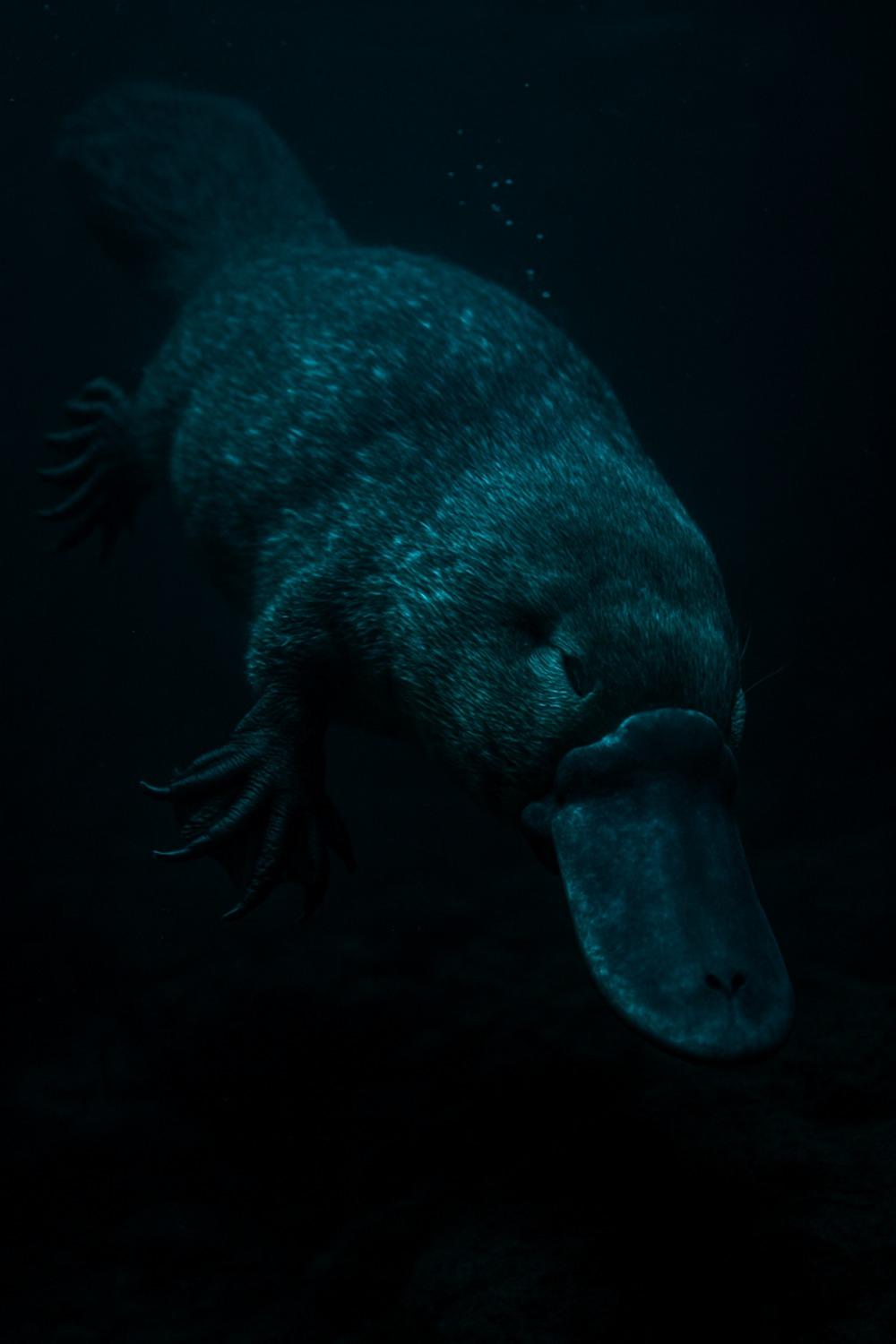
In the murky rivers of eastern Australia, something nobody expected happens each time a platypus dives. It closes its eyes. It seals its ears shut. Then it hunts — moving through dark water using nothing but its bill to detect the faint bioelectric fields generated by the muscle contractions of prey. Why does this even work? Because the bill contains around 40,000 electroreceptors packed into its surface, capable of detecting electrical signals as weak as a few microvolts. A shrimp flexing a single muscle produces an electrical pulse. The platypus finds it.
Research from the University of Melbourne across multiple decades has documented this system extensively. It makes the platypus one of the most electrically sensitive vertebrates ever documented. Even sharks, famous for their electroreception abilities, don’t rely on it with the same exclusivity during active foraging. The platypus doesn’t use backup senses to confirm what it’s detecting. It trusts the electricity completely.
As the platypus sweeps its bill from side to side underwater, the electroreceptors fire in sequence, giving the animal a constantly updating map of electrical activity. Mechanoreceptors in the same bill detect water pressure changes simultaneously. The two systems interact in the brain, producing a composite sensory picture that researchers still don’t fully understand. A 2004 study in Brain, Behavior and Evolution found that the region of the platypus brain dedicated to bill sensation is disproportionately large — occupying neural territory that vision dominates in most mammals. Here’s the thing: this animal experiences the world face-first, electrically. When it’s hunting, vision is off. Sound is off. It navigates the river through a sense humans don’t have and can’t directly imagine.
The Discovery Nobody Saw Coming
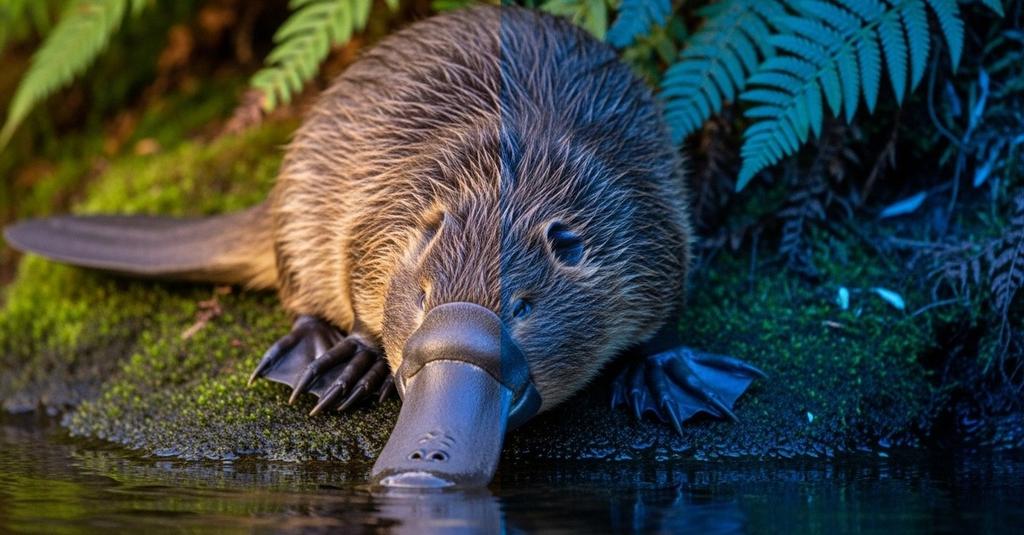
In 2020, Jonathan Martin at Northland College in Wisconsin was studying ultraviolet fluorescence in North American flying squirrels when the team decided to expand their survey. They borrowed platypus specimens from the Field Museum in Chicago and the University of Nebraska State Museum — dried, archived skins collected decades earlier. Under UV light, the platypus fur glowed. Not faintly. The fur fluoresced a vivid blue-green, visible across the full pelt.
The finding landed like an unexpected punch. UV fluorescence in mammals was considered a genuine rarity — something observed in only a handful of species globally. The scientific community’s response, when Martin’s team published in Mammalia in early 2020, was a collective, somewhat undignified double-take. According to National Geographic’s coverage, the discovery was particularly striking because platypus biology had been studied for over 200 years before anyone thought to point an ultraviolet light at the fur.
But here’s where it gets uncomfortable for science: nobody can explain why. UV fluorescence in animals generally serves a few functions — camouflage under certain light conditions, communication between individuals who can perceive UV wavelengths, or simple biochemical byproduct with no adaptive function. For the platypus, none of these explanations is well-supported. Whether platypuses can even see UV wavelengths remains uncertain. The rivers they inhabit, choked with tannins and sediment, filter most UV light anyway. The glow might never be visible to another platypus in the wild.
We don’t know yet.
What matters is the discovery itself: even a species as intensively studied as the platypus carried major biological surprises into the twenty-first century completely undiscovered. It confirms that our expectations about what else might be out there are probably too narrow.
The Genome Rewrites What We Thought We Knew
The 2021 genome study from the University of Copenhagen — led by Professor Guojie Zhang and published in Nature — didn’t just confirm the platypus’s evolutionary age. It revealed a genome that looks like nothing else in the mammal world. Ten sex chromosomes. Humans have two. Most mammals have two. The platypus has ten, arranged in a chain during cell division, and the system for determining sex is closer to what birds use than to typical mammalian mechanisms. The research team also found genes responsible for producing egg yolk proteins — present in the platypus genome as functional remnants — that are the same genes still producing egg yolk in reptiles and birds. They’ve been degraded by time and disuse, but they’re still there: molecular fossils of an evolutionary past connecting the platypus directly to the pre-mammalian world.
Venom is another chapter. The male platypus’s hind-leg spurs deliver a complex venom cocktail that includes defensin-like peptides — proteins that, in other contexts, are part of the immune system. The platypus evolved venom from immune proteins. That process, called neofunctionalization, is documented elsewhere but rarely this dramatically. A 2010 study in Genome Research found that platypus venom genes had diversified rapidly through gene duplication and rapid mutation, producing a venom profile sharing almost no components with snake venoms despite achieving similar physiological effects.
And researchers at Australian National University are now investigating whether compounds in platypus venom might have pharmaceutical applications, particularly in pain research. The venom activates pain pathways in mammals in ways that are medically interesting precisely because of how unusual they are. The platypus, inadvertently, may be contributing to human medicine just by existing with its improbable biochemistry intact.
By the Numbers
- 166 million years: the approximate age of the platypus’s divergence from other mammal lineages, confirmed by the 2021 University of Copenhagen genome study published in Nature.
- 40,000: the number of electroreceptors in a platypus bill, compared to around 60,000 in the electric eel — which uses electricity offensively rather than for detection.
- 10 sex chromosomes in the platypus genome, compared to 2 in humans — the most complex sex-determination system documented in any mammal.
- 83 venom component genes identified in the platypus genome by a 2010 Genome Research study — a complexity rivaling many dedicated venomous reptiles.
- The platypus is listed as Near Threatened by the IUCN as of 2020, with population estimates suggesting a 30% decline over the past 30 years due to habitat loss, drought, and river modification.
Field Notes
- Researchers at the Australian Platypus Conservancy documented in 2019 that platypus populations were severely impacted by the prolonged drought conditions preceding the 2019–2020 Australian bushfire season — river systems that had supported stable platypus groups for decades were found completely empty. Recovery timelines remain uncertain.
- Platypus milk contains over 250 distinct proteins, many of which have no known equivalent in other mammal milk — including a unique antimicrobial protein that researchers believe evolved partly because the young are raised in burrows exposed to bacteria, without the protection of a nipple or enclosed mammary gland.
- The platypus doesn’t have a stomach in the conventional sense. Food passes directly from the esophagus to the intestine. It’s one of only a small number of vertebrates known to have lost the stomach entirely during evolution — possibly because its invertebrate diet doesn’t require the acid pre-digestion that stomachs provide in most mammals.
- Researchers still can’t explain why platypuses sleep, on average, nearly 14 hours a day — more than almost any other mammal relative to body size — and what this extreme sleep need has to do with their unusual brain organization. It’s a question that’s been sitting open for decades without a satisfying answer.
Where to See This
- Eungella National Park in Queensland, Australia offers some of the most reliable wild platypus sightings, particularly at dawn and dusk along Broken River — visit between April and August for optimal conditions.
- The Australian Platypus Conservancy (platypus.asn.au) runs the most comprehensive ongoing research and monitoring program for wild platypus populations, publishing accessible research updates for public audiences.
- For deeper understanding of the electroreception system, the University of Melbourne’s Faculty of Science has published accessible explainer materials. The 2021 Nature genome paper is freely available through open access — search “platypus genome 2021 Nature Zhang.”
Frequently Asked Questions
Q: What are the most important platypus strange facts that scientists have discovered recently?
UV fluorescence in platypus fur (confirmed 2020, Northland College) and the sequencing of the full platypus genome (2021, University of Copenhagen) top the list, along with ongoing documentation of population decline. The UV fluorescence finding was particularly unexpected — platypus biology had been studied for over 200 years before anyone thought to point an ultraviolet light at the fur. It’s a reminder that even well-studied species can hide major surprises.
Q: How does the platypus actually use electroreception to hunt?
The platypus seals its eyes and ears when diving, relying entirely on roughly 40,000 electroreceptors embedded in its bill. These detect the bioelectric fields generated by muscle movements of prey — shrimp, insect larvae, small fish. The bill sweeps side to side as the animal swims, and the sequential firing of receptors gives it precise three-dimensional information about where prey is located. The system works in complete darkness and in highly turbid water where vision would be useless.
Q: Is the platypus actually endangered, and why do people get this wrong?
The platypus is currently classified as Near Threatened by the IUCN — not Endangered, but declining significantly. Many people assume it’s protected and stable because it’s an iconic Australian species, but that assumption is outdated. Populations have dropped an estimated 30% over 30 years due to river modification, agricultural runoff, prolonged drought, and climate-related changes to river hydrology. The 2019–2020 drought and bushfire season caused particularly severe local extinctions across Victoria and New South Wales.
Editor’s Take — Alex Morgan
What unsettles me most about the platypus isn’t the electroreception or the venom or even the glowing fur. It’s watching a species with this much evolutionary time invested in its own strangeness face population collapse from habitat destruction — something it evolved no defenses against because no mammal in 166 million years faced this particular threat. That’s the real story.
The platypus has been dismantling expectations for three centuries. Every time science closes one question — how the venom works, what the genome contains, how electroreception processes data — another opens. The UV fluorescence is a perfect example: one researcher, one borrowed museum specimen, one UV lamp, and an entirely new fact about a species humanity has been watching since the eighteenth century. What else is sitting in those drawers? What else are we not thinking to look for? The animal that a naturalist once checked for stitches keeps telling us, patiently, that we haven’t looked closely enough.
Illustrations are AI-generated. Article fact-checked and human-edited. Our editorial standards.