LA Forgot the Milky Way Existed Until the Lights Went Out
Over 80% of Americans will never see the Milky Way from their homes. Then an earthquake hit Los Angeles and, for one impossible night, everyone could.
January 17, 1994. 4:31 AM. A 6.7 magnitude earthquake shook the Northridge neighborhood hard enough to kill 57 people and cause $25 billion in damage. The power grid collapsed across the city. And in the sudden darkness—the kind of darkness Los Angeles hadn’t experienced in decades—residents stepped outside. They looked up. Most of them had no reference point for what they were seeing.
Calls started flooding into Griffith Observatory within hours. People were frightened. Some dialed 911.
They were reporting strange silver clouds overhead. Unfamiliar patterns stretching across the entire sky. Emergency dispatchers—possibly seeing it themselves for the first time—had to explain that nobody needed an ambulance. That wasn’t a storm or fallout or anything dangerous.
They were looking at the Milky Way.
Key Facts
- The Northridge earthquake struck Los Angeles on January 17, 1994, at 4:31 AM at magnitude 6.7, killing 57 people and causing $25 billion in damage.
- A 2016 study in Science Advances found one-third of the global population and roughly 80% of Americans can no longer see the Milky Way from home.
- Over 99% of Americans and Europeans now live under light-polluted skies, per Fabio Falchi’s 2016 Light Pollution Atlas.
- The Milky Way contains 100 to 400 billion stars, and its galactic disk spans 100,000 light-years across and 1,000 light-years thick.
- Light pollution increases globally at roughly 2% per year.
In short: When the 1994 Northridge earthquake knocked out the Los Angeles power grid, residents living under Milky Way light pollution flooded Griffith Observatory with frightened calls about strange silver clouds. A 2016 study found 80% of Americans cannot see the galaxy from home, an erasure that worsens roughly 2% every single year.
Light Pollution and the Milky Way’s Vanishing Act
Light pollution in Los Angeles isn’t new. What’s new is the scale. Astronomer Fabio Falchi, who co-authored the 2016 Light Pollution Atlas, documented something that sounds impossible until you think about it: over 99% of Americans and Europeans now live under light-polluted skies. The artificial glow across LA is so dense that the Milky Way—the actual galaxy you’re inside—has been erased. Not dimmed. Erased.
The galaxy contains 100 to 400 billion stars. On any given Tuesday night in central LA, you could stare at the sky for an hour and see almost nothing.
We built a ceiling of orange-white light so thick the cosmos can’t punch through it. That fact kept me reading for another hour. Because it means an entire metropolitan area grew up under a false sky. A simplified version. A edited version. And almost nobody noticed anything was missing.
The Strange Part? Nobody Was Calling to Report Beauty
Residents weren’t saying “the sky is magnificent.” They were frightened. Their first instinct when encountering the actual night sky was fear. That the sky looked wrong. Dangerous, maybe. Unfamiliar enough to require emergency response.
Think about what that means.
The only reference point they had was the corrupted one. So the real universe looked like an anomaly.
What the Milky Way Actually Looks Like
On a truly dark night—somewhere in the Mojave Desert, say, an hour and a half outside the city—the Milky Way isn’t a whisper. It’s a dense, luminous band stretching horizon to horizon. Bright enough to cast a faint shadow if you know where to look. The band itself is what you get when you’re inside a spiral galaxy and looking toward the disk edge-on. You’re seeing the compressed view of billions of stars stacked together.
Light pollution doesn’t just dim it. It drowns the entire structure in artificial photons until nothing survives.
In central LA: maybe a dozen visible stars on a clear night. In the Mojave: thousands. One experience tells you the universe is small and manageable. The other tells you something older and stranger—something harder to shake off once you’ve actually seen it.
Generations Never Got to See It
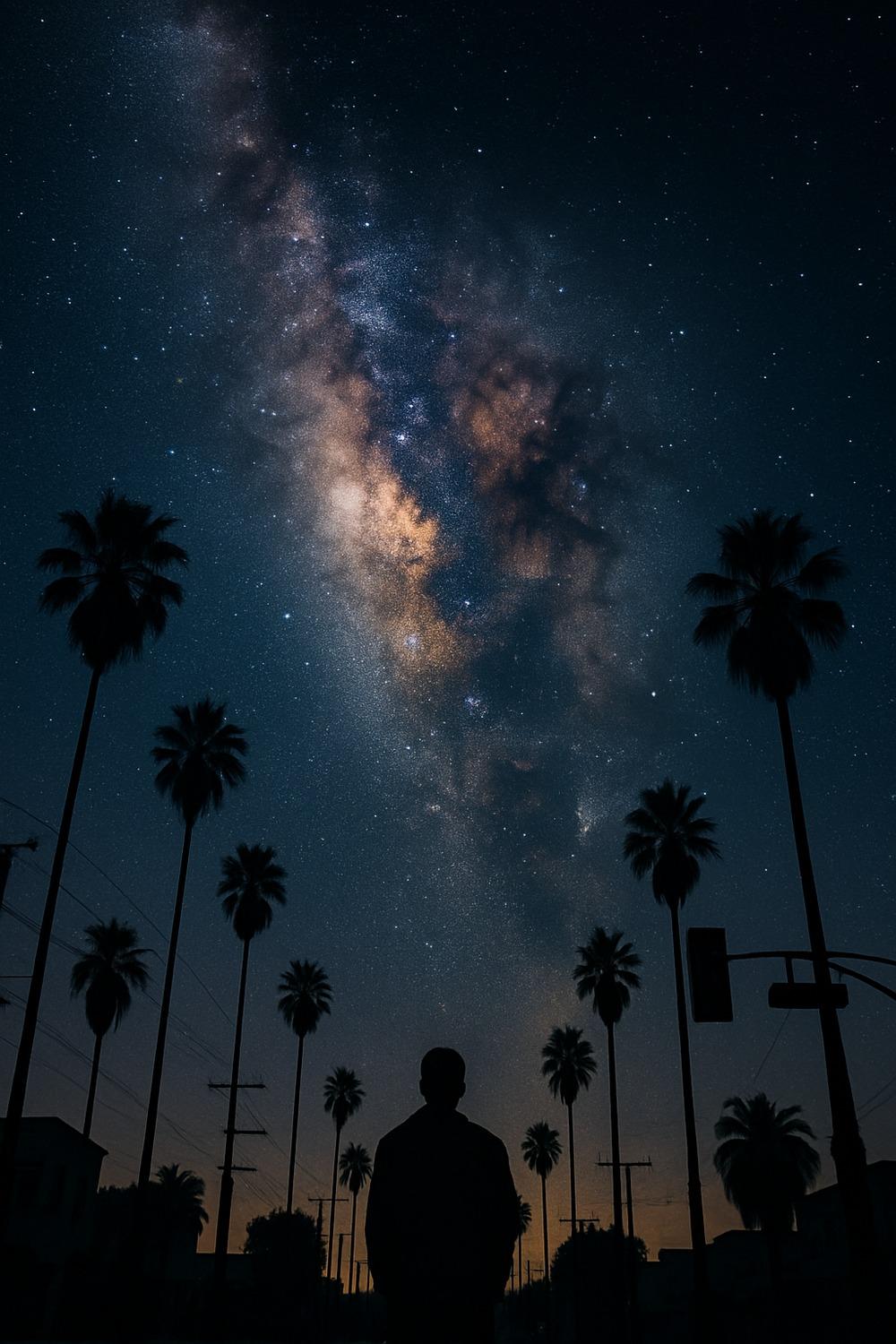
A 2016 study in Science Advances found that one-third of the global population can no longer see the Milky Way from home. In the United States, that number is roughly 80%. Entire generations in New York, Chicago, Houston, Los Angeles—they’ve grown up, gone to school, fallen in love, had careers—and never once looked up and actually seen the galaxy they were born inside.
You can’t grieve something you don’t know you’ve lost.
You don’t miss what you’ve never had a memory of. That’s what makes the Northridge earthquake so strange. It handed an entire city a single night with something they didn’t know had been taken from them. The light pollution problem isn’t just aesthetic. It’s a kind of slow erasure of context. And most people don’t realize anything’s gone.
The Universe Needed a Disaster to Be Seen
Here’s the uncomfortable part: nobody planned the Northridge blackout. No one organized a dark sky event. No one drove two hours to the desert. The earthquake simply removed the artificial ceiling, and the universe did the rest.
Griffith Observatory staff fielded calls for hours. People described the sky in terms usually reserved for unexpected weather—something that felt like it had arrived from somewhere else. In a way it had. It arrived from the actual, unfiltered cosmos, which is always up there. Just waiting.
The implication is uncomfortable if you sit with it.
The Milky Way hasn’t dimmed or moved. We simply decided—gradually, without much discussion, across a century—to build a civilization that couldn’t see it anymore. Every streetlight. Every all-night parking lot. Every billboard. Not a single decision. Ten thousand small ones, accumulating into something that required a natural disaster to undo for a single night.
By the Numbers
- 80% of Americans can no longer see the Milky Way from their homes as of 2016—and the situation has only worsened since.
- The Northridge earthquake: $25 billion in damage, 57 deaths, one accidental gift of the actual night sky to 10 million people for exactly one night.
- The Milky Way’s galactic disk spans 100,000 light-years across and 1,000 light-years thick. Visible to the naked eye from almost any truly dark location.
- Light pollution increases globally at roughly 2% per year. Every year, fewer people can see the Milky Way. Nobody voted on this. It’s just happening.
What Nobody Tells You
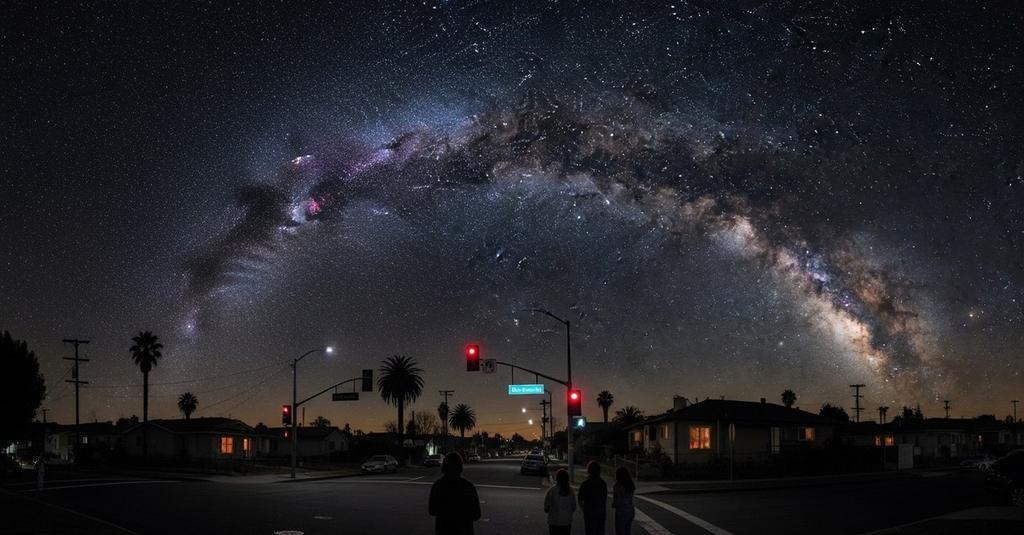
- Your eyes need 20-30 minutes of complete darkness before they can actually detect the Milky Way. You have to stop expecting electric light before the galaxy becomes visible.
- The term “light pollution” didn’t exist in scientific literature until the 1970s. Before that, the sky’s gradual dimming had no name. Astronomers noticed first.
- Dark sky tourism is now an actual industry. People pay money to travel to “dark sky reserves” on every continent to see something their great-grandparents could watch for free from their front porch.
What Disappears When the Dark Sky Does
This isn’t really a story about astronomy. It’s about what happens when something ancient and constant gets quietly removed from human experience. For the entirety of human history—philosophers, navigators, scientists, poets—everyone oriented themselves by the night sky. That relationship shaped how we thought about time, scale, meaning, our place in things. Severing it didn’t announce itself. Just happened. One lumens-per-square-meter at a time.
There are practical arguments for reducing light pollution. Saves energy. Reduces harm to nocturnal wildlife. Improves sleep. But the deeper argument is harder to measure. Something gets lost when you can’t step into your own backyard and locate yourself inside something vast. The scale of the universe is humbling in a way that’s actually useful. Changes how small your problems feel. Changes what feels worth worrying about.
The Milky Way is still up there right now. Above every city that can’t see it. It hasn’t moved. We just stopped looking. If you want more of this stuff—the forgotten history, the strange details nobody talks about—there’s more at this-amazing-world.com.
Frequently Asked Questions
Q: Why did people call 911 after the Northridge earthquake blackout?
When the 6.7 magnitude Northridge earthquake collapsed the Los Angeles power grid on January 17, 1994, the sudden darkness revealed the Milky Way for the first time in decades. Residents who had grown up under light-polluted skies had no reference point for the silvery band overhead. Frightened, some dialed 911 to report strange clouds, and Griffith Observatory fielded calls for hours explaining that the unfamiliar sight was simply the galaxy.
Q: How many people can no longer see the Milky Way?
A 2016 study published in Science Advances found that one-third of the global population can no longer see the Milky Way from home. In the United States that figure is roughly 80%. According to Fabio Falchi’s 2016 Light Pollution Atlas, over 99% of Americans and Europeans live under light-polluted skies, meaning entire generations in cities like New York, Chicago, and Los Angeles have never seen the galaxy they were born inside.
Q: What does the Milky Way actually look like under a truly dark sky?
On a genuinely dark night, such as in the Mojave Desert about 90 minutes from Los Angeles, the Milky Way appears as a dense, luminous band stretching horizon to horizon, bright enough to cast a faint shadow. It is the edge-on view of billions of stars in our spiral galaxy’s disk. In central LA you might see a dozen stars; in the Mojave you can see thousands.
Q: How long does it take your eyes to see the Milky Way?
Your eyes need 20 to 30 minutes of complete darkness before they can detect the Milky Way. The galaxy’s disk spans 100,000 light-years across and contains 100 to 400 billion stars, yet it stays invisible until your vision fully dark-adapts. You have to stop expecting electric light before the structure becomes visible, which is one reason dark sky tourism has grown into an actual industry on every continent.
Illustrations are AI-generated. Article fact-checked and human-edited. Our editorial standards.