Ladybugs: 50 Million Years of Ruthless, Beautiful Efficiency
Here’s what most people miss: a creature the size of your thumbnail can consume 5,000 aphids in a single lifetime, and nobody thinks twice about it. Ladybug facts and diet sound quaint until you do the math — fifty million years of evolution compressed into a shell smaller than a pencil eraser, performing calculations about survival that our best agricultural systems still can’t match at scale. The red isn’t decoration. It’s a threat written in color, and it’s been working since before the Himalayas finished rising.
That warning system has a name — aposematism — and ladybugs perfected it so thoroughly that other insects started plagiarizing the color scheme just to survive. The spots broadcast a message: whatever bit me last time tastes like chemicals and regret. Birds learn fast. They generalize faster. A single bad experience with one red-and-black beetle can rewire an entire species’ feeding behavior, and the signal is so ancient that some predators may be born already skeptical of the pattern.
Key Facts
- A single adult ladybug can eat 200 to 300 aphids per day and up to 5,000 prey items across its one-to-two-year lifespan (Wageningen University, 2017).
- The family Coccinellidae includes roughly 6,000 known species worldwide, distributed across every continent except Antarctica.
- The harlequin ladybug (Harmonia axyridis) was deliberately released in the United States in 1988 as a biocontrol agent and now preys on at least 26 native ladybug species.
- The UK’s two-spotted ladybug declined by 30% between 2004 and 2018, attributed primarily to harlequin competition (UK Centre for Ecology and Hydrology).
- The Coccinellidae fossil record extends to approximately 50 million years ago, based on Baltic amber specimens studied in 2019.
In short: Ladybug facts and diet reveal a tiny predator that eats up to 5,000 aphids in its lifetime, making it one of nature’s best biocontrol agents. The 6,000-species Coccinellidae family uses aposematic red warning coloring perfected over 50 million years, though the invasive harlequin ladybug now devastates native populations.
Ladybug Facts and Diet: Built to Consume
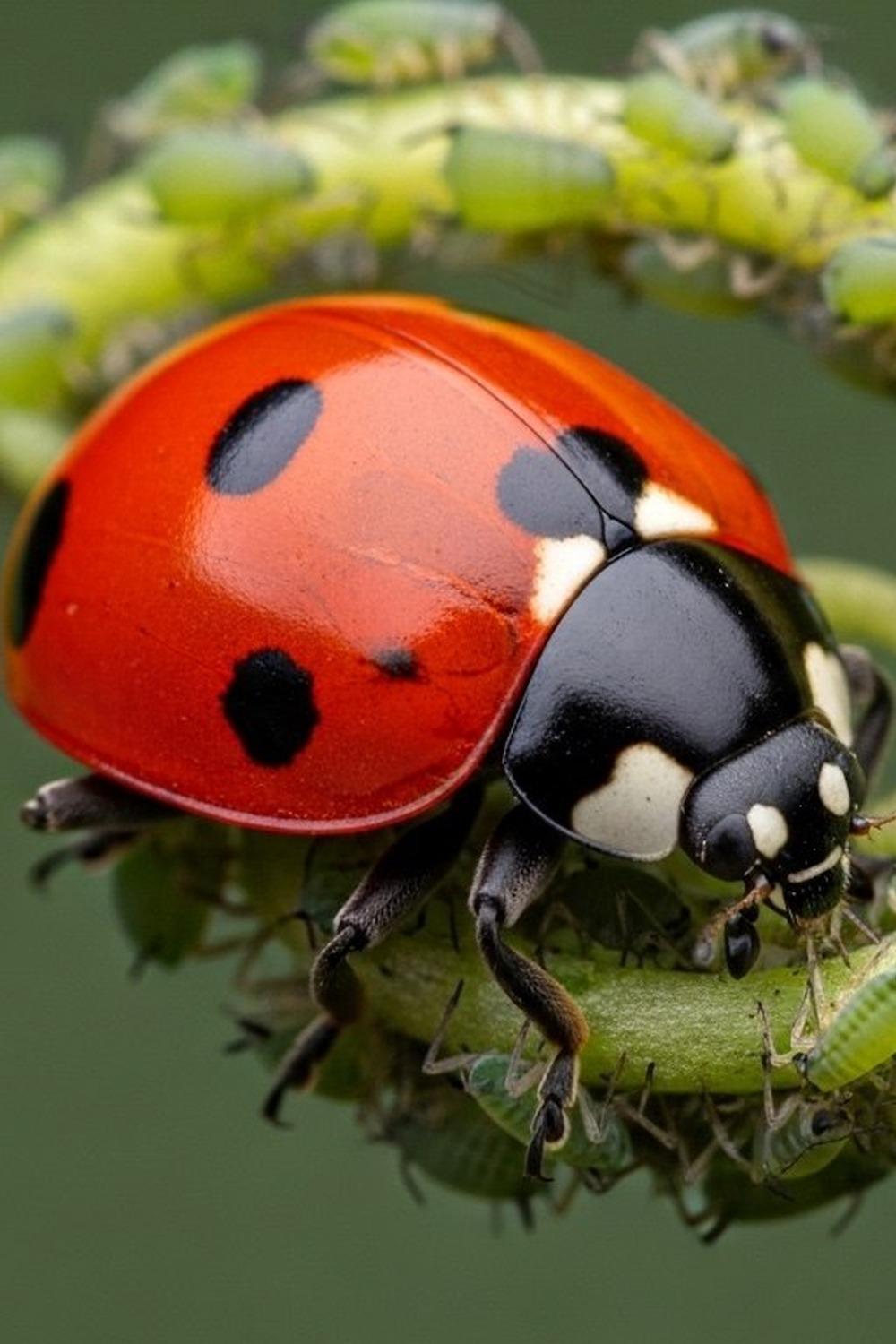
The seven-spotted ladybug — Coccinella septempunctata — is probably the one you picture. Red shell, seven black spots, roughly the size of your thumbnail. That tiny frame carries an appetite genuinely difficult to contextualize.
A single adult can eat between 200 and 300 aphids per day. Over the course of its one-to-two-year lifespan, the cumulative total reaches up to 5,000 prey items. Entomologists at Wageningen University in the Netherlands documented ladybug feeding rates in 2017 across controlled greenhouse environments, finding that larvae — yes, the larvae — are even more voracious than adults relative to their size. The Coccinellidae family, which includes all ladybug species, encompasses roughly 6,000 known species worldwide, each adapted to specific prey and habitat ranges. That’s not a bug. That’s a lineage.
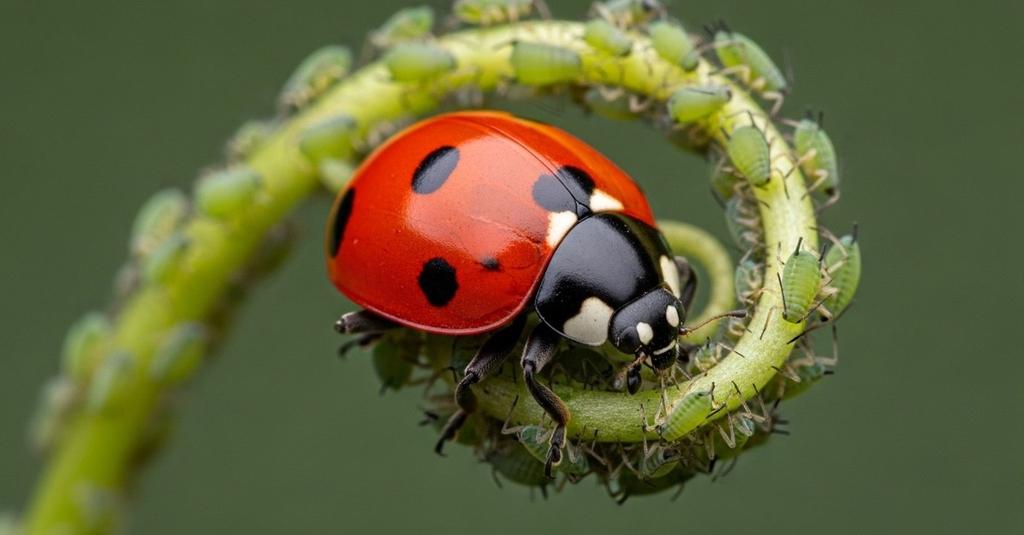
What makes ladybug diet particularly remarkable is its precision. Most species are specialist predators, tuned specifically to soft-bodied insects — aphids, scale insects, mealybugs, whiteflies. They’re not generalists eating whatever crosses their path. The larval stage is arguably the most critical phase. Newly hatched larvae begin hunting within hours of emergence, and in two weeks before pupation they can consume 400 aphids — which means a single colony of twenty ladybugs can strip a heavily infested plant back to something almost clean before the aphid colony has time to reproduce to full pressure again.
Farmers in medieval Europe didn’t know the biology, but they noticed the pattern. The beetle arrived and the plague of plant lice retreated — it looked like a blessing. The name “ladybug” itself likely derives from the Virgin Mary, “Our Lady’s beetle,” a name given by European farmers who saw divine intervention in what was, in fact, a predator doing its job with cold efficiency.
The Red Shell Is a Lie — In the Best Possible Way
Ladybugs produce a group of alkaloid compounds, most notably coccinelline, secreted through their leg joints in a process called reflex bleeding. It looks like blood. It isn’t. It tastes, apparently, genuinely awful. Birds that have sampled a ladybug once tend not to try again, and crucially, they generalize — that whole color pattern gets filed under “do not eat.” This is precisely why some completely harmless insects have evolved to mimic ladybug coloring.
Research conducted at the University of Exeter in 2015 demonstrated something counterintuitive: naive birds — birds with zero prior experience of ladybugs — showed measurable hesitation toward red-and-black patterned prey compared to cryptically colored alternatives. The signal is so evolutionarily ancient that the avoidance response may be partially hardwired into predator neurology. Some species of longhorn beetle and soldier beetle have evolved near-identical red-black coloration purely to borrow the reputation, without manufacturing any toxins themselves. This is called Batesian mimicry, and it’s essentially freeloading on 50 million years of brand recognition.
Why does this matter? Because some species have turned this strategy into an art form that nobody anticipated. The harlequin ladybug, Harmonia axyridis, native to East Asia, produces higher concentrations of defensive alkaloids than most European species, making it particularly unpalatable. It’s also, as it turns out, particularly successful at surviving in places it was never meant to be.
The Invasion Nobody Noticed Until It Was Too Late
In 1988, agricultural authorities in the United States deliberately released Harmonia axyridis — the harlequin ladybug — as a biocontrol agent against aphids in pecan orchards and greenhouse crops. The intention was reasonable.
What followed was something closer to a biological accident.
Within a decade, the species had established wild populations across North America. By the early 2000s, it was in Europe. By 2010, it had been recorded in South Africa, South America, and across much of the UK. A Smithsonian Magazine investigation into the harlequin’s spread traced the pattern of displacement — wherever H. axyridis established itself, native ladybug populations began contracting. The two-spotted ladybug in Britain declined by 30 percent between 2004 and 2018, according to the UK Centre for Ecology and Hydrology. The harlequin doesn’t just compete for the same aphid food source. It eats ladybug eggs and larvae.
The same feeding efficiency that makes ladybugs beloved as garden allies also makes an invasive species like the harlequin devastatingly effective at eliminating its own competitors. The harlequin consumes eggs from at least 26 other ladybug species and can survive on pollen, fruit, and even other beetles when aphid populations crash. Native species, specialized over millennia to specific prey in specific ecosystems, simply can’t keep pace with that flexibility. The harlequin doesn’t just fill the niche — it expands it, and then holds it. (And this matters more than it sounds: once a native ladybug species vanishes from a region, reintroduction is nearly impossible without expensive intervention.)
Scientists at the Catholic University of Leuven in Belgium have been tracking the harlequin’s European expansion since 2002, building one of the most comprehensive datasets on invasive insect spread in the Northern Hemisphere. Their data shows the species can colonize a new country within two to three years of first detection. Early intervention matters enormously. Watching a species disappear because we introduced something we didn’t fully understand, you stop calling it ecological management — you call it loss.
Fifty Million Years of Ladybug Evolution — Still Running
The fossil record for Coccinellidae extends to approximately 50 million years ago, placing the earliest identifiable ladybug relatives in the Eocene epoch. Amber specimens from Baltic deposits, studied by researchers at the Natural History Museum in London in 2019, show morphological structures in ancient coccinellid fossils that are strikingly similar to modern species — same basic wing case architecture, same leg joint positioning consistent with reflex bleeding. The chemical defense system appears to have been present, or at least anatomically plausible, from very early in the lineage’s history. Aposematism in ladybugs predates the Himalayas, predates most modern flowering plant families, and predates primates by tens of millions of years. The design wasn’t refined recently. It was locked in early, and it worked so well that evolution saw no reason to substantially alter it.
What has changed across that 50-million-year span is radiation — the diversification into thousands of species occupying specific ecological roles. Some species eat only certain aphid genera. Some have shifted entirely to plant matter, consuming mildew and fungal spores instead of insects. A small number are considered agricultural pests rather than allies, feeding on crops like potato and squash. The ladybug is not a single story. It’s a radiation of strategies all wearing the same costume, and the costume has remained conservative across the entire family tree because it keeps working.
Research published in Systematic Entomology in 2021 by a team at the Chinese Academy of Sciences used molecular phylogenetics to reconstruct the full family tree of Coccinellidae with greater resolution than any previous study. Their findings pushed the estimated origin of the family back further than the fossil record alone had suggested, and confirmed something counterintuitive: the predatory lifestyle was ancestral — with plant-feeding evolving independently in multiple lineages later. Most entomologists had assumed the reverse.
Where to See This
- The UK’s wildflower meadows and hedgerow corridors between April and September offer the best chance of spotting multiple native ladybug species in a single walk; Plantlife’s nature reserves in England and Wales maintain habitats specifically managed for invertebrate diversity.
- The UK Ladybird Survey (ladybird-survey.org) run by the Centre for Ecology and Hydrology actively solicits public sightings and provides species identification tools — citizen science data from this project has shaped conservation policy for over a decade.
- Royal Horticultural Society publications include free identification guides for beneficial garden insects including ladybugs, with invertebrate-focused events hosted at Wisley Garden in Surrey throughout spring and summer.
By the Numbers
- Up to 5,000 aphids consumed by a single ladybug across its one-to-two-year lifespan (Wageningen University, 2017).
- 6,000+ known species within family Coccinellidae, distributed across every continent except Antarctica.
- 30% decline in two-spotted ladybug populations in the UK between 2004 and 2018, attributed primarily to harlequin competition (UK Centre for Ecology and Hydrology).
- 50 million years — the minimum age of the Coccinellidae fossil record, based on Baltic amber specimens studied in 2019.
- 26 native ladybug species documented as prey items for Harmonia axyridis larvae and adults in European field studies (Catholic University of Leuven, 2009).
Field Notes
- In 2016, entomologists at the University of Cambridge discovered that ladybug wings fold using an origami-like mechanism so complex it took high-speed X-ray imaging to fully map — the wing compresses to one-third its open span inside the shell in under a tenth of a second, a feat no engineered folding structure has yet matched at that scale.
- Ladybugs can play dead with startling conviction — a behavior called thanatosis — holding still for up to 20 minutes after a perceived threat, during which they also release defensive fluids to reinforce the impression that they’re already unpleasant to eat.
- Spot intensity actually fades with age, which means a ladybug’s coloring is a rough indicator of how recently it emerged from its pupal stage — experienced entomologists use this detail in the field to estimate population age structures.
- Scientists still don’t fully understand how ladybugs navigate during overwintering migrations. Populations aggregate in specific mountain ridges, cliff faces, and building eaves year after year with extraordinary consistency, but the sensory mechanism behind site fidelity remains unresolved — whether it’s magnetic, olfactory, or visual cue-based is still genuinely unclear.
Frequently Asked Questions
Q: What are the key ladybug facts about diet that make them useful in gardens?
Ladybug diet centers almost entirely on soft-bodied pest insects — aphids above all, but also scale insects, mealybugs, and whitefly larvae. A single adult can eat 200 to 300 aphids per day, and larvae are comparably voracious relative to their size. This makes them one of the most effective natural biocontrol agents available to home gardeners, requiring no management and leaving no chemical residue on plants or soil.
Q: Are all ladybugs the same, or do different species behave differently?
The 6,000-plus species within Coccinellidae vary considerably in diet, prey preference, and habitat. Most familiar garden species are specialist predators of aphids, but some species have shifted to fungal food sources like mildew, and a small number feed on plant material directly. Spot count is not a reliable indicator of species — some species have none, some have more than twenty, and count can vary within the same species. Coloring and spot pattern together, alongside geographic location, are more reliable identification tools.
Q: Is the harlequin ladybug actually dangerous, or is the concern overblown?
The concern is well-founded, though it’s ecological rather than directly harmful to humans. Harmonia axyridis is a more generalist feeder than most native species, survives winter conditions better, and actively preys on the eggs and larvae of competing ladybug species. Its presence correlates with measurable declines in native populations across Europe and North America. It’s not dangerous to touch or handle — the defensive compounds it produces are unpleasant to eat, not toxic to humans at contact levels — but its ecological footprint is real and documented.
Editor’s Take — Alex Morgan
What stays with me isn’t the appetite or even the chemical defense — it’s the origami wings. An insect that folds a structure larger than its body into a rigid shell in under a tenth of a second, using a mechanism engineers have been trying to reverse-engineer for years. We spend enormous money on pest control. We build elaborate systems. And in every hedgerow, something that’s been functionally unchanged for 50 million years is doing the same job faster, cheaper, and without a single side effect. That’s not charming. That’s a rebuke.
Every garden is running on ancient software. The aphids, the ladybugs, the chemical signals bouncing between predator and prey — these are processes that predate human agriculture by tens of millions of years, and they’ll continue long after the last pesticide patent expires. The question isn’t whether nature has solutions. It’s whether we’re paying close enough attention to the small, red, spotted things already working the problem. Look down next time you’re outside. The answers are probably moving.
“
Illustrations are AI-generated. Article fact-checked and human-edited. Our editorial standards.